韓厥與趙氏孤兒
Han Jue and the Orphan of Zhao
韓之先與周同姓,姓姬氏。其後苗裔事晉,得封於韓原,曰韓武子。武子後三世有韓厥,從封姓為韓氏。
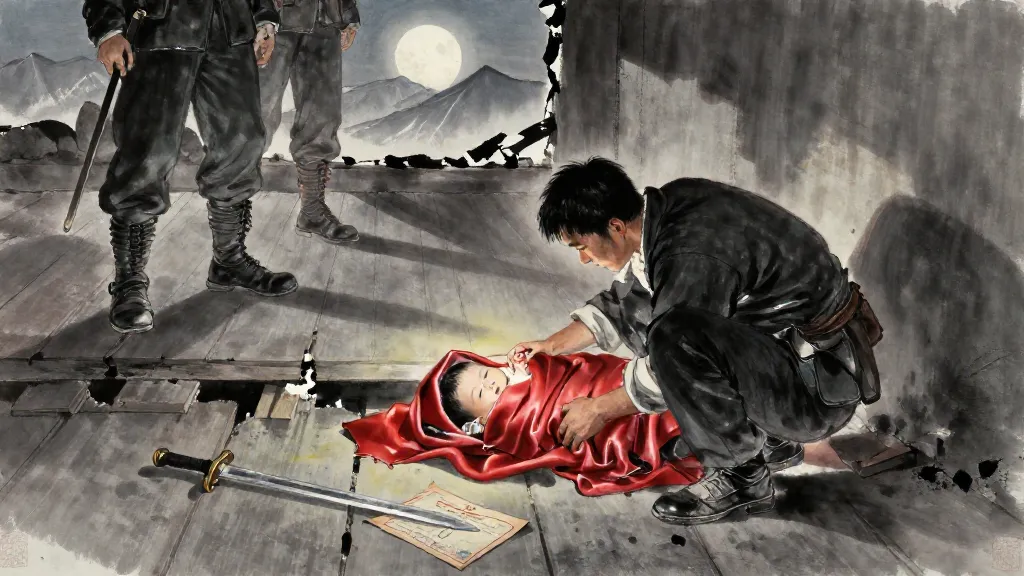
韓厥,晉景公之三年,晉司寇屠岸賈將作亂,誅靈公之賊趙盾。趙盾已死矣,欲誅其子趙朔。韓厥止賈,賈不聽。厥告趙朔令亡。朔曰:「子必能不絕趙祀,死不恨矣。」韓厥許之。及賈誅趙氏,厥稱疾不出。程嬰、公孫杵臼之藏趙孤趙武也,厥知之。
景公十一年,厥與郤克將兵八百乘伐齊,敗齊頃公於鞍,獲逢醜父。於是晉作六卿,而韓厥在一卿之位,號為獻子。
晉景公十七年,病,卜大業之不遂者為祟。韓厥稱趙成季之功,今後無祀,以感景公。景公問曰:「尚有世乎?」厥於是言趙武,而復與故趙氏田邑,續趙氏祀。
The ancestors of Han shared the Ji surname of the Zhou royal house. Later descendants served Jin and were enfeoffed at the Han Plain, where the line was called Han Wu Zi. Three generations after Wu Zi came Han Jue, who adopted the fief name as his clan name: Han.
In the third year of Duke Jing of Jin, the judicial minister Tu'an Gu plotted rebellion. He intended to punish Zhao Dun as the assassin of Duke Ling. But Zhao Dun was already dead, so Tu'an Gu sought to destroy his son Zhao Shuo. Han Jue tried to stop Tu'an Gu, but Tu'an Gu would not listen. Han Jue warned Zhao Shuo to flee. Zhao Shuo replied: "If you can ensure that the Zhao sacrifices are not cut off, I will die without regret." Han Jue gave his word. When Tu'an Gu massacred the Zhao clan, Han Jue pleaded illness and did not participate. When Cheng Ying and Gongsun Chujiu hid the Zhao orphan, Zhao Wu, Han Jue was aware of it.
In Duke Jing's eleventh year, Han Jue and Xi Ke led eight hundred chariots against Qi, defeating Duke Qing of Qi at An and capturing Feng Choufu. Jin then established the system of six ministers, and Han Jue held one of the six positions, with the posthumous name Xian Zi.
In Duke Jing's seventeenth year, the duke fell ill. Divination revealed that the cause was the spirit of an unfinished great enterprise. Han Jue reminded the duke of the merits of Zhao Chengji, noting that his line now had no heir to maintain the sacrifices, and moved the duke's conscience. Duke Jing asked: "Does the line still exist?" Han Jue then revealed the existence of Zhao Wu, and the duke restored the former Zhao estates and lands, continuing the Zhao sacrifices.
Notes
The story of the Zhao orphan (趙氏孤兒) is one of the most famous tales of loyalty and sacrifice in Chinese literature. Cheng Ying and Gongsun Chujiu risked (and in Chujiu's case, gave) their lives to save the infant Zhao Wu from Tu'an Gu's purge. Han Jue's role was pivotal: he warned the family, protected the secret, and ultimately engineered the restoration. This act of 'hidden virtue' (陰德) is credited by Sima Qian as the foundation of the Han clan's later success.
Han Jue (韓厥), posthumously known as Han Xian Zi (韓獻子), served Jin in the mid-sixth century BC. His protection of the Zhao orphan established a bond between the Han and Zhao clans that endured for generations.
The Han Plain (韓原) was located in modern Hancheng, Shaanxi, on the western bank of the Yellow River. It was the original seat of the Han clan before their later moves eastward.