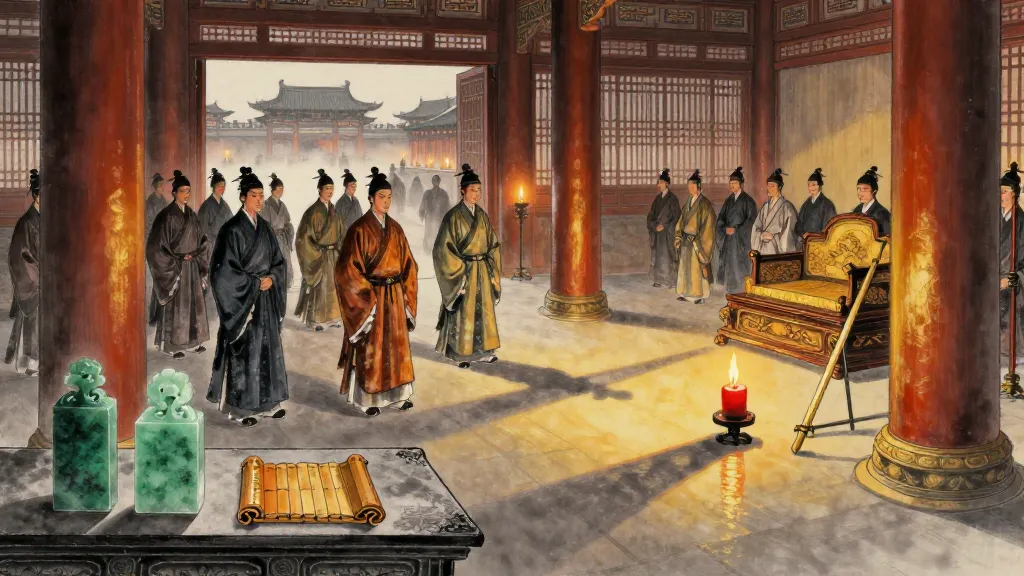
田敬仲完世家 (Hereditary House of Tian Jingzhong Wan) — Chinese ink painting

Chapter 46 of 130

田敬仲完世家

Hereditary House of Tian Jingzhong Wan

View:

陳完奔齊

Chen Wan Flees to Qi

陳完者,陳厲公他之子也。完生,周太史過陳,陳厲公使卜完,卦得觀之否:「是為觀國之光,利用賓於王。此其代陳有國乎?不在此而在異國乎?非此其身也,在其子孫。若在異國,必姜姓。姜姓,四岳之後。物莫能兩大,陳衰,此其昌乎?」

厲公者,陳文公少子也,其母蔡女。文公卒,厲公兄鮑立,是為桓公。桓公與他異母。及桓公病,蔡人為他殺桓公鮑及太子免而立他,為厲公。厲公既立,娶蔡女。蔡女淫於蔡人,數歸,厲公亦數如蔡。桓公之少子林怨厲公殺其父與兄,乃令蔡人誘厲公而殺之。林自立,是為莊公。故陳完不得立,為陳大夫。厲公之殺,以淫出國,故春秋曰「蔡人殺陳他」,罪之也。

莊公卒,立弟杵臼,是為宣公。宣公二十一年,殺其太子禦寇。禦寇與完相愛,恐禍及己,完故奔齊。齊桓公欲使為卿,辭曰:「羈旅之臣幸得免負檐,君之惠也,不敢當高位。」桓公使為工正。齊懿仲欲妻完,卜之,占曰:「是謂鳳皇於蜚,和鳴鏘鏘。有媯之後,將育於姜。五世其昌,並於正卿。八世之後,莫之與京。」卒妻完。完之奔齊,齊桓公立十四年矣。

完卒,謚為敬仲。仲生孟夷。敬仲之如齊,以陳字為田氏。

Chen Wan was the son of Duke Li of Chen, whose personal name was Ta. When Wan was born, the Grand Historian of Zhou was passing through Chen. Duke Li of Chen had him divine Wan's fortune. The hexagram drawn was Guan changing to Pi: "This reads 'Contemplating the glory of the state, it is favorable to be a guest of the king.' Will he replace Chen and possess a state? Not here but in a foreign land? Not in his own person but in his descendants. If in a foreign land, it must be among the Jiang surname. The Jiang are descendants of the Four Peaks. No two things can both be great — when Chen declines, this line will flourish."

Duke Li was the youngest son of Duke Wen of Chen, his mother a woman of Cai. When Duke Wen died, Duke Li's elder brother Bao succeeded — this was Duke Huan. Duke Huan and Ta had different mothers. When Duke Huan fell ill, people of Cai killed Duke Huan Bao and his heir apparent Mian on Ta's behalf, and installed Ta as Duke Li. After taking the throne, Duke Li married a Cai woman. The Cai woman was promiscuous with men of Cai and frequently returned there; Duke Li also visited Cai often. Duke Huan's youngest son Lin resented Duke Li for killing his father and brother. He had the men of Cai lure Duke Li into a trap and kill him, then installed himself — this was Duke Zhuang. Thus Chen Wan could not succeed to the throne and served as a minister of Chen. Duke Li was killed because of licentiousness abroad, and the Spring and Autumn Annals therefore say "the men of Cai killed Chen Ta" — to condemn him.

Duke Zhuang died and his brother Chuqiu was installed — this was Duke Xuan. In Duke Xuan's twenty-first year, he killed his heir apparent Yukou. Yukou and Wan were close friends, and Wan feared the disaster would reach him. He therefore fled to Qi. Duke Huan of Qi wished to make him a minister, but Wan declined: "I am a wandering exile. To have escaped the burden of a fugitive's load is already my lord's grace — I dare not accept a high position." Duke Huan appointed him Master of Works. Yi Zhong of Qi wished to give his daughter to Wan in marriage and had a divination performed. The reading said: "This is the phoenix in flight, its harmonious cry resounding. A descendant of the Gui surname shall be nurtured among the Jiang. In five generations they shall flourish, equal to the chief ministers. After eight generations, none shall rival them." The marriage was completed. When Wan fled to Qi, Duke Huan of Qi had been on the throne fourteen years.

Wan died and was given the posthumous name Jingzhong. Jingzhong sired Meng Yi. Upon coming to Qi, Jingzhong took the character Chen and transformed it to the surname Tian.

Notes

1person田敬仲完Tián Jìngzhòng Wán

Chen Wan (陳完), posthumously Tian Jingzhong (田敬仲), was a prince of the state of Chen who fled to Qi around 672 BC. His descendants gradually amassed power in Qi, eventually replacing the original Jiang-surname ruling house — one of the most famous usurpations in Chinese history.

2context

The Changes divination with its prophecy is central to Sima Qian's framing of this chapter. The hexagram Guan (觀, Contemplation) changing to Pi (否, Obstruction) predicts that greatness will come not to the Chen line itself but to its transplanted branch in a Jiang-surname state — i.e., Qi. This prophecy structures the entire narrative.

3translation

The surname change from Chen (陳) to Tian (田) reflects an ancient phonetic relationship. In the dialect of the time, the two characters were closely related in pronunciation. This is why the Tian family of Qi is traced back to the ruling house of the state of Chen.

田氏崛起

The Rise of the Tian Clan

田孟夷生湣孟莊,田湣孟莊生文子須無。田文子事齊莊公。

晉之大夫欒逞作亂於晉,來奔齊,齊莊公厚客之。晏嬰與田文子諫,莊公弗聽。

文子卒,生桓子無宇。田桓子無宇有力,事齊莊公,甚有寵。

無宇卒,生武子開與釐子乞。田釐子乞事齊景公為大夫,其收賦稅於民以小斗受之,其稟予民以大斗,行陰德於民,而景公弗禁。由此田氏得齊眾心,宗族益彊,民思田氏。晏子數諫景公,景公弗聽。已而使於晉,與叔向私語曰:「齊國之政卒歸於田氏矣。」

Tian Meng Yi sired Min Meng Zhuang. Min Meng Zhuang sired Wen Zi Xuwu. Tian Wenzi served Duke Zhuang of Qi.

Luan Cheng, a great minister of Jin, staged a rebellion in Jin and fled to Qi. Duke Zhuang of Qi received him lavishly. Yan Ying and Tian Wenzi remonstrated, but Duke Zhuang would not listen.

Wenzi died. He sired Huan Zi Wuyu. Tian Huanzi Wuyu was a man of great strength who served Duke Zhuang of Qi and enjoyed great favor.

Wuyu died. He sired Wu Zi Kai and Xi Zi Qi. Tian Xizi Qi served Duke Jing of Qi as a great minister. When collecting taxes and levies from the people, he received them using small measures; when distributing grain to the people, he gave using large measures — thus performing hidden kindness upon the people. Duke Jing did not stop him. Through this the Tian clan won the hearts of the Qi populace. Their clan grew ever stronger, and the people looked to the Tian family. Yan Ying repeatedly remonstrated with Duke Jing, but Duke Jing would not listen. Later, on a mission to Jin, Yan Ying spoke privately with Shu Xiang: "The governance of Qi will ultimately pass to the Tian family."

Notes

1person晏嬰Yàn Yīng

Yan Ying (晏嬰, d. 500 BC), also known as Yanzi, was the most celebrated minister of Qi during Duke Jing's reign and one of the wisest statesmen of the Spring and Autumn period. His warning about the Tian family's rise proved prophetic.

2context

The Tian family's strategy of 'small measure in, large measure out' (以小斗受之,以大斗予之) is one of the classic examples of buying popular loyalty at the expense of the state treasury. The ruling Jiang house of Qi was being hollowed out from within.

田乞篡齊

Tian Qi Usurps Qi's Government

晏嬰卒後,范、中行氏反晉。晉攻之急,范、中行請粟於齊。田乞欲為亂,樹黨於諸侯,乃說景公曰:「范、中行數有德於齊,齊不可不救。」齊使田乞救之而輸之粟。

景公太子死,後有寵姬曰芮子,生子荼。景公病,命其相國惠子與高昭子以子荼為太子。景公卒,兩相高、國立荼,是為晏孺子。而田乞不說,欲立景公他子陽生。陽生素與乞歡。晏孺子之立也,陽生奔魯。田乞偽事高昭子、國惠子者,每朝代參乘,言曰:「始諸大夫不欲立孺子。孺子既立,君相之,大夫皆自危,謀作亂。」又紿大夫曰:「高昭子可畏也,及未發先之。」諸大夫從之。田乞、鮑牧與大夫以兵入公室,攻高昭子。昭子聞之,與國惠子救公。公師敗。田乞之眾追國惠子,惠子奔莒,遂返殺高昭子。晏圉奔魯。

田乞使人之魯,迎陽生。陽生至齊,匿田乞家。請諸大夫曰:「常之母有魚菽之祭,幸而來會飲。」會飲田氏。田乞盛陽生橐中,置坐中央。發橐,出陽生,曰:「此乃齊君矣。」大夫皆伏謁。將盟立之,田乞誣曰:「吾與鮑牧謀共立陽生也。」鮑牧怒曰:「大夫忘景公之命乎?」諸大夫欲悔,陽生乃頓首曰:「可則立之,不可則已。」鮑牧恐禍及己,乃復曰:「皆景公之子,何為不可!」遂立陽生於田乞之家,是為悼公。乃使人遷晏孺子於駘,而殺孺子荼。悼公既立,田乞為相,專齊政。

After Yan Ying died, the Fan and Zhonghang clans rebelled in Jin. Jin attacked them fiercely, and they requested grain from Qi. Tian Qi, wishing to sow disorder, cultivated partisan ties among the feudal lords and persuaded Duke Jing: "The Fan and Zhonghang clans have shown us favor many times. Qi cannot fail to rescue them." Qi sent Tian Qi to aid them and ship grain.

Duke Jing's heir apparent had died. He had a favored consort called Ruizi who bore a son, Tu. When Duke Jing fell ill, he ordered his two chief ministers, Guo Huizi and Gao Zhaozi, to install Tu as heir apparent. Duke Jing died. The two ministers, Gao and Guo, installed Tu — this was the Young Lord Yan. But Tian Qi was displeased and wished to install another of Duke Jing's sons, Yangsheng. Yangsheng had always been on good terms with Tian Qi. When the Young Lord was enthroned, Yangsheng fled to Lu.

Tian Qi feigned loyalty to Gao Zhaozi and Guo Huizi. At every court audience he would ride alongside them and say: "The great ministers never wanted to install the Young Lord. Now that he is installed and you serve as his regents, all the ministers feel threatened and are plotting rebellion." He also deceived the ministers: "Gao Zhaozi is a man to be feared — we should strike before he acts." The ministers followed him. Tian Qi and Bao Mu led the ministers with armed men into the palace and attacked Gao Zhaozi. Gao Zhaozi heard of it and, together with Guo Huizi, tried to rescue the duke. The duke's forces were defeated. Tian Qi's men pursued Guo Huizi, who fled to Ju. They then returned and killed Gao Zhaozi. Yan Yu fled to Lu.

Tian Qi sent men to Lu to fetch Yangsheng. Yangsheng arrived in Qi and was hidden in Tian Qi's house. Tian Qi invited the ministers: "My mother is holding a fish-and-bean sacrifice. Please come and drink." They gathered to drink at the Tian residence. Tian Qi had concealed Yangsheng inside a large sack and placed it in the center of the room. He opened the sack, brought Yangsheng forth, and declared: "This is the lord of Qi!" The ministers all prostrated themselves. When they were about to swear the oath, Tian Qi lied: "Bao Mu and I jointly planned to install Yangsheng." Bao Mu was furious: "Have the ministers forgotten Duke Jing's command?" The ministers hesitated. Yangsheng bowed his head to the floor and said: "If it is possible, install me. If not, let it be." Bao Mu, fearing the consequences would fall on himself, said: "They are all sons of Duke Jing — why should it not be possible?" Yangsheng was thereupon installed at Tian Qi's house — this was Duke Dao. The Young Lord Tu was relocated to Tai and then killed. With Duke Dao installed, Tian Qi became chancellor and monopolized Qi's government.

Notes

1person田乞Tián Qǐ

Tian Qi (田乞, d. 485 BC), also known as Tian Xizi, was the Tian clan head who orchestrated the first overt Tian seizure of Qi's government. His coup — installing a duke of his own choosing and serving as chancellor — set the pattern that his descendants would follow to eventual complete usurpation.

2context

The scene of Yangsheng emerging from a sack at a banquet is one of the most dramatic moments in the Shiji. The combination of farce and menace — a new ruler literally unveiled like a conjuring trick — underscores how far Qi's government had degenerated from legitimate succession.

田常弒君專政

Tian Chang Assassinates the Lord and Seizes Full Control

四年,田乞卒,子常代立,是為田成子。

鮑牧與齊悼公有郄,弒悼公。齊人共立其子壬,是為簡公。田常成子與監止俱為左右相,相簡公。田常心害監止,監止幸於簡公,權弗能去。於是田常復脩釐子之政,以大斗出貸,以小斗收。齊人歌之曰:「嫗乎采芑,歸乎田成子!」齊大夫朝,御鞅諫簡公曰:「田、監不可並也,君其擇焉。」君弗聽。

子我者,監止之宗人也,常與田氏有卻。田氏疏族田豹事子我有寵。子我曰:「吾欲盡滅田氏適,以豹代田氏宗。」豹曰:「臣於田氏疏矣。」不聽。已而豹謂田氏曰:「子我將誅田氏,田氏弗先,禍及矣。」子我舍公宮,田常兄弟四人乘如公宮,欲殺子我。子我閉門。簡公與婦人飲檀台,將欲擊田常。太史子餘曰:「田常非敢為亂,將除害。」簡公乃止。田常出,聞簡公怒,恐誅,將出亡。田子行曰:「需,事之賊也。」田常於是擊子我。子我率其徒攻田氏,不勝,出亡。田氏之徒追殺子我及監止。

簡公出奔,田氏之徒追執簡公於徐州。簡公曰:「蚤從御鞅之言,不及此難。」田氏之徒恐簡公復立而誅己,遂殺簡公。簡公立四年而殺。於是田常立簡公弟驁,是為平公。平公即位,田常為相。

田常既殺簡公,懼諸侯共誅己,乃盡歸魯、衛侵地,西約晉、韓、魏、趙氏,南通吳、越之使,脩功行賞,親於百姓,以故齊復定。

田常言於齊平公曰:「德施人之所欲,君其行之;刑罰人之所惡,臣請行之。」行之五年,齊國之政皆歸田常。田常於是盡誅鮑、晏、監止及公族之彊者,而割齊自安平以東至琅邪,自為封邑。封邑大於平公之所食。

田常乃選齊國中女子長七尺以上為後宮,後宮以百數,而使賓客舍人出入後宮者不禁。及田常卒,有七十餘男。

In the fourth year, Tian Qi died and his son Chang succeeded — this was Tian Chengzi.

Bao Mu had a feud with Duke Dao of Qi and assassinated him. The people of Qi together installed his son Ren — this was Duke Jian. Tian Chang Chengzi and Jian Zhi both served as Left and Right Chancellors under Duke Jian. Tian Chang harbored enmity toward Jian Zhi, but Jian Zhi was favored by Duke Jian, and Tian Chang lacked the power to remove him. He therefore revived Xi Zi's policy: lending grain using large measures and collecting repayment using small ones. The people of Qi sang: "Old woman, gather your greens — and bring them home to Tian Chengzi!" The Qi minister Yu Yang advised Duke Jian at court: "Tian and Jian cannot both stand. Your lordship must choose." The duke did not listen.

Zi Wo was a kinsman of Jian Zhi's clan and had always been at odds with the Tian family. Tian Bao, a distant relative of the Tian clan, served Zi Wo and was in his favor. Zi Wo said: "I wish to annihilate the legitimate Tian line and install Bao as head of the Tian clan." Bao replied: "I am too distant from the main line." He refused. Later, Bao told the Tian family: "Zi Wo intends to destroy the Tian clan. If you do not strike first, disaster will come." Zi Wo was quartered in the ducal palace. Tian Chang and his three brothers drove to the palace intending to kill Zi Wo. Zi Wo barred the gates. Duke Jian was drinking with women on the Sandalwood Terrace and was about to attack Tian Chang. The Grand Historian Ziyu said: "Tian Chang does not dare to cause disorder — he is merely removing a threat." Duke Jian halted. Tian Chang emerged, heard that the duke was angry, feared execution, and was about to flee. Tian Zixing said: "Hesitation is the enemy of action." Tian Chang thereupon attacked Zi Wo. Zi Wo led his followers against the Tian family but was defeated and fled. Tian followers pursued and killed Zi Wo and Jian Zhi.

Duke Jian fled the capital. Tian followers pursued and captured him at Xuzhou. Duke Jian said: "Had I followed Yu Yang's advice earlier, I would not have come to this." The Tian followers feared that if Duke Jian were restored, he would execute them. They killed Duke Jian. He had reigned four years. Tian Chang then installed Duke Jian's brother Ao — this was Duke Ping. With Duke Ping on the throne, Tian Chang served as chancellor.

Having killed Duke Jian, Tian Chang feared the feudal lords would unite to punish him. He therefore returned all the land that had been seized from Lu and Wey, established western alliances with the Zhao, Han, and Wei houses of Jin, and opened southern communications with Wu and Yue. He distributed rewards, promoted merit, and cultivated the affection of the common people. Qi was thereby stabilized.

Tian Chang said to Duke Ping of Qi: "Bestowing virtue and granting what people desire — let my lord do this. Imposing punishments and carrying out what people hate — let your minister do this." After five years of this arrangement, all governance in Qi had passed to Tian Chang. Tian Chang then exterminated the Bao, Yan, and Jian Zhi clans along with the strongest members of the ducal lineage. He carved out for himself a personal fief stretching from Anping in the east to Langya — larger than the territory that Duke Ping himself consumed.

Tian Chang then selected all women in Qi who stood seven chi or taller for his private harem. His harem numbered in the hundreds, and he allowed guests and retainers to come and go freely among them. By the time Tian Chang died, he had more than seventy sons.

Notes

1person田常Tián Cháng

Tian Chang (田常, d. 456 BC), posthumously Tian Chengzi (田成子), was the Tian clan chief who completed the family's seizure of Qi's government. His assassination of Duke Jian in 481 BC was one of the defining events of the late Spring and Autumn period — Confucius, then still alive, is said to have urged Lu to punish the crime.

2context

Tian Chang's strategy of monopolizing punishment while leaving the duke to distribute rewards is a classic usurper's playbook: the chancellor becomes feared while the nominal ruler becomes irrelevant. This foreshadows the Tian family's eventual complete replacement of the Jiang ruling house.

3context

The enormous harem and seventy-plus sons served a calculated dynastic purpose: by proliferating the Tian bloodline, Tian Chang ensured his family would fill every administrative position in Qi within a generation, making the usurpation irreversible.

田氏代齊

The Tian Family Replaces the Jiang House of Qi

田常卒,子襄子盤代立,相齊。常謚為成子。

田襄子既相齊宣公,三晉殺知伯,分其地。襄子使其兄弟宗人盡為齊都邑大夫,與三晉通使,且以有齊國。

襄子卒,子莊子白立。田莊子相齊宣公。宣公四十三年,伐晉,毀黃城,圍陽狐。明年,伐魯、葛及安陵。明年,取魯之一城。

莊子卒,子太公和立。田太公相齊宣公。宣公四十八年,取魯之郕。明年,宣公與鄭人會西城。伐衛,取毌丘。宣公五十一年卒,田會自廩丘反。

宣公卒,子康公貸立。貸立十四年,淫於酒婦人,不聽政。太公乃遷康公於海上,食一城,以奉其先祀。明年,魯敗齊平陸。

三年,太公與魏文侯會濁澤,求為諸侯。魏文侯乃使使言周天子及諸侯,請立齊相田和為諸侯。周天子許之。康公之十九年,田和立為齊侯,列於周室,紀元年。

Tian Chang died. His son Xiangzi Pan succeeded him as head of the clan and chancellor of Qi. Chang was given the posthumous name Chengzi.

Tian Xiangzi served as chancellor under Duke Xuan of Qi. The Three Jin houses killed Zhi Bo and divided his territory. Xiangzi placed his brothers and clansmen in charge of all the major cities of Qi, exchanged envoys with the Three Jin, and prepared to take full possession of the state of Qi.

Xiangzi died. His son Zhuangzi Bai succeeded. Tian Zhuangzi served as chancellor under Duke Xuan of Qi. In Duke Xuan's forty-third year, they attacked Jin, destroyed Huangcheng, and besieged Yanghu. The following year they attacked Lu, Ge, and Anling. The year after that, they took one city from Lu.

Zhuangzi died. His son Taigong He succeeded. Tian Taigong served as chancellor under Duke Xuan of Qi. In Duke Xuan's forty-eighth year, they took Cheng from Lu. The next year, Duke Xuan met with the men of Zheng at Xicheng. They attacked Wey and took Wuqiu. Duke Xuan died in his fifty-first year. Tian Hui rebelled from Linqiu.

Duke Xuan died and his son Duke Kang, Dai, succeeded. Fourteen years into Dai's reign, he was given to wine and women and did not attend to governance. Taigong thereupon exiled Duke Kang to the seashore, giving him one city for the maintenance of his ancestral sacrifices. The following year, Lu defeated Qi at Pinglu.

In the third year, Taigong met Marquis Wen of Wei at Zhuoze and petitioned to be recognized as a feudal lord. Marquis Wen of Wei sent envoys to speak to the Zhou Son of Heaven and the other lords, requesting that Tian He, the chancellor of Qi, be established as a feudal lord. The Son of Heaven granted it. In the nineteenth year of Duke Kang, Tian He was installed as Marquis of Qi, listed among the states of the Zhou system, and inaugurated his first regnal year.

Notes

1context

The formal recognition of Tian He as Marquis of Qi by the Zhou court in 386 BC marks one of the most significant constitutional changes of the Warring States period. The original Jiang-surname ruling house, descended from the Grand Duke Taigong, was formally replaced after over six centuries. This paralleled the Three Jin partition of Jin, which was recognized the same year.

2person田和Tián Hé

Tian He (田和), known as Tian Taigong (田太公), was the Tian clan chief who completed the usurpation of Qi by formally deposing Duke Kang and receiving Zhou royal recognition as the legitimate ruler of Qi.

齊威王稱霸

King Wei of Qi Achieves Hegemony

齊侯太公和立二年,和卒,子桓公午立。桓公午五年,秦、魏攻韓,韓求救於齊。齊桓公召大臣而謀曰:「蚤救之孰與晚救之?」騶忌曰:「不若勿救。」段乾朋曰:「不救,則韓且折而入於魏,不若救之。」田臣思曰:「過矣君之謀也!秦、魏攻韓、楚,趙必救之,是天以燕予齊也。」桓公曰:「善」。乃陰告韓使者而遣之。韓自以為得齊之救,因與秦、魏戰。楚、趙聞之,果起兵而救之。齊因起兵襲燕國,取桑丘。

六年,救衛。桓公卒,子威王因齊立。是歲,故齊康公卒,絕無後,奉邑皆入田氏。

齊威王元年,三晉因齊喪來伐我靈丘。三年,三晉滅晉後而分其地。六年,魯伐我,入陽關。晉伐我,至博陵。七年,衛伐我,取薛陵。九年,趙伐我,取甄。

威王初即位以來,不治,委政卿大夫,九年之間,諸侯並伐,國人不治。於是威王召即墨大夫而語之曰:「自子之居即墨也,毀言日至。然吾使人視即墨,田野辟,民人給,官無留事,東方以寧。是子不事吾左右以求譽也。」封之萬家。召阿大夫語曰:「自子之守阿,譽言日聞。然使使視阿,田野不辟,民貧苦。昔日趙攻甄,子弗能救。衛取薛陵,子弗知。是子以幣厚吾左右以求譽也。」是日,烹阿大夫,及左右嘗譽者皆並烹之。遂起兵西擊趙、衛,敗魏於濁澤而圍惠王。惠王請獻觀以和解,趙人歸我長城。於是齊國震懼,人人不敢飾非,務盡其誠。齊國大治。諸侯聞之,莫敢致兵於齊二十餘年。

In the second year after Marquis Taigong He was installed, He died and his son Duke Huan, Wu, succeeded. In Duke Huan Wu's fifth year, Qin and Wei attacked Han. Han appealed to Qi for help. Duke Huan summoned his ministers to deliberate: "Is it better to rescue Han early or late?" Zou Ji said: "Better not to rescue them at all." Duan Ganpeng said: "If we do not rescue them, Han will break and be absorbed by Wei. Better to rescue them." Tian Chensi said: "Your Lordship's deliberation misses the point! Qin and Wei are attacking Han and Chu — Zhao will surely intervene. This is Heaven giving Yan to Qi." Duke Huan said: "Excellent." He secretly informed the Han envoy and sent him away. Han, believing it had Qi's support, engaged Qin and Wei in battle. Chu and Zhao, hearing of this, did indeed raise troops to rescue Han. Qi thereupon launched a surprise attack on the state of Yan and seized Sangqiu.

In the sixth year, Qi rescued Wey. Duke Huan died and his son King Wei, Yinqi, succeeded. That same year, the former Duke Kang of Qi died, leaving no heir. His maintenance fief reverted entirely to the Tian house.

In the first year of King Wei of Qi, the Three Jin took advantage of Qi's mourning to attack our Lingqiu. In the third year, the Three Jin destroyed the remaining Jin state and divided its territory. In the sixth year, Lu attacked us and entered Yangguan. Jin attacked us, reaching Boling. In the seventh year, Wey attacked us and took Xueling. In the ninth year, Zhao attacked us and took Zhen.

From the time King Wei first took the throne, he did not govern, delegating administration to his ministers and great officers. Over nine years, the feudal lords all attacked, and the state was in disorder. Then King Wei summoned the magistrate of Jimo and said to him: "Ever since you took charge of Jimo, criticism has reached me daily. Yet when I sent inspectors to Jimo, I found the fields opened up, the people well supplied, the offices with no backlog, and the eastern region at peace. This means you do not bribe my attendants to seek praise." He enfeoffed him with ten thousand households. He summoned the magistrate of A and said: "Ever since you guarded A, praise has reached me daily. Yet when I sent inspectors to A, the fields were uncultivated and the people were poor and suffering. When Zhao attacked Zhen, you could not rescue it. When Wey took Xueling, you did not even know. This means you bribe my attendants with gifts to seek praise." That day, he boiled the magistrate of A alive, along with all the attendants who had praised him.

He then raised troops, struck west against Zhao and Wey, defeated Wei at Zhuoze, and besieged King Hui. King Hui offered the city of Guan to negotiate peace. The men of Zhao returned our Long Wall. From then on, the state of Qi was filled with awe. Everyone dared not conceal wrongdoing and strove to act with sincerity. Qi was brought to excellent order. When the feudal lords heard of this, none dared send troops against Qi for over twenty years.

Notes

1person齊威王Qí Wēi Wáng

King Wei of Qi (齊威王, r. 356–320 BC) transformed Qi from a state in disorder to the dominant power of the Warring States period. His dramatic act of rewarding the honest magistrate and boiling the corrupt one became a proverbial example of decisive governance.

2context

The story of the two magistrates illustrates a key Warring States governance principle: outcomes matter more than reputation. The magistrate of A had cultivated good relations with court attendants but governed badly; the magistrate of Jimo had poor court relations but governed well. King Wei's judgment rewarded substance over spin.

威王與鄒忌及齊之霸業

King Wei, Zou Ji, and Qi's Hegemonic Campaigns

威王二十三年,與趙王會平陸。二十四年,與魏王會田於郊。魏王問曰:「王亦有寶乎?」威王曰:「無有。」梁王曰:「若寡人國小也,尚有徑寸之珠照車前後各十二乘者十枚,奈何以萬乘之國而無寶乎?」威王曰:「寡人之所以為寶與王異。吾臣有檀子者,使守南城,則楚人不敢為寇東取,泗上十二諸侯皆來朝。吾臣有朌子者,使守高唐,則趙人不敢東漁於河。吾吏有黔夫者,使守徐州,則燕人祭北門,趙人祭西門,徙而從者七千餘家。吾臣有種首者,使備盜賊,則道不拾遺。將以照千里,豈特十二乘哉!」梁惠王慚,不懌而去。

二十六年,魏惠王圍邯鄲,趙求救於齊。齊威王召大臣而謀曰:「救趙孰與勿救?」騶忌子曰:「不如勿救。」段乾朋曰:「不救則不義,且不利。」威王曰:「何也?」對曰:「夫魏氏並邯鄲,其於齊何利哉?且夫救趙而軍其郊,是趙不伐而魏全也。故不如南攻襄陵以弊魏,邯鄲拔而乘魏之弊。」威王從其計。

其後成侯騶忌與田忌不善,公孫閱謂成侯忌曰:「公何不謀伐魏,田忌必將。戰勝有功,則公之謀中也;戰不勝,非前死則後北,而命在公矣。」於是成侯言威王,使田忌南攻襄陵。十月,邯鄲拔,齊因起兵擊魏,大敗之桂陵。於是齊最彊於諸侯,自稱為王,以令天下。

In King Wei's twenty-third year, he met the King of Zhao at Pinglu. In the twenty-fourth year, he met King Hui of Wei for a hunting party. King Hui asked: "Does Your Majesty have any treasures?" King Wei said: "None." The King of Liang said: "Even in my small state, I have ten pearls an inch across that illuminate twelve chariots fore and aft. How can a state of ten thousand chariots have no treasures?" King Wei said: "What I consider treasures differs from Your Majesty. I have a minister named Tanzi — when I station him at Nancheng, the men of Chu dare not raid eastward, and the twelve lords along the Si River all come to court. I have a minister named Panzi — when I station him at Gaotang, the men of Zhao dare not fish eastward in the Yellow River. I have an official named Qianfu — when I station him at Xuzhou, the men of Yan sacrifice at their north gate and the men of Zhao at their west gate, and over seven thousand households have migrated to follow him. I have a minister named Zhongshou — when I charge him with suppressing bandits, nothing is left on the road unclaimed. These illuminate a thousand li — how can mere pearls illuminating twelve chariots compare?" King Hui of Liang was ashamed and departed unhappily.

In the twenty-sixth year, King Hui of Wei besieged Handan, and Zhao appealed to Qi for rescue. King Wei summoned his ministers: "Shall we rescue Zhao or not?" Zou Ji said: "Better not." Duan Ganpeng said: "Not to rescue them would be neither righteous nor advantageous." King Wei asked: "Why?" The reply: "If Wei annexes Handan, how does that benefit Qi? Moreover, if we rescue Zhao and camp on its border, Zhao is unscathed and Wei intact. Better to attack Xiangyang in the south and wear Wei down. Once Handan falls, we exploit Wei's exhaustion." King Wei followed this strategy.

Afterward, Chancellor Zou Ji and Tian Ji were on bad terms. Gongsun Yue counseled Zou Ji: "Why not propose an attack on Wei? Tian Ji will certainly command. If the battle is won, the credit goes to your strategy. If lost, Tian Ji either dies on the field or flees in defeat, and his fate is in your hands." Zou Ji therefore spoke to King Wei, and Tian Ji was sent south to attack Xiangyang. In the tenth month, Handan fell. Qi then launched its army against Wei and dealt a crushing defeat at Guiling. Qi thus became the strongest of the feudal lords, assumed the title of king, and issued commands to All-Under-Heaven.

Notes

1context

The Battle of Guiling (桂陵之戰, 354 BC) is one of the most famous in Chinese military history. The strategy of 'besieging Wei to rescue Zhao' (圍魏救趙) — attacking the enemy's undefended homeland rather than fighting at the besieged city — became one of the Thirty-Six Stratagems.

2context

King Wei's response about his 'four treasures' (four capable officials) versus King Hui's pearls is one of the most quoted exchanges in Chinese political philosophy, expressing the Warring States principle that human talent is the true wealth of a state.

宣王與馬陵之戰

King Xuan and the Battle of Maling

三十六年,威王卒,子宣王辟彊立。

宣王元年,秦用商鞅。周致伯於秦孝公。

二年,魏伐趙。趙與韓親,共擊魏。趙不利,戰於南梁。宣王召田忌復故位。韓氏請救於齊。宣王召大臣而謀曰:「蚤救孰與晚救?」騶忌子曰:「不如勿救。」田忌曰:「弗救,則韓且折而入於魏,不如蚤救之。」孫子曰:「夫韓、魏之兵未弊而救之,是吾代韓受魏之兵,顧反聽命於韓也。且魏有破國之志,韓見亡,必東面而愬於齊矣。吾因深結韓之親而晚承魏之弊,則可重利而得尊名也。」宣王曰:「善。」乃陰告韓之使者而遣之。韓因恃齊,五戰不勝,而東委國於齊。齊因起兵,使田忌、田嬰將,孫子為師,救韓、趙以擊魏,大敗之馬陵,殺其將龐涓,虜魏太子申。其後三晉之王皆因田嬰朝齊王於博望,盟而去。

宣王喜文學遊說之士,自如騶衍、淳于髡、田駢、接予、慎到、環淵之徒七十六人,皆賜列第,為上大夫,不治而議論。是以齊稷下學士復盛,且數百千人。

In the thirty-sixth year, King Wei died and his son King Xuan, Bijiang, succeeded.

In King Xuan's first year, Qin employed Shang Yang. Zhou conferred the title of Hegemon upon Duke Xiao of Qin.

In the second year, Wei attacked Zhao. Zhao allied with Han and together they struck Wei. Zhao fared badly in the fighting at Nanliang. King Xuan recalled Tian Ji to his former position. Han appealed to Qi for rescue. King Xuan summoned his ministers: "Is it better to rescue early or late?" Zou Ji said: "Better not." Tian Ji said: "If we do not rescue them, Han will break and be absorbed by Wei. Better to rescue early." Sunzi said: "If we rescue Han before the Han and Wei armies are exhausted, we will simply be taking Wei's blows on Han's behalf, and end up taking orders from Han. Moreover, Wei intends to conquer a state — when Han sees destruction approaching, it will turn east and plead with Qi. If we first deepen our bond with Han and then intervene late to exploit Wei's exhaustion, we can reap double profit and gain the name of honor." King Xuan said: "Excellent." He secretly informed the Han envoy and sent him away. Han, relying on Qi's support, fought five battles without success and finally entrusted its fate to Qi in the east. Qi then raised its army, with Tian Ji and Tian Ying as generals and Sunzi as strategist. They rescued Han and Zhao and struck Wei, inflicting a devastating defeat at Maling. They killed Wei's general Pang Juan and captured Crown Prince Shen of Wei. Afterward, the kings of all Three Jin states visited King Xuan of Qi at Bowang through Tian Ying's mediation, swore oaths, and departed.

King Xuan delighted in scholars of literature and persuasion. Men such as Zou Yan, Chunyu Kun, Tian Pian, Jie Yu, Shen Dao, and Huan Yuan — seventy-six of them — were all given residences, appointed as Senior Grand Masters, and tasked not with administration but with discussion and debate. The academy at Jixia thus flourished again, with several hundred to a thousand scholars.

Notes

1person孫臏Sūn Bìn

Sun Bin (孫臏, fl. 4th century BC), referred to here as Sunzi, was the great military strategist who served as Qi's supreme advisor. A descendant (or alleged descendant) of Sun Wu, he engineered the victory at Maling using the strategy of feigned retreat and ambush. His rivalry with Pang Juan is one of the most famous in Chinese military history.

2context

The Battle of Maling (馬陵之戰, 341 BC) shattered Wei's military power permanently. The strategem of reducing cooking fires each day to feign desertion, luring Pang Juan into an ambush where a tree was inscribed 'Pang Juan dies under this tree,' is one of the most celebrated episodes in Chinese military literature.

3place

Jixia (稷下) was the famous academy located at the capital of Qi (Linzi). Under Kings Wei and Xuan, it became the greatest center of intellectual life in the Warring States period, hosting philosophers from every school of thought.

湣王滅宋與齊之覆亡

King Min Destroys Song and the Collapse of Qi

十九年,宣王卒,子湣王地立。

湣王元年,秦使張儀與諸侯執政會於齧桑。三年,封田嬰於薛。四年,迎婦於秦。七年,與宋攻魏,敗之觀澤。

三十六年,王為東帝,秦昭王為西帝。蘇代自燕來,入齊,見於章華東門。齊王曰:「嘻,善,子來!秦使魏厓致帝,子以為何如?」對曰:「王之問臣也卒,而患之所從來微,原王受之而勿備稱也。秦稱之,天下安之,王乃稱之,無後也。且讓爭帝名,無傷也。秦稱之,天下惡之,王因勿稱,以收天下,此大資也。且天下立兩帝,王以天下為尊齊乎?尊秦乎?」王曰:「尊秦。」曰:「釋帝,天下愛齊乎?愛秦乎?」王曰:「愛齊而憎秦。」曰:「兩帝立約伐趙,孰與伐桀宋之利?」王曰:「伐桀宋利。」對曰:「夫約鈞,然與秦為帝而天下獨尊秦而輕齊,釋帝則天下愛齊而憎秦,伐趙不如伐桀宋之利,故原王明釋帝以收天下,倍約賓秦,無爭重,而王以其間舉宋。」於是齊去帝復為王,秦亦去帝位。

三十八年,伐宋。秦昭王怒曰:「吾愛宋與愛新城、陽晉同。韓聶與吾友也,而攻吾所愛,何也?」

四十年,燕、秦、楚、三晉合謀,各出銳師以伐,敗我濟西。王解而卻。燕將樂毅遂入臨淄,盡取齊之寶藏器。湣王出亡,之衛。衛君辟宮舍之,稱臣而共具。湣王不遜,人侵之。湣王去,走鄒、魯,有驕色,鄒、魯君弗內,遂走莒。楚使淖齒將兵救齊,因相齊湣王。淖齒遂殺湣王而與燕共分齊之侵地鹵器。

In the nineteenth year, King Xuan died and his son King Min, Di, succeeded.

In King Min's first year, Qin sent Zhang Yi to meet with the chief ministers of the feudal lords at Niesang. In the third year, Tian Ying was enfeoffed at Xue. In the fourth year, a bride was received from Qin. In the seventh year, Qi and Song attacked Wei and defeated them at Guanze.

In the thirty-sixth year, the King of Qi assumed the title Eastern Emperor, while King Zhao of Qin became Western Emperor. Su Dai came from Yan and entered Qi, meeting the king at the eastern gate of Zhanghua. The King of Qi said: "Welcome! Qin's envoy Wei Ran has offered me the imperial title. What do you think?" Su Dai replied: "Your Majesty's question is abrupt, and the source of the danger is subtle. I would suggest you accept the title but refrain from actually using it. If Qin uses it and All-Under-Heaven accepts it, then you may use it too — there is no harm in being second. But if you defer the title: should Qin use it and All-Under-Heaven resent it, you can refrain and thereby win All-Under-Heaven's support — that is a great asset. Moreover, if two emperors are established, does All-Under-Heaven honor Qi or Qin?" The king said: "Qin." "And if you renounce the title, does All-Under-Heaven love Qi or Qin?" The king said: "They would love Qi and hate Qin." "And as between the two emperors' pact to attack Zhao and attacking tyrannical Song, which is more profitable?" The king said: "Attacking Song." Su Dai replied: "The pacts are equal. But if you become emperor alongside Qin, All-Under-Heaven will honor only Qin and slight Qi. If you renounce the title, All-Under-Heaven will love Qi and hate Qin. Attacking Zhao is less profitable than attacking Song. Therefore, I urge Your Majesty to openly renounce the title to win All-Under-Heaven, break the pact and treat Qin as a guest, avoid contesting primacy, and in the interval, take Song." Qi thereupon renounced the title and reverted to being a king. Qin also renounced the imperial title.

In the thirty-eighth year, Qi attacked Song. King Zhao of Qin was furious.

In the fortieth year, Yan, Qin, Chu, and the Three Jin jointly conspired and each sent crack troops to attack Qi. They defeated Qi west of the Ji River. King Min withdrew. The Yan general Yue Yi entered Linzi and seized all of Qi's treasures and stored artifacts. King Min fled to Wey. The Lord of Wey vacated his palace for him, called himself a subject, and provided supplies. King Min was arrogant and rude, and people mistreated him. He left, fled to Zou and Lu, but displayed a haughty manner. The lords of Zou and Lu refused him entry. He fled to Ju. Chu sent Nao Chi with troops ostensibly to rescue Qi and had him made chancellor to King Min. Nao Chi then killed King Min and together with Yan divided Qi's conquered territory and seized its valuables.

Notes

1person齊湣王Qí Mǐn Wáng

King Min of Qi (齊湣王, r. 300–284 BC) brought Qi to its greatest territorial extent by conquering Song, but his arrogance and overreach provoked a coalition of all major states. His downfall — from the most powerful king in All-Under-Heaven to a murdered fugitive — is one of the most dramatic reversals in the Shiji.

2person樂毅Yuè Yì

Yue Yi (樂毅, fl. 280s BC) was the Yan general who led the five-state coalition that nearly destroyed Qi. He conquered over seventy cities and occupied Linzi for five years. Only Ju and Jimo held out.

田單復齊至齊亡

Tian Dan Restores Qi; Qi's Final Fall to Qin

湣王之遇殺,其子法章變名姓為莒太史敫家庸。太史敫女奇法章狀貌,以為非恆人,憐而常竊衣食之,而與私通焉。淖齒既以去莒,莒中人及齊亡臣相聚求湣王子,欲立之。法章懼其誅己也,久之,乃敢自言「我湣王子也」。於是莒人共立法章,是為襄王。以保莒城而布告齊國中:「王已立在莒矣。」

襄王在莒五年,田單以即墨攻破燕軍,迎襄王於莒,入臨菑。齊故地盡復屬齊。齊封田單為安平君。

王建立六年,秦攻趙,齊楚救之。秦計曰:「齊楚救趙,親則退兵,不親遂攻之。」趙無食,請粟於齊,齊不聽。周子曰:「不如聽之以退秦兵,不聽則秦兵不卻,是秦之計中而齊楚之計過也。且趙之於齊楚,扞蔽也,猶齒之有脣也,脣亡則齒寒。今日亡趙,明日患及齊楚。且救趙之務,宜若奉漏甕沃焦釜也。夫救趙,高義也;卻秦兵,顯名也。義救亡國,威卻彊秦之兵,不務為此而務愛粟,為國計者過矣。」齊王弗聽。秦破趙於長平四十餘萬,遂圍邯鄲。

四十四年,秦兵擊齊。齊王聽相後勝計,不戰,以兵降秦。秦虜王建,遷之共。遂滅齊為郡。天下壹並於秦,秦王政立號為皇帝。始,君王后賢,事秦謹,與諸侯信,齊亦東邊海上,秦日夜攻三晉、燕、楚,五國各自救於秦,以故王建立四十餘年不受兵。君王后死,後勝相齊,多受秦間金,多使賓客入秦,秦又多予金,客皆為反間,勸王去從朝秦,不脩攻戰之備,不助五國攻秦,秦以故得滅五國。五國已亡,秦兵卒入臨淄,民莫敢格者。王建遂降,遷於共。故齊人怨王建不蚤與諸侯合從攻秦,聽奸臣賓客以亡其國,歌之曰:「松耶柏耶?住建共者客耶?」疾建用客之不詳也。

When King Min was killed, his son Fa Zhang changed his name and worked as a menial servant in the household of the Grand Historian Jiao of Ju. The grand historian's daughter noticed that Fa Zhang's appearance was extraordinary and considered him no ordinary man. She took pity on him, secretly gave him food and clothing, and the two became intimate. After Nao Chi had left Ju, the people of Ju and Qi's exiled ministers gathered to seek King Min's son, wishing to enthrone him. Fa Zhang feared they would kill him. After a long time, he finally dared to declare: "I am King Min's son." The people of Ju together installed Fa Zhang — this was King Xiang. He held the city of Ju and sent word throughout Qi: "The king has been enthroned at Ju."

King Xiang held Ju for five years. Tian Dan, from Jimo, attacked and destroyed the Yan army, welcomed King Xiang from Ju, and entered Linzi. All of Qi's former territory was restored. Qi enfeoffed Tian Dan as Lord of Anping.

In the sixth year of King Jian's reign, Qin attacked Zhao. Qi and Chu moved to rescue Zhao. Qin calculated: "If Qi and Chu are truly committed to rescuing Zhao, we withdraw. If they are not, we press the attack." Zhao ran out of food and requested grain from Qi. Qi refused. Zhou Zi said: "Better to give it and thereby make Qin withdraw. If we refuse, Qin's troops will not retreat — Qin's strategy will succeed and ours will fail. Zhao serves as a buffer for Qi and Chu, just as teeth depend on lips — when the lips are gone, the teeth grow cold. Destroy Zhao today, and the threat reaches Qi and Chu tomorrow. The urgency of rescuing Zhao is like carrying a leaking jar to pour water on a burning pot. To rescue Zhao is high righteousness; to drive back Qin's army is glorious renown. To rescue a perishing state with righteousness and repel mighty Qin with martial prestige — to neglect this and instead hoard grain is a grave error in statecraft." The King of Qi did not listen. Qin destroyed over four hundred thousand Zhao troops at Changping and went on to besiege Handan.

In the forty-fourth year, Qin troops attacked Qi. King Jian followed the advice of his chancellor Hou Sheng and did not fight, surrendering his army to Qin. Qin captured King Jian and exiled him to Gong. Qi was abolished and made into commanderies. All-Under-Heaven was united under Qin, and King Zheng of Qin assumed the title of Emperor.

Originally, Queen Junwang had been wise: she served Qin with punctiliousness and kept faith with the feudal lords. Qi, moreover, occupied the eastern seaboard. While Qin relentlessly attacked the Three Jin, Yan, and Chu, each of the five states was occupied with defending itself against Qin — that is why King Jian reigned over forty years without suffering attack. When Queen Junwang died, Hou Sheng became chancellor. He accepted large quantities of Qin bribery gold and frequently sent envoys to Qin. Qin also lavished gold upon them, and the envoys all became double agents, urging the king to abandon the Vertical Alliance and attend Qin's court, to neglect military preparations, and not to assist the other five states against Qin. Qin was therefore able to destroy the five states. After the five had fallen, Qin's troops marched into Linzi and no one among the people dared resist. King Jian surrendered and was exiled to Gong.

The people of Qi resented King Jian for not joining the feudal lords early in a Vertical Alliance against Qin, and for listening to treacherous ministers and envoys until he lost his state. They sang: "Pines! Cypresses! The guests who housed Jian at Gong — was it they?" — condemning Jian for trusting the wrong advisors.

Notes

1person田單Tián Dān

Tian Dan (田單, fl. 280s–270s BC) is one of the greatest military heroes in Chinese history. From the besieged city of Jimo, he devised the famous 'fire-ox' stratagem (火牛陣), strapping torches to a thousand oxen and driving them into the Yan camp, then counterattacking to recover all of Qi's seventy-plus lost cities.

2context

The fall of Qi in 221 BC was the final conquest that completed Qin's unification of All-Under-Heaven. Qi was the last state to fall, precisely because its policy of appeasement had kept it out of the wars that destroyed the other five states — but that same policy left it isolated and helpless when its turn came.

3translation

The folk song 松耶柏耶 ('Pines? Cypresses?') is a lament using evergreen trees as a metaphor for the advisors who 'sheltered' King Jian at Gong — implying that the same guests who profited from his trust are the ones who led him to ruin.

Edition & Source

Text
《史記》 Shiji
Edition
中華古詩文古書籍網 transcription
Commentary
裴駰《史記集解》、司馬貞《史記索隱》、張守節《史記正義》(Three Commentaries)