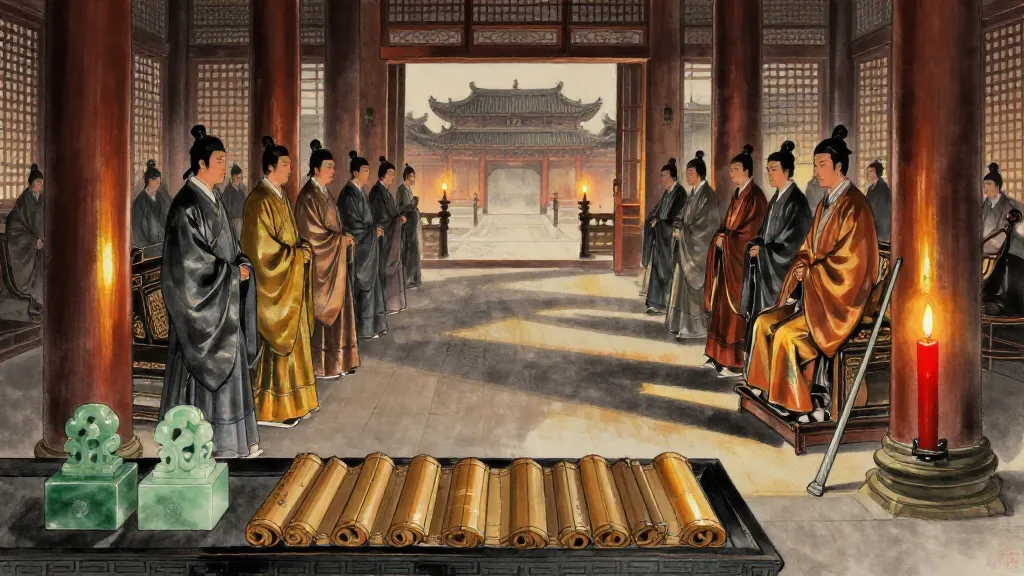
楚元王世家 (Hereditary House of Prince Yuan of Chu) — Chinese ink painting

Chapter 50 of 130

楚元王世家

Hereditary House of Prince Yuan of Chu

View:

楚元王劉交受封

Liu Jiao Is Enfeoffed as Prince Yuan of Chu

楚元王劉交者,高祖之同母少弟也,字游。

高祖兄弟四人,長兄伯,伯蚤卒。始高祖微時,嘗辟事,時時與賓客過巨嫂食。嫂厭叔,叔與客來,嫂詳為羹盡,櫟釜,賓客以故去。已而視釜中尚有羹,高祖由此怨其嫂。及高祖為帝,封昆弟,而伯子獨不得封。太上皇以為言,高祖曰:“某非忘封之也,為其母不長者耳。“於是乃封其子信為羹頡侯。而王次兄仲於代。

高祖六年,已禽楚王韓信於陳,乃以弟交為楚王,都彭城。即位二十三年卒,子夷王郢立。

Prince Yuan of Chu, Liu Jiao, was the youngest full brother of Emperor Gaozu. His courtesy name was You.

Emperor Gaozu had four brothers. The eldest, Bo, died young. In the early days, when the future emperor was still a commoner, he would often evade his labor duties and bring guests to his eldest sister-in-law's house to eat. The sister-in-law resented her brother-in-law. Whenever he arrived with guests, she would pretend the soup was finished and scrape the pot, so the guests would leave. But afterward, when they looked in the pot, there was still soup. From then on, Gaozu bore a grudge against her. When Gaozu became emperor and enfeoffed his brothers, Bo's son alone received no fief. The Grand Supreme Emperor raised the matter, and Gaozu said: "It is not that I forgot to enfeoff him — it is because his mother was not a person of good character." He then enfeoffed Bo's son Xin as Marquis of Gengjie — "Soup-Scraping" Marquis. He made his next eldest brother Zhong king of Dai.

In the sixth year of Gaozu's reign, having captured the King of Chu, Han Xin, at Chen, he made his younger brother Jiao King of Chu, with his capital at Pengcheng. Jiao reigned twenty-three years and died. His son, King Yi, Ying, succeeded him.

Notes

1person劉交Liú Jiāo

Liu Jiao (劉交, d. 179 BC), courtesy name You, was the youngest full brother of Liu Bang (Emperor Gaozu). He was enfeoffed as King of Chu in 201 BC with his capital at Pengcheng (modern Xuzhou, Jiangsu). He was known for his scholarly interests and patronage of Confucian learning.

2translation

The title 羹頡侯 (Marquis of Gengjie) is a deliberate insult. 羹 means 'soup' and 頡 means 'to scrape' — the fief name perpetually memorialized the sister-in-law's petty deception. This anecdote illustrates Gaozu's earthy, vindictive humor.

3person韓信Hán Xìn

Han Xin (韓信, d. 196 BC), the brilliant general who helped Gaozu defeat Xiang Yu, was originally enfeoffed as King of Chu but was later arrested at Chen on suspicion of treason and demoted to Marquis of Huaiyin.

4place

Pengcheng (彭城) was the capital of Chu, located at modern Xuzhou, Jiangsu province. It had previously been Xiang Yu's capital.

楚王戊之叛與楚國存續

The Rebellion of King Wu of Chu and the Continuation of the Chu Line

王戊立二十年,冬,坐為薄太后服私奸,削東海郡。春,戊與吳王合謀反,其相張尚、太傅趙夷吾諫,不聽。戊則殺尚、夷吾,起兵與吳西攻梁,破棘壁。至昌邑南,與漢將周亞夫戰。漢絕吳楚糧道,士卒飢,吳王走,楚王戊自殺,軍遂降漢。

漢已平吳楚,孝景帝欲以德侯子續吳,以元王子禮續楚。竇太后曰:“吳王,老人也,宜為宗室順善。今乃首率七國,紛亂天下,柰何續其後!“不許吳,許立楚後。是時禮為漢宗正。乃拜禮為楚王,奉元王宗廟,是為楚文王。

文王立三年卒,子安王道立。安王二十二年卒,子襄王注立。襄王立十四年卒,子王純代立。王純立,地節二年,中人上書告楚王謀反,王自殺,國除,入漢為彭城郡。

In the twentieth year of King Wu's reign, in winter, he was found guilty of conducting an illicit affair during the mourning period for Empress Dowager Bo, and his Donghai commandery was stripped away. In spring, Wu conspired with the King of Wu to rebel. His chancellor Zhang Shang and Grand Tutor Zhao Yiwu remonstrated, but he refused to listen. Wu killed Zhang Shang and Zhao Yiwu, raised troops, and joined Wu in attacking westward against Liang, breaking through the Jubi fortifications. They reached the area south of Changyi and engaged the Han general Zhou Yafu. The Han cut the Wu-Chu supply lines. The soldiers starved. The King of Wu fled; King Wu of Chu killed himself, and his army surrendered to the Han.

After the Han had pacified Wu and Chu, Emperor Jing wished to install the son of the Marquis of De to continue Wu's line, and a son of Prince Yuan named Li to continue Chu's line. Empress Dowager Dou said: "The King of Wu was an old man who should have been a loyal pillar of the imperial house. Instead he led the Seven Kingdoms into rebellion and threw All-Under-Heaven into chaos — how can we continue his line!" She forbade the continuation of Wu but permitted the restoration of Chu. At that time, Li was serving as Director of the Imperial Clan. He was appointed King of Chu and charged with maintaining Prince Yuan's ancestral temple — this was King Wen of Chu.

King Wen reigned three years and died. His son King An, Dao, succeeded. King An reigned twenty-two years and died. His son King Xiang, Zhu, succeeded. King Xiang reigned fourteen years and died. His son King Chun succeeded. In the second year of the Dijie era, a palace attendant submitted a memorial accusing King Chun of plotting rebellion. The king killed himself, the state was abolished, and it was incorporated into the Han as Pengcheng commandery.

Notes

1person周亞夫Zhōu Yàfū

Zhou Yafu (周亞夫, d. 143 BC) was the son of Zhou Bo and one of the most celebrated Han generals. He defeated the Rebellion of the Seven Kingdoms in 154 BC by cutting the rebels' supply lines rather than engaging in pitched battle.

2context

The Rebellion of the Seven Kingdoms (七國之亂, 154 BC) was triggered by Emperor Jing's policy of reducing the power of the vassal kingdoms, implemented on the advice of Chao Cuo. The kingdoms of Wu, Chu, Zhao, Jiaoxi, Jiaodong, Zichuan, and Jinan rose in revolt but were crushed within three months.

3person竇太后Dòu Tàihòu

Empress Dowager Dou (竇太后, d. 135 BC) was the consort of Emperor Wen and mother of Emperor Jing. A patron of Huang-Lao Daoist philosophy, she wielded considerable political influence during two reigns.

趙王劉遂及河間國

King Sui of Zhao and the Kingdom of Hejian

趙王劉遂者,其父高祖中子,名友,謚曰“幽”。幽王以憂死,故為“幽”。高后王呂祿於趙,一歲而高后崩。大臣誅諸呂呂祿等,乃立幽王子遂為趙王。

孝文帝即位二年,立遂弟辟彊,取趙之河間郡為河間王,為文王。立十三年卒,子哀王福立。一年卒,無子,絕後,國除,入於漢。

King Sui of Zhao — his father was Gaozu's middle son, named You, posthumously titled "the Dark." King You died of grief, hence the posthumous name "Dark." Empress Dowager Lü made Lü Lu king of Zhao. After one year, the empress dowager died. The great ministers put Lü Lu and the other Lü clan members to death, and installed King You's son Sui as King of Zhao.

In the second year after Emperor Wen took the throne, he enfeoffed Sui's younger brother Biqiang, carving out Zhao's Hejian commandery for him as King of Hejian — he became King Wen. He reigned thirteen years and died. His son King Ai, Fu, succeeded. Fu reigned one year and died without an heir. The line was cut off, the state was abolished, and it reverted to the Han.

Notes

1person劉友Liú Yǒu

Liu You (劉友, d. 181 BC), known as King You ('the Dark') of Zhao, was a son of Emperor Gaozu. Empress Lü married him to a Lü clan woman, but when he favored another consort, the Lü wife slandered him. He was summoned to the capital and starved to death in confinement.

2translation

The posthumous title 幽 (yōu, 'dark/secluded') was a negative epithet in the Zhou posthumous naming system, implying a ruler who suffered or caused suffering. The text explains it was chosen because he 'died of grief' (憂死).

趙王遂之叛與覆滅

King Sui of Zhao's Rebellion and Destruction

遂既王趙二十六年,孝景帝時坐晁錯以適削趙王常山之郡。吳楚反,趙王遂與合謀起兵。其相建德、內史王悍諫,不聽。遂燒殺建德、王悍,發兵屯其西界,欲待吳與俱西。北使匈奴,與連和攻漢。漢使曲周侯酈寄擊之。趙王遂還,城守邯鄲,相距七月。吳楚敗於梁,不能西。匈奴聞之,亦止,不肯入漢邊。欒布自破齊還,乃並兵引水灌趙城。趙城壞,趙王自殺,邯鄲遂降。趙幽王絕後。

Sui had been king of Zhao for twenty-six years when, during Emperor Jing's reign, Chao Cuo's policy of territorial reduction was applied to strip Zhao of its Changshan commandery. When Wu and Chu rebelled, King Sui of Zhao joined the conspiracy and raised troops. His chancellor Jiande and Prefect of the Capital Wang Han remonstrated, but he would not listen. Sui burned Jiande and Wang Han alive, mobilized his forces, and stationed them on his western border, intending to wait for the armies of Wu before advancing west together. He sent envoys north to the Xiongnu, seeking an alliance to attack the Han. The Han dispatched the Marquis of Quzhou, Li Ji, to strike him. King Sui of Zhao fell back and defended Handan behind its walls. The standoff lasted seven months. Wu and Chu were defeated in Liang and could not advance west. When the Xiongnu heard this, they too halted and refused to cross the Han frontier. Luan Bu returned from crushing Qi, combined his forces, and diverted a river to flood Zhao's walls. The walls collapsed. The King of Zhao killed himself, and Handan surrendered. The line of King You of Zhao was extinguished.

Notes

1person晁錯Cháo Cuò

Chao Cuo (晁錯, d. 154 BC) was Emperor Jing's chief advisor who advocated the aggressive policy of reducing vassal kingdoms' territories. His policies provoked the Rebellion of the Seven Kingdoms, and he was executed in a failed attempt to appease the rebels.

2place

Handan (邯鄲) was the ancient capital of Zhao, located at modern Handan, Hebei province. It had been one of the great cities of the Warring States period.

3person欒布Luán Bù

Luan Bu (欒布) was a Han general who had served under Peng Yue before joining the Han. He played a key role in suppressing the Rebellion of the Seven Kingdoms by defeating the rebel forces in Qi and Zhao.

太史公論贊

The Grand Historian's Appraisal

太史公曰:國之將興,必有禎祥,君子用而小人退。國之將亡,賢人隱,亂臣貴。使楚王戊毋刑申公,遵其言,趙任防與先生,豈有篡殺之謀,為天下僇哉?賢人乎,賢人乎!非質有其內,惡能用之哉?甚矣,“安危在出令,存亡在所任”,誠哉是言也!

漢封同姓,楚有令名。既滅韓信,王於彭城。穆生置醴,韋孟作程。王戊棄德,與吳連兵。太后命禮,為楚罪輕。文襄繼立,世挺才英。如何趙遂,代殞厥聲!興亡之兆,所任宜明。

The Grand Historian remarks: When a state is about to rise, there are always auspicious signs — worthy men are employed and petty men withdraw. When a state is about to perish, the wise go into hiding and treacherous ministers are honored. Had King Wu of Chu not punished Master Shen, had he heeded his counsel — had Zhao employed Fang and the Elder — would there have been plots of usurpation and murder, bringing disgrace upon them before All-Under-Heaven? Worthy men, worthy men! Without the right substance within, how can one employ them? How profoundly true: "Security and peril lie in the edicts one issues; survival and ruin lie in those one appoints." These words are truly so!

The Han enfeoffed its kinsmen; Chu earned a fine name. After Han Xin was eliminated, they ruled at Pengcheng. Master Mu set out sweet wine; Wei Meng composed his admonitions. King Wu abandoned virtue and joined arms with Wu. The Empress Dowager appointed Li, for Chu's guilt was light. Wen and Xiang succeeded in turn, an age of talent. But how did Sui of Zhao come to destroy his own reputation! The signs of rise and fall — whom one appoints must be clear.

Notes

1person申公Shēn Gōng

Master Shen (申公) was a renowned Confucian scholar who served in the court of Chu. When King Wu punished him, it marked the king's turn away from virtuous counsel.

2context

Master Mu (穆生) was a scholar who, as a non-drinker, was always provided sweet wine (醴) at court banquets under the early Chu kings. When King Wu stopped the custom, Mu recognized the decline of propriety and left. Wei Meng (韋孟) was another scholar who composed verse admonitions for the Chu court.

Edition & Source

Text
《史記》 Shiji
Edition
中華古詩文古書籍網 transcription
Commentary
裴駰《史記集解》、司馬貞《史記索隱》、張守節《史記正義》(Three Commentaries)