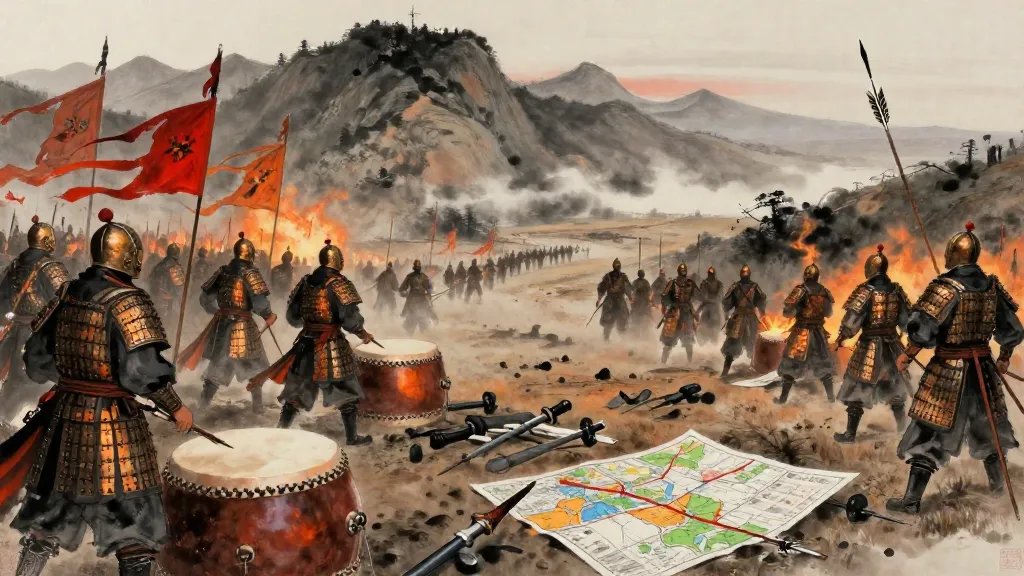
荊燕世家 (Hereditary House of Jing and Yan) — Chinese ink painting

Chapter 51 of 130

荊燕世家

Hereditary House of Jing and Yan

View:

荊王劉賈從漢定天下

King Jia of Jing Helps the Han Settle All-Under-Heaven

荊王劉賈者,諸劉,不知其何屬初起時。漢王元年,還定三秦,劉賈為將軍,定塞地,從東擊項籍。

漢四年,漢王之敗成皋,北渡河,得張耳、韓信軍,軍脩武,深溝高壘,使劉賈將二萬人,騎數百,渡白馬津入楚地,燒其積聚,以破其業,無以給項王軍食。已而楚兵擊劉賈,賈輒壁不肯與戰,而與彭越相保。

漢五年,漢王追項籍至固陵,使劉賈南渡淮圍壽春。還至,使人間招楚大司馬周殷。周殷反楚,佐劉賈舉九江,迎武王黥布兵,皆會垓下,共擊項籍。漢王因使劉賈將九江兵,與太尉盧綰西南擊臨江王共尉。共尉已死,以臨江為南郡。

King Jia of Jing, Liu Jia, was a member of the Liu clan, though it is unknown which branch he belonged to when the enterprise first began. In the first year of the King of Han, when he returned to pacify the Three Qin, Liu Jia served as a general, secured the Sai region, and followed the campaign eastward against Xiang Ji.

In the fourth year, when the King of Han suffered defeat at Chenggao, crossed north over the Yellow River, and joined the forces of Zhang Er and Han Xin, he encamped at Xiuwu with deep ditches and high ramparts. He dispatched Liu Jia with twenty thousand infantry and several hundred cavalry to cross the Baima Ford into Chu territory and burn their stores and supplies, destroying the logistical base that fed Xiang Yu's army. When Chu forces attacked Liu Jia, he would simply fortify his camp and refuse battle, operating in coordination with Peng Yue.

In the fifth year, the King of Han pursued Xiang Ji to Guling and sent Liu Jia south across the Huai River to besiege Shouchun. Returning from this, he sent agents to secretly recruit the Grand Marshal of Chu, Zhou Yin, who defected from Chu and assisted Liu Jia in taking the Nine Rivers region. They linked up with the forces of the Martial King Qing Bu, and all converged at Gaixia to jointly attack Xiang Ji. The King of Han then ordered Liu Jia to lead the Nine Rivers troops, together with Grand Commandant Lu Wan, to strike southwest against King Gong Wei of Linjiang. Gong Wei was killed, and Linjiang became the Nan commandery.

Notes

1person劉賈Liú Jiǎ

Liu Jia (劉賈, d. 196 BC) was a distant kinsman of Liu Bang. He served as a general specializing in guerrilla operations behind enemy lines during the Chu-Han war, then was enfeoffed as King of Jing. He was killed when Qing Bu rebelled.

2person彭越Péng Yuè

Peng Yue (彭越, d. 196 BC) was a guerrilla leader who harassed Xiang Yu's supply lines from his base in the Liang region. He was later enfeoffed as King of Liang but was executed by Gaozu on charges of treason.

3place

Gaixia (垓下) was the site of Xiang Yu's final defeat in 202 BC, located near modern Lingbi County, Anhui. It was here that Xiang Yu heard the 'songs of Chu on all sides' and realized his cause was lost.

荊王受封與覆滅

The Enfeoffment and Fall of the King of Jing

漢六年春,會諸侯於陳,廢楚王信,囚之,分其地為二國。當是時也,高祖子幼,昆弟少,又不賢,欲王同姓以鎮天下,乃詔曰:“將軍劉賈有功,及擇子弟可以為王者。“群臣皆曰:“立劉賈為荊王,王淮東五十二城;高祖弟交為楚王,王淮西三十六城。“因立子肥為齊王。始王昆弟劉氏也。

高祖十一年秋,淮南王黥布反,東擊荊。荊王賈與戰,不勝,走富陵,為布軍所殺。高祖自擊破布。十二年,立沛侯劉濞為吳王,王故荊地。

In the spring of the sixth year, the Emperor convened the lords at Chen, deposed Han Xin as King of Chu, imprisoned him, and divided his territory into two kingdoms. At that time, Gaozu's sons were young, his brothers were few and lacked ability, and he wished to install members of the Liu clan as kings to stabilize All-Under-Heaven. He therefore issued an edict: "General Liu Jia has rendered great service. Choose from among our sons and brothers those worthy to be made kings." The court ministers all said: "Install Liu Jia as King of Jing, ruling fifty-two cities east of the Huai; make Gaozu's younger brother Jiao King of Chu, ruling thirty-six cities west of the Huai." At the same time, he installed his son Fei as King of Qi. This was the beginning of enfeoffing Liu kinsmen as kings.

In the autumn of Gaozu's eleventh year, Qing Bu, King of Huainan, rebelled and struck east against Jing. King Jia engaged him in battle but was defeated, fled to Fuling, and was killed by Qing Bu's forces. Gaozu personally led the campaign that crushed Qing Bu. In the twelfth year, he installed Liu Bi, Marquis of Pei, as King of Wu, to rule the former Jing territories.

Notes

1person黥布Qíng Bù

Qing Bu (黥布, also known as Ying Bu 英布, d. 196 BC), King of Huainan, was originally one of Xiang Yu's most powerful generals. He defected to Liu Bang during the Chu-Han war but later rebelled against the Han. The character 黥 refers to the tattooing punishment he received in his youth as a convict laborer.

2person劉濞Liú Bì

Liu Bi (劉濞, 216–154 BC), King of Wu, was a nephew of Emperor Gaozu. He would later lead the Rebellion of the Seven Kingdoms in 154 BC, the most serious challenge to Han central authority before the late Western Han period.

營陵侯劉澤與田生之謀

Liu Ze, Marquis of Yingling, and the Schemes of Tian Sheng

燕王劉澤者,諸劉遠屬也。高帝三年,澤為郎中。高帝十一年,澤以將軍擊陳豨,得王黃,為營陵侯。

高后時,齊人田生游乏資,以畫乾營陵侯澤。澤大說之,用金二百斤為田生壽。田生已得金,即歸齊。二年,澤使人謂田生曰:“弗與矣。“田生如長安,不見澤,而假大宅,令其子求事呂后所幸大謁者張子卿。居數月,田生子請張卿臨,親脩具。張卿許往。田生盛帷帳共具,譬如列侯。張卿驚。酒酣,乃屏人說張卿曰:“臣觀諸侯王邸弟百餘,皆高祖一切功臣。今呂氏雅故本推轂高帝就天下,功至大,又親戚太后之重。太后春秋長,諸呂弱,太后欲立呂產為王,王代。太后又重發之,恐大臣不聽。今卿最幸,大臣所敬,何不風大臣以聞太后,太后必喜。諸呂已王,萬戶侯亦卿之有。太后心欲之,而卿為內臣,不急發,恐禍及身矣。“張卿大然之,乃風大臣語太后。太后朝,因問大臣。大臣請立呂產為呂王。太后賜張卿千斤金,張卿以其半與田生。田生弗受,因說之曰:“呂產王也,諸大臣未大服。今營陵侯澤,諸劉,為大將軍,獨此尚觖望。今卿言太后,列十餘縣王之,彼得王,喜去,諸呂王益固矣。“張卿入言,太后然之。乃以營陵侯劉澤為琅邪王。琅邪王乃與田生之國。田生勸澤急行,毋留。出關,太后果使人追止之,已出,即還。

Liu Ze, King of Yan, was a distant kinsman of the Liu house. In the third year of Emperor Gaozu, Ze served as a Gentleman of the Palace. In the eleventh year, serving as a general in the campaign against Chen Xi, he captured Wang Huang and was made Marquis of Yingling.

During the reign of Empress Dowager Lü, a man of Qi named Tian Sheng was traveling without funds and approached the Marquis of Yingling with a scheme. Ze was greatly pleased and gave Tian Sheng a gift of two hundred catties of gold. Having obtained the gold, Tian Sheng immediately returned to Qi. Two years later, Ze sent a message to Tian Sheng: "You have given me nothing in return." Tian Sheng went to Chang'an but did not visit Ze. Instead he rented a grand mansion and had his son seek employment under Zhang Ziqing, the Grand Usher favored by Empress Lü. After several months, Tian Sheng's son invited Zhang Ziqing to a banquet, personally preparing the feast. Zhang Ziqing accepted. Tian Sheng laid out curtains, canopies, and vessels as lavishly as a marquis's establishment. Zhang Ziqing was astonished. When the wine flowed freely, Tian Sheng dismissed the attendants and addressed Zhang Ziqing privately: "I observe that the hundred-odd lords' mansions in the capital all belong to Emperor Gaozu's one-time meritorious subjects. Now the Lü house was originally instrumental in pushing Emperor Gaozu to win All-Under-Heaven — their merit is great indeed, and they have the weight of kinship with the Empress Dowager. The Empress Dowager is advanced in years and the Lü clan is still weak. She wishes to make Lü Chan a king, to rule Dai. But she hesitates to act, fearing the great ministers will not accept it. You, sir, are the most favored — respected by the great ministers. Why not hint to the ministers and let the Empress Dowager know of their assent? She will be delighted. Once the Lü clan are kings, a marquisate of ten thousand households will be yours as well. The Empress Dowager's heart desires this, and you, as her inner minister, must act quickly — otherwise disaster may overtake you." Zhang Ziqing fully agreed. He hinted to the ministers, who spoke to the Empress Dowager. At the next court session, the Empress Dowager raised the matter, and the ministers proposed making Lü Chan King of Lü. The Empress Dowager rewarded Zhang Ziqing with a thousand catties of gold, and Zhang Ziqing gave half to Tian Sheng. Tian Sheng refused it, and instead said: "Now that Lü Chan is king, the great ministers are not truly reconciled. The Marquis of Yingling, Liu Ze, is a Liu kinsman and Grand General — he alone still nurses resentment. If you speak to the Empress Dowager and give him a kingdom of ten-odd counties, he will be delighted and leave, and the Lü kings will be all the more secure." Zhang Ziqing conveyed this to the Empress Dowager, who agreed. Liu Ze, Marquis of Yingling, was thus made King of Langya. The new King of Langya departed for his domain together with Tian Sheng. Tian Sheng urged Ze to travel swiftly and not linger. Once they were past the passes, the Empress Dowager indeed sent men to stop him — but he had already gone through, so the pursuers turned back.

Notes

1person劉澤Liú Zé

Liu Ze (劉澤, d. 178 BC) was a distant kinsman of the Liu imperial house. Through Tian Sheng's machinations he became King of Langya, then was transferred to become King of Yan after helping install Emperor Wen. His line held Yan for three generations.

2person田生Tián Shēng

Tian Sheng (田生) was a political schemer from Qi who manipulated the Lü court to advance Liu Ze's interests while appearing to serve the Lü clan. His plan was a masterpiece of indirection — he helped the Lü enfeoff their own, then used that as leverage to get Liu Ze a kingdom.

3place

Langya (琅邪) was a commandery in modern southeastern Shandong, near modern Linyi. It had historically been part of Qi territory.

劉澤立燕及後嗣覆滅

Liu Ze Becomes King of Yan and the Fall of His Descendants

及太后崩,琅邪王澤乃曰:“帝少,諸呂用事,劉氏孤弱。“乃引兵與齊王合謀西,欲誅諸呂。至梁,聞漢遣灌將軍屯滎陽,澤還兵備西界,遂跳驅至長安。代王亦從代至。諸將相與琅邪王共立代王為天子。天子乃徙澤為燕王,乃復以琅邪予齊,復故地。

澤王燕二年,薨,謚為敬王。傳子嘉,為康王。

至孫定國,與父康王姬奸,生子男一人。奪弟妻為姬。與子女三人奸。定國有所欲誅殺臣肥如令郢人,郢人等告定國,定國使謁者以他法劾捕格殺郢人以滅口。至元朔元年,郢人昆弟復上書具言定國陰事,以此發覺。詔下公卿,皆議曰:“定國禽獸行,亂人倫,逆天,當誅。“上許之。定國自殺,國除為郡。

When the Empress Dowager died, the King of Langya, Ze, declared: "The emperor is young, the Lü clan controls the government, and the Liu house is isolated and weak." He led his troops to join the King of Qi in a western campaign to exterminate the Lü clan. Reaching Liang, he heard that the Han had dispatched General Guan Ying to garrison Xingyang. Ze redeployed his forces to guard his western border, then raced ahead to Chang'an. The King of Dai also arrived from Dai. The generals and ministers, together with the King of Langya, installed the King of Dai as Son of Heaven. The new emperor transferred Ze to be King of Yan, returning Langya to Qi and restoring its former territory.

Ze reigned as King of Yan for two years before he died, receiving the posthumous title King Jing. His son Jia succeeded, becoming King Kang.

By the time of his grandson Dingguo, depravity consumed the house. Dingguo had an affair with his father King Kang's concubine, by whom he fathered a son. He took his younger brother's wife as his own concubine. He had illicit relations with three of his own children. Dingguo wished to kill one of his subjects, the Magistrate of Feiru named Ying Ren. When Ying Ren and others reported Dingguo's crimes, Dingguo sent his chamberlain to frame and arrest Ying Ren on other charges, then had him beaten to death to silence him. In the first year of the Yuanshuo era, Ying Ren's brothers submitted a memorial detailing all of Dingguo's secret crimes, and the matter was exposed. The Emperor sent the case to the ministers for deliberation. All agreed: "Dingguo has behaved like a beast, violating human bonds and defying Heaven — he deserves death." The Emperor approved. Dingguo killed himself, and the kingdom was abolished and converted to a commandery.

Notes

1person漢文帝Hàn Wén Dì

The King of Dai who became Emperor was Liu Heng (劉恆, 203–157 BC), later known as Emperor Wen of Han (漢文帝). He was chosen by the ministers precisely because his mother's clan, the Bo family, was weak and posed no threat of a repeat of the Lü clan's domination.

2context

The Yuanshuo era (元朔) was the second era name of Emperor Wu of Han, spanning 128–123 BC. The first year of Yuanshuo is 128 BC.

太史公論贊

The Grand Historian's Appraisal

太史公曰:荊王王也,由漢初定,天下未集,故劉賈雖屬疏,然以策為王,填江淮之間。劉澤之王,權激呂氏,然劉澤卒南面稱孤者三世。事發相重,豈不為偉乎!

劉賈初從,首定三秦。既渡白馬,遂圍壽春。始迎黥布,絕間周殷。賞功胙士,與楚為鄰。營陵始爵,勛由擊陳。田生遊說,受賜千斤。權激諸呂,事發榮身。徙封傳嗣,亡於郢人。

The Grand Historian remarks: The reason Liu Jia became king was that the Han had just been established and All-Under-Heaven was not yet settled. Though Liu Jia was only a distant kinsman, he was made king by virtue of his strategic service, to fill the power vacuum between the Jiang and Huai rivers. Liu Ze's kingship was won by leveraging the Lü clan's ambitions against themselves — yet in the end, Liu Ze faced south and reigned for three generations. Events compounded upon events — is this not remarkable!

Liu Jia first followed the cause and led the pacification of the Three Qin. He crossed at Baima and besieged Shouchun. He welcomed Qing Bu's forces and drove a wedge to turn Zhou Yin. Rewarded for merit, he became Chu's neighbor. Yingling first received his title for the campaign against Chen Xi. Tian Sheng schemed his way to a gift of a thousand catties. By manipulating the Lü clan, he won both rank and domain. The fief was transferred and the line passed on — until destroyed by the case of Ying Ren.

Notes

1translation

南面稱孤 ('face south and call oneself the Solitary One') is a standard formula for reigning as a king. In the Chinese orientation system, the ruler faces south; 孤 ('the Solitary One') is a royal self-deprecation, equivalent to 寡人.

Edition & Source

Text
《史記》 Shiji
Edition
中華古詩文古書籍網 transcription
Commentary
裴駰《史記集解》、司馬貞《史記索隱》、張守節《史記正義》(Three Commentaries)