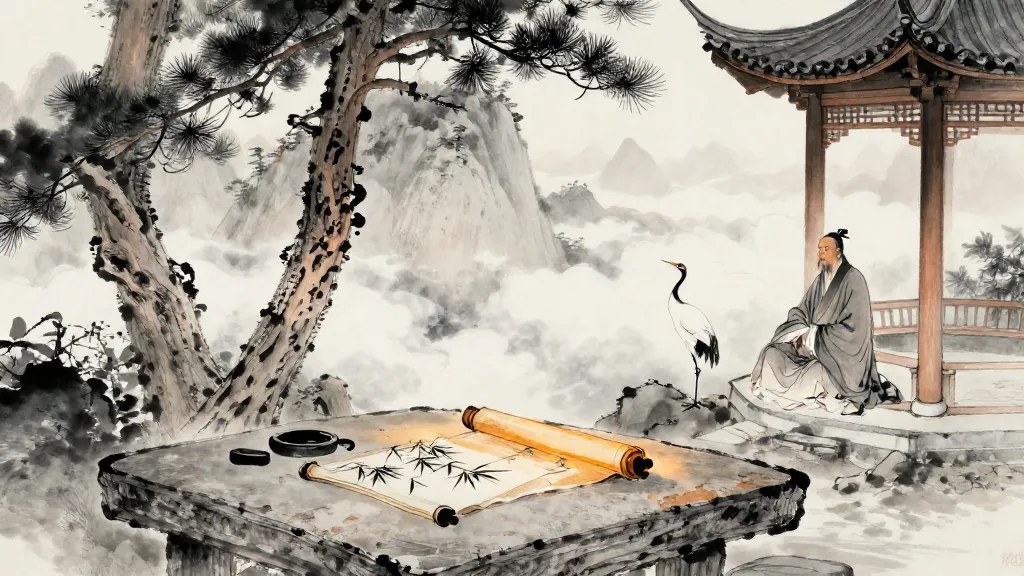
齊悼惠王世家 (Hereditary House of King Daohui of Qi) — Chinese ink painting

Chapter 52 of 130

齊悼惠王世家

Hereditary House of King Daohui of Qi

View:

齊悼惠王受封與朝漢

King Daohui of Qi Is Enfeoffed and Visits the Han Court

齊悼惠王劉肥者,高祖長庶男也。其母外婦也,曰曹氏。高祖六年,立肥為齊王,食七十城,諸民能齊言者皆予齊王。

齊王,孝惠帝兄也。孝惠帝二年,齊王入朝。惠帝與齊王燕飲,亢禮如家人。呂太后怒,且誅齊王。齊王懼不得脫,乃用其內史勛計,獻城陽郡,以為魯元公主湯沐邑。呂太后喜,乃得辭就國。

悼惠王即位十三年,以惠帝六年卒。子襄立,是為哀王。

King Daohui of Qi, Liu Fei, was Emperor Gaozu's eldest illegitimate son. His mother was an unofficial consort surnamed Cao. In the sixth year of Gaozu's reign, Fei was made King of Qi, with seventy cities for his revenue, and all the people who spoke the Qi dialect were assigned to him.

The King of Qi was the elder brother of Emperor Hui. In the second year of Emperor Hui, the King of Qi came to court. Emperor Hui drank with the King of Qi at an informal banquet, treating him with the familiarity of family members and seating him as an equal. Empress Dowager Lü was furious and made preparations to execute the King of Qi. Terrified that he would not escape alive, the king adopted a plan from his Prefect of the Capital, Xun: he presented the Chengyang commandery to serve as the appanage of Princess Yuan of Lu. Empress Dowager Lü was pleased, and the king was permitted to take his leave and return to his domain.

King Daohui reigned for thirteen years and died in the sixth year of Emperor Hui. His son Xiang succeeded — this was King Ai.

Notes

1person劉肥Liú Féi

Liu Fei (劉肥, d. 189 BC) was Emperor Gaozu's eldest son, born to a concubine surnamed Cao before Liu Bang's marriage to Empress Lü. As the eldest son, he received the largest kingdom — Qi, with its seventy walled cities — but his illegitimate birth barred him from the succession.

2person漢惠帝Hàn Huì Dì

Emperor Hui of Han (漢惠帝, Liu Ying 劉盈, 210–188 BC, r. 195–188 BC) was Gaozu's legitimate heir by Empress Lü. He was known as a gentle and kind ruler, largely overshadowed by his domineering mother.

3person魯元公主Lǔ Yuán Gōngzhǔ

Princess Yuan of Lu (魯元公主) was the daughter of Emperor Gaozu and Empress Lü, and thus Emperor Hui's full sister. She was a key figure in Empress Lü's marriage alliances.

呂后專權與朱虛侯之怒

Empress Lü's Autocracy and the Anger of the Marquis of Zhuixu

哀王元年,孝惠帝崩,呂太后稱制,天下事皆決於高后。二年,高后立其兄子酈侯呂台為呂王,割齊之濟南郡為呂王奉邑。

哀王三年,其弟章入宿衛於漢,呂太后封為硃虛侯,以呂祿女妻之。後四年,封章弟興居為東牟侯,皆宿衛長安中。

哀王八年,高后割齊琅邪郡立營陵侯劉澤為琅邪王。

其明年,趙王友入朝,幽死於邸。三趙王皆廢。高后立諸呂諸呂為三王,擅權用事。

硃虛侯年二十,有氣力,忿劉氏不得職。嘗入待高后燕飲,高后令硃虛侯劉章為酒吏。章自請曰:“臣,將種也,請得以軍法行酒。“高后曰:“可。“酒酣,章進飲歌舞。已而曰:“請為太后言耕田歌。“高后兒子畜之,笑曰:“顧而父知田耳。若生而為王子,安知田乎?“章曰:“臣知之。“太后曰:“試為我言田。“章曰:“深耕穊種,立苗欲疏,非其種者,鉏而去之。“呂后默然。頃之,諸呂有一人醉,亡酒,章追,拔劍斬之,而還報曰:“有亡酒一人,臣謹行法斬之。“太后左右皆大驚。業已許其軍法,無以罪也。因罷。自是之後,諸呂憚硃虛侯,雖大臣皆依硃虛侯,劉氏為益彊。

In the first year of King Ai, Emperor Hui died. Empress Dowager Lü assumed direct rule, and all affairs of the realm were decided by her. In the second year, the Empress Dowager installed her brother's son, Lü Tai, Marquis of Li, as King of Lü, and carved out Qi's Jinan commandery as his appanage.

In the third year of King Ai, his younger brother Zhang entered service as a palace guard in the capital. Empress Dowager Lü enfeoffed him as Marquis of Zhuixu and married him to a daughter of Lü Lu. Four years later, she enfeoffed Zhang's younger brother Xingju as Marquis of Dongmou. Both served as guards in Chang'an.

In the eighth year of King Ai, the Empress Dowager carved out Qi's Langya commandery and made Liu Ze, Marquis of Yingling, King of Langya.

The following year, King You of Zhao came to court and was confined in his residence until he died. All three Kings of Zhao were deposed. The Empress Dowager installed members of the Lü clan as three kings, monopolizing power.

The Marquis of Zhuixu was twenty years old, powerfully built, and furious that the Liu clan was denied its rightful positions. Once, attending a banquet hosted by the Empress Dowager, she ordered the Marquis of Zhuixu, Liu Zhang, to serve as wine officer. Zhang volunteered: "I am a soldier's son — I request permission to enforce the drinking rules under military law." The Empress Dowager said: "Granted." When the wine flowed freely, Zhang led the company in drinking songs and dances. Then he said: "I beg leave to sing the Empress Dowager the Plowing Song." The Empress Dowager, who treated him as a child, laughed and said: "Your father may have known farming. But you were born a prince — what do you know of plowing?" Zhang said: "I know it." The Empress Dowager said: "Try singing it for me." Zhang sang: "Plow deep, plant thick — but let the seedlings stand sparse. What is not of the right seed — hoe it out and remove it." Empress Lü fell silent. Shortly after, one of the Lü clansmen got drunk and tried to slip away from the drinking. Zhang pursued him, drew his sword, and cut him down. He returned and reported: "One man fled the drinking — I have dutifully applied the law and executed him." The Empress Dowager's entire retinue was shocked. But since she had already granted him military authority, there was no basis to punish him. The banquet was ended. From that day on, the Lü clan feared the Marquis of Zhuixu. Even the great ministers rallied to him, and the Liu house grew stronger.

Notes

1person劉章Liú Zhāng

Liu Zhang (劉章, d. 176 BC), Marquis of Zhuixu (朱虛侯), was a son of King Daohui of Qi. Bold and hot-tempered, he played a central role in the extermination of the Lü clan in 180 BC, personally killing the Lü chancellor Lü Chan.

2translation

The 'Plowing Song' (耕田歌) was a thinly veiled political allegory. 'What is not of the right seed — hoe it out' (非其種者,鉏而去之) meant: the Lü clan members occupying Liu positions should be eliminated. Empress Lü understood immediately.

齊王起兵誅呂

The King of Qi Raises Troops to Exterminate the Lü Clan

其明年,高后崩。趙王呂祿為上將軍,呂王產為相國,皆居長安中,聚兵以威大臣,欲為亂。硃虛侯章以呂祿女為婦,知其謀,乃使人陰出告其兄齊王,欲令發兵西,硃虛侯、東牟侯為內應,以誅諸呂,因立齊王為帝。

齊王既聞此計,乃與其舅父駟鈞、郎中令祝午、中尉魏勃陰謀發兵。齊相召平聞之,乃發卒衛王宮。魏勃紿召平曰:“王欲發兵,非有漢虎符驗也。而相君圍王,固善。勃請為君將兵衛衛王。“召平信之,乃使魏勃將兵圍王宮。勃既將兵,使圍相府。召平曰:“嗟乎!道家之言'當斷不斷,反受其亂',乃是也。“遂自殺。於是齊王以駟鈞為相,魏勃為將軍,祝午為內史,悉發國中兵。使祝午東詐琅邪王曰:“呂氏作亂,齊王發兵欲西誅之。齊王自以兒子,年少,不習兵革之事,原舉國委大王。大王自高帝將也,習戰事。齊王不敢離兵,使臣請大王幸之臨菑見齊王計事,並將齊兵以西平關中之亂。“琅邪王信之,以為然,馳見齊王。齊王與魏勃等因留琅邪王,而使祝午盡發琅邪國而並將其兵。

The following year, the Empress Dowager died. Lü Lu, King of Zhao, held the post of Supreme General, and Lü Chan, King of Lü, was Chancellor of State. Both resided in Chang'an, massing troops to intimidate the great ministers, intending to seize power. The Marquis of Zhuixu, Zhang, whose wife was Lü Lu's daughter, learned of their plot. He secretly sent a messenger to inform his elder brother, the King of Qi, urging him to mobilize and march west, with the Marquis of Zhuixu and the Marquis of Dongmou serving as agents within the capital, to destroy the Lü clan and install the King of Qi as emperor.

When the King of Qi received this plan, he secretly plotted with his maternal uncle Si Jun, his Gentleman of the Palace Zhu Wu, and his Commandant Wei Bo to raise troops. The Chancellor of Qi, Zhao Ping, heard of it and deployed soldiers to surround the royal palace. Wei Bo deceived Zhao Ping, saying: "The king wishes to mobilize, but he has no imperial tiger tallies to authorize it. Your encirclement of the king is therefore proper. Allow me to take command of the troops guarding the palace on your behalf." Zhao Ping believed him and handed over command. Once Wei Bo had the troops, he turned them around to surround the chancellor's residence. Zhao Ping said: "Alas! The Daoist saying, 'When you should act decisively but do not, you will instead suffer the consequences' — this is exactly what it means." He then killed himself. The King of Qi thereupon appointed Si Jun as chancellor, Wei Bo as general, and Zhu Wu as prefect of the capital, mobilizing every soldier in the kingdom. He sent Zhu Wu east to deceive the King of Langya: "The Lü clan has risen in rebellion. The King of Qi has raised troops to march west and punish them. The King of Qi considers himself young and inexperienced in military matters, and wishes to entrust the entire enterprise to Your Majesty. Your Majesty served as a general under Emperor Gaozu and is experienced in warfare. The King of Qi dares not leave his army and sends me to invite Your Majesty to come to Linzi to plan the campaign and take combined command of Qi's forces for the western expedition to pacify the disorders in the capital." The King of Langya believed this, thinking it reasonable, and rode at speed to meet the King of Qi. The King of Qi and Wei Bo then detained the King of Langya while sending Zhu Wu to commandeer every soldier in Langya and absorb them into the Qi army.

Notes

1person魏勃Wèi Bó

Wei Bo (魏勃) was a resourceful but timid officer who rose to prominence in Qi. Despite engineering the seizure of power from Chancellor Zhao Ping through sheer bluff, he later trembled with fear when questioned by General Guan Ying.

2context

The tiger tally (虎符) was a bronze token split in two — one half held by the central government, one by the local commander. Troops could only be legally mobilized when both halves matched. The King of Qi's lack of a tiger tally made his mobilization technically illegal.

3place

Linzi (臨菑/臨淄) was the capital of Qi, located in modern Linzi District, Zibo, Shandong. One of the largest cities in ancient China, with a population reportedly reaching 70,000 households.

琅邪王脫身與諸呂被誅

The King of Langya Escapes and the Lü Clan Is Annihilated

琅邪王劉澤既見欺,不得反國,乃說齊王曰:“齊悼惠王高皇帝長子,推本言之,而大王高皇帝適長孫也,當立。今諸大臣狐疑未有所定,而澤於劉氏最為長年,大臣固待澤決計。今大王留臣無為也,不如使我入關計事。“齊王以為然,乃益具車送琅邪王。

琅邪王既行,齊遂舉兵西攻呂國之濟南。於是齊哀王遺諸侯王書曰:“高帝平定天下,王諸子弟,悼惠王於齊。悼惠王薨,惠帝使留侯張良立臣為齊王。惠帝崩,高后用事,春秋高,聽諸呂擅廢高帝所立,又殺三趙王,滅梁、燕、趙以王諸呂,分齊國為四。忠臣進諫,上惑亂不聽。今高后崩,皇帝春秋富,未能治天下,固恃大臣諸。今諸呂又擅自尊官,聚兵嚴威,劫列侯忠臣,矯制以令天下,宗廟所以危。今寡人率兵入誅不當為王者。”

漢聞齊發兵而西,相國呂產乃遣大將軍灌嬰東擊之。灌嬰至滎陽,乃謀曰:“諸呂將兵居關中,欲危劉氏而自立。我今破齊還報,是益呂氏資也。“乃留兵屯滎陽,使使喻齊王及諸侯,與連和,以待呂氏之變而共誅之。齊王聞之,乃西取其故濟南郡,亦屯兵於齊西界以待約。

呂祿、呂產欲作亂關中,硃虛侯與太尉勃、丞相平等誅之。硃虛侯首先斬呂產,於是太尉勃等乃得盡誅諸呂。而琅邪王亦從齊至長安。

Having been tricked and unable to return to his domain, the King of Langya, Liu Ze, persuaded the King of Qi: "King Daohui was Emperor Gaozu's eldest son. Tracing the lineage to its source, Your Majesty is Emperor Gaozu's eldest legitimate grandson and rightful heir. The great ministers are still hesitating and undecided. Among the Liu clan, I am the eldest in years — the ministers are naturally waiting for me to make the decision. Detaining me here serves no purpose. Better to let me enter the passes and settle matters." The King of Qi thought this reasonable and provided additional carriages to escort the King of Langya on his way.

Once the King of Langya had departed, Qi raised its army and marched west, attacking the Lü-held Jinan commandery. King Ai of Qi then sent a circular letter to the vassal kings: "Emperor Gaozu pacified All-Under-Heaven and enfeoffed his sons and brothers — King Daohui in Qi. When King Daohui passed away, Emperor Hui sent the Marquis of Liu, Zhang Liang, to install me as King of Qi. When Emperor Hui died, Empress Dowager Lü took power. Advanced in years, she let the Lü clan arbitrarily depose those Gaozu had installed, killed three Kings of Zhao, destroyed Liang, Yan, and Zhao to create kingdoms for the Lü, and split Qi into four. Loyal ministers remonstrated, but the sovereign was deluded and refused to listen. Now the Empress Dowager has died. The emperor is young and cannot govern All-Under-Heaven, relying entirely on the great ministers. Yet the Lü clan has arrogated high office to themselves, massed troops to project their power, coerced the marquises and loyal ministers, and forged imperial edicts to command All-Under-Heaven. The ancestral temples are thereby endangered. I now lead my army to punish those who should never have been made kings."

When the Han court heard that Qi had mobilized and was marching west, Chancellor of State Lü Chan dispatched Grand General Guan Ying to strike eastward against Qi. Guan Ying reached Xingyang but deliberated: "The Lü clan holds military power in the capital region and intends to destroy the Liu house and seize power. If I crush Qi and report back, I will only be adding to the Lü clan's strength." He therefore halted at Xingyang, sent envoys to the King of Qi and the other lords, formed a coalition with them, and waited for the Lü clan to make their move before jointly destroying them. When the King of Qi heard this, he recovered his former Jinan commandery in the west and also stationed his troops on Qi's western border to await the agreed signal.

When Lü Lu and Lü Chan attempted their coup in the capital, the Marquis of Zhuixu, together with Grand Commandant Bo and Chancellor Ping, destroyed them. The Marquis of Zhuixu was the first to cut down Lü Chan, and Grand Commandant Bo was then able to exterminate the entire Lü clan. The King of Langya also arrived in Chang'an from Qi.

Notes

1person灌嬰Guàn Yīng

Guan Ying (灌嬰, d. 176 BC) was one of Gaozu's most trusted generals, known for his cavalry expertise. His decision to halt at Xingyang rather than attack Qi was pivotal — it effectively doomed the Lü clan by denying them military support.

2person周勃Zhōu Bó

Grand Commandant Zhou Bo (周勃, d. 169 BC) and Chancellor Chen Ping (陳平, d. 178 BC) were the architects of the palace coup that destroyed the Lü clan. Zhou Bo seized control of the Northern Army by presenting the tiger tally, while Chen Ping managed the political maneuvering.

3place

Xingyang (滎陽) was the strategic garrison city controlling the pass between the Central Plain and the Guanzhong region, near modern Xingyang, Henan. It had been a key battleground during the Chu-Han war.

代王立為帝與齊國分封

The King of Dai Becomes Emperor and Qi Is Divided

大臣議欲立齊王,而琅邪王及大臣曰:“齊王母家駟鈞,惡戾,虎而冠者也。方以呂氏故幾亂天下,今又立齊王,是欲復為呂氏也。代王母家薄氏,君子長者;且代王又親高帝子,於今見在,且最為長。以子則順,以善人則大臣安。“於是大臣乃謀迎立代王,而遣硃虛侯以誅呂氏事告齊王,令罷兵。

灌嬰在滎陽,聞魏勃本教齊王反,既誅呂氏,罷齊兵,使使召責問魏勃。勃曰:“失火之家,豈暇先言大人而後救火乎!“因退立,股戰而栗,恐不能言者,終無他語。灌將軍熟視笑曰:“人謂魏勃勇,妄庸人耳,何能為乎!“乃罷魏勃。魏勃父以善鼓琴見秦皇帝。及魏勃少時,欲求見齊相曹參,家貧無以自通,乃常獨早夜埽齊相舍人門外。相舍人怪之,以為物,而伺之,得勃。勃曰:“原見相君,無因,故為子埽,欲以求見。“於是舍人見勃曹參,因以為舍人。一為參御,言事,參以為賢,言之齊悼惠王。悼惠王召見,則拜為內史。始,悼惠王得自置二千石。及悼惠王卒而哀王立,勃用事,重於齊相。

王既罷兵歸,而代王來立,是為孝文帝。

The great ministers deliberated and wished to install the King of Qi as emperor. But the King of Langya and other ministers objected: "The King of Qi's maternal family, the Si clan of Si Jun, is vicious and violent — a tiger wearing a cap. We have only just nearly lost All-Under-Heaven because of the Lü clan. To install the King of Qi now would be to create another Lü clan. The King of Dai's maternal family, the Bo clan, are men of integrity and decency. Moreover, the King of Dai is a direct son of Emperor Gaozu, still living, and the eldest among the surviving sons. By lineage it is proper; by character the ministers can rest easy." The ministers therefore resolved to welcome and install the King of Dai, and dispatched the Marquis of Zhuixu to inform the King of Qi of the Lü clan's destruction and order him to stand down his army.

Guan Ying was at Xingyang when he heard that Wei Bo had originally encouraged the King of Qi to rebel. After the Lü clan was destroyed and Qi's troops disbanded, he summoned Wei Bo for questioning. Wei Bo said: "When a house is on fire, does one stop to inform the master before putting out the flames?" He then stepped back and stood at attention, his thighs trembling and knees knocking, so frightened he could barely speak, and added nothing more. General Guan Ying looked at him for a long moment, laughed, and said: "People called Wei Bo brave — he is nothing but a common fool. What harm could he do?" And dismissed him. Wei Bo's father had once gained audience with the First Emperor of Qin through his skill at playing the qin. When Wei Bo was young and wished to meet the Chancellor of Qi, Cao Shen, he was too poor to arrange an introduction. So he would rise alone, early and late, to sweep outside the door of the chancellor's steward. The steward, puzzled, thought it must be a ghost, and kept watch — and found Bo. Bo said: "I wish to see the Chancellor but have no connection, so I sweep your doorstep to earn an audience." The steward introduced Bo to Cao Shen, who took him on as an attendant. Once, while serving as Cao Shen's charioteer, Bo discussed affairs. Shen judged him capable and mentioned him to King Daohui. The king summoned Bo and appointed him Prefect of the Capital. At that time, King Daohui had the right to appoint his own officials of two-thousand-bushel rank. After King Daohui died and King Ai succeeded, Bo rose to power and outweighed the chancellor of Qi.

The King of Qi disbanded his army and returned. The King of Dai came from Dai and was enthroned — this was Emperor Wen.

Notes

1person曹參Cáo Shēn

Cao Shen (曹參, d. 190 BC) served as Chancellor of Qi under King Daohui before succeeding Xiao He as Chancellor of the Han. His governance of Qi, based on Huang-Lao non-interventionist principles, is detailed in Shiji chapter 54.

2translation

虎而冠 ('a tiger wearing a cap') is a vivid idiom meaning someone who looks civilized on the surface but is savage beneath — essentially 'a beast in human clothing.'

齊國七王分封與七國之亂

The Seven Kings of Qi and the Rebellion of the Seven Kingdoms

孝文帝元年,盡以高后時所割齊之城陽、琅邪、濟南郡復與齊,而徙琅邪王王燕,益封硃虛侯、東牟侯各二千戶。

是歲,齊哀王卒,太子立,是為文王。

齊文王元年,漢以齊之城陽郡立硃虛侯為城陽王,以齊濟北郡立東牟侯為濟北王。

二年,濟北王反,漢誅殺之,地入於漢。

後二年,孝文帝盡封齊悼惠王子罷軍等七人皆為列侯。

齊文王立十四年卒,無子,國除,地入於漢。

後一歲,孝文帝以所封悼惠王子分齊為王,齊孝王將閭以悼惠王子楊虛侯為齊王。故齊別郡盡以王悼惠王子:子志為濟北王,子辟光為濟南王,子賢為菑川王,子卬為膠西王,子雄渠為膠東王,與城陽、齊凡七王。

齊孝王十一年,吳王濞、楚王戊反,興兵西,告諸侯曰“將誅漢賊臣晁錯以安宗廟”。膠西、膠東、菑川、濟南皆擅發兵應吳楚。欲與齊,齊孝王狐疑,城守不聽,三國兵共圍齊。齊王使路中大夫告於天子。天子復令路中大夫還告齊王:“善堅守,吾兵今破吳楚矣。“路中大夫至,三國兵圍臨菑數重,無從入。三國將劫與路中大夫盟,曰:“若反言漢已破矣,齊趣下三國,不且見屠。“路中大夫既許之,至城下,望見齊王,曰:“漢已發兵百萬,使太尉周亞夫擊破吳楚,方引兵救齊,齊必堅守無下!“三國將誅路中大夫。

In the first year of Emperor Wen, all the commanderies carved from Qi during Empress Lü's reign — Chengyang, Langya, and Jinan — were returned to Qi. The King of Langya was transferred to become King of Yan, and the Marquis of Zhuixu and the Marquis of Dongmou each received an additional two thousand households.

That year, King Ai of Qi died, and the crown prince succeeded — this was King Wen.

In the first year of King Wen of Qi, the Han carved Qi's Chengyang commandery to make the Marquis of Zhuixu King of Chengyang, and Qi's Jibei commandery to make the Marquis of Dongmou King of Jibei.

In the second year, the King of Jibei rebelled. The Han put him to death, and his territory reverted to the Han.

Two years later, Emperor Wen enfeoffed seven sons of King Daohui — Bajun and the rest — as marquises.

King Wen of Qi reigned fourteen years and died without an heir. The kingdom was abolished, and the territory reverted to the Han.

The following year, Emperor Wen used the sons of King Daohui whom he had previously enfeoffed to divide Qi into separate kingdoms. King Xiao of Qi, Jianglü, a son of King Daohui, became King of Qi as the Marquis of Yangxu. The former separate commanderies of Qi were all given to sons of King Daohui as kingdoms: Zhi became King of Jibei, Piguang King of Jinan, Xian King of Zichuan, Ang King of Jiaoxi, Xiongqu King of Jiaodong — together with Chengyang and Qi proper, seven kings in all.

In the eleventh year of King Xiao of Qi, King Bi of Wu and King Wu of Chu rebelled, raising troops and marching west, declaring to the lords: "We will execute the traitorous minister Chao Cuo to secure the ancestral temples." Jiaoxi, Jiaodong, Zichuan, and Jinan all independently mobilized in support of Wu and Chu. They called on Qi to join them, but King Xiao of Qi hesitated, defending his walls and refusing. The three kingdoms' armies jointly besieged Qi. The King of Qi sent the Grand Master Lu Zhong to inform the Son of Heaven. The Son of Heaven sent Lu Zhong back with a message: "Hold firm — my armies are already destroying Wu and Chu." When Lu Zhong arrived, the three kingdoms' forces had surrounded Linzi in multiple layers and there was no way in. The rebel generals seized Lu Zhong and forced him to swear an oath: "Tell them the Han has been defeated. If Qi quickly surrenders to the three kingdoms, they will not be slaughtered." Lu Zhong agreed, but when he reached the base of the city walls and caught sight of the King of Qi, he called out: "The Han has mobilized a million men and dispatched Grand Commandant Zhou Yafu, who has crushed Wu and Chu. They are now leading a relief force to Qi — Qi must hold fast and never surrender!" The rebel generals executed Lu Zhong.

Notes

1context

Emperor Wen's division of the great kingdom of Qi into seven smaller kingdoms was part of a deliberate policy to weaken the vassal states by fragmentation, a strategy developed further by his successor Emperor Jing and the advisor Chao Cuo.

2context

Lu Zhong (路中大夫) chose death over complicity with the rebels. His defiant shout from beneath the walls is one of the celebrated acts of loyalty in Han history.

齊孝王之死與齊厲王之亂

The Death of King Xiao of Qi and the Scandal of King Li

齊初圍急,陰與三國通謀,約未定,會聞路中大夫從漢來,喜,及其大臣乃復勸王毋下三國。居無何,漢將欒布、平陽侯等兵至齊,擊破三國兵,解齊圍。已而復聞齊初與三國有謀,將欲移兵伐齊。齊孝王懼,乃飲藥自殺。景帝聞之,以為齊首善,以迫劫有謀,非其罪也,乃立孝王太子壽為齊王,是為懿王,續齊後。而膠西、膠東、濟南、菑川王鹹誅滅,地入於漢。徙濟北王王菑川。齊懿王立二十二年卒,子次景立,是為厲王。

齊厲王,其母曰紀太后。太后取其弟紀氏女為厲王后。王不愛紀氏女。太后欲其家重寵,令其長女紀翁主入王宮,正其後宮,毋令得近王,欲令愛紀氏女。王因與其姊翁主奸。

齊有宦者徐甲,入事漢皇太后。皇太后有愛女曰脩成君,脩成君非劉氏,太后憐之。脩成君有女名娥,太后欲嫁之於諸侯,宦者甲乃請使齊,必令王上書請娥。皇太后喜,使甲之齊。是時齊人主父偃知甲之使齊以取後事,亦因謂甲:“即事成,幸言偃女原得充王後宮。“甲既至齊,風以此事。紀太后大怒,曰:“王有後,後宮具備。且甲,齊貧人,急乃為宦者,入事漢,無補益,乃欲亂吾王家!且主父偃何為者?乃欲以女充後宮!“徐甲大窮,還報皇太后曰:“王已原尚娥,然有一害,恐如燕王。“燕王者,與其子昆弟奸,新坐以死,亡國,故以燕感太后。太后曰:“無復言嫁女齊事。“事浸潯聞於天子。主父偃由此亦與齊有卻。

When the siege first closed in, Qi had secretly been in communication with the three rebel kingdoms, though no agreement had been finalized. Then word came that Lu Zhong had arrived from the Han court, and the king was relieved. His senior ministers again urged him not to surrender. Shortly after, Han generals Luan Bu, the Marquis of Pingyang, and others arrived with their armies, smashed the rebel forces, and lifted the siege of Qi. But then they learned that Qi had initially been in contact with the rebels, and they prepared to turn their troops against Qi. King Xiao of Qi, terrified, drank poison and killed himself. When Emperor Jing heard of this, he judged that Qi had fundamentally been loyal and that its contact with the rebels had been made under duress, not by its own will. He installed King Xiao's crown prince, Shou, as King of Qi — this was King Yi — continuing the Qi line. The Kings of Jiaoxi, Jiaodong, Jinan, and Zichuan were all put to death and their territories reverted to the Han. The King of Jibei was transferred to rule Zichuan. King Yi of Qi reigned twenty-two years and died. His son Cijing succeeded — this was King Li.

King Li of Qi — his mother was Empress Dowager Ji. The Empress Dowager took a woman from her own Ji clan as King Li's queen. The king did not care for the Ji woman. The Empress Dowager, wishing to increase her family's favor, had her eldest daughter, the Princess Ji, enter the palace to supervise the harem and prevent other women from approaching the king, hoping to force him to love the Ji queen. Instead, the king began an affair with his own elder sister, the princess.

A eunuch of Qi named Xu Jia had entered the service of the Han Empress Dowager. The Empress Dowager had a beloved stepdaughter called the Lady of Xiucheng, who was not of the Liu clan but whom the Empress Dowager pitied. The Lady of Xiucheng had a daughter named E. The Empress Dowager wished to marry E to a vassal king. The eunuch Xu Jia volunteered to go to Qi, promising he would get the king to submit a formal request for E. The Empress Dowager was pleased and sent him. At that time, the Qi man Zhufu Yan learned that Xu Jia's mission was to arrange the marriage, and told Xu Jia: "If the matter succeeds, please mention that my daughter would like to serve in the king's harem." When Xu Jia arrived in Qi and hinted at the proposition, Empress Dowager Ji flew into a rage: "The king already has a queen and a full harem. Xu Jia is nothing but a poor man from Qi who became a eunuch out of desperation and entered Han service without contributing anything — and now he wants to meddle in my son's household! And who is this Zhufu Yan that he dares try to place his daughter in the harem!" Xu Jia, thoroughly rebuffed, returned and reported to the Empress Dowager: "The king was willing to marry E, but there is one concern — I fear it may turn out like the case of the King of Yan." The King of Yan had committed incest with his siblings and had recently been condemned to death, his kingdom abolished. By invoking Yan, Xu Jia planted suspicion in the Empress Dowager's mind. The Empress Dowager said: "Say no more of marrying E to Qi." The matter gradually reached the Son of Heaven's ears. Zhufu Yan, for his part, now bore a grudge against Qi.

Notes

1person主父偃Zhǔfù Yǎn

Zhufu Yan (主父偃, d. 126 BC) was a political advisor who rose to great influence under Emperor Wu. Originally from Qi, he was known for advocating the 'push-grace' (推恩) policy of subdividing vassal kingdoms. His vendetta against the King of Qi ultimately led to the king's suicide and his own execution.

主父偃覆齊與齊國終結

Zhufu Yan Destroys Qi and the End of the Qi Kingdom

主父偃方幸於天子,用事,因言:“齊臨菑十萬戶,市租千金,人眾殷富,巨於長安,此非天子親弟愛子不得王此。今齊王於親屬益疏。“乃從容言:“呂太后時齊欲反,吳楚時孝王幾為亂。今聞齊王與其姊亂。“於是天子乃拜主父偃為齊相,且正其事。主父偃既至齊,乃急治王後宮宦者為王通於姊翁主所者,令其辭證皆引王。王年少,懼大罪為吏所執誅,乃飲藥自殺。絕無後。

是時趙王懼主父偃一出廢齊,恐其漸疏骨肉,乃上書言偃受金及輕重之短。天子亦既囚偃。公孫弘言:“齊王以憂死毋後,國入漢,非誅偃無以塞天下之望。“遂誅偃。

齊厲王立五年死,毋後,國入於漢。

Zhufu Yan was at that time in high favor with the Son of Heaven and wielded great influence. He remarked: "Qi's capital Linzi has a hundred thousand households, its market taxes bring in a thousand catties of gold, its people are numerous and wealthy — larger than Chang'an itself. No one but the Son of Heaven's own brothers or beloved sons should rule such a kingdom. Yet the present King of Qi grows ever more distant in kinship." He then added casually: "During Empress Lü's time, Qi tried to rebel. During the Wu-Chu rebellion, King Xiao nearly joined the insurgents. Now I hear the King of Qi is conducting an affair with his own sister." The Son of Heaven thereupon appointed Zhufu Yan as Chancellor of Qi, with orders to investigate the matter. Once Zhufu Yan arrived in Qi, he aggressively prosecuted the palace eunuchs who had facilitated the king's liaisons with the Princess Ji, forcing their testimony to implicate the king directly. The king was young and terrified that he would be arrested and executed for a capital crime. He drank poison and killed himself, leaving no heir.

At that time, the King of Zhao, fearing that Zhufu Yan's destruction of Qi in a single stroke might be the start of a campaign to thin out the imperial kinsmen, submitted a memorial accusing Yan of taking bribes and other offenses. The Son of Heaven had already imprisoned Yan. Gongsun Hong argued: "The King of Qi died of anxiety with no heir, and his kingdom has reverted to the Han. Unless Yan is executed, there is no way to satisfy the expectations of All-Under-Heaven." Yan was put to death.

King Li of Qi reigned five years before his death. He left no heir, and the kingdom was absorbed into the Han.

Notes

1person公孫弘Gōngsūn Hóng

Gongsun Hong (公孫弘, 200–121 BC) was Chancellor under Emperor Wu, the first commoner to reach that position. A Confucian from Qi, he was known for frugality but also for political ruthlessness — his insistence on executing Zhufu Yan may have been motivated by personal rivalry.

城陽王與諸分國後嗣

The Kings of Chengyang and the Successor States

齊悼惠王後尚有二國,城陽及菑川。菑川地比齊。天子憐齊,為悼惠王冢園在郡,割臨菑東環悼惠王冢園邑盡以予菑川,以奉悼惠王祭祀。

城陽景王章,齊悼惠王子,以硃虛侯與大臣共誅諸呂,而章身首先斬相國呂王產於未央宮。孝文帝既立,益封章二千戶,賜金千斤。孝文二年,以齊之城陽郡立章為城陽王。立二年卒,子喜立,是為共王。

共王八年,徙王淮南。四年,復還王城陽。凡三十三年卒,子延立,是為頃王。

頃王二十年卒,子義立,是為敬王。敬王九年卒,子武立,是為惠王。惠王十一年卒,子順立,是為荒王。荒王四十六年卒,子恢立,是為戴王。戴王八年卒,子景立,至建始三年,十五歲,卒。

濟北王興居,齊悼惠王子,以東牟侯助大臣誅諸呂,功少。及文帝從代來,興居曰:“請與太僕嬰入清宮。“廢少帝,共與大臣尊立孝文帝。

孝文帝二年,以齊之濟北郡立興居為濟北王,與城陽王俱立。立二年,反。始大臣誅呂氏時,硃虛侯功尤大,許盡以趙地王硃虛侯,盡以梁地王東牟侯。及孝文帝立,聞硃虛、東牟之初欲立齊王,故絀其功。及二年,王諸子,乃割齊二郡以王章、興居。章、興居自以失職奪功。章死,而興居聞匈奴大入漢,漢多發兵,使丞相灌嬰擊之,文帝親幸太原,以為天子自擊胡,遂發兵反於濟北。天子聞之,罷丞相及行兵,皆歸長安。使棘蒲侯柴將軍擊破虜濟北王,王自殺,地入於漢,為郡。

After the extinction of King Daohui's main line, two kingdoms descended from him remained: Chengyang and Zichuan. Zichuan's territory bordered the old Qi heartland. The Son of Heaven, pitying Qi, and because King Daohui's tomb and ritual park were within that commandery, carved out the eastern portion of Linzi surrounding the tomb and granted it all to Zichuan, to maintain the sacrifices to King Daohui.

King Jing of Chengyang, Zhang, was a son of King Daohui of Qi. As the Marquis of Zhuixu, he had joined the great ministers in exterminating the Lü clan, and Zhang himself was the first to cut down the Chancellor of State, Lü Chan, King of Lü, in the Weiyang Palace. After Emperor Wen was enthroned, he increased Zhang's fief by two thousand households and bestowed a thousand catties of gold. In the second year of Emperor Wen, Qi's Chengyang commandery was used to establish Zhang as King of Chengyang. He reigned two years and died. His son Xi succeeded — this was King Gong.

King Gong reigned eight years before being transferred to rule Huainan. After four years, he was restored to Chengyang. He reigned a total of thirty-three years and died. His son Yan succeeded — this was King Qing.

King Qing reigned twenty years and died. His son Yi succeeded — King Jing. King Jing reigned nine years and died. His son Wu succeeded — King Hui. King Hui reigned eleven years and died. His son Shun succeeded — King Huang. King Huang reigned forty-six years and died. His son Hui succeeded — King Dai. King Dai reigned eight years and died. His son Jing succeeded, and in the third year of the Jianshi era died at age fifteen.

Xingju, King of Jibei, was a son of King Daohui of Qi. As Marquis of Dongmou, he assisted the great ministers in exterminating the Lü clan, though his contribution was minor. When Emperor Wen arrived from Dai, Xingju said: "I request permission to enter the palace with the Grand Coachman Ying to cleanse it." They deposed the boy emperor and, together with the ministers, elevated Emperor Wen.

In the second year of Emperor Wen, Qi's Jibei commandery was used to establish Xingju as King of Jibei, installed at the same time as the King of Chengyang. After two years, he rebelled. When the ministers had first destroyed the Lü clan, the Marquis of Zhuixu's merit had been the greatest. They had promised him all of Zhao's territory as his kingdom, and all of Liang's territory for the Marquis of Dongmou. But when Emperor Wen took the throne and learned that Zhuixu and Dongmou had originally wanted to install the King of Qi, he downgraded their contributions. In the second year, when he enfeoffed his sons as kings, he merely carved two commanderies from Qi for Zhang and Xingju. Both felt they had been cheated of their rightful reward. After Zhang died, Xingju heard that the Xiongnu had launched a major invasion and that the Han had mobilized large forces, sending Chancellor Guan Ying to repel them while Emperor Wen himself went to Taiyuan. Xingju believed the Son of Heaven had gone to fight the Hu in person and seized the moment to rebel in Jibei. When the Son of Heaven heard of this, he recalled the chancellor and all the field armies to Chang'an, then sent the Marquis of Jipu, General Chai, to attack and destroy the King of Jibei. The king killed himself, and his territory reverted to the Han as a commandery.
Notes

1place

The Weiyang Palace (未央宮) was the main imperial palace in Chang'an, built by Xiao He for Emperor Gaozu. It served as the seat of Han government throughout the Western Han period.

2context

The Jianshi era (建始) was an era name of Emperor Cheng of Han (r. 33–7 BC). The third year of Jianshi is 30 BC, showing the Chengyang line survived for over 150 years.

濟南、菑川、膠西、膠東諸王

The Kings of Jinan, Zichuan, Jiaoxi, and Jiaodong

後十年,文帝十六年,復以齊悼惠王子安都侯志為濟北王。十一年,吳楚反時,志堅守,不與諸侯合謀。吳楚已平,徙志王菑川。

濟南王辟光,齊悼惠王子,以勒侯孝文十六年為濟南王。十一年,與吳楚反。漢擊破,殺辟光,以濟南為郡,地入於漢。

菑川王賢,齊悼惠王子,以武城侯文帝十六年為菑川王。十一年,與吳楚反,漢擊破,殺賢。

天子因徙濟北王志王菑川。志亦齊悼惠王子,以安都侯王濟北。菑川王反,毋後,乃徙濟北王王菑川。凡立三十五年卒,謚為懿王。子建代立,是為靖王。二十年卒,子遺代立,是為頃王。三十六年卒,子終古立,是為思王。二十八年卒,子尚立,是為孝王。五年卒,子橫立,至建始三年,十一歲,卒。

膠西王卬,齊悼惠王子,以昌平侯文帝十六年為膠西王。十一年,與吳楚反。漢擊破,殺卬,地入於漢,為膠西郡。

膠東王雄渠,齊悼惠王子,以白石侯文帝十六年為膠東王。十一年,與吳楚反,漢擊破,殺雄渠,地入於漢,為膠東郡。

Ten years later, in Emperor Wen's sixteenth year, he again enfeoffed a son of King Daohui — Zhi, Marquis of Andu — as King of Jibei. In his eleventh year, when Wu and Chu rebelled, Zhi held firm and refused to join the conspiracy. After Wu and Chu were pacified, he was transferred to rule Zichuan.

King Piguang of Jinan, a son of King Daohui of Qi, was made King of Jinan from the Marquis of Le in Emperor Wen's sixteenth year. In his eleventh year, he joined the Wu-Chu rebellion. The Han crushed him, killed Piguang, and converted Jinan to a commandery under direct imperial control.

King Xian of Zichuan, a son of King Daohui of Qi, was made King of Zichuan from the Marquis of Wucheng in Emperor Wen's sixteenth year. In his eleventh year, he joined the Wu-Chu rebellion. The Han crushed him and killed Xian.

The Son of Heaven then transferred King Zhi of Jibei to rule Zichuan. Zhi was also a son of King Daohui, who had ruled Jibei as Marquis of Andu. Since King Xian of Zichuan had rebelled and left no heir, the King of Jibei was transferred there. He reigned a total of thirty-five years and died, receiving the posthumous title King Yi. His son Jian succeeded — King Jing. He reigned twenty years and died. His son Yi succeeded — King Qing. He reigned thirty-six years and died. His son Zhonggu succeeded — King Si. He reigned twenty-eight years and died. His son Shang succeeded — King Xiao. He reigned five years and died. His son Heng succeeded, and in the third year of the Jianshi era died at age eleven.

King Ang of Jiaoxi, a son of King Daohui of Qi, was made King of Jiaoxi from the Marquis of Changping in Emperor Wen's sixteenth year. In his eleventh year, he joined the Wu-Chu rebellion. The Han crushed him, killed Ang, and converted his territory to Jiaoxi commandery.

King Xiongqu of Jiaodong, a son of King Daohui of Qi, was made King of Jiaodong from the Marquis of Baishi in Emperor Wen's sixteenth year. In his eleventh year, he joined the Wu-Chu rebellion. The Han crushed him, killed Xiongqu, and converted his territory to Jiaodong commandery.

Notes

1context

Of King Daohui's seven descendant kingdoms, four (Jiaoxi, Jiaodong, Jinan, and Zichuan) joined the Rebellion of the Seven Kingdoms and were destroyed. Only King Xiao of Qi proper and King Zhi of Jibei remained loyal, and the Chengyang line survived independently. This chapter thus chronicles the fragmentation and gradual extinction of what had been the Han empire's largest vassal kingdom.

太史公論贊

The Grand Historian's Appraisal

太史公曰:諸侯大國無過齊悼惠王。以海內初定,子弟少,激秦之無尺土封,故大封同姓,以填萬民之心。及後分裂,固其理也。

漢矯秦制,樹屏自彊。表海大國,悉封齊王。呂后肆怒,乃獻城陽。哀王嗣立,其力不量。硃虛仕漢,功大策長。東牟受賞,稱亂貽殃。膠東、濟北,雄渠,辟光。齊雖七國,忠孝者昌。

The Grand Historian remarks: Among all the vassal kingdoms, none surpassed King Daohui's Qi. Because All-Under-Heaven had just been settled, there were few sons and brothers available, and as a corrective to Qin's policy of granting not an inch of land to its kinsmen, the Han lavished great fiefs on members of the same surname, to steady the hearts of the people. That the kingdom was later fragmented was simply the natural course of events.

The Han corrected the Qin system, planting shields to strengthen itself. The great kingdom by the sea — all was given to the King of Qi. When Empress Lü vented her fury, Chengyang was offered up. King Ai succeeded, but overestimated his strength. Zhuixu served the Han — great in merit, far-sighted in strategy. Dongmou received his reward, but named himself rebel and brought calamity. Jiaodong and Jibei — Xiongqu and Piguang. Though Qi yielded seven kingdoms, those loyal and filial prospered.

Notes

1translation

樹屏自彊 ('plant shields to strengthen oneself') refers to the policy of enfeoffing kinsmen as vassal kings to serve as protective barriers (屏藩) for the central court — a direct reversal of the Qin dynasty's exclusive reliance on centrally appointed officials.

Edition & Source

Text
《史記》 Shiji
Edition
中華古詩文古書籍網 transcription
Commentary
裴駰《史記集解》、司馬貞《史記索隱》、張守節《史記正義》(Three Commentaries)