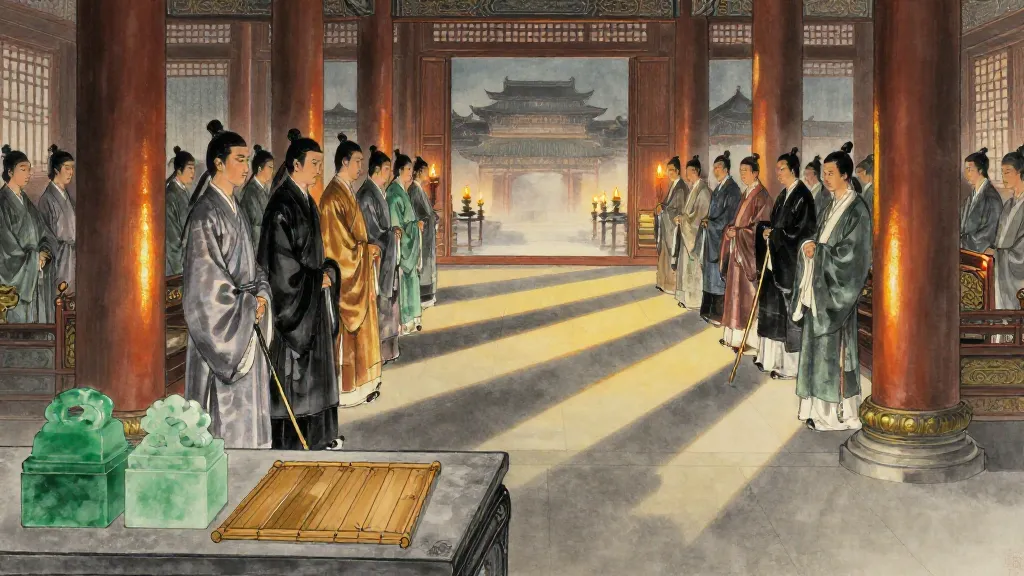
蕭相國世家 (Hereditary House of Chancellor Xiao) — Chinese ink painting

Chapter 53 of 130

蕭相國世家

Hereditary House of Chancellor Xiao

View:

蕭何早年與收秦圖書

Xiao He's Early Career and the Seizure of the Qin Archives

蕭相國何者,沛豐人也。以文無害為沛主吏掾。

高祖為布衣時,何數以吏事護高祖。高祖為亭長,常左右之。高祖以吏繇鹹陽,吏皆送奉錢三,何獨以五。

秦御史監郡者與從事,常辨之。何乃給泗水卒史事,第一。秦御史欲入言徵何,何固請,得毋行。

及高祖起為沛公,何常為丞督事。沛公至鹹陽,諸將皆爭走金帛財物之府分之,何獨先入收秦丞相御史律令圖書藏之。沛公為漢王,以何為丞相。項王與諸侯屠燒鹹陽而去。漢王所以具知天下戹塞,戶口多少,彊弱之處,民所疾苦者,以何具得秦圖書也。何進言韓信,漢王以信為大將軍。語在淮陰侯事中。

Chancellor Xiao He was a man of Feng in Pei. He served as Chief Clerk of Pei because of his skill in legal documents and his irreproachable character.

When the future Emperor Gaozu was still a commoner, Xiao He repeatedly used his official position to shield him. When Gaozu became a Pavilion Chief, He was constantly at his side. When Gaozu was sent as an official escort on corvee duty to Xianyang, every clerk gave him three cash as a farewell gift — He alone gave five.

The Qin Censor overseeing the commandery worked alongside He and was always impressed by his ability. He ranked first among the clerks of Sishui commandery. The Censor wished to recommend He for promotion to the capital, but He firmly declined and managed to stay.

When Gaozu rose as the Lord of Pei, He constantly served as his assistant overseeing administration. When the Lord of Pei entered Xianyang, all the other generals raced to the treasuries to divide up gold, silk, and valuables. He alone went first to the offices of the Qin chancellor and censor, seized the legal codes, ordinances, maps, and census records, and secured them. When the Lord of Pei became King of Han, he made He his chancellor. When the Hegemon-King and the other lords sacked and burned Xianyang and departed, the reason the King of Han was able to know in complete detail every strategic pass and chokepoint in the realm, the population of every district, the distribution of strength and weakness, and the grievances of the common people — this was because He had obtained the complete Qin archives. He recommended Han Xin, and the King of Han appointed Xin as Grand General. The details are in the account of the Marquis of Huaiyin.

Notes

1person蕭何Xiāo Hé

Xiao He (蕭何, d. 193 BC) was a native of Feng in the county of Pei (modern Feng County, Jiangsu). He served as Emperor Gaozu's chief administrator throughout the founding of the Han dynasty, managing logistics, drafting laws, and maintaining the home front. He is counted as the foremost of the 'Three Heroes of the early Han' alongside Zhang Liang and Han Xin.

2context

Xiao He's seizure of the Qin administrative archives while others looted treasure was perhaps the single most consequential logistical act in the founding of the Han. The maps, census records, and legal codes gave Liu Bang an unmatched information advantage over all his rivals, including Xiang Yu.

3place

Pei (沛) was a county in what is now Pei County, Jiangsu province. It was the hometown of Liu Bang and many of his key followers, including Xiao He, Cao Shen, and Fan Kuai.

蕭何守關中供給前線

Xiao He Guards Guanzhong and Supplies the Front

漢王引兵東定三秦,何以丞相留收巴蜀,填撫諭告,使給軍食。漢二年,漢王與諸侯擊楚,何守關中,侍太子,治櫟陽。為法令約束,立宗廟社稷宮室縣邑,輒奏上,可,許以從事;即不及奏上,輒以便宜施行,上來以聞。關中事計戶口轉漕給軍,漢王數失軍遁去,何常興關中卒,輒補缺。上以此專屬任何關中事。

漢三年,漢王與項羽相距京索之間,上數使使勞苦丞相。鮑生謂丞相曰:“王暴衣露蓋,數使使勞苦君者,有疑君心也。為君計,莫若遣君子孫昆弟能勝兵者悉詣軍所,上必益信君。“於是何從其計,漢王大說。

The King of Han led his army east to pacify the Three Qin. He, as chancellor, remained behind to consolidate Ba and Shu, pacifying the people with assurances and proclamations, and ensuring a steady supply of provisions for the army. In the second year, the King of Han joined the other lords in attacking Chu. He guarded Guanzhong, attended the heir apparent, and administered from Liyang. He drafted laws and regulations, established ancestral temples, state altars, palaces, and administrative districts. In each case he submitted proposals for approval; if approved, he proceeded. If there was no time to submit for approval, he acted on his own authority and informed the king after the fact. In Guanzhong he registered households, organized grain transport by water, and supplied the army. When the King of Han repeatedly lost his forces and fled, He would raise fresh troops from Guanzhong to fill the gaps. For this reason, the king entrusted all Guanzhong affairs exclusively to He.

In the third year, the King of Han and Xiang Yu were locked in confrontation between Jing and Suo. The king repeatedly sent messengers to convey his regards to the chancellor. A man named Bao Sheng said to the chancellor: "The king is exposed to wind and rain in the field, yet he keeps sending messengers to inquire after you — this means he suspects you. My advice: send every one of your sons, brothers, and kinsmen capable of bearing arms to join the king's army. His trust in you will deepen." He followed this advice, and the King of Han was greatly pleased.

Notes

1place

Guanzhong (關中, 'within the passes') refers to the Wei River valley in modern Shaanxi, bounded by strategic passes on all sides. It served as the Han dynasty's base of power, just as it had for the Qin.

2place

Ba (巴) and Shu (蜀) were regions in modern Sichuan province. They formed the Han's strategic rear, providing grain and manpower for the Chu-Han war.

3context

Bao Sheng's advice reflects a recurring theme in the early Han: the tension between a ruler dependent on his officials and his suspicion of their growing power. Sending family members to the front as hostages was a standard way to demonstrate loyalty.

論功行封:蕭何第一

Ranking Merit: Xiao He Is Placed First

漢五年,既殺項羽,定天下,論功行封。群臣爭功,歲餘功不決。高祖以蕭何功最盛,封為酇侯,所食邑多。功臣皆曰:“臣等身被堅執銳,多者百餘戰,少者數十合,攻城略地,大小各有差。今蕭何未嘗有汗馬之勞,徒持文墨議論,不戰,顧反居臣等上,何也?“高帝曰:“諸君知獵乎?“曰:“知之。”“知獵狗乎?“曰:“知之。“高帝曰:“夫獵,追殺獸兔者狗也,而發蹤指示獸處者人也。今諸君徒能得走獸耳,功狗也。至如蕭何,發蹤指示,功人也。且諸君獨以身隨我,多者兩三人。今蕭何舉宗數十人皆隨我,功不可忘也。“群臣皆莫敢言。

列侯畢已受封,及奏位次,皆曰:“平陽侯曹參身被七十創,攻城略地,功最多,宜第一。“上已橈功臣,多封蕭何,至位次未有以復難之,然心欲何第一。關內侯鄂君進曰:“群臣議皆誤。夫曹參雖有野戰略地之功,此特一時之事。夫上與楚相距五歲,常失軍亡眾,逃身遁者數矣。然蕭何常從關中遣軍補其處,非上所詔令召,而數萬眾會上之乏絕者數矣。夫漢與楚相守滎陽數年,軍無見糧,蕭何轉漕關中,給食不乏。陛下雖數亡山東,蕭何常全關中以待陛下,此萬世之功也。今雖亡曹參等百數,何缺於漢?漢得之不必待以全。柰何欲以一旦之功而加萬世之功哉!蕭何第一,曹參次之。“高祖曰:“善。“於是乃令蕭何,賜帶劍履上殿,入朝不趨。

In the fifth year, after Xiang Yu was killed and All-Under-Heaven was settled, the emperor assessed merit and conferred fiefs. The ministers disputed each other's contributions for over a year without resolution. Gaozu judged Xiao He's merit the greatest and enfeoffed him as Marquis of Zan with the largest revenue estate. The other meritorious ministers protested: "We have personally worn armor and wielded weapons — the most battle-tested among us have fought over a hundred engagements, the least several dozen — storming cities and seizing territory, each with proportional achievement. Yet Xiao He has never broken a sweat on horseback. He merely held a brush and engaged in discussion, never fighting a battle. How is it that he ranks above us all?" Emperor Gaozu said: "Do you gentlemen know about hunting?" "We do." "Do you know about hunting dogs?" "We do." The Emperor said: "In a hunt, it is the dog that chases down and kills the prey, but it is the man who detects the trail and points out where the quarry lies. Now, you gentlemen can only catch the running game — you are the dogs of merit. As for Xiao He, he found the trail and pointed the way — he is the man of merit. Moreover, each of you followed me with at most two or three kinsmen. Xiao He sent his entire clan of several dozen people to join me. This must not be forgotten." None of the ministers dared speak further.

After all the marquises had received their fiefs, the question of precedence arose. Everyone said: "The Marquis of Pingyang, Cao Shen, sustained seventy wounds, and his record of storming cities and seizing territory is unmatched — he should be ranked first." The Emperor had already overridden the meritorious officials by giving Xiao He the largest fief, and now at the question of rank he had no further grounds to challenge them — yet in his heart he wanted He placed first. The Marquis Within the Passes, Lord E, stepped forward and said: "The ministers' judgment is entirely wrong. Cao Shen may have the merit of field battles and territorial conquest, but these are achievements of the moment. His Majesty fought Chu for five years, repeatedly losing his army and his followers, fleeing alone more than once. Yet Xiao He always sent reinforcements from Guanzhong to fill the gaps — tens of thousands of troops arriving at the point of exhaustion, without any imperial summons, time after time. When the Han and Chu were deadlocked at Xingyang for years and the army had no visible grain supply, Xiao He organized water transport from Guanzhong and the provisions never ran out. Though Your Majesty lost the east of the mountains time and again, Xiao He always held Guanzhong intact, waiting for Your Majesty. This is merit for ten thousand generations. Even if you lost a hundred Cao Shens, what would the Han lack? The Han could survive without them. How can you place the merit of a single day above the merit of ten thousand generations? Xiao He must be first, Cao Shen second." Gaozu said: "Excellent." He thereupon decreed that Xiao He be granted the privilege of wearing his sword and shoes into the audience hall, and of entering court without hurrying.

Notes

1translation

The hunting metaphor of 功狗 ('dogs of merit') versus 功人 ('man of merit') became one of the most famous analogies in Chinese political discourse, distinguishing between those who execute and those who strategize.

2person鄂君È Jūn

Lord E (鄂君), formally the Marquis Within the Passes of E, was a minor noble whose intervention proved decisive. Emperor Gaozu had been unable to override his generals' consensus; Lord E provided the argument he needed.

3context

The privileges granted — wearing sword and shoes in the audience hall and not having to hurry (趨, the formal quick-step) when approaching the throne — were the highest honors a Han subject could receive, previously associated only with the Grand Duke of Qi.

蕭何進封與召平之諫

Xiao He's Further Honors and Zhao Ping's Warning

上曰:“吾聞進賢受上賞。蕭何功雖高,得鄂君乃益明。“於是因鄂君故所食關內侯邑封為安平侯。是日,悉封何父子兄弟十餘人,皆有食邑。乃益封何二千戶,以帝嘗繇鹹陽時何送我獨贏錢二也。

漢十一年,陳豨反,高祖自將,至邯鄲。未罷,淮陰侯謀反關中,呂后用蕭何計,誅淮陰侯,語在淮陰事中。上已聞淮陰侯誅,使使拜丞相何為相國,益封五千戶,令卒五百人一都尉為相國衛。諸君皆賀,召平獨吊。召平者,故秦東陵侯。秦破,為布衣,貧,種瓜於長安城東,瓜美,故世俗謂之“東陵瓜”,從召平以為名也。召平謂相國曰:“禍自此始矣。上暴露於外而君守於中,非被矢石之事而益君封置衛者,以今者淮陰侯新反於中,疑君心矣。夫置衛衛君,非以寵君也。原君讓封勿受,悉以家私財佐軍,則上心說。“相國從其計,高帝乃大喜。

The Emperor said: "I have heard that he who recommends a worthy man deserves the highest reward. Xiao He's merit, though great, was made all the clearer thanks to Lord E." He therefore converted Lord E's existing Marquis Within the Passes estate to make him the Marquis of Anping. That same day, over ten members of He's family — sons and brothers — were all enfeoffed with revenue estates. He further increased He's fief by two thousand households, on the grounds that when the Emperor had once been escorted to Xianyang on corvee duty, He alone had given him two extra cash.

In the eleventh year, Chen Xi rebelled and Gaozu personally led the campaign, reaching Handan. Before the campaign was concluded, the Marquis of Huaiyin plotted rebellion in Guanzhong. Empress Lü used Xiao He's stratagem to lure and execute the Marquis of Huaiyin — the details are in the account of the Marquis of Huaiyin. When the Emperor heard that the Marquis of Huaiyin had been executed, he sent a messenger to promote Chancellor He to Chancellor of State, increase his fief by five thousand households, and assign five hundred soldiers under a commandant as his personal guard. All the ministers congratulated him. Zhao Ping alone offered condolences. Zhao Ping was the former Marquis of Dongling under Qin. After Qin fell, he became a commoner, poor, growing melons east of Chang'an. His melons were so fine that people called them "Dongling melons" after him. Zhao Ping said to the Chancellor of State: "Your disaster begins now. The Emperor is exposed to danger in the field while you guard the interior. You have faced no arrows or stones, yet he increases your fief and assigns you a guard — this is because the Marquis of Huaiyin has just rebelled from within, and he suspects your heart. The guard assigned to protect you is not meant to honor you. I urge you to decline the fief and donate your entire personal fortune to support the army. Then the Emperor's heart will be at ease." The Chancellor of State followed this advice, and Emperor Gaozu was greatly pleased.

Notes

1person召平Zhào Píng

Zhao Ping (召平) was the former Marquis of Dongling (東陵侯) under the Qin dynasty. After the fall of Qin, he became a melon farmer — his 'Dongling melons' became legendary. His political wisdom, born of having witnessed the fall of one dynasty, saved Xiao He from destruction.

2context

The promotion from 丞相 (Chancellor) to 相國 (Chancellor of State) was the highest civil office in the Han. Zhao Ping's insight — that the promotion was a trap born of suspicion, not genuine favor — reflects the lethal dynamics of the early Han court where every meritorious subject was a potential threat.

蕭何自汙與入獄

Xiao He Tarnishes His Reputation and Is Imprisoned

漢十二年秋,黥布反,上自將擊之,數使使問相國何為。相國為上在軍,乃拊循勉力百姓,悉以所有佐軍,如陳豨時。客有說相國曰:“君滅族不久矣。夫君位為相國,功第一,可復加哉?然君初入關中,得百姓心,十餘年矣,皆附君,常復孳孳得民和。上所為數問君者,畏君傾動關中。今君胡不多買田地,賤貰貸以自汙?上心乃安。“於是相國從其計,上乃大說。

上罷布軍歸,民道遮行上書,言相國賤彊買民田宅數千萬。上至,相國謁。上笑曰:“夫相國乃利民!“民所上書皆以與相國,曰:“君自謝民。“相國因為民請曰:“長安地狹,上林中多空地,棄,原令民得入田,毋收為禽獸食。“上大怒曰:“相國多受賈人財物,乃為請吾苑!“乃下相國廷尉,械繫之。數日,王衛尉侍,前問曰:“相國何大罪,陛下系之暴也?“上曰:“吾聞李斯相秦皇帝,有善歸主,有惡自與。今相國多受賈豎金而為民請吾苑,以自媚於民,故系治之。“王衛尉曰:“夫職事苟有便於民而請之,真宰相事,陛下柰何乃疑相國受賈人錢乎!且陛下距楚數歲,陳豨、黥布反,陛下自將而往,當是時,相國守關中,搖足則關以西非陛下有也。相國不以此時為利,今乃利賈人之金乎?且秦以不聞其過亡天下,李斯之分過,又何足法哉。陛下何疑宰相之淺也。“高帝不懌。是日,使使持節赦出相國。相國年老,素恭謹,入,徒跣謝。高帝曰:“相國休矣!相國為民請苑,吾不許,我不過為桀紂主,而相國為賢相。吾故系相國,欲令百姓聞吾過也。”

In the autumn of the twelfth year, Qing Bu rebelled. The Emperor personally led the campaign, repeatedly sending messengers to ask what the Chancellor of State was doing. Since the Emperor was in the field, the Chancellor of State soothed and encouraged the people, devoting all his resources to supporting the army, just as during the Chen Xi rebellion. A retainer said to the Chancellor of State: "Your clan's extermination is not far off. You hold the highest office, ranked first in merit — how can anything more be added? Yet ever since you first entered Guanzhong, you have won the people's hearts. For over ten years they have all been devoted to you, and you ceaselessly cultivate their goodwill. The reason the Emperor keeps asking what you are doing is that he fears you could turn Guanzhong against him. Why not buy up large amounts of farmland at exploitative prices and on usurious terms, to soil your reputation? Then the Emperor's heart will be at peace." The Chancellor of State followed this advice, and the Emperor was greatly pleased.

When the Emperor returned from the campaign against Qing Bu, the people lined the road and submitted petitions accusing the Chancellor of State of buying their fields and houses by coercion for tens of millions in cash. When the Emperor arrived, the Chancellor of State came to greet him. The Emperor laughed: "So the Chancellor of State profits the people!" He handed all the petitions to the Chancellor of State, saying: "Settle this with the people yourself." The Chancellor of State then took the opportunity to petition on the people's behalf: "The land around Chang'an is cramped. There is much empty land in the Shanglin Park, lying fallow. I ask that the people be permitted to farm it, and that the harvest not be collected, leaving the straw for the park animals." The Emperor flew into a rage: "The Chancellor of State has taken money from merchants and now petitions for my hunting park!" He had the Chancellor of State sent to the Commandant of Justice and clapped in irons. After several days, the Commandant of the Guard, Wang, was in attendance and asked: "What great crime has the Chancellor of State committed that Your Majesty imprisons him so harshly?" The Emperor said: "I have heard that when Li Si served as chancellor to the First Emperor of Qin, he attributed all good to his master and took all blame upon himself. Now the Chancellor of State takes merchants' money and petitions for my park — to ingratiate himself with the people at my expense. That is why I have imprisoned him." The Commandant of the Guard replied: "If an official sees something that would benefit the people and petitions for it, that is precisely what a true chancellor should do. How can Your Majesty suspect him of taking merchants' money! Moreover, when Your Majesty fought Chu for years, and when Chen Xi and Qing Bu rebelled and Your Majesty personally led the campaigns, the Chancellor of State guarded Guanzhong. Had he merely tapped his foot, everything west of the passes would have ceased to be yours. He did not seize that opportunity for profit — would he now sell himself for merchants' gold? Furthermore, Qin lost All-Under-Heaven precisely because it never heard criticism of its faults. Li Si's practice of deflecting blame is hardly worth emulating. How can Your Majesty harbor such shallow suspicions of your chancellor?" Gaozu was displeased but that same day sent a messenger bearing the imperial staff to pardon and release the Chancellor of State. The Chancellor of State was old and had always been deferential. He entered barefoot to offer his apologies. Gaozu said: "Let the Chancellor of State be at ease! You petitioned for the park on the people's behalf. I refused. This makes me no better than a Jie or Zhou tyrant, and you a worthy chancellor. I deliberately imprisoned you so that the people would hear of my fault."

Notes

1context

The Shanglin Park (上林苑) was a vast imperial hunting preserve southwest of Chang'an, inherited from the Qin dynasty. Emperor Wu would later expand it enormously. Xiao He's petition to open it for farming was the proximate cause of his imprisonment.

2person李斯Lǐ Sī

Li Si (李斯, d. 208 BC) was the powerful chancellor of the First Emperor of Qin. His practice of 'attributing good to the master, taking blame himself' (有善歸主,有惡自與) became a byword for sycophancy. Gaozu's invocation of Li Si as a model reveals the contradictions of his own paranoia.

3translation

Gaozu's final words are deeply ironic. By claiming he imprisoned his chancellor deliberately to make himself look bad, he retroactively reframes an act of paranoid cruelty as a calculated display of humility. Sima Qian presents this without comment, leaving the reader to judge.

蕭何薦曹參與身後

Xiao He Recommends Cao Shen and His Legacy

何素不與曹參相能,及何病,孝惠自臨視相國病,因問曰:“君即百歲後,誰可代君者?“對曰:“知臣莫如主。“孝惠曰:“曹參何如?“何頓首曰:“帝得之矣!臣死不恨矣!”

何置田宅必居窮處,為家不治垣屋。曰:“後世賢,師吾儉;不賢,毋為勢家所奪。”

孝惠二年,相國何卒,謚為文終侯。

後嗣以罪失侯者四世,絕,天子輒復求何後,封續酇侯,功臣莫得比焉。

He and Cao Shen had never been on good terms. When He fell ill, Emperor Hui personally came to visit the Chancellor of State and asked: "When you are gone, who can take your place?" He replied: "No one knows his ministers better than the sovereign." Emperor Hui said: "What about Cao Shen?" He bowed his head to the ground: "Your Majesty has found the man! I can die without regret!"

Whenever He purchased land or houses, he always chose the poorest locations. He built his family residence without decorating the walls. He said: "If my descendants are worthy, they will emulate my frugality. If they are unworthy, at least the property will not be worth seizing by powerful families."

In the second year of Emperor Hui, Chancellor of State He died. He was given the posthumous title Marquis Wenzhong — "the Cultured and Complete."

In later generations, his heirs lost the marquisate four times through criminal offenses. Each time, the Son of Heaven sought out He's descendants and restored the succession of the Marquis of Zan. No other meritorious minister's line received comparable treatment.

Notes

1person曹參Cáo Shēn

Cao Shen (曹參, d. 190 BC), Marquis of Pingyang, succeeded Xiao He as Chancellor of State. Despite their personal rivalry, He recognized Cao Shen as the only man capable of continuing his work — a testament to He's integrity.

2translation

The posthumous title 文終 (Wenzhong, 'Cultured and Complete') combines 文 (civil accomplishment, culture) with 終 (completion, bringing to fulfillment) — indicating one who perfected the work of civil governance.

太史公論贊

The Grand Historian's Appraisal

太史公曰:蕭相國何於秦時為刀筆吏,錄錄未有奇節。及漢興,依日月之末光,何謹守管籥,因民之疾法,順流與之更始。淮陰、黥布等皆以誅滅,而何之勛爛焉。位冠群臣,聲施後世,與閎夭、散宜生等爭烈矣。

蕭何為吏,文而無害。及佐興王,舉宗從沛。關中既守,轉輸是賴。漢軍屢疲,秦兵必會。約法可久,收圖可大。指獸發蹤,其功實最。政稱畫一,居乃非泰。繼絕寵勤,式旌礪帶。

The Grand Historian remarks: Xiao He, when he served under Qin, was a mere clerk of brush and knife — ordinary, with nothing remarkable about him. But when the Han rose, basking in the last rays of the sun and moon, He carefully guarded the keys of state, taking account of the people's resentment of the law, going with the current to give them a fresh start. Han Xin, Qing Bu, and the rest were all destroyed, yet He's glory blazes on. He ranked above all ministers, and his reputation has echoed through the ages, rivaling such ancients as Hong Yao and San Yisheng.

Xiao He as a clerk was cultured and blameless. When he helped found the dynasty, his whole clan followed from Pei. He guarded Guanzhong, and the army depended on his supply trains. When Han forces were exhausted, Qin-region troops would always arrive. His simplified laws were built to last; his seizure of the archives bore immeasurable fruit. Pointing out the quarry, tracking the trail — his merit was truly the greatest. His governance was uniform and consistent; his household was far from extravagant. Restoring the broken line, honoring diligence — a standard and sash for all to emulate.

Notes

1translation

刀筆吏 ('clerk of knife and brush') refers to a minor Qin bureaucrat. The 'knife' was used to scrape corrections on bamboo strips; the 'brush' for writing. 錄錄 means unremarkable or mediocre. Sima Qian emphasizes the contrast between He's humble origins and his epochal contribution.

2context

Hong Yao (閎夭) and San Yisheng (散宜生) were ministers of King Wen of Zhou who helped ransom him from Shang captivity. By comparing Xiao He to these ancient worthies, Sima Qian places him in the highest tier of loyal ministers in Chinese history.

Edition & Source

Text
《史記》 Shiji
Edition
中華古詩文古書籍網 transcription
Commentary
裴駰《史記集解》、司馬貞《史記索隱》、張守節《史記正義》(Three Commentaries)