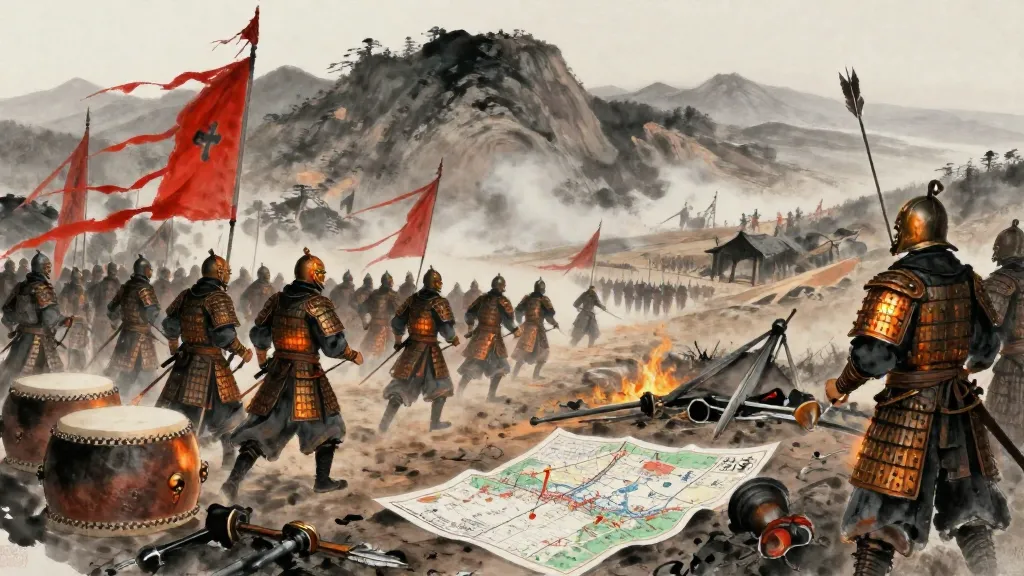
曹相國世家 (Hereditary House of Chancellor Cao) — Chinese ink painting

Chapter 54 of 130

曹相國世家

Hereditary House of Chancellor Cao

View:

曹參從沛公擊秦

Cao Shen Follows the Lord of Pei Against Qin

平陽侯曹參者,沛人也。秦時為沛獄掾,而蕭何為主吏,居縣為豪吏矣。

高祖為沛公而初起也,參以中涓從。將擊胡陵、方與,攻秦監公軍,大破之。東下薛,擊泗水守軍薛郭西。復攻胡陵,取之。徙守方與。方與反為魏,擊之。豐反為魏,攻之。賜爵七大夫。擊秦司馬枿軍碭東,破之,取碭、狐父、祁善置。又攻下邑以西,至虞,擊章邯車騎。攻爰戚及亢父,先登。遷為五大夫。北救阿,擊章邯軍,陷陳,追至濮陽。攻定陶,取臨濟。南救雍丘。擊李由軍,破之,殺李由,虜秦候一人。秦將章邯破殺項梁也,沛公與項羽引而東。楚懷王以沛公為碭郡長,將碭郡兵。於是乃封參為執帛,號曰建成君。遷為戚公,屬碭郡。

Cao Shen, Marquis of Pingyang, was a man of Pei. Under Qin, he served as a prison clerk in Pei, while Xiao He was the chief clerk — both were already prominent officials of the county.

When Gaozu first rose as the Lord of Pei, Shen followed him as a body servant. He led attacks on Huling and Fangyu, assaulting the army of the Qin Overseer and routing it completely. Moving east, he took Xue, engaging the army of the Governor of Sishui west of Xue's outer wall. He attacked Huling again and took it. He was transferred to defend Fangyu. When Fangyu went over to Wei, he attacked it. When Feng went over to Wei, he attacked that too. He was granted the rank of Seventh Grand Master. He struck the army of the Qin Marshal Nie east of Dang, defeating it, and took Dang, Hufu, and Qishanchi. He attacked from Xiayi westward to Yu, engaging Zhang Han's chariots and cavalry. He assaulted Yuanqi and Kangfu, being the first to scale the walls. He was promoted to Fifth Grand Master. He marched north to relieve Ah, attacked Zhang Han's army, broke through the enemy formation, and pursued them to Puyang. He assaulted Dingtao and took Linji. He marched south to relieve Yongqiu, attacked the army of Li You, routed it, killed Li You, and captured one Qin lord. When the Qin general Zhang Han defeated and killed Xiang Liang, the Lord of Pei and Xiang Yu withdrew eastward. King Huai of Chu appointed the Lord of Pei as Governor of Dang commandery, commanding Dang's troops. Shen was then enfeoffed as Holder of Silk, with the title Lord of Jiancheng, and transferred to be Lord of Qi, attached to Dang commandery.

Notes

1person曹參Cáo Shēn

Cao Shen (曹參, d. 190 BC) was one of the founding generals of the Han dynasty, second only to Xiao He in the ranking of merit. He later became Chancellor of State, famous for his policy of 'doing nothing' (wu wei) in governance.

2person章邯Zhāng Hán

Zhang Han (章邯, d. 205 BC) was the last great Qin general. He defeated multiple rebel forces, including killing Xiang Liang, before surrendering to Xiang Yu at the Battle of Julu. Xiang Yu later buried his 200,000 surrendered troops alive.

3person李由Lǐ Yóu

Li You (李由) was the son of Chancellor Li Si and served as Governor of Sanchuan commandery for Qin. His death at Cao Shen's hands was a significant blow to Qin's defense of the eastern regions.

西征入關滅秦

The Westward Campaign: Entering the Passes and Destroying Qin

其後從攻東郡尉軍,破之成武南。擊王離軍成陽南,復攻之槓里,大破之。追北,西至開封,擊趙賁軍,破之,圍趙賁開封城中。西擊將楊熊軍於曲遇,破之,虜秦司馬及御史各一人。遷為執珪。從攻陽武,下轘轅、緱氏,絕河津,還擊趙賁軍屍北,破之。從南攻犨,與南陽守齮戰陽城郭東,陷陳,取宛,虜齮,盡定南陽郡。從西攻武關、嶢關,取之。前攻秦軍藍田南,又夜擊其北,秦軍大破,遂至鹹陽,滅秦。

Subsequently, he followed the campaign against the forces of the Commandant of Dongjun, routing them south of Chengwu. He struck Wang Li's army south of Chengyang, attacked again at Gangli, and inflicted a crushing defeat. Pursuing the fleeing enemy westward to Kaifeng, he engaged Zhao Ben's army, defeated it, and besieged Zhao Ben inside Kaifeng city. Moving west, he struck General Yang Xiong's army at Quyu, defeated it, and captured a Qin Marshal and a Censor, one each. He was promoted to the rank of Holder of the Jade Tablet. He joined the attack on Yangwu, took the Huanyuan and Goushi passes, cut the Yellow River ferry crossings, then turned back to strike Zhao Ben's army north of Shi, defeating it. He marched south to attack Chou, engaged the Governor of Nanyang, Qi, at the eastern wall of Yangcheng, broke through the formation, took Wan, captured Qi, and pacified the entire Nanyang commandery. He then marched west to attack Wuguan and Yaoguan, taking both. He led the assault on the Qin army south of Lantian, then attacked its northern flank by night. The Qin army was utterly shattered, and they advanced to Xianyang, extinguishing the Qin dynasty.

Notes

1person王離Wáng Lí

Wang Li (王離) was a Qin general and grandson of the great general Wang Jian. He was eventually captured by Xiang Yu at the Battle of Julu.

2place

Lantian (藍田) was the last defensive position before Xianyang, located southeast of modern Xi'an, Shaanxi. The double attack — south by day, north by night — was the decisive engagement that ended Qin resistance.

還定三秦與彭城之敗

Pacifying the Three Qin and the Defeat at Pengcheng

項羽至,以沛公為漢王。漢王封參為建成侯。從至漢中,遷為將軍。從還定三秦,初攻下辯、故道、雍、斄。擊章平軍於好畤南,破之,圍好畤,取壤鄉。擊三秦軍壤東及高櫟,破之。復圍章平,章平出好畤走。因擊趙賁、內史保軍,破之。東取鹹陽,更名曰新城。參將兵守景陵二十日,三秦使章平等攻參,參出擊,大破之。賜食邑於寧秦。參以將軍引兵圍章邯於廢丘。以中尉從漢王出臨晉關。至河內,下脩武,渡圍津,東擊龍且、項他定陶,破之。東取碭、蕭、彭城。擊項籍軍,漢軍大敗走。參以中尉圍取雍丘。王武反於黃,程處反於燕,往擊,盡破之。柱天侯反於衍氏,又進破取衍氏。擊羽嬰於昆陽,追至葉。還攻武彊,因至滎陽。參自漢中為將軍中尉,從擊諸侯,及項羽敗,還至滎陽,凡二歲。

When Xiang Yu arrived, he made the Lord of Pei King of Han. The King of Han enfeoffed Shen as Marquis of Jiancheng. Shen followed to Hanzhong and was promoted to general. He followed the campaign to pacify the Three Qin, first attacking Xiabian, Gudao, Yong, and Tai. He struck Zhang Ping's army south of Haozhi, defeated it, besieged Haozhi, and took Rangxiang. He struck the Three Qin armies east of Rang and at Gaoli, defeating them. He besieged Zhang Ping again; Zhang Ping fled Haozhi. He then struck the armies of Zhao Ben and Prefect Bao, defeating them. He took Xianyang in the east, which was renamed Xincheng. Shen held Jingling with his troops for twenty days. The Three Qin sent Zhang Ping and others to attack; Shen sallied forth and routed them. He was given a revenue estate at Ningqin. As general, Shen led troops to besiege Zhang Han at Feiqu. As Commandant of the Center, he followed the King of Han out through Linjin Pass. They reached Henei, took Xiuwu, crossed at Weijin, and struck east against Long Qie and Xiang Ta at Dingtao, defeating them. They took Dang, Xiao, and Pengcheng in the east. They engaged Xiang Ji's army — the Han army suffered a catastrophic defeat and fled. As Commandant of the Center, Shen besieged and took Yongqiu. When Wang Wu rebelled at Huang and Cheng Chu at Yan, he marched against them and crushed them all. When the Marquis Pillar-of-Heaven rebelled at Yanshi, he advanced to take Yanshi. He struck Yu Ying at Kunyang, pursuing to Ye. He returned to attack Wuqiang, then proceeded to Xingyang. From the time Shen served as general and commandant after leaving Hanzhong, following the campaigns against the various lords until Xiang Yu's defeat, returning to Xingyang — it was two full years.

Notes

1place

Feiqu (廢丘) was the capital of Zhang Han's Yong kingdom, one of the Three Qin states created by Xiang Yu. Its fall ended Qin loyalist resistance in the Wei River valley. Located near modern Xingping, Shaanxi.

2context

The defeat at Pengcheng (彭城之敗, 205 BC) was one of Gaozu's worst disasters. Xiang Yu, with only 30,000 cavalry, shattered a coalition army of over 500,000. The Han survivors, including Cao Shen, were scattered across the eastern plain.

從韓信破魏趙齊

Serving Under Han Xin to Defeat Wei, Zhao, and Qi

高祖年,拜為假左丞相,入屯兵關中。月餘,魏王豹反,以假左丞相別與韓信東攻魏將軍孫軍東張,大破之。因攻安邑,得魏將王襄。擊魏王於曲陽,追至武垣,生得魏王豹。取平陽,得魏王母妻子,盡定魏地,凡五十二城。賜食邑平陽。因從韓信擊趙相國夏說軍於鄔東,大破之,斬夏說。韓信與故常山王張耳引兵下井陘,擊成安君,而令參還圍趙別將戚將軍於鄔城中。戚將軍出走,追斬之。乃引兵詣敖倉漢王之所。韓信已破趙,為相國,東擊齊。參以右丞相屬韓信,攻破齊歷下軍,遂取臨菑。還定濟北郡,攻著、漯陰、平原、鬲、盧。已而從韓信擊龍且軍於上假密,大破之,斬龍且,虜其將軍周蘭。定齊,凡得七十餘縣。得故齊王田廣相田光,其守相許章,及故齊膠東將軍田既。韓信為齊王,引兵詣陳,與漢王共破項羽,而參留平齊未服者。

In the third year of Gaozu, Shen was appointed Acting Left Chancellor and sent to garrison Guanzhong. After a little over a month, King Bao of Wei rebelled. As Acting Left Chancellor, Shen was detached to join Han Xin in the eastern campaign, attacking Wei General Sun's army at Dongzhang and routing it. He then assaulted Anyi and captured Wei General Wang Xiang. He struck the King of Wei at Quyang, pursued him to Wuyuan, and captured King Bao alive. He took Pingyang, captured the King of Wei's mother, wife, and children, and pacified the entire Wei territory — fifty-two cities in all. He was awarded a revenue estate at Pingyang. He then followed Han Xin to attack Zhao Chancellor Xia Shuo's army east of Wu, inflicting a devastating defeat and beheading Xia Shuo. Han Xin and the former King of Changshan, Zhang Er, led their forces down through Jingxing Pass to attack the Lord of Cheng'an, while ordering Shen to return and besiege the Zhao subordinate commander, General Qi, inside Wu city. General Qi fled; Shen pursued and beheaded him. He then led his troops to the Ao Granary to rejoin the King of Han. Han Xin, having defeated Zhao and been appointed Chancellor of State, marched east against Qi. Shen, as Right Chancellor, was attached to Han Xin's command. They smashed the Qi army at Lixia and took Linzi. Shen turned to pacify Jibei commandery, attacking Zhu, Taoyin, Pingyuan, Ge, and Lu. He then followed Han Xin to strike Long Qie's army at Shangjami, crushing it, beheading Long Qie, and capturing his general Zhou Lan. They pacified Qi in full — over seventy counties. They captured the chancellor of the former King of Qi, Tian Guang, the garrison chancellor Xu Zhang, and the former Jiaodong General Tian Ji. Han Xin became King of Qi and led his troops to Chen to join the King of Han in the final destruction of Xiang Yu, while Shen remained behind to pacify those in Qi who had not yet submitted.

Notes

1person韓信Hán Xìn

Han Xin (韓信, d. 196 BC), Marquis of Huaiyin, was the supreme military commander of the early Han. His campaign to conquer Wei, Zhao, Yan, and Qi in rapid succession is considered one of the greatest military achievements in Chinese history. Cao Shen served as his executive officer throughout.

2place

Jingxing (井陘) was a narrow mountain pass between Zhao and Han territories in modern Hebei. Han Xin's victory there, using the tactic of fighting with a river at his back to eliminate retreat, became one of the most studied battles in Chinese military history.

3person龍且Lóng Jū

Long Qie (龍且) was one of Xiang Yu's most trusted generals. His death at the Battle of Weishui (濰水) in 203 BC, where Han Xin used a dam-break flood to split the Chu army, effectively sealed Xiang Yu's fate by depriving him of his last major field army.

封侯相齊與戰功總計

Enfeoffment, Governance of Qi, and the Tally of Military Achievements

項籍已死,天下定,漢王為皇帝,韓信徙為楚王,齊為郡。參歸漢相印。高帝以長子肥為齊王,而以參為齊相國。以高祖六年賜爵列侯,與諸侯剖符,世世勿絕。食邑平陽萬六百三十戶,號曰平陽侯,除前所食邑。

以齊相國擊陳豨將張春軍,破之。黥布反,參以齊相國從悼惠王將兵車騎十二萬人,與高祖會擊黥布軍,大破之。南至蘄,還定竹邑、相、蕭、留。

參功:凡下二國,縣一百二十二;得王二人,相三人,將軍六人,大莫敖、郡守、司馬、候、御史各一人。

After Xiang Ji was killed and All-Under-Heaven was settled, the King of Han became emperor. Han Xin was transferred to be King of Chu, and Qi was converted to a commandery. Shen returned his Han chancellor's seal. Emperor Gaozu made his eldest son Fei King of Qi and appointed Shen as Chancellor of Qi. In the sixth year of Gaozu, Shen was granted the rank of full marquis, receiving a split tally shared with the lords, to be passed down in perpetuity. His revenue estate was Pingyang, with ten thousand six hundred and thirty households. He was titled Marquis of Pingyang, superseding all previous estates.

As Chancellor of Qi, he attacked the army of Zhang Chun, a general under Chen Xi, and defeated it. When Qing Bu rebelled, Shen, as Chancellor of Qi, accompanied King Daohui with a force of one hundred and twenty thousand infantry and cavalry to join Gaozu in striking Qing Bu's army, inflicting a devastating defeat. They advanced south to Qi, then returned to pacify Zhuyi, Xiang, Xiao, and Liu.

Shen's total military record: he conquered two kingdoms and one hundred and twenty-two counties; captured two kings, three chancellors, six generals, and one each of Grand Moao, commandery governor, marshal, marquis, and censor.

Notes

1context

The split tally (剖符) was a bronze credential divided between the emperor and the marquis, guaranteeing hereditary succession of the fief. The formula 'to be passed down in perpetuity' (世世勿絕) was the standard language of perpetual enfeoffment.

2translation

大莫敖 (Grand Moao) was a high military title of Chu origin. Its inclusion in the list of captured officials reflects the diverse state origins of the forces Cao Shen fought against.

相齊用黃老之術

Governing Qi with Huang-Lao Methods

孝惠帝元年,除諸侯相國法,更以參為齊丞相。參之相齊,齊七十城。天下初定,悼惠王富於春秋,參盡召長老諸生,問所以安集百姓,如齊故諸儒以百數,言人人殊,參未知所定。聞膠西有蓋公,善治黃老言,使人厚幣請之。既見蓋公,蓋公為言治道貴清靜而民自定,推此類具言之。參於是避正堂,舍蓋公焉。其治要用黃老術,故相齊九年,齊國安集,大稱賢相。

In the first year of Emperor Hui, the law governing the chancellors of vassal states was revised, and Shen was redesignated as Chancellor of Qi. As chancellor, Shen governed Qi's seventy cities. All-Under-Heaven had just been settled, and King Daohui was young. Shen summoned all the elders and scholars to ask how to pacify and settle the people. The old Confucian scholars of Qi numbered in the hundreds, and each gave a different answer. Shen did not know which to adopt. He heard that in Jiaoxi there was a Master Gai who was expert in Huang-Lao thought. He sent a generous gift to invite him. When they met, Master Gai expounded: "The essence of governance is to prize stillness and non-interference, and the people will settle themselves." He elaborated on this principle in full. Shen thereupon vacated the main hall and lodged Master Gai there. The core of his governance employed Huang-Lao methods. As a result, in nine years as chancellor of Qi, the kingdom was peaceful and settled, and he was widely hailed as a worthy chancellor.

Notes

1person蓋公Gài Gōng

Master Gai (蓋公) of Jiaoxi was a practitioner of Huang-Lao philosophy — the school of thought attributed to the Yellow Emperor and Laozi that emphasized non-interventionist governance (清靜無為). His influence on Cao Shen shaped the entire early Han governing philosophy.

2context

Huang-Lao (黃老) thought was the dominant political philosophy of the early Han dynasty. After the exhausting wars and harsh legalism of Qin, the founders adopted a policy of minimal governance, light taxation, and allowing the people to recover. This 'governance through non-action' (無為而治) lasted until Emperor Wu shifted to activist Confucianism.

代蕭何為漢相國

Succeeding Xiao He as Chancellor of State

惠帝二年,蕭何卒。參聞之,告舍人趣治行,“吾將入相”。居無何,使者果召參。參去,屬其後相曰:“以齊獄市為寄,慎勿擾也。“後相曰:“治無大於此者乎?“參曰:“不然。夫獄市者,所以並容也,今君擾之,奸人安所容也?吾是以先之。”

參始微時,與蕭何善;及為將相,有卻。至何且死,所推賢唯參。參代何為漢相國,舉事無所變更,一遵蕭何約束。

擇郡國吏木詘於文辭,重厚長者,即召除為丞相史。吏之言文刻深,欲務聲名者,輒斥去之。日夜飲醇酒。卿大夫已下吏及賓客見參不事事,來者皆欲有言。至者,參輒飲以醇酒,間之,欲有所言,復飲之,醉而後去,終莫得開說,以為常。

相舍後園近吏舍,吏舍日飲歌呼。從吏惡之,無如之何,乃請參遊園中,聞吏醉歌呼,從吏幸相國召按之。乃反取酒張坐飲,亦歌呼與相應和。

參見人之有細過,專掩匿覆蓋之,府中無事。

In the second year of Emperor Hui, Xiao He died. When Shen heard the news, he told his steward to prepare for the journey at once: "I am about to become chancellor." Before long, a messenger did indeed arrive to summon him. Before leaving, Shen instructed his successor as chancellor of Qi: "Treat the prisons and markets of Qi as your charge — take care not to disturb them." The successor said: "Is there no greater matter of governance than this?" Shen said: "It is not so simple. Prisons and markets are places that contain all sorts. If you meddle with them, where will the petty offenders find refuge? That is why I put this first."

When Shen was still of humble station, he and Xiao He had been close friends. When they rose to the ranks of general and chancellor, a rift developed. Yet when He was on his deathbed, the only man he recommended as worthy was Shen. Shen succeeded He as Chancellor of State of the Han. He changed nothing in any matter of policy, following Xiao He's regulations to the letter.

For his staff, he selected officials from the commanderies and kingdoms who were plain and inarticulate, steady and substantial men of mature character, and summoned them to serve as secretaries to the chancellor. Officials who spoke in sharp, legalistic language and sought to make a name for themselves he dismissed at once. Day and night he drank fine wine. When ministers, subordinate officials, and guests saw that Shen was doing nothing, they all came hoping to speak with him. But whenever anyone arrived, Shen would immediately ply them with strong wine. If they tried to find an opening to speak, he poured more wine until they were drunk and left. No one ever managed to open a discussion. This became his standard practice.

The garden behind the chancellor's residence was near the clerks' quarters. The clerks drank and sang boisterously every day. Shen's attendants found this offensive but could do nothing about it. They invited Shen to stroll in the garden, hoping that when he heard the clerks' drunken singing, he would summon and punish them. Instead, Shen sent for wine, set up seats for drinking, and joined in the singing, matching their songs.

Whenever Shen noticed someone had committed a minor offense, he would deliberately cover it up and conceal it. The chancellor's office had no business to conduct.

Notes

1translation

The doctrine of the prisons and markets (獄市) as places that 'contain all sorts' (並容) is Cao Shen's most famous political statement. It encapsulates the Huang-Lao philosophy: governance works best when it provides space for all elements of society, including minor transgressors, rather than trying to regulate everything.

2context

Cao Shen's deliberate policy of doing nothing and drinking all day was not incompetence but a philosophical position. By refusing to make new regulations, he prevented the bureaucracy from becoming oppressive — exactly what the war-weary people needed.

蕭規曹隨

Cao Follows Xiao's Rules

參子窋為中大夫。惠帝怪相國不治事,以為“豈少朕與”?乃謂窋曰:“若歸,試私從容問而父曰:'高帝新棄群臣,帝富於春秋,君為相,日飲,無所請事,何以憂天下乎?'然無言吾告若也。“窋既洗沐歸,間侍,自從其所諫參。參怒,而笞窋二百,曰:“趣入侍,天下事非若所當言也。“至朝時,惠帝讓參曰:“與窋胡治乎?乃者我使諫君也。“參免冠謝曰:“陛下自察聖武孰與高帝?“上曰:“朕乃安敢望先帝乎!“曰:“陛下觀臣能孰與蕭何賢?“上曰:“君似不及也。“參曰:“陛下言之是也。且高帝與蕭何定天下,法令既明,今陛下垂拱,參等守職,遵而勿失,不亦可乎?“惠帝曰:“善。君休矣!”

參為漢相國,出入三年。卒,謚懿侯。子窋代侯。百姓歌之曰:“蕭何為法,若畫一;曹參代之,守而勿失。載其清淨,民以寧一。”

Shen's son Zhu served as a Palace Grandee. Emperor Hui was puzzled that the Chancellor of State conducted no business and thought: "Does he look down on me?" He said to Zhu: "When you go home, try to ask your father casually: 'Emperor Gaozu has only recently departed from his ministers. The emperor is young. You serve as chancellor, yet you drink all day and never bring up any matter of governance. How can you bear responsibility for All-Under-Heaven?' But do not tell him I put you up to it." When Zhu had finished his ablutions and returned home, he found a quiet moment to attend on his father and delivered the admonition as instructed. Shen was furious. He had Zhu flogged two hundred strokes and said: "Get back to your duties at court. Affairs of All-Under-Heaven are not for you to discuss." At the next audience, Emperor Hui rebuked Shen: "Why did you punish Zhu? It was I who told him to remonstrate with you." Shen removed his cap and bowed his head: "May Your Majesty consider — in sagacity and martial prowess, how do you compare to Emperor Gaozu?" The Emperor said: "How would I dare compare myself to the late emperor!" Shen said: "And does Your Majesty consider me as capable as Xiao He?" The Emperor said: "You seem not quite his equal." Shen said: "Your Majesty speaks truly. Emperor Gaozu and Xiao He settled All-Under-Heaven and established clear laws and regulations. Now Your Majesty sits with folded hands, and ministers like me guard our posts and follow their precedents without deviation. Is this not sufficient?" Emperor Hui said: "Excellent. You may rest."

Shen served as Chancellor of State for just over three years before he died. He received the posthumous title Marquis Yi — "the Judicious." His son Zhu succeeded to the marquisate. The common people sang of them: "Xiao He made the laws, uniform as a drawn line. Cao Shen succeeded him, guarding them without loss. He carried forward stillness and non-interference, and the people found peace and unity."

Notes

1translation

The phrase 蕭規曹隨 ('Xiao made the rules, Cao followed them') became a four-character idiom (chengyu) in Chinese, meaning to faithfully follow a predecessor's established policies without unnecessary change. It is still widely used today.

2context

Shen's argument to Emperor Hui is a concise statement of political conservatism: when the system works, the best governance is to maintain it rather than innovate. The phrase 垂拱 ('sit with folded hands') — governing without active intervention — became the ideal of Huang-Lao governance.

平陽侯後嗣與太史公論贊

The Later Marquises of Pingyang and the Grand Historian's Appraisal

平陽侯窋,高后時為御史大夫。孝文帝立,免為侯。立二十九年卒,謚為靜侯。子奇代侯,立七年卒,謚為簡侯。子時代侯。時尚平陽公主,生子襄。時病癘,歸國。立二十三年卒,謚夷侯。子襄代侯。襄尚衛長公主,生子宗。立十六年卒,謚為共侯。子宗代侯。征和二年中,宗坐太子死,國除。

太史公曰:曹相國參攻城野戰之功所以能多若此者,以與淮陰侯俱。及信已滅,而列侯成功,唯獨參擅其名。參為漢相國,清靜極言合道。然百姓離秦之酷後,參與休息無為,故天下俱稱其美矣。

曹參初起,為沛豪吏。始從中涓,先圍善置。執珪執帛,攻城略地。衍氏既誅,昆陽失位。北禽夏說,東討田溉。剖符定封,功無與二。市獄勿擾,清淨不事。尚主平陽,代享其利。

The Marquis of Pingyang, Zhu, served as Censor-in-Chief during Empress Lü's reign. When Emperor Wen took the throne, he was relieved of office and retained only his marquisate. He held it for twenty-nine years and died, receiving the posthumous title Marquis Jing — "the Tranquil." His son Qi succeeded, held it seven years and died — Marquis Jian, "the Simple." His son Shi succeeded. Shi married Princess Pingyang and fathered Xiang. Shi contracted leprosy and returned to his domain. He held the marquisate twenty-three years and died — Marquis Yi, "the Mild." His son Xiang succeeded. Xiang married the Elder Princess of Wei and fathered Zong. He held the marquisate sixteen years and died — Marquis Gong, "the Respectful." His son Zong succeeded. In the second year of the Zhenghe era, Zong was implicated in the Crown Prince affair and executed. The marquisate was abolished.

The Grand Historian remarks: The reason Cao Shen, Chancellor of State, was able to accumulate such enormous merit in storming cities and fighting in the field was that he served alongside the Marquis of Huaiyin. After Han Xin was destroyed, only Shen among the marquises bore the distinction of those accomplishments. As Han Chancellor of State, Shen embraced stillness and non-interference — the fullest expression of the Way. Coming after the people had suffered the cruelties of Qin, Shen's policy of rest and non-action won the praise of all under Heaven.

Cao Shen rose first as a mighty clerk of Pei. Starting as a body servant, he led the van in sieges. Bearing jade tablet and silk banner, he stormed cities and seized land. After Yanshi was punished and Kunyang fell, he captured Xia Shuo in the north and campaigned against the Tian lords in the east. Receiving the split tally and confirmed in his fief, his merit was second to none. Markets and prisons undisturbed, still and taking no action. Marrying into the princess's house at Pingyang, his descendants inherited the rewards.

Notes

1context

The Zhenghe era (征和) was a late era of Emperor Wu's reign. The 'Crown Prince affair' (巫蠱之禍, 'Witchcraft Calamity') of 91 BC was a purge in which Emperor Wu's heir apparent was falsely accused of sorcery. The prince rebelled and was killed; thousands were executed or implicated, including Marquis Zong of Pingyang.

2translation

Sima Qian's remark that Cao Shen's military fame was possible 'because he served alongside the Marquis of Huaiyin' is a characteristically honest assessment — Shen was the executive officer, but Han Xin was the strategic genius. Yet Sima Qian notes with quiet irony that after Han Xin was destroyed, only Shen remained to claim the glory.

Edition & Source

Text
《史記》 Shiji
Edition
中華古詩文古書籍網 transcription
Commentary
裴駰《史記集解》、司馬貞《史記索隱》、張守節《史記正義》(Three Commentaries)