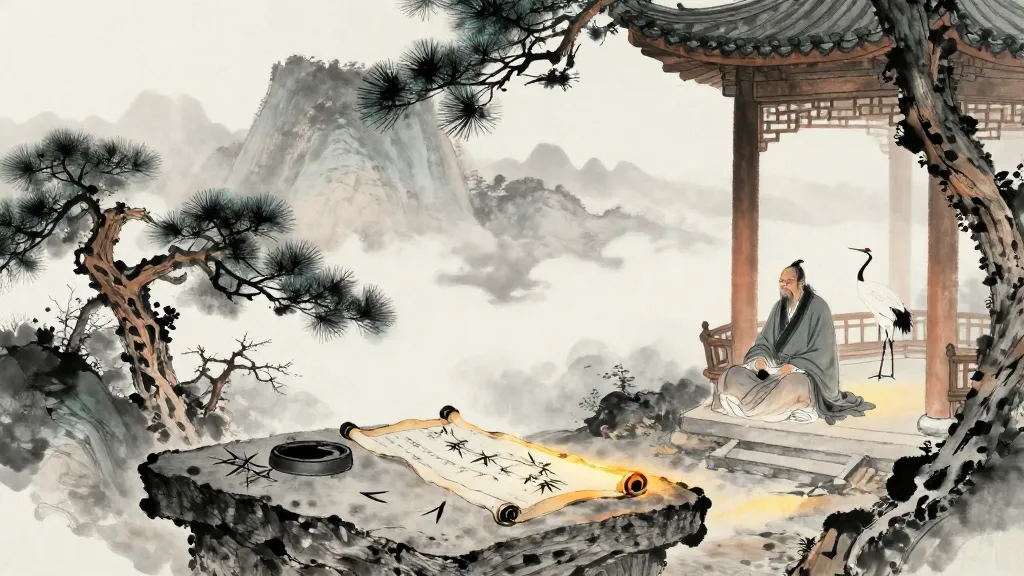
陳丞相世家 (Hereditary House of Chancellor Chen) — Chinese ink painting

Chapter 56 of 130

陳丞相世家

Hereditary House of Chancellor Chen

View:

陳平少年與婚姻

Chen Ping's Youth and Marriage

陳丞相平者,陽武戶牖鄉人也。少時家貧,好讀書,有田三十畝,獨與兄伯居。伯常耕田,縱平使遊學。平為人長美色。人或謂陳平曰:"貧何食而肥若是?"其嫂嫉平之不視家生產,曰:"亦食糠覈耳。有叔如此,不如無有。"伯聞之,逐其婦而棄之。

及平長,可娶妻,富人莫肯與者,貧者平亦恥之。久之,戶牖富人有張負,張負女孫五嫁而夫輒死,人莫敢娶。平欲得之。邑中有喪,平貧,侍喪,以先往後罷為助。張負既見之喪所,獨視偉平,平亦以故後去。負隨平至其家,家乃負郭窮巷,以弊席為門,然門外多有長者車轍。張負歸,謂其子仲曰:"吾欲以女孫予陳平。"張仲曰:"平貧不事事,一縣中盡笑其所為,獨柰何予女乎?"負曰:"人固有好美如陳平而長貧賤者乎?"卒與女。為平貧,乃假貸幣以聘,予酒肉之資以內婦。負誡其孫曰:"毋以貧故,事人不謹。事兄伯如事父,事嫂如母。"平既娶張氏女,齎用益饒,游道日廣。

里中社,平為宰,分肉食甚均。父老曰:"善,陳孺子之為宰!"平曰:"嗟乎,使平得宰天下,亦如是肉矣!"

Chancellor Chen Ping was a man of Huyou village in Yangwu. In his youth the family was poor, but he loved reading. They owned thirty mu of land. He lived alone with his elder brother Bo. Bo always worked the fields and let Ping travel to study. Ping was tall and handsome. Someone said to him: "You are poor — what do you eat to be so well-fed?" His sister-in-law, resentful that Ping did nothing for the household, said: "He eats chaff and husks, that is all. Having a brother-in-law like this is worse than having none." When Bo heard this, he expelled his wife and divorced her.

When Ping came of age to marry, no wealthy family would give him a bride, and he was too proud to marry into a poor one. In time, a rich man of Huyou named Zhang Fu had a granddaughter who had been married five times, each husband dying in turn — no one dared marry her. Ping wanted her. There was a funeral in the village. Ping, though poor, attended as a helper, arriving first and leaving last. Zhang Fu observed him at the funeral and was struck by Ping's stature. Ping deliberately lingered. Fu followed Ping home. The house stood in a dead-end alley backed against the outer wall, with a worn mat for a door — yet outside it were many wheel-ruts left by distinguished visitors' carriages. Zhang Fu returned home and told his son Zhong: "I wish to give my granddaughter to Chen Ping." Zhong said: "Ping is poor and does nothing. The whole county laughs at him — why give him the girl?" Fu said: "Has there ever been a man as handsome as Chen Ping who remained poor and lowly forever?" He gave her in the end. Because Ping was poor, Fu borrowed money for the betrothal gifts and provided the funds for wine and meat to welcome the bride. Fu warned his granddaughter: "Do not be careless in serving others because of your poverty. Serve your brother-in-law Bo as you would a father, and his wife as you would a mother." After Ping married the Zhang girl, his resources grew more ample and his network of connections wider by the day.

At the village festival, Ping served as the meat-carver and divided the sacrificial portions with perfect fairness. The elders said: "Well done, young Chen, as carver!" Ping said: "Ah! If I could carve up all under Heaven, I would divide it just as evenly as this meat!"

Notes

1person陳平Chén Píng

Chen Ping (陳平, d. 178 BC) was one of the key strategists who helped Liu Bang found the Han dynasty. He served as Chancellor under Emperors Gaozu, Hui, Empress Lü, and Wen — a remarkably long career navigating some of the most dangerous court politics in Chinese history.

2place

Yangwu (陽武) was a county in modern Yuanyang County (原陽縣), Henan province. Huyou (戶牖) was a village within it.

3context

The anecdote of dividing sacrificial meat is a classic illustration of Chen Ping's ambition. The meat-carver (宰) at village festivals was a position of minor responsibility, but Ping explicitly draws the parallel to governing the realm — the character 宰 also means 'to govern' or 'prime minister.'

事魏事楚與歸漢

Serving Wei, Serving Chu, and Defecting to Han

陳涉起而王陳,使周市略定魏地,立魏咎為魏王,與秦軍相攻於臨濟。陳平固已前謝其兄伯,從少年往事魏王咎於臨濟。魏王以為太僕。說魏王不聽,人或讒之,陳平亡去。

久之,項羽略地至河上,陳平往歸之,從入破秦,賜平爵卿。項羽之東王彭城也,漢王還定三秦而東,殷王反楚。項羽乃以平為信武君,將魏王咎客在楚者以往,擊降殷王而還。項王使項悍拜平為都尉,賜金二十溢。居無何,漢王攻下殷。項王怒,將誅定殷者將吏。陳平懼誅,乃封其金與印,使使歸項王,而平身間行杖劍亡。渡河,船人見其美丈夫獨行,疑其亡將,要中當有金玉寶器,目之,欲殺平。平恐,乃解衣裸而佐刺船。船人知其無有,乃止。

Chen She rose in revolt and declared himself king at Chen. He sent Zhou Shi to conquer and pacify Wei territory, installing Wei Jiu as King of Wei. Wei fought the Qin armies at Linji. Chen Ping had already taken leave of his brother Bo and gone with a group of young men to serve King Jiu of Wei at Linji. The king appointed him Grand Coachman. Ping offered counsel, but the king would not listen. Others slandered him, and Ping fled.

Some time later, Xiang Yu swept through the region and reached the Yellow River. Ping went to join him, followed him in destroying Qin, and was given the rank of Senior Minister. When Xiang Yu went east to rule at Pengcheng and the King of Han returned to pacify the Three Qin and then marched east, the King of Yin rebelled against Chu. Xiang Yu made Ping the Lord of Xinwu and gave him command of the former retainers of King Jiu of Wei who were in Chu, sending him to attack and subdue the King of Yin. Upon his return, Xiang Yu had Xiang Han invest Ping as Commandant and rewarded him with twenty yi of gold. Shortly after, the King of Han attacked and took Yin. Xiang Yu was furious and intended to execute the officers who had pacified Yin. Ping, fearing execution, sealed up his gold and his seal of office, sent them back to Xiang Yu by messenger, and fled alone on foot with only his sword.

Crossing the Yellow River, the ferryman saw a tall, handsome man traveling alone and suspected he was a fugitive officer with gold, jade, and treasures hidden on his person. The ferryman eyed him and planned to kill him. Ping, alarmed, stripped off his clothes and helped pole the boat naked. The ferryman, seeing he had nothing, let him be.

Notes

1person陳涉Chén Shè

Chen She (陳涉, also Chen Sheng 陳勝, d. 208 BC) led the first major peasant uprising against the Qin dynasty in 209 BC, sparking the chain of revolts that destroyed Qin.

2person項羽Xiàng Yǔ

Xiang Yu (項羽, 232–202 BC), the Hegemon-King of Western Chu, was the dominant military figure of the Chu-Han Contention until his defeat by Liu Bang.

3place

Linji (臨濟) was in modern Dong'e County (東阿縣), Shandong. Pengcheng (彭城) is modern Xuzhou, Jiangsu.

4context

The river-crossing episode illustrates both the dangers of the era and Chen Ping's quick-witted resourcefulness. By stripping naked, he demonstrated he carried nothing worth stealing — a humiliating but effective survival tactic.

降漢與護軍之任

Surrendering to Han and the Appointment as Protector of the Army

平遂至修武降漢,因魏無知求見漢王,漢王召入。是時萬石君奮為漢王中涓,受平謁,入見平。平等七人俱進,賜食。王曰:"罷,就舍矣。"平曰:"臣為事來,所言不可以過今日。"於是漢王與語而說之,問曰:"子之居楚何官?"曰:"為都尉。"是日乃拜平為都尉,使為參乘,典護軍。諸將盡讙,曰:"大王一日得楚之亡卒,未知其高下,而即與同載,反使監護軍長者!"漢王聞之,愈益幸平。遂與東伐項王。至彭城,為楚所敗。引而還,收散兵至滎陽,以平為亞將,屬於韓王信,軍廣武。

絳侯、灌嬰等鹹讒陳平曰:"平雖美丈夫,如冠玉耳,其中未必有也。臣聞平居家時,盜其嫂;事魏不容,亡歸楚;歸楚不中,又亡歸漢。今日大王尊官之,令護軍。臣聞平受諸將金,金多者得善處,金少者得惡處。平,反覆亂臣也,原王察之。"漢王疑之,召讓魏無知。無知曰:"臣所言者,能也;陛下所問者,行也。今有尾生、孝己之行而無益處於勝負之數,陛下何暇用之乎?楚漢相距,臣進奇謀之士,顧其計誠足以利國家不耳。且盜嫂受金又何足疑乎?"漢王召讓平曰:"先生事魏不中,遂事楚而去,今又從吾游,信者固多心乎?"平曰:"臣事魏王,魏王不能用臣說,故去事項王。項王不能信人,其所任愛,非諸項即妻之昆弟,雖有奇士不能用,平乃去楚。聞漢王之能用人,故歸大王。臣裸身來,不受金無以為資。誠臣計畫有可采者,大王用之;使無可用者,金具在,請封輸官,得請骸骨。"漢王乃謝,厚賜,拜為護軍中尉,盡護諸將。諸將乃不敢復言。

Ping made his way to Xiuwu and surrendered to Han. Through Wei Wuzhi he obtained an audience with the King of Han. The king summoned him in. At that time Shi Fen, the future Marquis of Wanshi, was serving as the king's personal attendant and received Ping's petition, then brought him before the king. Ping and six others were presented together and given a meal. The king said: "That will do — go to your quarters." Ping said: "I have come on urgent business. What I have to say cannot wait past today." The King of Han conversed with him and was pleased. He asked: "What office did you hold in Chu?" Ping replied: "Commandant." That very day the king appointed Ping as Commandant, made him his chariot companion, and put him in charge of supervising the army. The generals were outraged: "His Majesty gets a deserter from Chu for one day, knows nothing of the man's quality, and immediately rides in the same chariot with him — even puts him in charge of overseeing the senior officers!"

The King of Han, hearing this, favored Ping all the more. He then marched east with Ping to attack Xiang Yu. They reached Pengcheng but were defeated by Chu. They withdrew, rallying scattered troops at Xingyang. Ping was made Vice-General under King Xin of Han and stationed at Guangwu.

The Marquis of Jiang, Guan Ying, and others slandered Chen Ping to the king: "Ping may be a handsome man, but he is like a jade cap-ornament — pretty on the outside, nothing inside. We hear that when he lived at home he seduced his sister-in-law. He served Wei and was forced out; he fled to Chu and did not fit in; now he has fled again to Han. Today Your Majesty honors him with high office and puts him in charge of the army. We hear Ping accepts bribes from the generals — those who pay more get good postings, those who pay less get bad ones. Ping is a turncoat and a troublemaker. We beg Your Majesty to look into this."

The King of Han grew suspicious and summoned Wei Wuzhi to reprimand him. Wei Wuzhi said: "What I recommended was the man's ability. What Your Majesty asks about is his personal conduct. Even if a man had the integrity of Wei Sheng and the filial virtue of Xiao Ji, if it does not help win battles, what use has Your Majesty for it? Chu and Han are locked in a struggle — I brought you a man of extraordinary stratagems. The only question is whether his plans can benefit the state. What does seducing a sister-in-law or taking bribes matter?"

The King of Han summoned Ping and rebuked him: "Sir, you did not last with Wei, then served Chu and left. Now you follow me. Is it in the nature of a trustworthy man to change allegiance so often?" Ping said: "I served the King of Wei. He could not use my counsel, so I left for Xiang Yu. Xiang Yu cannot trust anyone — the only men he appoints and favors are members of the Xiang clan or his wife's brothers. Even men of extraordinary talent cannot gain employment. So I left Chu. I heard the King of Han knows how to use people, and so I came to Your Majesty. I arrived with nothing but my naked body. Without taking payments I would have no means to live. If my plans are worth adopting, Your Majesty may use them. If they are worthless, the money is all still here — I will seal it up, return it to the treasury, and beg leave to retire." The King of Han apologized, rewarded him generously, and appointed him Protector-Commandant of the Army, with authority over all the generals. The generals dared not speak against him again.

Notes

1person魏無知Wèi Wúzhī

Wei Wuzhi (魏無知) was a retainer who introduced Chen Ping to Liu Bang. His name literally means 'Wei the Unknown.' His pragmatic defense of Ping — ability matters more than personal morality in wartime — articulates a key theme of early Han political thought.

2person周勃Zhōu Bó

The Marquis of Jiang (絳侯) is Zhou Bo (周勃, d. 169 BC), and Guan Ying (灌嬰, d. 176 BC) was another leading Han general. Both were early followers of Liu Bang who resented the rapid promotion of a latecomer.

3place

Xingyang (滎陽) was a critical stronghold in modern Xingyang city, Henan, and the main theater of the Chu-Han war from 205 to 203 BC. Guangwu (廣武) was a pair of fortified hills nearby.

4translation

The phrase 如冠玉耳 ('like a jade cap-ornament') became a proverbial expression for someone who is handsome but lacks substance — all surface, no depth.

反間計與滎陽脫困

The Stratagem of Sowing Discord and the Escape from Xingyang

其後,楚急攻,絕漢甬道,圍漢王於滎陽城。久之,漢王患之,請割滎陽以西以和。項王不聽。漢王謂陳平曰:"天下紛紛,何時定乎?"陳平曰:"項王為人,恭敬愛人,士之廉節好禮者多歸之。至於行功爵邑,重之,士亦以此不附。今大王慢而少禮,士廉節者不來;然大王能饒人以爵邑,士之頑鈍嗜利無恥者亦多歸漢。誠各去其兩短,襲其兩長,天下指麾則定矣。然大王恣侮人,不能得廉節之士。顧楚有可亂者,彼項王骨鯁之臣亞父、鍾離眛、龍且、周殷之屬,不過數人耳。大王誠能出捐數萬斤金,行反間,間其君臣,以疑其心,項王為人意忌信讒,必內相誅。漢因舉兵而攻之,破楚必矣。"漢王以為然,乃出黃金四萬斤,與陳平,恣所為,不問其出入。

陳平既多以金縱反間於楚軍,宣言諸將鍾離眛等為項王將,功多矣,然而終不得裂地而王,欲與漢為一,以滅項氏而分王其地。項羽果意不信鍾離眜等。項王既疑之,使使至漢。漢王為太牢具,舉進。見楚使,即詳驚曰:"吾以為亞父使,乃項王使!"復持去,更以惡草具進楚使。楚使歸,具以報項王。項王果大疑亞父。亞父欲急攻下滎陽城,項王不信,不肯聽。亞父聞項王疑之,乃怒曰:"天下事大定矣,君王自為之!原請骸骨歸!"歸未至彭城,疽發背而死。陳平乃夜出女子二千人滎陽城東門,楚因擊之,陳平乃與漢王從城西門夜出去。遂入關,收散兵復東。

Afterward, Chu pressed its attack, cut the Han supply corridor, and besieged the King of Han inside Xingyang. After a long siege the King of Han grew desperate and offered to cede everything west of Xingyang in exchange for peace. Xiang Yu refused.

The King of Han said to Chen Ping: "The realm is in chaos — when will it be settled?" Chen Ping said: "Xiang Yu is respectful and caring toward people. Officers of integrity and propriety flock to him. But when it comes to rewarding merit with titles and fiefs, he grudges them, and so officers also refuse to stay. Your Majesty is rude and lacking in courtesy — men of integrity will not come. But Your Majesty is generous with titles and fiefs, and so officers who are rough, dull, greedy, and shameless also flock to Han. If each side could shed its weaknesses and combine its strengths, the realm could be settled with a wave of the hand. But Your Majesty insults people too freely to attract men of integrity. On the other hand, Chu can be thrown into disarray. Xiang Yu's stalwart ministers — Fan Zeng, Zhong Limei, Long Ju, Zhou Yin — number no more than a handful. If Your Majesty will spend a few tens of thousands of catties of gold on a campaign of counter-intelligence to sow suspicion between Xiang Yu and his ministers, and since Xiang Yu is by nature jealous and credulous of slander, his own people will turn on each other. Then Han can raise its armies and attack — Chu will certainly be destroyed."

The King of Han agreed, gave Chen Ping forty thousand catties of gold, and let him spend it as he wished, asking no accounting.

Ping spread the gold lavishly to plant agents in the Chu army, spreading rumors that generals like Zhong Limei had rendered great service to Xiang Yu but had never been enfeoffed as kings, and that they wished to join with Han to destroy the Xiang clan and carve up his territory. Xiang Yu indeed grew suspicious of Zhong Limei and the others.

Once suspicious, Xiang Yu sent an envoy to Han. The King of Han had a grand feast of the Three Sacrificial Animals prepared and brought out. When the Chu envoy appeared, the king feigned surprise: "I thought this was the Elder Father's envoy — it turns out to be Xiang Yu's!" He had the feast taken away and replaced with coarse provisions for the Chu envoy. The envoy returned and reported everything. Xiang Yu now deeply suspected Fan Zeng. Fan Zeng urged an immediate assault on Xingyang, but Xiang Yu distrusted him and refused to listen. When Fan Zeng learned of Xiang Yu's suspicion, he said in fury: "The great affair of the realm is settled! Your Majesty may handle it yourself! I beg leave to return my old bones home!" On the road back, before reaching Pengcheng, a carbuncle erupted on his back and he died.

Chen Ping then sent two thousand women out through the east gate of Xingyang at night. The Chu troops rushed to attack them. While they were distracted, Chen Ping and the King of Han slipped out through the west gate under cover of darkness. They passed through the passes, rallied scattered forces, and marched east again.

Notes

1person范增Fàn Zēng

Fan Zeng (范增, 277–204 BC), styled 'the Elder Father' (亞父), was Xiang Yu's chief strategist and the only advisor who consistently urged decisive action against Liu Bang. His alienation and death from Chen Ping's counter-intelligence operation was a turning point in the Chu-Han war.

2person鍾離眛Zhōng Lí Mèi

Zhong Limei (鍾離眛, d. 201 BC) was one of Xiang Yu's most capable generals. After Chu's defeat he sought refuge with Han Xin but was forced to commit suicide.

3context

Chen Ping's counter-intelligence campaign is one of the most celebrated stratagems in Chinese history. The feast deception — pretending to expect Fan Zeng's envoy and then visibly downgrading the reception for Xiang Yu's — was a masterpiece of psychological warfare that exploited Xiang Yu's paranoia.

4context

The night escape using women as a diversion was another of Chen Ping's 'extraordinary stratagems' (奇計). The two thousand women created enough confusion at the east gate for the king and his retinue to escape undetected from the west.

計擒韓信與封侯

The Stratagem to Capture Han Xin and Enfeoffment

其明年,淮陰侯破齊,自立為齊王,使使言之漢王。漢王大怒而罵,陳平躡漢王。漢王亦悟,乃厚遇齊使,使張子房卒立信為齊王。封平以戶牖鄉。用其奇計策,卒滅楚。常以護軍中尉從定燕王臧荼。

漢六年,人有上書告楚王韓信反。高帝問諸將,諸將曰:"亟發兵阬豎子耳。"高帝默然。問陳平,平固辭謝,曰:"諸將云何?"上具告之。陳平曰:"人之上書言信反,有知之者乎?"曰:"未有。"曰:"信知之乎?"曰:"不知。"陳平曰:"陛下精兵孰與楚?"上曰:"不能過。"平曰:"陛下將用兵有能過韓信者乎?"上曰:"莫及也。"平曰:"今兵不如楚精,而將不能及,而舉兵攻之,是趣之戰也,竊為陛下危之。"上曰:"為之柰何?"平曰:"古者天子巡狩,會諸侯。南方有雲夢,陛下弟出偽游雲夢,會諸侯於陳。陳,楚之西界,信聞天子以好出遊,其勢必無事而郊迎謁。謁,而陛下因禽之,此特一力士之事耳。"高帝以為然,乃發使告諸侯會陳,"吾將南遊雲夢"。上因隨以行。行未至陳,楚王信果郊迎道中。高帝豫具武士,見信至,即執縛之,載後車。信呼曰:"天下已定,我固當烹!"高帝顧謂信曰:"若毋聲!而反,明矣!"武士反接之。遂會諸侯於陳,盡定楚地。還至雒陽,赦信以為淮陰侯,而與功臣剖符定封。

於是與平剖符,世世勿絕,為戶牖侯。平辭曰:"此非臣之功也。"上曰:"吾用先生謀計,戰勝剋敵,非功而何?"平曰:"非魏無知臣安得進?"上曰;"若子可謂不背本矣。"乃復賞魏無知。

The following year, the Marquis of Huaiyin destroyed Qi and proclaimed himself King of Qi, sending a messenger to inform the King of Han. The king flew into a rage and cursed. Chen Ping stepped on his foot. The king caught himself, and instead treated the Qi envoy generously, sending Zhang Liang to formally install Han Xin as King of Qi. Ping was enfeoffed with Huyou village. Through his extraordinary stratagems, Chu was ultimately destroyed. He regularly served as Protector-Commandant in the campaigns that pacified Zang Tu, the King of Yan.

In the sixth year of Han, someone submitted a memorial accusing Han Xin, King of Chu, of plotting rebellion. Emperor Gao consulted his generals. They all said: "Send troops at once and bury the wretch!" The Emperor was silent. He asked Chen Ping. Ping demurred, saying: "What did the generals advise?" The Emperor told him everything. Ping said: "The man who filed the accusation — does anyone else know about it?" "No one." "Does Han Xin know?" "He does not." Ping said: "Your Majesty's crack troops — are they better than Chu's?" "They cannot match them." "Your Majesty's generals — is there one who surpasses Han Xin?" "None comes close." Ping said: "Your troops are inferior to his, and your generals cannot match him. If you raise an army and attack, you are simply forcing him into battle. I fear for Your Majesty." The Emperor said: "Then what is to be done?" Ping said: "In antiquity the Son of Heaven would make a royal progress and convene the feudal lords. There is the Yunmeng marshlands in the south. Your Majesty need only pretend to tour Yunmeng and convene the lords at Chen. Chen is on the western border of Chu. When Han Xin hears the Son of Heaven is on a pleasure tour, he will feel obliged to come out and pay his respects in the suburbs. The moment he pays his respects, Your Majesty seizes him — it is merely a job for one strong man."

Emperor Gao agreed. He dispatched envoys summoning the lords to assemble at Chen: "I will tour Yunmeng in the south." The Emperor followed along. Before reaching Chen, the King of Chu, Han Xin, came out to pay his respects on the road as expected. The Emperor had warriors prepared in advance. The moment Han Xin appeared, they seized and bound him and loaded him onto a rear carriage. Han Xin cried out: "The realm is settled, and so of course the hound is to be boiled!" The Emperor turned and said: "Silence! Your rebellion is plain!" The warriors pinioned his arms behind his back. The Emperor convened the lords at Chen and settled all of Chu's territory. Returning to Luoyang, he pardoned Han Xin and demoted him to Marquis of Huaiyin, then divided tallies with his meritorious subjects to confirm their fiefs.

Ping received a split tally, heritable in perpetuity, as Marquis of Huyou. He declined, saying: "This is not my achievement." The Emperor said: "I used your stratagems to win battles and defeat enemies — if that is not merit, what is?" Ping said: "Without Wei Wuzhi, how would I have gained an audience?" The Emperor said: "A man like you truly never forgets his roots." He rewarded Wei Wuzhi again.

Notes

1person韓信Hán Xìn

Han Xin (韓信, d. 196 BC), Marquis of Huaiyin, was the greatest military commander of the Chu-Han era, credited with conquering most of the realm for Liu Bang. His arrest at Chen and eventual execution are among the most famous episodes of political betrayal in Chinese history.

2place

Yunmeng (雲夢) was a vast marshland in modern Hubei province, associated with the ancient state of Chu. The 'tour' was purely a pretext. Chen (陳) is modern Huaiyang, Henan.

3translation

Han Xin's cry '天下已定,我固當烹' ('The realm is settled, and so of course the hound is boiled') paraphrases the proverb '狡兔死,走狗烹' — 'When the cunning hare is dead, the running hound is boiled.' It expresses the bitter truth that indispensable wartime allies become expendable in peacetime.

平城之圍與曲逆封侯

The Siege of Pingcheng and Enfeoffment at Quni

其明年,以護軍中尉從攻反者韓王信於代。卒至平城,為匈奴所圍,七日不得食。高帝用陳平奇計,使單于閼氏,圍以得開。高帝既出,其計礻必,世莫得聞。

高帝南過曲逆,上其城,望見其屋室甚大,曰:"壯哉縣!吾行天下,獨見洛陽與是耳。"顧問御史曰:"曲逆戶口幾何?"對曰:"始秦時三萬餘戶,間者兵數起,多亡匿,今見五千戶。"於是乃詔御史,更以陳平為曲逆侯,盡食之,除前所食戶牖。

其後常以護軍中尉從攻陳豨及黥布。凡六出奇計,輒益邑,凡六益封。奇計或頗祕,世莫能聞也。

The following year, Ping served as Protector-Commandant in the campaign against the rebel Han Wang Xin in Dai. The army reached Pingcheng and was surrounded by the Xiongnu. For seven days they had no food. Emperor Gao employed one of Chen Ping's extraordinary stratagems, directed at the Chanyu's consort, and the encirclement was broken. After the Emperor escaped, this particular stratagem was kept secret, and the world never learned its details.

On his way south, the Emperor passed through Quni. He ascended the city walls and, gazing at the buildings, said: "What a magnificent city! In all my travels through the realm, I have seen only Luoyang and this place." He turned and asked the Imperial Secretary: "How many households does Quni have?" The reply: "In Qin times, over thirty thousand. Through the repeated wars, many have fled or gone into hiding. The current count is five thousand." The Emperor thereupon decreed that Chen Ping be made Marquis of Quni, with the revenues of the entire district, replacing his former fief of Huyou.

Afterward, Ping continued to serve as Protector-Commandant in the campaigns against Chen Xi and Qing Bu. In all, he devised six extraordinary stratagems, and each time his fief was increased — six increases in total. Some of the stratagems were deeply secret, and the world never learned them.

Notes

1context

The siege of Pingcheng (平城, modern Datong, Shanxi) in 200 BC was a major military disaster. Emperor Gao and his advance force were trapped on Mount Baideng by the Xiongnu Chanyu Modu for seven days. The secret stratagem traditionally involved sending a painting of a beautiful Chinese woman to the Chanyu's consort (閼氏), warning her that if the siege continued, the Emperor would offer this woman as tribute — prompting the consort to persuade the Chanyu to lift the siege.

2place

Quni (曲逆, later renamed Puyang 蒲陽) was in modern Wanxian area, Hebei province. It was a prosperous county that had suffered severely from the wars.

3person陳豨Chén Xī

Chen Xi (陳豨, d. 195 BC) was a Han general who rebelled in Dai. Qing Bu (黥布, also called Ying Bu 英布, d. 196 BC) was King of Huainan who also rebelled. Both were defeated by Emperor Gao.

計代樊噲與呂后時期

The Plot to Replace Fan Kuai and the Era of Empress Lü

高帝從破布軍還,病創,徐行至長安。燕王盧綰反,上使樊噲以相國將兵攻之。既行,人有短惡噲者。高帝怒曰:"噲見吾病,乃冀我死也。"用陳平謀而召絳侯周勃受詔床下,曰:"陳平亟馳傳載勃代噲將,平至軍中即斬噲頭!"二人既受詔,馳傳未至軍,行計之曰:"樊噲,帝之故人也,功多,且又乃呂后弟呂嬃之夫,有親且貴,帝以忿怒故,欲斬之,則恐後悔。寧囚而致上,上自誅之。"未至軍,為壇,以節召樊噲。噲受詔,即反接載檻車,傳詣長安,而令絳侯勃代將,將兵定燕反縣。

平行聞高帝崩,平恐呂太后及呂嬃讒怒,乃馳傳先去。逢使者詔平與灌嬰屯於滎陽。平受詔,立復馳至宮,哭甚哀,因奏事喪前。呂太后哀之,曰:"君勞,出休矣。"平畏讒之就,因固請得宿衛中。太后乃以為郎中令,曰:"傅教孝惠。"是後呂嬃讒乃不得行。樊噲至,則赦復爵邑。

Emperor Gao returned from crushing Qing Bu's army, but he was wounded and ill, traveling slowly back to Chang'an. When Lu Wan, King of Yan, rebelled, the Emperor sent Fan Kuai as Chancellor-General to lead the attack. After Fan Kuai had departed, someone spoke ill of him. The Emperor said in a fury: "Fan Kuai sees that I am ill and hopes I will die!" Acting on Chen Ping's advice, the Emperor summoned the Marquis of Jiang, Zhou Bo, to receive a secret edict by his bedside: "Chen Ping is to ride post-haste to the army with Zhou Bo, relieve Fan Kuai of command, and behead Fan Kuai the moment he arrives!"

The two men received the edict and rode by relay, but before reaching the army they reconsidered: "Fan Kuai is the Emperor's oldest companion and a man of great merit. Moreover, he is the husband of Lü Xu, Empress Lü's sister — both a relative and a man of standing. The Emperor acts out of momentary anger and may later regret it. Better to arrest him and deliver him to the Emperor to deal with personally." Before reaching the army, they set up an altar, summoned Fan Kuai with the imperial tally, bound his arms behind his back, loaded him into a prisoner's cart, and sent him to Chang'an by relay. Zhou Bo took command of the army and pacified the rebellious Yan districts.

On the road, Ping heard that Emperor Gao had died. Fearing that Empress Lü and Lü Xu would turn their anger on him, he raced ahead by relay to the capital. On the way he encountered a messenger with an edict ordering him and Guan Ying to garrison Xingyang. Ping acknowledged the edict but immediately raced to the palace, wept with extreme grief, and presented his report before the coffin. Empress Lü was moved, saying: "You have worked hard — go out and rest." But Ping, fearing that slander would soon reach its mark, firmly requested to serve in the palace guard. The Empress made him Commandant of the Palace Gentlemen, saying: "Tutor and guide Emperor Hui." After this, Lü Xu's slanders could gain no traction. When Fan Kuai arrived, he was pardoned and his titles and fief restored.

Notes

1person樊噲Fán Kuài

Fan Kuai (樊噲, d. 189 BC) was one of Liu Bang's earliest followers and among his most loyal generals. He was married to Lü Xu (呂嬃), the younger sister of Empress Lü, making him both a meritorious subject and a relative by marriage of the imperial family.

2person盧綰Lú Wǎn

Lu Wan (盧綰, d. 194 BC) was Emperor Gao's childhood friend, born on the same day. Despite being made King of Yan, he grew fearful and eventually defected to the Xiongnu.

3context

Chen Ping's decision not to execute Fan Kuai — disobeying a direct imperial order — demonstrates his political acumen. He correctly anticipated that the Emperor might die (which he did), leaving Empress Lü in power. Had Ping killed Empress Lü's brother-in-law, his own life would have been forfeit.

王陵與呂氏亂政

Wang Ling and the Lü Clan's Usurpation

孝惠帝六年,相國曹參卒,以安國侯王陵為右丞相,陳平為左丞相。

王陵者,故沛人,始為縣豪,高祖微時,兄事陵。陵少文,任氣,好直言。及高祖起沛,入至鹹陽,陵亦自聚黨數千人,居南陽,不肯從沛公。及漢王之還攻項籍,陵乃以兵屬漢。項羽取陵母置軍中,陵使至,則東鄉坐陵母,欲以招陵。陵母既私送使者,泣曰:"為老妾語陵,謹事漢王。漢王,長者也,無以老妾故,持二心。妾以死送使者。"遂伏劍而死。項王怒,烹陵母。陵卒從漢王定天下。以善雍齒,雍齒,高帝之仇,而陵本無意從高帝,以故晚封,為安國侯。

安國侯既為右丞相,二歲,孝惠帝崩。高后欲立諸呂為王,問王陵,王陵曰:"不可。"問陳平,陳平曰:"可。"呂太后怒,乃詳遷陵為帝太傅,實不用陵。陵怒,謝疾免,杜門竟不朝請,七年而卒。

陵之免丞相,呂太后乃徙平為右丞相,以辟陽侯審食其為左丞相。左丞相不治,常給事於中。

食其亦沛人。漢王之敗彭城西,楚取太上皇、呂后為質,食其以舍人侍呂后。其後從破項籍為侯,幸於呂太后。及為相,居中,百官皆因決事。

呂嬃常以前陳平為高帝謀執樊噲,數讒曰:"陳平為相非治事,日飲醇酒,戲婦女。"陳平聞,日益甚。呂太后聞之,私獨喜。面質呂嬃於陳平曰:"鄙語曰'兒婦人口不可用',顧君與我何如耳。無畏呂嬃之讒也。"

In the sixth year of Emperor Hui, Chancellor Cao Can died. Wang Ling, Marquis of Anguo, was made Right Chancellor, and Chen Ping Left Chancellor.

Wang Ling was originally from Pei. He had been a local strongman, and when the High Ancestor was still a commoner, he treated Ling as an elder brother. Ling was unlettered, headstrong, and blunt-spoken. When the High Ancestor rose at Pei and entered Xianyang, Ling had independently gathered several thousand followers at Nanyang and refused to follow the Duke of Pei. Only when the King of Han returned to fight Xiang Ji did Ling bring his forces under Han command. Xiang Yu seized Ling's mother and placed her in his camp. When Ling's envoy arrived, Xiang Yu seated the mother in the place of honor, facing east, hoping to use her to lure Ling over. Ling's mother privately saw the envoy off, weeping: "Tell Ling from this old servant: serve the King of Han faithfully. The King of Han is a man of virtue. Do not waver because of an old woman. I will see the envoy off with my death." She threw herself on a sword and died. Xiang Yu, in a rage, boiled her body. Ling eventually followed the King of Han to settle the realm. Because he had been friends with Yong Chi — the High Ancestor's personal enemy — and had initially refused to follow him, Ling was enfeoffed late, as Marquis of Anguo.

After two years as Right Chancellor, Emperor Hui died. Empress Lü wished to make members of the Lü clan kings. She asked Wang Ling. Ling said: "It must not be done." She asked Chen Ping. Ping said: "It may be done." Empress Lü was furious at Ling. She made a show of promoting him to Grand Tutor of the Emperor, but in fact stripped him of power. Ling resigned in anger, pleading illness. He shut his gates and never again attended court, dying seven years later.

Once Ling was removed, Empress Lü transferred Ping to Right Chancellor and installed Shen Shiqi, Marquis of Piyang, as Left Chancellor. The Left Chancellor conducted no business — he stayed constantly at court attending the Empress.

Shen Shiqi was also from Pei. When the King of Han was defeated west of Pengcheng and Chu captured the Grand Supreme Emperor and Empress Lü as hostages, Shiqi attended Empress Lü as a household retainer. He later served in the campaign that destroyed Xiang Ji and was made a marquis. He was Empress Lü's favorite. Upon becoming chancellor, he resided within the palace, and all officials submitted their business through him.

Lü Xu constantly bore a grudge against Chen Ping for having plotted to arrest Fan Kuai, and repeatedly slandered him: "Chen Ping does nothing as chancellor — he just drinks fine wine and plays with women all day." When Ping heard this, he did it all the more. Empress Lü heard of it and was privately delighted. She confronted Lü Xu in Ping's presence: "The proverb says, 'Don't trust a daughter-in-law's gossip.' What matters is how you and I get along. Do not fear Lü Xu's slanders."

Notes

1person王陵Wáng Líng

Wang Ling (王陵, d. 180 BC), Marquis of Anguo, was a blunt and principled man whose refusal to support the Lü clan's power grab cost him his office. His mother's suicide — refusing to be used as a hostage — is one of the most celebrated acts of maternal loyalty in Chinese history.

2person審食其Shěn Yìjī

Shen Shiqi (審食其, d. 177 BC), Marquis of Piyang, was Empress Lü's longtime intimate companion. His appointment as Left Chancellor was widely understood as a personal favor rather than recognition of ability.

3context

Chen Ping's strategy under Empress Lü was deliberate self-abasement. By publicly behaving as a drunkard and womanizer, he convinced the Empress he was harmless — while secretly preserving his position for the moment he could act. His 'yes' to the Lü enfeoffments was pure survival tactics, not genuine agreement.

誅呂安劉與文帝朝政

Destroying the Lü Clan, Securing the Liu, and Governance Under Emperor Wen

呂太后立諸呂為王,陳平偽聽之。及呂太后崩,平與太尉勃合謀,卒誅諸呂,立孝文皇帝,陳平本謀也。審食其免相。

孝文帝立,以為太尉勃親以兵誅呂氏,功多;陳平欲讓勃尊位,乃謝病。孝文帝初立,怪平病,問之。平曰:"高祖時,勃功不如臣平。及誅諸呂,臣功亦不如勃。原以右丞相讓勃。"於是孝文帝乃以絳侯勃為右丞相,位次第一;平徙為左丞相,位次第二。賜平金千斤,益封三千戶。

居頃之,孝文皇帝既益明習國家事,朝而問右丞相勃曰:"天下一歲決獄幾何?"勃謝曰:"不知。"問:"天下一歲錢穀出入幾何?"勃又謝不知,汗出沾背,愧不能對。於是上亦問左丞相平。平曰:"有主者。"上曰:"主者謂誰?"平曰:"陛下即問決獄,責廷尉;問錢穀,責治粟內史。"上曰:"苟各有主者,而君所主者何事也?"平謝曰:"主臣!陛下不知其駑下,使待罪宰相。宰相者,上佐天子理陰陽,順四時,下育萬物之宜,外鎮撫四夷諸侯,內親附百姓,使卿大夫各得任其職焉。"孝文帝乃稱善。右丞相大慚,出而讓陳平曰:"君獨不素教我對!"陳平笑曰:"君居其位,不知其任邪?且陛下即問長安中盜賊數,君欲彊對邪?"於是絳侯自知其能不如平遠矣。居頃之,絳侯謝病請免相,陳平專為一丞相。

Empress Lü made the members of the Lü clan kings. Chen Ping pretended to go along. When Empress Lü died, Ping conspired with Grand Commandant Zhou Bo, and together they destroyed the entire Lü faction and enthroned Emperor Wen. The master plan was Chen Ping's. Shen Shiqi was removed from the chancellorship.

When Emperor Wen took the throne, he considered that Grand Commandant Bo had personally led troops to destroy the Lü clan and had the greater military credit. Chen Ping wished to yield the senior position to Bo and pleaded illness. Emperor Wen, newly enthroned, found Ping's illness suspicious and inquired. Ping said: "In the High Ancestor's time, Bo's merit did not match mine. But in the destruction of the Lü clan, my merit does not match Bo's. I wish to yield the Right Chancellorship to Bo." Emperor Wen therefore made the Marquis of Jiang, Zhou Bo, Right Chancellor, ranked first, and transferred Ping to Left Chancellor, ranked second. He gave Ping a thousand catties of gold and added three thousand households to his fief.

After some time, Emperor Wen grew increasingly familiar with affairs of state. At court he asked the Right Chancellor, Bo: "How many legal cases are decided in the realm each year?" Bo apologized: "I do not know." "How much revenue in cash and grain enters and leaves the treasury each year?" Bo again apologized that he did not know, sweating through his robes in embarrassment. The Emperor then asked the Left Chancellor, Ping. Ping said: "Each matter has its responsible official." "Who are they?" "If Your Majesty asks about legal cases, hold the Commandant of Justice accountable. If about revenue, hold the Grand Director of Grain accountable." The Emperor said: "If every matter has its responsible official, then what are you responsible for?" Ping replied: "Your servant! Your Majesty does not realize how mediocre I am, yet makes me serve at the risk of my life as chancellor. The chancellor's duty is: above, to assist the Son of Heaven in harmonizing yin and yang and following the four seasons; below, to nurture all things as is fitting; outward, to pacify the barbarians and the feudal lords; inward, to bind the people in affection — and to ensure that every minister and officer fulfills his own duties properly."

Emperor Wen praised him. The Right Chancellor, deeply mortified, went out and rebuked Chen Ping: "Why did you never teach me how to answer?" Ping laughed: "You hold the office — do you not know its duties? Besides, if the Emperor had asked how many bandits there are in Chang'an, would you have tried to force an answer to that too?" The Marquis of Jiang knew then that his ability fell far short of Ping's. Before long, he pleaded illness and resigned. Chen Ping became sole Chancellor.

Notes

1person漢文帝Hàn Wén Dì

Emperor Wen of Han (漢文帝, Liu Heng 劉恆, r. 180–157 BC) was enthroned after the Lü clan's destruction. His reign, together with that of Emperor Jing, is celebrated as the 'Rule of Wen and Jing' (文景之治), a period of light taxation and recovery.

2context

Chen Ping's answer about the chancellor's role became a classic definition of the prime minister's function in Chinese political theory. The chancellor does not handle specific administrative details but ensures that the entire system of government operates in harmony — a conception with strong Daoist overtones.

3context

The contrast between Zhou Bo (blunt military man, unable to answer policy questions) and Chen Ping (sophisticated strategist who articulates the philosophy of governance) is deliberately drawn by Sima Qian to illustrate that different talents serve different moments.

陳平之死與太史公論贊

Chen Ping's Death and the Grand Historian's Appraisal

孝文帝二年,丞相陳平卒,謚為獻侯。子共侯買代侯。二年卒,子簡侯恢代侯。二十三年卒,子何代侯。二十三年,何坐略人妻,棄市,國除。

始陳平曰:"我多陰謀,是道家之所禁。吾世即廢,亦已矣,終不能復起,以吾多陰禍也。"然其後曾孫陳掌以衛氏親貴戚,原得續封陳氏,然終不得。

太史公曰:陳丞相平少時,本好黃帝、老子之術。方其割肉俎上之時,其意固已遠矣。傾側擾攘楚魏之間,卒歸高帝。常出奇計,救紛糾之難,振國家之患。及呂后時,事多故矣,然平竟自脫,定宗廟,以榮名終,稱賢相,豈不善始善終哉!非知謀孰能當此者乎?

曲逆窮巷,門多長者。宰肉先均,佐喪後罷。魏楚更用,腹心難假。棄印封金,刺船露裸。間行歸漢,委質麾下。滎陽計全,平城圍解。推陵讓勃,裒多益寡。應變合權,克定宗社。

In the second year of Emperor Wen, Chancellor Chen Ping died. He was given the posthumous title Marquis Xian ("the Devoted"). His son Gong, Marquis Gong, inherited. After two years he died, and his son Jian, Marquis Jian ("the Simple"), inherited. After twenty-three years he died, and his son He inherited. After twenty-three years, He was convicted of abducting another man's wife, executed in the marketplace, and the fief was abolished.

Earlier, Chen Ping had said: "I have employed too many covert schemes — this is what the Way of the Daoists forbids. My line will be cut off, and that will be that. It can never recover, for I have accumulated too much hidden karma." Later, his great-grandson Chen Zhang, through his connection to the Wei family as a relative, sought to have the Chen enfeoffment renewed, but it was never granted.

The Grand Historian says: Chancellor Chen Ping in his youth was devoted to the arts of the Yellow Emperor and Laozi. Already when he was carving meat on the chopping block, his ambitions reached far beyond. He was tossed about between Chu and Wei, yet in the end came to the High Ancestor. He constantly devised extraordinary stratagems, rescuing the state from tangled crises and relieving national emergencies. In the time of Empress Lü, affairs were dangerous beyond measure, yet Ping managed to extricate himself, secure the ancestral temples, and end his life with an honored name, acclaimed as a worthy chancellor. Is this not a life that began well and ended well? Who but a man of wisdom and resourcefulness could have achieved this?

In a dead-end alley of Quni, distinguished visitors left their wheel-ruts at his door. He carved the meat with perfect fairness; he came first to funerals and left last. Employed by Wei and Chu in turn, no one could fathom his innermost heart. He sealed his gold and returned his seal, poled the boat stripped bare. He slipped through the lines to Han and pledged himself beneath the banner. His stratagems saved Xingyang; his ruse broke the Pingcheng siege. He deferred to Ling and yielded to Bo — taking from what had too much and giving to what had too little. Adapting to change and wielding expedient power, he secured the dynastic altars.

Notes

1context

Chen Ping's self-assessment — that his 'dark schemes' (陰謀) violated Daoist principles and would bring karmic retribution on his descendants — is one of the most psychologically revealing passages in the Shiji. It shows a man who understood the moral cost of his methods even as he judged them necessary.

2context

The final rhyming verse (贊) is Sima Qian's poetic summary of the chapter, a standard feature of Shiji biography chapters. It condenses the key episodes into parallel couplets.

3translation

裒多益寡 ('taking from the excess to supplement the deficit') alludes to Hexagram 42 (益, Increase) of the Yijing, which states: 'Decrease the upper, increase the lower.' It captures Ping's principle of yielding rank to maintain balance.

Edition & Source

Text
《史記》 Shiji
Edition
中華古詩文古書籍網 transcription
Commentary
裴駰《史記集解》、司馬貞《史記索隱》、張守節《史記正義》(Three Commentaries)