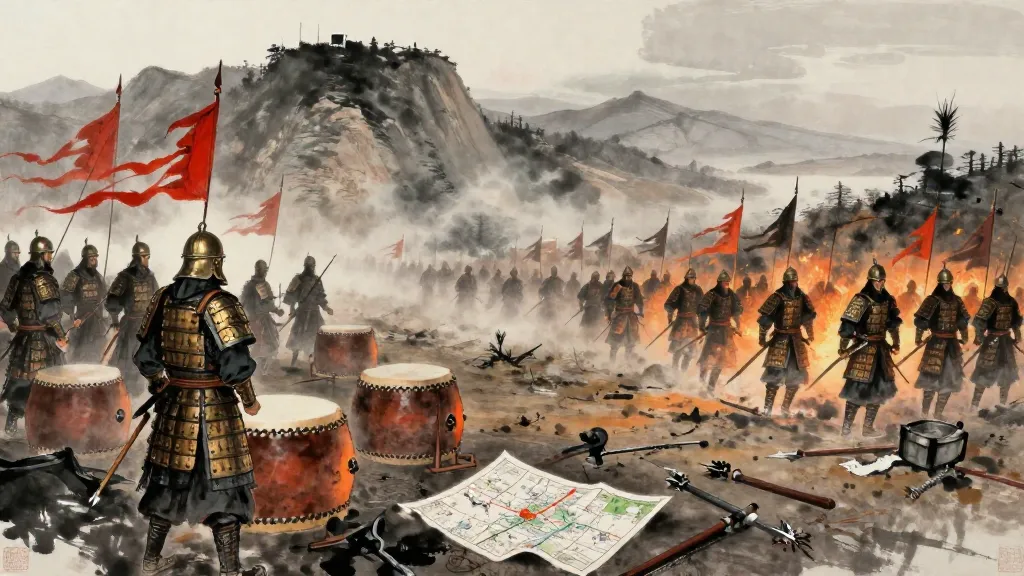
絳侯周勃世家 (Hereditary House of the Marquis of Jiang, Zhou Bo) — Chinese ink painting

Chapter 57 of 130

絳侯周勃世家

Hereditary House of the Marquis of Jiang, Zhou Bo

View:

周勃從沛公起兵滅秦

Zhou Bo Rises with the Duke of Pei and Destroys Qin

絳侯周勃者,沛人也。其先卷人,徙沛。勃以織薄曲為生,常為人吹簫給喪事,材官引彊。

高祖之為沛公初起,勃以中涓從攻胡陵,下方與。方與反,與戰,卻適。攻豐。擊秦軍碭東。還軍留及蕭。復攻碭,破之。下下邑,先登。賜爵五大夫。攻蒙、虞,取之。擊章邯車騎,殿。定魏地。攻爰戚、東緡,以往至栗,取之。攻齧桑,先登。擊秦軍阿下,破之。追至濮陽,下甄城。攻都關、定陶,襲取宛朐,得單父令。夜襲取臨濟,攻張,以前至卷,破之。擊李由軍雍丘下。攻開封,先至城下為多。後章邯破殺項梁,沛公與項羽引兵東如碭。自初起沛還至碭,一歲二月。楚懷王封沛公號安武侯,為碭郡長。沛公拜勃為虎賁令,以令從沛公定魏地。攻東郡尉於城武,破之。擊王離軍,破之。攻長社,先登。攻潁陽、緱氏,絕河津。擊趙賁軍屍北。南攻南陽守齮,破武關、嶢關。破秦軍於藍田,至鹹陽,滅秦。

The Marquis of Jiang, Zhou Bo, was a man of Pei. His forebears came from Juan and later moved to Pei. Bo made his living weaving silk mats and screens, and regularly played the xiao flute at funerals. He was also a trained archer serving in the county militia.

When the High Ancestor first rose as Duke of Pei, Bo served as personal attendant and followed him to attack Huling and take Fangyu. Fangyu rebelled and they fought to retake it, driving the enemy back. They attacked Feng, struck the Qin army east of Dang, returned to garrison Liu and Xiao, then attacked Dang again and destroyed it. Bo was first to scale the walls at Xiapi, and was given the rank of Fifth Grand Officer. They took Meng and Yu, struck Zhang Han's chariot forces — Bo serving as the rearguard — and pacified Wei territory. They attacked Yuanqi and Dongmin, advanced to Li and took it, attacked Niesang where Bo was again first to scale the walls, struck the Qin army below E and broke it, pursued to Puyang, and took Zhencheng. They attacked Duguan and Dingtao, seized Wanqu by surprise, and captured the magistrate of Shanfu. They took Linji in a night raid, attacked Zhang, advanced to Juan and broke it, struck Li You's army below Yongqiu, and attacked Kaifeng — Bo being among the first to reach the walls.

Later, Zhang Han defeated and killed Xiang Liang. The Duke of Pei and Xiang Yu withdrew east toward Dang. From the initial rising at Pei to the return to Dang took one year and two months. King Huai of Chu enfeoffed the Duke of Pei as Marquis of Anwu and made him Chief of Dang Commandery. The Duke of Pei appointed Bo as Commander of the Tiger Guards. In this capacity Bo followed the Duke of Pei to pacify Wei territory, broke the Commandant of Dong Commandery at Chengwu, defeated Wang Li's army, was first to scale the walls of Changshe, attacked Yingyang and Goushi, cut the river crossings, struck Zhao Ben's army north of Shi, attacked the Governor of Nanyang, Qi, from the south, broke through Wuguan and Yaoguan, shattered the Qin army at Lantian, reached Xianyang, and destroyed Qin.

Notes

1person周勃Zhōu Bó

Zhou Bo (周勃, d. 169 BC) was one of the founding generals of the Han dynasty. A man of humble origins — mat-weaver and funeral musician — he rose to become Grand Commandant and Chancellor. His greatest achievement was the destruction of the Lü clan after Empress Lü's death in 180 BC.

2place

Pei (沛) is modern Pei County, Jiangsu — the home of Liu Bang and many of his earliest followers. Juan (卷) was in modern Yuanyang County, Henan.

3context

This section reads like a military campaign log, listing dozens of battles in rapid succession. The recurrent phrase '先登' (first to scale the walls) indicates Zhou Bo's personal bravery as a front-line fighter. '殿' (serving as rearguard) was equally dangerous.

4person章邯Zhāng Hán

Zhang Han (章邯, d. 205 BC) was the last effective Qin general, who defeated multiple rebel armies before being cornered and surrendering to Xiang Yu.

楚漢之爭與封絳侯

The Chu-Han War and Enfeoffment as Marquis of Jiang

項羽至,以沛公為漢王。漢王賜勃爵為威武侯。從入漢中,拜為將軍。還定三秦,至秦,賜食邑懷德。攻槐里、好畤,最。擊趙賁、內史保於鹹陽,最。北攻漆。擊章平、姚卬軍。西定汧。還下郿、頻陽。圍章邯廢丘。破西丞。擊盜巴軍,破之。攻上邽。東守嶢關。轉擊項籍。攻曲逆,最。還守敖倉,追項籍。籍已死,因東定楚地泗、東海郡,凡得二十二縣。還守洛陽、櫟陽,賜與潁侯共食鍾離。以將軍從高帝反者燕王臧荼,破之易下。所將卒當馳道為多。賜爵列侯,剖符世世勿絕。食絳八千一百八十戶,號絳侯。

When Xiang Yu arrived, he made the Duke of Pei King of Han. The King of Han gave Bo the rank of Marquis of Weiwu. Bo followed him into Hanzhong and was appointed General. They returned to pacify the Three Qin. Reaching Qin territory, Bo received the revenue fief of Huaide. He attacked Huaili and Haozhi — rated top merit. He struck Zhao Ben and the Metropolitan Governor Bao at Xianyang — top merit. He attacked Qi to the north, struck the armies of Zhang Ping and Yao Ang, pacified Qian to the west, returned to take Mei and Pinyang, laid siege to Zhang Han at Feiqi, broke the Western Deputy, defeated the Bandit Ba army, attacked Shanggui, and guarded Yaoguan to the east. He then shifted to fight Xiang Ji, attacked Quni — top merit — returned to guard the Ao Granary, and pursued Xiang Ji. After Xiang Ji's death, Bo went east to pacify the Chu territories of Si and Donghai commanderies, taking twenty-two counties in all. He returned to garrison Luoyang and Liyang, and was granted the shared revenue of Zhongli with the Marquis of Ying.

As a general, he followed Emperor Gao against the rebel Zang Tu, King of Yan, and defeated him below Yi. Of all units under his command, more men held the honored road-guard position than any other. He was given the rank of Full Marquis, with a split tally heritable in perpetuity. His fief was Jiang, with 8,180 households. He was styled Marquis of Jiang.

Notes

1place

Jiang (絳) is modern Jiangxian County (絳縣) in Shanxi. The fief of 8,180 households was substantial, reflecting Zhou Bo's accumulated military merit.

2context

The designation '最' (top merit) appears repeatedly in Zhou Bo's campaign record, indicating he received the highest merit rating for that engagement. These ratings directly determined rewards and rank advancement in the Han military system.

3place

The Ao Granary (敖倉) was a massive strategic grain depot near Xingyang, critical to control of the Central Plain. Whoever held it could sustain a prolonged campaign.

平定叛亂與升太尉

Suppressing Rebellions and Promotion to Grand Commandant

以將軍從高帝擊反韓王信於代,降下霍人。以前至武泉,擊胡騎,破之武泉北。轉攻韓信軍銅鞮,破之。還,降太原六城。擊韓信胡騎晉陽下,破之,下晉陽。後擊韓信軍於硰石,破之,追北八十里。還攻樓煩三城,因擊胡騎平城下,所將卒當馳道為多。勃遷為太尉。

擊陳豨,屠馬邑。所將卒斬豨將軍乘馬絺。擊韓信、陳豨、趙利軍於樓煩,破之。得豨將宋最、雁門守。因轉攻得雲中守、丞相箕肆、將勛。定雁門郡十七縣,雲中郡十二縣。因復擊豨靈丘,破之,斬豨,得豨丞相程縱、將軍陳武、都尉高肆。定代郡九縣。燕王盧綰反,勃以相國代樊噲將,擊下薊,得綰大將抵、丞相偃、守陘、太尉弱、御史大夫施,屠渾都。破綰軍上蘭,復擊破綰軍沮陽。追至長城,定上谷十二縣,右北平十六縣,遼西、遼東二十九縣,漁陽二十二縣。最從高帝得相國一人,丞相二人,將軍、二千石各三人;別破軍二,下城三,定郡五,縣七十九,得丞相、大將各一人。

As a general, Bo followed Emperor Gao to strike the rebel Han Wang Xin in Dai, forcing the surrender of Huoren. Advancing to Wuquan, he defeated the Hu cavalry north of Wuquan, then turned to attack Han Xin's army at Tongdi and broke it. Returning, he forced the surrender of six cities in Taiyuan. He struck the combined force of Han Xin and the Hu cavalry below Jinyang, broke them, and took Jinyang. Later he struck Han Xin's army at Shashi, broke it, and pursued the fleeing enemy eighty li. He returned and attacked three cities of Loufan, then struck the Hu cavalry below Pingcheng. Again, more of his soldiers held the honored road-guard position than any other unit. Bo was promoted to Grand Commandant.

He struck Chen Xi and slaughtered Mayi. His troops beheaded Chen Xi's general Chengma Chi. He attacked the combined forces of Han Xin, Chen Xi, and Zhao Li at Loufan and broke them, capturing Xi's general Song Zui and the Governor of Yanmen. He then took the Governor of Yunzhong, the Chancellor Jisi, and the general Xun. He pacified seventeen counties of Yanmen Commandery and twelve counties of Yunzhong. He then struck Xi again at Lingqiu, broke him, beheaded Xi, and captured his Chancellor Cheng Zong, General Chen Wu, and Commandant Gao Si. He pacified nine counties of Dai Commandery.

When Lu Wan, King of Yan, rebelled, Bo took over as Chancellor-General in place of Fan Kuai, struck and took Ji, captured Wan's Great General Di, Chancellor Yan, Governor of Xing, Grand Commandant Ruo, and Imperial Secretary Shi, and slaughtered Hundu. He broke Wan's army at Shanglan and again at Juyang, pursued to the Great Wall, and pacified twelve counties of Shanggou, sixteen of Youbeiping, twenty-nine of Liaoxi and Liaodong, and twenty-two of Yuyang.

In total, following Emperor Gao, Bo captured one Chancellor of State, two Chancellors, three each of generals and officials of two-thousand-bushel rank; independently broke two enemy armies, took three cities, pacified five commanderies and seventy-nine counties, and captured one Chancellor and one Great General.

Notes

1person韓王信Hán Wáng Xìn

Han Wang Xin (韓王信, d. 196 BC) was King of Han (the old Han state area) who defected to the Xiongnu. He should not be confused with Han Xin (韓信), the Marquis of Huaiyin, though both appear in this passage.

2place

Mayi (馬邑) is modern Shuozhou (朔州), Shanxi. Jinyang (晉陽) is modern Taiyuan, Shanxi. Ji (薊) was the capital of Yan, near modern Beijing.

3context

The chapter's tally of Zhou Bo's cumulative achievements reads like an official military record — which it likely was, drawn from Han administrative archives. The total of 79 counties pacified is extraordinary.

勃之為人與誅呂安劉

Bo's Character and the Destruction of the Lü Clan

勃為人木彊敦厚,高帝以為可屬大事。勃不好文學,每召諸生說士,東鄉坐而責之:"趣為我語。"其椎少文如此。

勃既定燕而歸,高祖已崩矣,以列侯事孝惠帝。孝惠帝六年,置太尉官,以勃為太尉。十歲,高后崩。呂祿以趙王為漢上將軍,呂產以呂王為漢相國,秉漢權,欲危劉氏。勃為太尉,不得入軍門。陳平為丞相,不得任事。於是勃與平謀,卒誅諸呂而立孝文皇帝。其語在呂后、孝文事中。

Bo was by nature blunt, stubborn, and solid. Emperor Gao considered him a man to whom great affairs could be entrusted. Bo had no taste for letters. Whenever he summoned Confucian scholars for discussion, he would sit facing east and bark at them: "Get to the point!" He was that rough and unpolished.

By the time Bo returned from pacifying Yan, the High Ancestor had already died. He served Emperor Hui as a full marquis. In the sixth year of Emperor Hui, the office of Grand Commandant was established, and Bo was appointed to it. Ten years later, Empress Lü died. Lü Lu, as King of Zhao, had been made Supreme General of Han; Lü Chan, as King of Lü, had been made Chancellor of State of Han. They controlled Han power and intended to destroy the House of Liu. Bo, though Grand Commandant, could not enter the army gates. Chen Ping, though Chancellor, could not conduct state business. So Bo and Ping conspired together, destroyed the entire Lü faction, and enthroned Emperor Wen. The full account is in the chapters on Empress Lü and Emperor Wen.

Notes

1context

The characterization of Zhou Bo as 木彊敦厚 (blunt, stubborn, solid) is one of Sima Qian's most economical character portraits. It explains both his military virtues (reliable, brave, obedient) and his political limitations (unable to handle courtly argumentation).

2context

The Lü clan crisis of 180 BC was the most dangerous internal threat to the early Han dynasty. Empress Lü had systematically placed her relatives in positions of military and political power. After her death, the Lü clan attempted to seize the throne entirely. Zhou Bo's role in wresting control of the Northern Army from the Lü faction was decisive.

3person呂祿Lǚ Lù

Lü Lu (呂祿) and Lü Chan (呂產) were nephews of Empress Lü who had been made kings and given command of Han military forces. Both were killed in the coup led by Zhou Bo and Chen Ping.

為丞相與就國免禍

As Chancellor, Returning to His Fief, and Narrowly Escaping Disaster

文帝既立,以勃為右丞相,賜金五千斤,食邑萬戶。居月餘,人或說勃曰:"君既誅諸呂,立代王,威震天下,而君受厚賞,處尊位,以寵,久之即禍及身矣。"勃懼,亦自危,乃謝請歸相印。上許之。歲餘,丞相平卒,上復以勃為丞相。十餘月,上曰:"前日吾詔列侯就國,或未能行,丞相吾所重,其率先之。"乃免相就國。

歲餘,每河東守尉行縣至絳,絳侯勃自畏恐誅,常被甲,令家人持兵以見之。其後人有上書告勃欲反,下廷尉。廷尉下其事長安,逮捕勃治之。勃恐,不知置辭。吏稍侵辱之。勃以千金與獄吏,獄吏乃書牘背示之,曰"以公主為證"。公主者,孝文帝女也,勃太子勝之尚之,故獄吏教引為證。勃之益封受賜,盡以予薄昭。及系急,薄昭為言薄太后,太后亦以為無反事。文帝朝,太后以冒絮提文帝,曰:"絳侯綰皇帝璽,將兵於北軍,不以此時反,今居一小縣,顧欲反邪!"文帝既見絳侯獄辭,乃謝曰:"吏方驗而出之。"於是使使持節赦絳侯,復爵邑。絳侯既出,曰:"吾嘗將百萬軍,然安知獄吏之貴乎!"

Once Emperor Wen was enthroned, he made Bo Right Chancellor, awarded him five thousand catties of gold, and increased his fief to ten thousand households. After a little over a month, someone advised Bo: "You destroyed the Lü clan and installed the King of Dai. Your prestige shakes the realm. Yet you accept lavish rewards and occupy the highest position in the Emperor's favor. Keep this up and disaster will follow." Bo grew fearful and felt the danger himself. He asked to return the chancellor's seal. The Emperor consented.

Over a year later, Chancellor Ping died, and the Emperor again made Bo chancellor. After ten-odd months, the Emperor said: "I previously decreed that the marquises should go to their fiefs. Some have not yet complied. The chancellor is the man I most rely upon — let him set the example." Bo was thus dismissed from the chancellorship and sent to his fief.

Over a year later, whenever the Governor or Commandant of Hedong inspected the district and came to Jiang, the Marquis of Jiang — fearing arrest and execution — would don his armor and have his household retainers stand armed to receive the officials. Subsequently, someone submitted a memorial accusing Bo of plotting rebellion. The case was sent to the Commandant of Justice, who delegated it to the authorities in Chang'an. Bo was arrested and interrogated. Terrified, he did not know what to say. The clerks gradually harassed and humiliated him. Bo paid a thousand catties of gold to the prison clerk. The clerk wrote on the back of a wooden tablet and showed it to him: "Call the princess as your witness." The princess was Emperor Wen's daughter, married to Bo's eldest son Shengzhi — the clerk was coaching him to invoke this connection.

All the additional fiefs and gifts Bo had received, he had given to Bo Zhao. When the crisis worsened, Bo Zhao spoke to Empress Dowager Bo, who also believed there was no rebellion. At the next morning audience, the Empress Dowager hurled her headdress at Emperor Wen, saying: "The Marquis of Jiang held the Emperor's seal and commanded the Northern Army. He did not rebel then — and now, living in one small county, he wants to rebel?" After reading the Marquis of Jiang's deposition, Emperor Wen apologized: "The investigators were merely verifying the facts and will release him." He dispatched an envoy bearing the imperial tally to pardon the Marquis of Jiang and restore his title and fief.

When the Marquis of Jiang emerged from prison, he said: "I once commanded a million soldiers — yet how was I to know how powerful a prison clerk could be!"

Notes

1person薄太后Bó Tàihòu

Empress Dowager Bo (薄太后, d. 155 BC) was Emperor Wen's mother. Her brother Bo Zhao (薄昭) served as intermediary. Her intervention — throwing her headdress at the Emperor — was an extraordinary act that likely saved Zhou Bo's life.

2context

Zhou Bo's prison experience — the man who saved the dynasty, reduced to bribing a clerk for legal advice — is one of the Shiji's great ironies. His remark about the power of prison clerks became proverbial in Chinese literature.

3context

Bo's habit of receiving local officials in full armor illustrates both his paranoia and the precarious position of powerful subjects under the early Han. His fear was justified: the accusation of rebellion, though baseless, nearly cost him his life.

周勃之死與亞夫早年

Zhou Bo's Death and Zhou Yafu's Early Years

絳侯復就國。孝文帝十一年卒,謚為武侯。子勝之代侯。六歲,尚公主,不相中,坐殺人,國除。絕一歲,文帝乃擇絳侯勃子賢者河內守亞夫,封為條侯,續絳侯後。

條侯亞夫自未侯為河內守時,許負相之,曰:"君後三歲而侯。侯八歲為將相,持國秉,貴重矣,於人臣無兩。其後九歲而君餓死。"亞夫笑曰:"臣之兄已代父侯矣,有如卒,子當代,亞夫何說侯乎?然既已貴如負言,又何說餓死?指示我。"許負指其口曰:"有從理入口,此餓死法也。"居三歲,其兄絳侯勝之有罪,孝文帝擇絳侯子賢者,皆推亞夫,乃封亞夫為條侯,續絳侯後。

The Marquis of Jiang returned to his fief. He died in the eleventh year of Emperor Wen and was given the posthumous title Marquis Wu ("the Martial"). His son Shengzhi inherited the marquisate. After six years, having married a princess and fallen out with her, he was convicted of murder, and the fief was abolished. After a gap of one year, Emperor Wen chose the most worthy of Zhou Bo's sons — Yafu, Governor of Henei — and enfeoffed him as Marquis of Tiao, to continue the line of the Marquis of Jiang.

Before Yafu was enfeoffed, while still serving as Governor of Henei, the physiognomist Xu Fu examined him and said: "In three years you will become a marquis. Eight years after that, you will serve as general and chancellor, holding the balance of the state — as honored as any subject can be, with none to equal you. Nine years after that, you will starve to death." Yafu laughed: "My elder brother has already inherited my father's marquisate. If he should die, his son would inherit — how would I become a marquis? And if I am destined to be as honored as you say, why then would I starve to death? Show me the sign." Xu Fu pointed to the lines around his mouth: "There are creases running into the mouth. This is the mark of one who starves." Three years later, his brother Shengzhi committed a crime. Emperor Wen chose the worthiest of the Marquis of Jiang's sons; all recommended Yafu. So Yafu was enfeoffed as Marquis of Tiao, continuing the line.

Notes

1person周亞夫Zhōu Yàfū

Zhou Yafu (周亞夫, d. 143 BC) was Zhou Bo's son and one of the greatest generals of the early Han dynasty. His defense at Xiliuliu and his suppression of the Rebellion of the Seven Kingdoms are among the most celebrated military achievements of the period.

2person許負Xǔ Fù

Xu Fu (許負) was a famous female physiognomist of the early Han, reportedly enfeoffed by Emperor Gao for her accurate predictions. Her prophecy about Zhou Yafu frames the entire second half of this chapter.

3place

Tiao (條) was a small district whose exact location is debated, possibly near modern Jingxian County (景縣), Hebei.

細柳營與真將軍

The Camp at Xiliu and 'A True General'

文帝之後六年,匈奴大入邊。乃以宗正劉禮為將軍,軍霸上;祝茲侯徐厲為將軍,軍棘門;以河內守亞夫為將軍,軍細柳:以備胡。上自勞軍。至霸上及棘門軍,直馳入,將以下騎送迎。已而之細柳軍,軍士吏被甲,銳兵刃,彀弓弩,持滿。天子先驅至,不得入。先驅曰:"天子且至!"軍門都尉曰:"將軍令曰'軍中聞將軍令,不聞天子之詔'。"居無何,上至,又不得入。於是上乃使使持節詔將軍:"吾欲入勞軍。"亞夫乃傳言開壁門。壁門士吏謂從屬車騎曰:"將軍約,軍中不得驅馳。"於是天子乃按轡徐行。至營,將軍亞夫持兵揖曰:"介冑之士不拜,請以軍禮見。"天子為動,改容式車。使人稱謝:"皇帝敬勞將軍。"成禮而去。既出軍門,群臣皆驚。文帝曰:"嗟乎,此真將軍矣!曩者霸上、棘門軍,若兒戲耳,其將固可襲而虜也。至於亞夫,可得而犯邪!"稱善者久之。月餘,三軍皆罷。乃拜亞夫為中尉。

孝文且崩時,誡太子曰:"即有緩急,周亞夫真可任將兵。"文帝崩,拜亞夫為車騎將軍。

Six years before the end of Emperor Wen's reign, the Xiongnu launched a massive incursion along the frontier. The Emperor deployed three armies: Liu Li, the Director of the Imperial Clan, as general at Bashang; Xu Li, Marquis of Zhuzi, at Jimen; and Yafu, Governor of Henei, at Xiliu — all to defend against the Hu.

The Emperor went in person to inspect the troops. At the Bashang and Jimen camps, he rode straight in; the officers and cavalry lined up to escort and see him off. Then he went to the Xiliu camp. There the soldiers and officers wore full armor, their blades sharpened, bows drawn to the full. The Emperor's advance riders arrived but were not admitted. The advance riders said: "The Son of Heaven is coming!" The Commandant of the camp gate replied: "The General's orders state: 'In the army, obey the General's commands — not the Son of Heaven's edicts.'" Shortly after, the Emperor himself arrived and was again denied entry. The Emperor then sent an envoy bearing the imperial tally to order the General: "I wish to enter and inspect the troops." Only then did Yafu transmit the order to open the camp gates.

The gate guards told the imperial escort: "The General's regulations: no galloping within the camp." The Son of Heaven reined in and rode slowly. At the headquarters, General Yafu, armed, saluted with a bow and said: "A man in armor and helmet does not prostrate himself. I request permission to greet you with military protocol." The Son of Heaven was moved. He straightened in his chariot and leaned forward on the crossbar in a gesture of respect. He sent a man to announce: "The Emperor respectfully commends the General." The ceremony complete, he departed.

Once outside the camp gates, all the courtiers were astonished. Emperor Wen said: "Ah! This is a true general! The camps at Bashang and Jimen were child's play — their commanders could easily be ambushed and captured. But Yafu — who could assail him?" He praised Yafu for a long time. A month later, the three armies were disbanded. Yafu was appointed Commandant of the Capital.

When Emperor Wen was near death, he warned the Crown Prince: "If there is ever a crisis, Zhou Yafu is truly the man to command the army." After Emperor Wen died, Yafu was made General of Chariots and Cavalry.

Notes

1place

Xiliu (細柳) was a location southwest of Chang'an, near modern Xi'an, Shaanxi. It became synonymous with strict military discipline thanks to this episode. Bashang (霸上) was east of Chang'an; Jimen (棘門) was north of the capital.

2context

The Xiliu camp inspection is one of the most famous scenes in the Shiji and one of the most frequently excerpted passages in Chinese literary education. It dramatizes the ideal of military discipline: even the Son of Heaven must submit to the general's authority within the camp. Emperor Wen's praise — '此真將軍矣' ('This is a true general!') — became a canonical phrase.

3translation

式車 (shì chē) means to lean forward and grasp the crossbar of the chariot, a formal gesture of respect. The Emperor performing this gesture toward a subject was extraordinary and signals genuine admiration.

平吳楚七國之亂

Suppressing the Rebellion of the Seven Kingdoms

孝景三年,吳楚反。亞夫以中尉為太尉,東擊吳楚。因自請上曰:"楚兵剽輕,難與爭鋒。原以梁委之,絕其糧道,乃可制。"上許之。

太尉既會兵滎陽,吳方攻梁,梁急,請救。太尉引兵東北走昌邑,深壁而守。梁日使使請太尉,太尉守便宜,不肯往。樑上書言景帝,景帝使使詔救梁。太尉不奉詔,堅壁不出,而使輕騎兵弓高侯等絕吳楚兵後食道。吳兵乏糧,飢,數欲挑戰,終不出。夜,軍中驚,內相攻擊擾亂,至於太尉帳下。太尉終臥不起。頃之,復定。後吳奔壁東南陬,太尉使備西北。已而其精兵果奔西北,不得入。吳兵既餓,乃引而去。太尉出精兵追擊,大破之。吳王濞棄其軍,而與壯士數千人亡走,保於江南丹徒。漢兵因乘勝,遂盡虜之,降其兵,購吳王千金。月餘,越人斬吳王頭以告。凡相攻守三月,而吳楚破平。於是諸將乃以太尉計謀為是。由此梁孝王與太尉有卻。

In the third year of Emperor Jing, Wu and Chu rebelled. Yafu was promoted from Commandant of the Capital to Grand Commandant and sent east to strike Wu and Chu. He petitioned the Emperor: "The Chu troops are swift and aggressive — it is hard to face them head-on. I request permission to use Liang as a buffer, cut their supply lines, and bring them under control that way." The Emperor approved.

The Grand Commandant assembled his forces at Xingyang. Wu was currently attacking Liang, and Liang sent urgent pleas for rescue. The Grand Commandant led his army northeast to Changyi and dug in behind deep ramparts. Liang sent envoys daily begging the Grand Commandant for relief. The Grand Commandant held to his strategy and refused to go. Liang appealed directly to Emperor Jing, who sent an envoy with an edict ordering Yafu to rescue Liang. The Grand Commandant did not comply. He stayed behind his walls and instead dispatched light cavalry under the Marquis of Gonggao and others to sever Wu and Chu's supply lines from the rear.

Wu's troops ran short of grain and grew hungry. They repeatedly tried to provoke a battle, but Yafu never came out. One night, panic broke out in the camp — soldiers attacked each other in the confusion, and the disturbance reached the Grand Commandant's own tent. The Grand Commandant lay still and did not rise. Before long, order was restored.

Later, Wu's forces rushed the southeast corner of the ramparts. The Grand Commandant ordered his men to defend the northwest. Sure enough, the crack troops struck the northwest — and could not get in. Starving, Wu's army withdrew. The Grand Commandant unleashed his elite troops in pursuit and crushed them. King Bi of Wu abandoned his army and fled south with a few thousand warriors, taking refuge at Dantu south of the Yangtze. Han forces pressed their advantage, capturing and subduing the rest. A bounty of a thousand catties of gold was placed on the King of Wu. A month later, men of Yue beheaded the King of Wu and presented his head.

The entire campaign of attack and defense lasted three months, and Wu and Chu were destroyed. Only then did the generals acknowledge that the Grand Commandant's strategy had been correct. From this point on, King Xiao of Liang bore a grudge against the Grand Commandant.

Notes

1context

The Rebellion of the Seven Kingdoms (七國之亂, 154 BC) was the most serious challenge to Han central authority before the end of the Western Han. Wu and Chu were the main military powers; five other kingdoms joined them. Zhou Yafu's strategy of refusing battle and cutting supply lines — despite enormous political pressure — is considered a textbook example of strategic patience.

2person吳王濞Wú Wáng Bì

King Bi of Wu (吳王濞, Liu Bi 劉濞, 215–154 BC) had ruled Wu for over forty years and amassed enormous wealth from copper mining and salt production. His rebellion was partly motivated by Emperor Jing's policy of reducing the kingdoms' territory.

3context

Yafu's refusal to rescue Liang created a lasting feud with King Xiao of Liang (梁孝王), Emperor Jing's own brother and Empress Dowager Dou's favorite son. The king never forgave Yafu for using Liang as bait, and this enmity contributed to Yafu's eventual downfall.

4place

Changyi (昌邑) was in modern Jinxiang County (金鄉縣), Shandong. Dantu (丹徒) is modern Dantu District, Zhenjiang, Jiangsu.

為丞相與失寵

As Chancellor and Falling from Favor

歸,復置太尉官。五歲,遷為丞相,景帝甚重之。景帝廢栗太子,丞相固爭之,不得。景帝由此疏之。而梁孝王每朝,常與太后言條侯之短。

竇太后曰:"皇后兄王信可侯也。"景帝讓曰:"始南皮、章武侯先帝不侯,及臣即位乃侯之。信未得封也。"竇太后曰:"人主各以時行耳。自竇長君在時,竟不得侯,死後乃其子彭祖顧得侯。吾甚恨之。帝趣侯信也!"景帝曰:"請得與丞相議之。"丞相議之,亞夫曰:"高皇帝約'非劉氏不得王,非有功不得侯。不如約,天下共擊之'。今信雖皇后兄,無功,侯之,非約也。"景帝默然而止。

其後匈奴王徐盧等五人降,景帝欲侯之以勸後。丞相亞夫曰:"彼背其主降陛下,陛下侯之,則何以責人臣不守節者乎?"景帝曰:"丞相議不可用。"乃悉封徐盧等為列侯。亞夫因謝病。景帝中三年,以病免相。

Upon returning from the campaign, the Grand Commandant office was restored. Five years later, Yafu was promoted to Chancellor. Emperor Jing valued him highly. But when Emperor Jing deposed Crown Prince Li, the Chancellor firmly objected and could not be moved. Emperor Jing grew distant from him. And whenever King Xiao of Liang came to court, he would speak to the Empress Dowager about the Marquis of Tiao's failings.

Empress Dowager Dou said: "The Empress's brother Wang Xin should be made a marquis." Emperor Jing demurred: "The Marquises of Nanpi and Zhangwu — the late Emperor did not enfeoff them; only after I took the throne were they enfeoffed. Wang Xin has not yet earned it." The Empress Dowager said: "Each ruler acts according to his times. When Dou Changjun was alive, he never received a marquisate; only after his death did his son Pengzu receive one. I deeply regret it. Hurry and enfeoff Wang Xin!" The Emperor said: "Let me discuss it with the Chancellor."

When consulted, Yafu said: "The High Emperor's covenant states: 'No one not of the Liu clan shall be made king; no one without merit shall be made marquis. Whoever violates this, let the realm attack him together.' Wang Xin, though the Empress's brother, has no merit. To enfeoff him would violate the covenant." Emperor Jing fell silent and let the matter drop.

Later, five Xiongnu kings including Xu Lu surrendered, and Emperor Jing wished to enfeoff them as an incentive for future defectors. Chancellor Yafu said: "They betrayed their own lord to surrender to Your Majesty. If Your Majesty enfeoffs them, how will you hold your own subjects to the standard of loyalty?" Emperor Jing said: "The Chancellor's opinion is not acceptable." He enfeoffed all five, including Xu Lu, as full marquises. Yafu thereupon pleaded illness. In the third year of the middle period of Emperor Jing's reign, he was dismissed from the chancellorship on grounds of illness.

Notes

1person栗太子Lì Tàizǐ

Crown Prince Li (栗太子, Liu Rong 劉榮) was Emperor Jing's eldest son, deposed in 150 BC partly at the urging of Empress Wang. Yafu's opposition to the deposition put him on a collision course with the Emperor.

2person竇太后Dòu Tàihòu

Empress Dowager Dou (竇太后, d. 135 BC) was Emperor Jing's mother, a formidable political figure who favored Daoist governance and championed her relatives and her favorite son, King Xiao of Liang.

3context

Yafu's two principled stands — refusing to enfeoff Wang Xin and opposing the enfeoffment of Xiongnu defectors — demonstrate his rigid adherence to precedent. While principled, this inflexibility alienated Emperor Jing, who saw the chancellor as an obstacle rather than an adviser.

亞夫之死與太史公論贊

Yafu's Death and the Grand Historian's Appraisal

頃之,景帝居禁中,召條侯,賜食。獨置大胾,無切肉,又不置櫡。條侯心不平,顧謂尚席取櫡。景帝視而笑曰:"此不足君所乎?"條侯免冠謝。上起,條侯因趨出。景帝以目送之,曰:"此怏怏者非少主臣也!"

居無何,條侯子為父買工官尚方甲楯五百被可以葬者。取庸苦之,不予錢。庸知其盜買縣官器,怒而上變告子,事連汙條侯。書既聞上,上下吏。吏簿責條侯,條侯不對。景帝罵之曰:"吾不用也。"召詣廷尉。廷尉責曰:"君侯欲反邪?"亞夫曰:"臣所買器,乃葬器也,何謂反邪?"吏曰:"君侯縱不反地上,即欲反地下耳。"吏侵之益急。初,吏捕條侯,條侯欲自殺,夫人止之,以故不得死,遂入廷尉。因不食五日,嘔血而死。國除。

絕一歲,景帝乃更封絳侯勃他子堅為平曲侯,續絳侯後。十九年卒,謚為共侯。子建德代侯,十三年,為太子太傅。坐酎金不善,元鼎五年,有罪,國除。

條侯果餓死。死後,景帝乃封王信為蓋侯。

太史公曰:絳侯周勃始為布衣時,鄙朴人也,才能不過凡庸。及從高祖定天下,在將相位,諸呂欲作亂,勃匡國家難,復之乎正。雖伊尹、周公,何以加哉!亞夫之用兵,持威重,執堅刃,穰苴曷有加焉!足己而不學,守節不遜,終以窮困。悲夫!

Shortly afterward, Emperor Jing summoned the Marquis of Tiao to dine with him in the inner palace. A large slab of meat was set before him — uncut, with no chopsticks provided. The Marquis of Tiao, displeased, turned to ask the steward for chopsticks. Emperor Jing watched and smiled: "Is this not to your satisfaction?" The Marquis of Tiao removed his cap and bowed in apology. The Emperor rose; the Marquis of Tiao hurried out. Emperor Jing watched him go and said: "This resentful man is not fit to serve a young sovereign."

Shortly after, the Marquis of Tiao's son purchased five hundred sets of armor and shields from the imperial workshops — burial goods for his father's eventual funeral. He hired laborers but refused to pay them. The laborers, learning that the equipment had been illicitly purchased from the imperial armory, angrily filed a report accusing the son, and the case implicated the Marquis of Tiao. When the report reached the Emperor, he sent the case to the authorities. The clerks interrogated the Marquis of Tiao with written charges, but he refused to answer. Emperor Jing cursed: "I have no use for him." He was summoned before the Commandant of Justice, who demanded: "Does the Marquis intend to rebel?" Yafu said: "The equipment I bought is for burial — what rebellion?" The clerk said: "Even if the Marquis does not rebel above ground, he clearly means to rebel underground." The interrogation grew more brutal.

When he was first arrested, the Marquis of Tiao had tried to kill himself, but his wife stopped him, and so he did not die but was brought before the Commandant of Justice. He refused to eat for five days, vomited blood, and died. His fief was abolished.

After a gap of one year, Emperor Jing enfeoffed another of Zhou Bo's sons, Jian, as Marquis of Pingqu, to continue the line of the Marquis of Jiang. He died after nineteen years, with the posthumous title Marquis Gong ("the Respectful"). His son Jiande inherited, served thirteen years as Grand Tutor of the Crown Prince, but was convicted of submitting impure gold at the ritual libation offering in the fifth year of Yuanding, and the fief was abolished.

The Marquis of Tiao did indeed starve to death. After his death, Emperor Jing enfeoffed Wang Xin as Marquis of Gai.

The Grand Historian says: When the Marquis of Jiang, Zhou Bo, was still a commoner, he was a rough and simple man whose abilities did not exceed the ordinary. Yet when he followed the High Ancestor to settle the realm, rose to the positions of general and chancellor, and the Lü clan plotted usurpation, Bo rescued the state from peril and restored it to order. Even Yi Yin and the Duke of Zhou — what more could they have done? As for Yafu's use of troops — his stern authority, his iron resolve — even Rangju could not have surpassed him! Yet he was self-satisfied and unlearned, rigid in principle and unyielding. In the end, he was driven to ruin. How tragic!

Notes

1context

The chopsticks scene is a deliberate test by Emperor Jing. By providing meat without chopsticks, the Emperor tests whether Yafu will humbly eat with his hands or demand proper utensils. Yafu's demand for chopsticks confirms the Emperor's view that he is too proud to serve submissively — and by extension, too dangerous to leave alive for the next emperor.

2context

The charge of 'rebelling underground' — that armor purchased for burial proved treasonous intent — is an absurd pretext. The Shiji makes clear that Emperor Jing wanted Yafu dead, and the legal system obliged. The fulfillment of Xu Fu's prophecy — starvation death — gives the narrative a fatalistic structure.

3translation

Sima Qian's appraisal carefully balances admiration and critique. Both father and son are compared to legendary paragons (Yi Yin, Duke of Zhou, Rangju), yet each has a fatal flaw: Zhou Bo's ignorance, Yafu's pride. The final exclamation '悲夫' ('How tragic!') is a signature Sima Qian expression of sympathy for the fallen.

4person穰苴Ráng Jū

Rangju (穰苴, also Sima Rangju 司馬穰苴) was a legendary military commander of the state of Qi in the Spring and Autumn period, famous for strict discipline — making him a fitting comparison for Zhou Yafu.

Edition & Source

Text
《史記》 Shiji
Edition
中華古詩文古書籍網 transcription
Commentary
裴駰《史記集解》、司馬貞《史記索隱》、張守節《史記正義》(Three Commentaries)