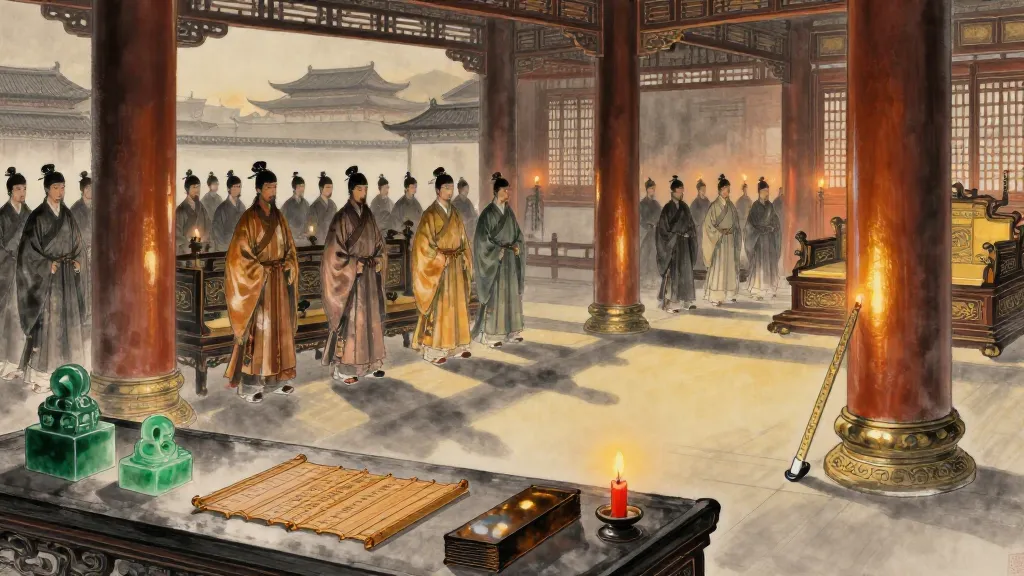
梁孝王世家 (Hereditary House of King Xiao of Liang) — Chinese ink painting

Chapter 58 of 130

梁孝王世家

Hereditary House of King Xiao of Liang

View:

梁孝王的身世與封王

King Xiao of Liang's Origins and Enfeoffment

梁孝王武者,孝文皇帝子也,而與孝景帝同母。母,竇太后也。

孝文帝凡四男:長子曰太子,是為孝景帝;次子武;次子參;次子勝。孝文帝即位二年,以武為代王,以參為太原王,以勝為梁王。二歲,徙代王為淮陽王。以代盡與太原王,號曰代王。參立十七年,孝文後二年卒,謚為孝王。子登嗣立,是為代共王。立二十九年,元光二年卒。子義立,是為代王。十九年,漢廣關,以常山為限,而徙代王王清河。清河王徙以元鼎三年也。

初,武為淮陽王十年,而梁王勝卒,謚為梁懷王。懷王最少子,愛幸異於他子。其明年,徙淮陽王武為梁王。梁王之初王梁,孝文帝之十二年也。梁王自初王通曆已十一年矣。

King Xiao of Liang, whose personal name was Wu, was a son of Emperor Wen and shared a mother with Emperor Jing. Their mother was Empress Dowager Dou.

Emperor Wen had four sons in all: the eldest was the Crown Prince, who became Emperor Jing; the second was Wu; the third, Can; the fourth, Sheng. In the second year after Emperor Wen took the throne, he made Wu King of Dai, Can King of Taiyuan, and Sheng King of Liang. Two years later, the King of Dai was transferred to become King of Huaiyang. All of Dai was given to the King of Taiyuan, who took the title King of Dai. Can reigned for seventeen years and died in the second year of the Later period of Emperor Wen, with the posthumous title King Xiao. His son Deng succeeded as King Gong of Dai, reigning twenty-nine years until the second year of Yuanguang. His son Yi succeeded as King of Dai. After nineteen years, Han extended the passes and set Changshan as the boundary, transferring the King of Dai to rule as King of Qinghe. The transfer took place in the third year of Yuanding.

Originally, Wu had been King of Huaiyang for ten years when King Sheng of Liang died, receiving the posthumous title King Huai of Liang. King Huai had been the youngest son and was loved with a special affection beyond the other sons. The following year, Wu, King of Huaiyang, was transferred to become King of Liang. His first year as King of Liang was the twelfth year of Emperor Wen. From his original enfeoffment, Wu had been a king for eleven years already.

Notes

1person梁孝王Liáng Xiào Wáng

King Xiao of Liang (梁孝王, Liu Wu 劉武, d. 144 BC) was Emperor Wen's second son and Emperor Jing's younger brother. His mother, Empress Dowager Dou (竇太后), doted on him and at one point pushed for him to be named heir — a proposal that shook the court.

2place

Liang (梁) was a kingdom centered on Suiyang (睢陽, modern Shangqiu, Henan), occupying some of the richest agricultural land in the Central Plain. It had over forty cities.

朝見與繼嗣之議

Court Visits and the Question of Succession

梁王十四年,入朝。十七年,十八年,比年入朝,留,其明年,乃之國。二十一年,入朝。二十二年,孝文帝崩。二十四年,入朝。二十五年,復入朝。是時上未置太子也。上與梁王燕飲,嘗從容言曰:"千秋萬歲後傳於王。"王辭謝。雖知非至言,然心內喜。太后亦然。

In his fourteenth year as king, the King of Liang came to court. In his seventeenth and eighteenth years, he came to court in consecutive years and stayed. The following year he returned to his kingdom. In his twenty-first year he came to court again. In his twenty-second year, Emperor Wen died. In his twenty-fourth year he came to court; in the twenty-fifth, he came again.

At this time the Emperor had not yet appointed a crown prince. During a private banquet, the Emperor said casually to the King of Liang: "After ten thousand years, I shall pass the throne to you." The king declined with polite protests. Though he knew these were not words sincerely meant, he was privately delighted. The Empress Dowager felt the same.

Notes

1context

The phrase '千秋萬歲後' ('after a thousand autumns and ten thousand years') is a euphemism for 'after my death.' Emperor Jing's remark — likely made in wine — planted a seed of ambition in his brother that would have devastating consequences.

2context

The frequency of the King of Liang's court visits was far beyond what protocol required. Han law permitted feudal kings only brief, infrequent visits. The King of Liang's repeated and prolonged stays reflect both Empress Dowager Dou's indulgence and the king's growing political ambitions.

吳楚之亂中的梁國

Liang During the Wu-Chu Rebellion

其春,吳楚齊趙七國反。吳楚先擊梁棘壁,殺數萬人。梁孝王城守睢陽,而使韓安國、張羽等為大將軍,以距吳楚。吳楚以梁為限,不敢過而西,與太尉亞夫等相距三月。吳楚破,而梁所破殺虜略與漢中分。明年,漢立太子。其後梁最親,有功,又為大國,居天下膏腴地。地北界泰山,西至高陽,四十餘城,皆多大縣。

That spring, the seven kingdoms — Wu, Chu, Qi, Zhao, and others — rebelled. Wu and Chu first struck Liang at Jibi, killing tens of thousands. King Xiao of Liang defended Suiyang from behind its walls, sending Han Anguo, Zhang Yu, and others as his Great Generals to resist Wu and Chu. Wu and Chu treated Liang as a barrier and dared not push past it westward. The standoff with Grand Commandant Yafu lasted three months. When Wu and Chu were destroyed, Liang's kills, captures, and seizures were roughly equal to those of the central Han forces.

The following year, Han appointed a crown prince. Thereafter, Liang was the closest royal kinsman, had distinguished military merit, and was a great kingdom occupying the richest land in the realm. Its territory bordered Mount Tai to the north and reached Gaoyang to the west — over forty cities, mostly large counties.

Notes

1person韓安國Hán Ānguó

Han Anguo (韓安國, d. 127 BC) was one of King Xiao's most capable officials, later serving the Han central government as a general and minister. He played a critical diplomatic role in reconciling the king with Emperor Jing after the assassination scandal.

2context

Liang's role in the Seven Kingdoms rebellion was pivotal. By holding Suiyang and absorbing the brunt of Wu and Chu's assault, Liang allowed Zhou Yafu to execute his strategy of cutting the rebels' supply lines. But the king felt his sacrifice was never properly recognized, fueling his resentment.

驕奢與僭越

Extravagance and Overstepping Royal Prerogatives

孝王,竇太后少子也,愛之,賞賜不可勝道。於是孝王築東苑,方三百餘里。廣睢陽城七十里。大治宮室,為衤復道,自宮連屬於平台三十餘里。得賜天子旌旗,出從千乘萬騎。東西馳獵,擬於天子。出言蹕,入言警。招延四方豪桀,自山以東遊說之士。莫不畢至,齊人羊勝、公孫詭、鄒陽之屬。公孫詭多奇邪計,初見王,賜千金,官至中尉,梁號之曰公孫將軍,梁多作兵器弩弓矛數十萬,而府庫金錢且百巨萬,珠玉寶器多於京師。

King Xiao was Empress Dowager Dou's youngest son, and her love for him knew no bounds — the gifts and rewards showered upon him were beyond reckoning. The king built the Eastern Park, covering over three hundred li on each side. He expanded Suiyang city by seventy li. He constructed great palace complexes and covered walkways stretching over thirty li from the palace to the Terrace of Ping. He was granted the Son of Heaven's banners and standards. When he went out, a thousand chariots and ten thousand horsemen followed. He hunted east and west in a style rivaling the Son of Heaven's. When he departed, the cry was 'Clear the road!'; when he returned, 'Alert!' He summoned talented men and wandering persuaders from all four directions, especially from east of the mountains. All came without exception — men like Yang Sheng, Gongsun Gui, and Zou Yang of Qi.

Gongsun Gui specialized in devious and unorthodox schemes. Upon first meeting the king, he was given a thousand catties of gold, rose to the rank of Commandant, and was styled "General Gongsun" in the kingdom of Liang. Liang manufactured weapons — crossbows, bows, and spears — numbering in the hundreds of thousands. Its treasury held nearly a hundred billion in cash, and its pearls, jade, and precious objects exceeded those of the capital itself.

Notes

1person鄒陽Zōu Yáng

Zou Yang (鄒陽, fl. 154 BC) was a noted essayist and persuader who served the King of Liang. He is famous for his prison letter to the king, a masterpiece of rhetorical argument that secured his release.

2context

The markers of royal excess listed here — the Son of Heaven's banners, the 'Clear the road' announcements, the massive armory — were all technically reserved for the Emperor. Sima Qian presents them as evidence of dangerous 僭越 (overstepping), a theme that runs through many Shiji chapters on vassal kings.

3person公孫詭Gōngsūn Guǐ

Gongsun Gui (公孫詭) and Yang Sheng (羊勝) were the advisors who later masterminded the assassination of Yuan Ang and other court officials, leading to the king's disgrace. Both were forced to commit suicide.

朝見與太子之爭

Court Visit and the Succession Dispute

二十九年十月,梁孝王入朝。景帝使使持節乘輿駟馬,迎梁王於關下。既朝,上疏因留,以太后親故。王入則侍景帝同輦,出則同車遊獵,射禽獸上林中。梁之侍中、郎、謁者著籍引出入天子殿門,與漢宦官無異。

十一月,上廢栗太子,竇太后心欲以孝王為後嗣。大臣及袁盎等有所關說於景帝,竇太后義格,亦遂不復言以梁王為嗣事由此。以事秘,世莫知。乃辭歸國。

In the tenth month of his twenty-ninth year, King Xiao of Liang came to court. Emperor Jing sent an envoy with the imperial tally and a four-horse imperial carriage to welcome the King of Liang at the pass. After the audience, the king petitioned to stay, citing the bond with the Empress Dowager. He entered the palace and rode the same carriage as Emperor Jing, went out hunting with him in the same chariot, and shot game in the Shanglin Park. Liang's Attendants of the Palace, Gentlemen, and Masters of Ceremony were registered and permitted to pass freely through the Son of Heaven's palace gates, no differently from Han court officials.

In the eleventh month, the Emperor deposed Crown Prince Li. Empress Dowager Dou secretly wished to make King Xiao the heir. But the great ministers, including Yuan Ang, remonstrated with Emperor Jing. The Empress Dowager's proposal was blocked on principle, and she did not raise the matter of making the King of Liang the heir again. Because the affair was kept secret, the world did not know of it. The king took his leave and returned to his kingdom.

Notes

1person袁盎Yuán Àng

Yuan Ang (袁盎, d. 148 BC) was a forthright official who opposed Empress Dowager Dou's plan to make King Xiao the heir. His principled stance cost him his life: the King of Liang had him assassinated.

2context

The attempt to make a younger brother, rather than a son, the imperial heir would have violated Zhou-dynasty precedent (立子 vs. 立弟). Yuan Ang and others argued from the Spring and Autumn Annals that brother-to-brother succession inevitably produced civil war, citing the example of Song.

刺殺袁盎與危機

The Assassination of Yuan Ang and the Crisis

其夏四月,上立膠東王為太子。梁王怨袁盎及議臣,乃與羊勝、公孫詭之屬陰使人刺殺袁盎及他議臣十餘人。逐其賊,未得也。於是天子意梁王,逐賊,果梁使之。乃遣使冠蓋相望於道,覆按梁,捕公孫詭、羊勝。公孫詭、羊勝匿王後宮。使者責二千石急,梁相軒丘豹及內史韓安國進諫王,王乃令勝、詭皆自殺,出之。上由此怨望於梁王。梁王恐,乃使韓安國因長公主謝罪太后,然後得釋。

In the fourth month of that summer, the Emperor installed the King of Jiaodong as crown prince. The King of Liang bore a grudge against Yuan Ang and the ministers who had blocked him, and secretly conspired with Yang Sheng, Gongsun Gui, and their associates to send assassins to murder Yuan Ang and more than ten other officials.

A hunt for the assassins was launched but they were not found. The Son of Heaven suspected the King of Liang. When the investigation traced the assassins, they proved to be Liang's agents. Envoys were dispatched in such numbers that their carriages were visible one after another along the road. They conducted a thorough investigation of Liang and sought to arrest Gongsun Gui and Yang Sheng. The two hid in the king's inner palace. The envoys pressed the two-thousand-bushel officials urgently. The Chancellor of Liang, Xuanqiu Bao, and the Internal Secretary Han Anguo remonstrated with the king, and the king finally ordered Sheng and Gui to kill themselves and surrendered their bodies.

The Emperor harbored deep resentment against the King of Liang. The king was terrified. He sent Han Anguo to approach the Elder Princess, who interceded with the Empress Dowager on his behalf. Only then was the matter resolved.

Notes

1person漢武帝Hàn Wǔ Dì

The King of Jiaodong (膠東王) who became crown prince was the future Emperor Wu of Han (漢武帝, Liu Che 劉徹, r. 141–87 BC), one of the most important rulers in Chinese history.

2context

The assassination of Yuan Ang and other officials was an extraordinary act of royal violence that shocked the court. That over ten officials were murdered by agents of a vassal king demonstrated both the King of Liang's recklessness and the breakdown in central control over the kingdoms.

3person館陶公主Guǎntáo Gōngzhǔ

The Elder Princess (長公主) was Princess Guan Tao (館陶公主, Liu Piao 劉嫖), Emperor Jing's elder sister and Empress Dowager Dou's daughter. She was a powerful political broker who later engineered the marriage between her daughter and the future Emperor Wu.

謝罪入京與疏遠

Apologizing in the Capital and Growing Estrangement

上怒稍解,因上書請朝。既至關,茅蘭說王,使乘布車,從兩騎入,匿於長公主園。漢使使迎王,王已入關,車騎盡居外,不知王處。太后泣曰:"帝殺吾子!"景帝憂恐。於是梁王伏斧質於闕下,謝罪,然後太后、景帝大喜,相泣,復如故。悉召王從官入關。然景帝益疏王,不同車輦矣。

The Emperor's anger gradually subsided. The king petitioned to come to court. Upon reaching the pass, Mao Lan advised the king to enter in a plain cloth-covered cart with only two riders, and to hide in the Elder Princess's garden. Han sent envoys to welcome the king, but he had already slipped through the pass. His carriages and cavalry were all outside; no one knew where the king was.

Empress Dowager Dou wept: "The Emperor has killed my son!" Emperor Jing grew anxious and fearful. Then the King of Liang prostrated himself on the executioner's block beneath the palace gate, begging forgiveness. At this the Empress Dowager and Emperor Jing were overjoyed, wept together, and relations were restored as before. All the king's attendants were summoned through the pass.

Yet Emperor Jing kept the king at greater distance from that point on, and no longer shared his carriage.

Notes

1context

The dramatic scene of the King of Liang prostrating himself on the executioner's block (斧質) was a ritual of extreme self-abasement, offering his life to the Emperor's judgment. It was a calculated gesture — entering incognito to alarm the Empress Dowager, then appearing in abject submission — that exploited the mother's love to force a reconciliation.

梁孝王之死與分國

Death of King Xiao and the Division of Liang

三十五年冬,復朝。上疏欲留,上弗許。歸國,意忽忽不樂。北獵良山,有獻牛,足出背上,孝王惡之。六月中,病熱,六日卒,謚曰孝王。

孝王慈孝,每聞太后病,口不能食,居不安寢,常欲留長安侍太后。太后亦愛之。及聞梁王薨,竇太后哭極哀,不食,曰:"帝果殺吾子!"景帝哀懼,不知所為。與長公主計之,乃分梁為五國,盡立孝王男五人為王,女五人皆食湯沐邑。於是奏之太后,太后乃說,為帝加壹餐。

梁孝王長子買為梁王,是為共王;子明為濟川王;子彭離為濟東王;子定為山陽王;子不識為濟陰王。

孝王未死時,財以巨萬計,不可勝數。及死,藏府餘黃金尚四十餘萬斤,他財物稱是。

In the winter of his thirty-fifth year, the king came to court again. He petitioned to stay, but the Emperor refused. He returned to his kingdom in a state of listless melancholy. While hunting to the north at Mount Liang, someone presented a cow with a foot growing from its back. The king took this as a dire omen. In the sixth month, he fell ill with a fever and died after six days. He was given the posthumous title King Xiao ("the Filial").

King Xiao had been devoted and filial. Whenever he heard the Empress Dowager was ill, he could not eat and could not sleep, and always wished to stay in Chang'an to attend her. The Empress Dowager loved him in return. When she learned the King of Liang had died, she wept with extreme grief and refused to eat, saying: "The Emperor has indeed killed my son!"

Emperor Jing was stricken with sorrow and fear, not knowing what to do. He consulted with the Elder Princess and decided to divide Liang into five kingdoms, installing all five of King Xiao's sons as kings and granting all five daughters revenue from bath-towns. When this was reported to the Empress Dowager, she was pleased and took one more meal on the Emperor's behalf.

The eldest son Mai became King of Liang — King Gong; Ming became King of Jichuan; Pengli became King of Jidong; Ding became King of Shanyang; Bushi became King of Jiyin.

Before King Xiao died, his wealth was counted in hundreds of millions, beyond reckoning. Upon his death, the treasury still held over four hundred thousand catties of gold, with other assets to match.

Notes

1context

The cow with a foot growing from its back was interpreted as a monstrous portent (妖) — a sign that the natural order was disturbed. In Han cosmological thinking, such anomalies presaged the death of great men or dynastic misfortune.

2context

The division of Liang into five kingdoms was a classic application of the 'push-grace' (推恩) policy later formalized under Emperor Wu. By splitting a large, powerful kingdom among multiple heirs, the central government reduced each successor state to manageable size without open confrontation.

3context

Four hundred thousand catties (斤) of gold represents an extraordinary private treasury — roughly comparable to the Han imperial reserves. This wealth had been accumulated from Liang's position astride major trade routes and its control of rich agricultural land.

梁國後嗣與平王醜聞

Liang's Successors and the Scandal of King Ping

梁共王三年,景帝崩。共王立七年卒,子襄立,是為平王。

梁平王襄十四年,母曰陳太后。共王母曰李太后。李太后,親平王之大母也。而平王之后姓任,曰任王后。任王后甚有寵於平王襄。初,孝王在時,有罍樽,直千金。孝王誡後世,善保罍樽,無得以與人。任王后聞而欲得罍樽。平王大母李太后曰:"先王有命,無得以罍樽與人。他物雖百巨萬,猶自恣也。"任王后絕欲得之。平王襄直使人開府取罍樽,賜任王后。李太后大怒,漢使者來,欲自言,平王襄及任王后遮止,閉門,李太后與爭門,措指,遂不得見漢使者。李太后亦私與食官長及郎中尹霸等士通亂,而王與任王后以此使人風止李太后,李太后內有淫行,亦已。後病薨。病時,任後未嘗請病;薨,又不持喪。

元朔中,睢陽人類犴反者,人有辱其父,而與淮陽太守客出同車。太守客出下車,類犴反殺其仇於車上而去。淮陽太守怒,以讓梁二千石。二千石以下求反甚急,執反親戚。反知國陰事,乃上變事,具告知王與大母爭樽狀。時丞相以下見知之,欲以傷梁長吏,其書聞天子。天子下吏驗問,有之。公卿請廢襄為庶人。天子曰:"李太后有淫行,而梁王襄無良師傅,故陷不義。"乃削梁八城,梟任王后首於市。梁餘尚有十城。襄立三十九年卒,謚為平王。子無傷立為梁王也。

In the third year of King Gong of Liang, Emperor Jing died. King Gong reigned seven years and died. His son Xiang succeeded — this was King Ping.

In the fourteenth year of King Ping, Xiang: his mother was Dowager Chen. King Gong's mother was Dowager Li. Dowager Li was King Ping's paternal grandmother. King Ping's consort was Queen Ren. Queen Ren was greatly favored by King Ping.

In King Xiao's time, there had been a lei ritual vessel worth a thousand catties of gold. King Xiao had instructed his descendants to preserve it carefully and never give it away. Queen Ren heard of the vessel and coveted it. The king's grandmother, Dowager Li, said: "The late king's command forbids giving the lei vessel to anyone. Other gifts, even worth a hundred billion, are yours to give as you please." Queen Ren insisted on having it. King Ping simply ordered someone to open the treasury, take the lei vessel, and give it to Queen Ren.

Dowager Li was furious. When a Han envoy arrived, she wished to present her case, but King Ping and Queen Ren blocked her, shutting the gates. Dowager Li struggled at the door and her fingers were injured. She was unable to see the Han envoy. Dowager Li, for her part, had been conducting secret affairs with the Director of the Kitchen and the Palace Gentleman Yin Ba, among others. The king and Queen Ren used this to pressure Dowager Li into silence about her own illicit conduct. She fell ill and died. During her illness, Queen Ren never inquired after her health; after her death, she observed no mourning.

During the Yuanshuo period, a man of Suiyang named Lei Anfan killed his enemy — a man who had insulted his father — in the carriage of a guest of the Governor of Huaiyang. The governor was furious and censured the two-thousand-bushel officials of Liang. They searched urgently for Anfan and arrested his relatives. Anfan, who knew the kingdom's secrets, filed a report of irregularities, fully revealing the king's quarrel with his grandmother over the vessel. Officials from the chancellor down had known of the matter and sought to use it against the Liang administration. The report reached the Son of Heaven, who sent investigators to verify it. It was confirmed.

The court ministers petitioned to depose Xiang as a commoner. The Son of Heaven said: "Dowager Li had illicit conduct, and the King of Liang had no good tutors — hence he fell into impropriety." He reduced Liang by eight cities and had Queen Ren's head displayed in the marketplace. Liang retained ten cities. Xiang reigned thirty-nine years and died, with the posthumous title King Ping. His son Wushang succeeded as King of Liang.

Notes

1context

The lei vessel (罍樽) scandal reveals the decay of the Liang royal house within two generations of King Xiao's death. The combination of family squabbles, sexual misconduct, and violence — culminating in Queen Ren's public execution — illustrates the theme of dynastic decline that pervades the Shiji's treatment of vassal kingdoms.

2context

Emperor Wu's response — punishing the kingdom but not deposing the king — followed his general policy of weakening vassal kingdoms through territorial reduction rather than outright abolition, consistent with the 'push-grace' (推恩) approach.

梁孝王諸子與太史公論贊

King Xiao's Other Sons and the Grand Historian's Appraisal

濟川王明者,梁孝王子,以桓邑侯孝景中六年為濟川王。七歲,坐射殺其中尉,漢有司請誅,天子弗忍誅,廢明為庶人。遷房陵,地入於漢為郡。

濟東王彭離者,梁孝王子,以孝景中六年為濟東王。二十九年,彭離驕悍,無人君禮,昏暮私與其奴、亡命少年數十人行剽殺人,取財物以為好。所殺發覺者百餘人,國皆知之,莫敢夜行。所殺者子上書言。漢有司請誅,上不忍,廢以為庶人,遷上庸,地入於漢,為大河郡。

山陽哀王定者,梁孝王子,以孝景中六年為山陽王。九年卒,無子,國除,地入於漢,為山陽郡。

濟陰哀王不識者,梁孝王子,以孝景中六年為濟陰王。一歲卒,無子,國除,地入於漢,為濟陰郡。

太史公曰:梁孝王雖以親愛之故,王膏腴之地,然會漢家隆盛,百姓殷富,故能植其財貨,廣宮室,車服擬於天子。然亦僭矣。

King Ming of Jichuan was a son of King Xiao of Liang. In the sixth year of the middle period of Emperor Jing, he was made King of Jichuan from his former title as Marquis of Huanyi. After seven years, he was convicted of shooting and killing his Commandant. The Han authorities requested execution, but the Son of Heaven could not bear to kill him. Ming was deposed to commoner status and relocated to Fangling. His territory reverted to Han as a commandery.

King Pengli of Jidong was a son of King Xiao of Liang, made King of Jidong in the sixth year of the middle period of Emperor Jing. After twenty-nine years, Pengli was arrogant and violent, devoid of any royal propriety. At dusk he would go out privately with his slaves and dozens of fugitive youths to rob and murder people, seizing their property for sport. Over a hundred of his victims were eventually discovered. Everyone in the kingdom knew of it; no one dared go out at night. The sons of the victims filed petitions. The Han authorities requested execution, but the Emperor could not bear it. He deposed Pengli to commoner status and relocated him to Shangyong. His territory reverted to Han as Dahe Commandery.

King Ai of Shanyang, Ding, was a son of King Xiao, made King of Shanyang in the sixth year of the middle period of Emperor Jing. He died after nine years without an heir. The kingdom was abolished and reverted to Han as Shanyang Commandery.

King Ai of Jiyin, Bushi, was a son of King Xiao, made King of Jiyin in the sixth year of the middle period of Emperor Jing. He died after one year without an heir. The kingdom was abolished and reverted to Han as Jiyin Commandery.

The Grand Historian says: King Xiao of Liang, though he ruled rich territory through the favor of kinship, benefited from the Han dynasty's flourishing and the people's prosperity, and so was able to amass his wealth, expand his palaces, and match his carriages and robes to those of the Son of Heaven. Yet this, too, was overstepping.

Notes

1context

The fates of King Xiao's five sons form a cautionary pattern: one killed his own official, another was a serial murderer, two died without heirs. Only the eldest, King Gong, produced a viable succession — and even that line was tainted by scandal. Sima Qian implies that the father's extravagance and ambition corrupted the entire house.

2translation

The Grand Historian's final word — 僭 (jiàn, 'overstepping') — is the chapter's key judgment. Despite the loving portrait of the king's filial devotion to his mother, Sima Qian's verdict is clear: the King of Liang exceeded the bounds proper to a vassal, and this arrogance was the root of his family's destruction.

褚先生補述:太后立嗣之爭

Supplement by Chu Shaosun: The Empress Dowager's Succession Dispute

褚先生曰:臣為郎時,聞之於宮殿中老郎吏好事者稱道之也。竊以為令梁孝王怨望,欲為不善者,事從中生。今太后,女主也,以愛少子故,欲令梁王為太子。大臣不時正言其不可狀,阿意治小,私說意以受賞賜,非忠臣也。齊如魏其侯竇嬰之正言也,何以有後禍?景帝與王燕見,侍太后飲,景帝曰:"千秋萬歲之後傳王。"太后喜說。竇嬰在前,據地言曰:"漢法之約,傳子適孫,今帝何以得傳弟,擅亂高帝約乎!"於是景帝默然無聲。太后意不說。

故成王與小弱弟立樹下,取一桐葉以與之,曰:"吾用封汝。"周公聞之,進見曰:"天王封弟,甚善。"成王曰:"吾直與戲耳。"周公曰:"人主無過舉,不當有戲言,言之必行之。"於是乃封小弟以應縣。是後成王沒齒不敢有戲言,言必行之。孝經曰:"非法不言,非道不行。"此聖人之法言也。今主上不宜出好言於梁王。梁王上有太后之重,驕蹇日久,數聞景帝好言,千秋萬世之後傳王,而實不行。

又諸侯王朝見天子,漢法凡當四見耳。始到,入小見;到正月朔旦,奉皮薦璧玉賀正月,法見;後三日,為王置酒,賜金錢財物;後二日,復入小見,辭去。凡留長安不過二十日。小見者,燕見於禁門內,飲於省中,非士人所得入也。今梁王西朝,因留,且半歲。入與人主同輦,出與同車。示風以大言而實不與,令出怨言,謀畔逆,乃隨而憂之,不亦遠乎!非大賢人,不知退讓。今漢之儀法,朝見賀正月者,常一王與四侯俱朝見,十餘歲一至。今梁王常比年入朝見,久留。鄙語曰"驕子不孝",非惡言也。故諸侯王當為置良師傅,相忠言之士,如汲黯、韓長孺等,敢直言極諫,安得有患害!

Chu Shaosun says: When I served as a Palace Gentleman, I heard this from elderly officials of the palace halls who delighted in such matters. In my humble opinion, what caused King Xiao of Liang to harbor resentment and contemplate wrongdoing was something that originated at court itself. The Empress Dowager, being a woman ruler, wanted the King of Liang to be made heir out of love for her youngest son. The great ministers did not speak up firmly and at the right moment about why this was impermissible; instead they pandered to her wishes and attended to trivia, hoping for private rewards — they were not loyal ministers. If they had all spoken as plainly as Dou Ying, the Marquis of Weiqi, how could there have been later calamity?

At a private banquet with the king, in attendance on the Empress Dowager, Emperor Jing said: "After ten thousand years, the throne shall pass to the King." The Empress Dowager was delighted. Dou Ying, standing before them, struck the ground and said: "The laws of Han provide that the throne passes to a son, then to a legitimate grandson. By what right does the Emperor pass it to his brother and willfully violate the covenant of Emperor Gao!" Emperor Jing fell silent. The Empress Dowager was displeased.

In ancient times, King Cheng of Zhou stood with his young brother under a tree, picked a paulownia leaf, and gave it to him, saying: "I shall enfeoff you with this." The Duke of Zhou heard of it and came before the king: "The Son of Heaven enfeoffs his brother — excellent." King Cheng said: "I was only playing." The Duke of Zhou said: "A ruler does not make idle gestures. He must not speak in jest. What he says, he must carry out." The young brother was accordingly enfeoffed with Ying. From that day until his death, King Cheng never again dared speak in jest; what he said, he carried out. The Classic of Filial Piety says: "Speak nothing that is not in accord with law; do nothing that is not in accord with the Way." These are the canonical words of the sages. The ruler ought not to have spoken fair words to the King of Liang. The king, bolstered by the Empress Dowager's authority, had grown arrogant over time. He heard Emperor Jing's fine words about passing the throne after ten thousand years, yet they were never fulfilled.

Moreover, when feudal kings come to court, Han law requires only four audiences: an initial informal audience upon arrival; a formal audience on the first day of the first month to present hides, jade, and felicitations; a banquet with gifts three days later; and a final informal audience two days after that, followed by departure — a total stay of no more than twenty days. Informal audiences are held within the restricted gates, with drinking in the inner quarters, where ordinary officials are not admitted. Yet the King of Liang came west to court and stayed nearly half a year, riding the same carriage as the sovereign going in and going out. To dangle great promises and then fail to honor them, so that the man gives voice to resentment and plots treason, and only then fret about it — is that not short-sighted? Only a man of great virtue knows when to step back. Under Han ceremonial law, kings and marquises who come for the New Year audience typically come one king and four marquises at a time, once every decade or so. Yet the King of Liang came to court almost every year and stayed for extended periods. The common saying goes: "A spoiled child is an unfilial one" — and that is no idle saying. For this reason, feudal kings should be provided with good tutors and ministers of frank counsel, men like Ji An and Han Changru, who dare to speak bluntly — then how could disaster occur?

Notes

1person褚少孫Chǔ Shàosūn

Chu Shaosun (褚少孫, fl. c. 50 BC) was a later Han scholar who supplemented Sima Qian's Shiji where sections had been lost or were incomplete. His additions are typically marked with '褚先生曰' and are stylistically distinct from Sima Qian's prose.

2person竇嬰Dòu Yīng

Dou Ying (竇嬰, d. 131 BC), Marquis of Weiqi, was a relative of Empress Dowager Dou who nonetheless opposed her plan to make the King of Liang heir. His blunt intervention at the banquet was decisive but also made him lifelong enemies.

3context

The anecdote of King Cheng and the paulownia leaf (桐葉封弟) is one of the most famous parables about the weight of a ruler's words. Chu Shaosun uses it to argue that Emperor Jing's careless remark at the banquet bore the force of a promise, and its non-fulfillment inevitably bred resentment and treason.

褚先生補述:袁盎遇刺始末

Supplement by Chu Shaosun: The Full Account of Yuan Ang's Assassination

蓋聞梁王西入朝,謁竇太后,燕見,與景帝俱侍坐於太后前,語言私說。太后謂帝曰:"吾聞殷道親親,周道尊尊,其義一也。安車大駕,用梁孝王為寄。"景帝跪席舉身曰:"諾。"罷酒出,帝召袁盎諸大臣通經術者曰:"太后言如是,何謂也?"皆對曰:"太后意欲立梁王為帝太子。"帝問其狀,袁盎等曰:"殷道親親者,立弟。周道尊尊者,立子。殷道質,質者法天,親其所親,故立弟。周道文,文者法地,尊者敬也,敬其本始,故立長子。周道,太子死,立適孫。殷道。太子死,立其弟。"帝曰:"於公何如?"皆對曰:"方今漢家法周,周道不得立弟,當立子。故春秋所以非宋宣公。宋宣公死,不立子而與弟。弟受國死,復反之與兄之子。弟之子爭之,以為我當代父後,即刺殺兄子。以故國亂,禍不絕。故春秋曰'君子大居正,宋之禍宣公為之'。臣請見太后白之。"袁盎等入見太后:"太后言欲立梁王,梁王即終,欲誰立?"太后曰:"吾復立帝子。"袁盎等以宋宣公不立正,生禍,禍亂後五世不絕,小不忍害大義狀報太后。太后乃解說,即使梁王歸就國。而梁王聞其義出於袁盎諸大臣所,怨望,使人來殺袁盎。袁盎顧之曰:"我所謂袁將軍者也,公得毋誤乎?"刺者曰:"是矣!"刺之,置其劍,劍著身。視其劍,新治。問長安中削厲工,工曰:"梁郎某子來治此劍。"以此知而發覺之,發使者捕逐之。獨梁王所欲殺大臣十餘人,文吏窮本之,謀反端頗見。太后不食,日夜泣不止。景帝甚憂之,問公卿大臣,大臣以為遣經術吏往治之,乃可解。於是遣田叔、呂季主往治之。此二人皆通經術,知大禮。來還,至霸昌廄,取火悉燒梁之反辭,但空手來對景帝。景帝曰:"何如?"對曰:"言梁王不知也。造為之者,獨其幸臣羊勝、公孫詭之屬為之耳。謹以伏誅死,梁王無恙也。"景帝喜說,曰:"急趨謁太后。"太后聞之,立起坐餐,氣平復。故曰,不通經術知古今之大禮,可以為三公及左右近臣。少見之人,如從管中闚天也。

I have heard the following account: When the King of Liang came west to court and visited Empress Dowager Dou for a private audience, he and Emperor Jing sat together attending the Empress Dowager. They spoke intimately. The Empress Dowager said to the Emperor: "I have heard that the Way of Yin favored closeness of kin, and the Way of Zhou favored reverence for rank — but the principle is one. Let the royal carriage and the grand equipage rest with King Xiao of Liang as my trust." Emperor Jing rose on his mat and said: "Agreed."

After the drinking ended and they withdrew, the Emperor summoned Yuan Ang and other great ministers versed in the classics: "The Empress Dowager spoke thus — what does she mean?" They all replied: "The Empress Dowager intends to make the King of Liang the imperial heir." The Emperor asked for their analysis. Yuan Ang and others said: "The Yin Way of favoring kin means installing a brother. The Zhou Way of favoring rank means installing a son. The Yin Way was plain and modeled on Heaven — it favors those who are close, hence installs a brother. The Zhou Way was refined and modeled on Earth — reverence means respecting origins, hence installs the eldest son. Under Zhou practice, if the crown prince dies, the legitimate grandson succeeds. Under Yin practice, the brother succeeds."

The Emperor asked: "In your judgment, which applies?" They all replied: "Han currently follows Zhou. Under Zhou law one cannot install a brother — one must install a son. This is precisely why the Spring and Autumn Annals criticizes Duke Xuan of Song. Duke Xuan died and passed the state to his brother instead of his son. When the brother died, he returned it to the elder brother's son. The brother's son contested this, claiming he should succeed his own father, and assassinated the brother's nephew. The state fell into chaos and the disasters continued for five generations. Hence the Spring and Autumn Annals says: 'The noble man values adherence to the correct. Song's misfortunes were Duke Xuan's making.' Let us see the Empress Dowager and explain this."

Yuan Ang and the others went in to see the Empress Dowager: "Your Majesty wishes to install the King of Liang. When the King of Liang dies, whom will you install then?" The Empress Dowager said: "I will install the Emperor's son again." Yuan Ang and the others reported the case of Duke Xuan of Song, whose failure to install the rightful heir produced disasters lasting five generations — showing that small indulgence harms the greater principle. The Empress Dowager understood and relented, immediately sending the King of Liang back to his kingdom.

But the King of Liang learned that the argument had originated with Yuan Ang and the other ministers. He harbored a grievance and sent men to kill Yuan Ang. When the assassin struck, Yuan Ang turned and said: "I am the one called General Yuan — are you sure you have the right man?" The assassin said: "You are the one!" He stabbed him and left his sword in the body.

Examining the sword, it was newly polished. Inquiries among the sword-grinders of Chang'an produced a craftsman who said: "A certain young gentleman from Liang brought this sword to be polished." From this the connection was discovered, and envoys were sent to pursue the matter. In all, the King of Liang had wanted to assassinate over ten senior officials. The investigating clerks traced the conspiracy to its root, and clear evidence of a treasonous plot emerged.

The Empress Dowager refused to eat and wept day and night without stopping. Emperor Jing was deeply worried and consulted the ministers. The ministers advised sending officials versed in the classics to handle the investigation, as only such men could resolve the situation. Tian Shu and Lü Jizhu were dispatched. Both were learned in the classics and understood the great rites. On their return, they stopped at the post station at Bachang, set fire to all the documentary evidence of Liang's treasonous statements, and came before Emperor Jing empty-handed.

The Emperor asked: "What is the verdict?" They replied: "The King of Liang knew nothing of it. The perpetrators were solely his favored ministers Yang Sheng, Gongsun Gui, and their associates. They have been duly executed. The King of Liang is unharmed." Emperor Jing was delighted: "Go at once and report to the Empress Dowager." When the Empress Dowager heard, she immediately sat up, ate a meal, and her spirits were restored.

Hence it is said: Those who master the classics and understand the great rites of past and present are fit to serve as one of the Three Excellencies or as a close attendant of the ruler. Men of narrow experience are like those who peer at heaven through a tube.
Notes

1context

Tian Shu and Lü Jizhu's decision to burn the evidence was an act of political wisdom disguised as judicial resolution. By destroying proof of treason, they preserved the fiction that the king was innocent, satisfying the Empress Dowager and avoiding a constitutional crisis — while the actual perpetrators were still punished.

2context

The precedent of Duke Xuan of Song (宋宣公) passing the throne to his brother rather than his son, which produced generations of civil war, was a classic argument from the Spring and Autumn Annals used against brother-to-brother succession. It proved persuasive even to Empress Dowager Dou.

3context

Yuan Ang's composure at his assassination — confirming his identity to the assassin — is presented as a mark of a man who accepts the consequences of principled action. The detail of the newly polished sword providing the forensic clue is a touch of narrative craft.

Edition & Source

Text
《史記》 Shiji
Edition
中華古詩文古書籍網 transcription
Commentary
裴駰《史記集解》、司馬貞《史記索隱》、張守節《史記正義》(Three Commentaries)