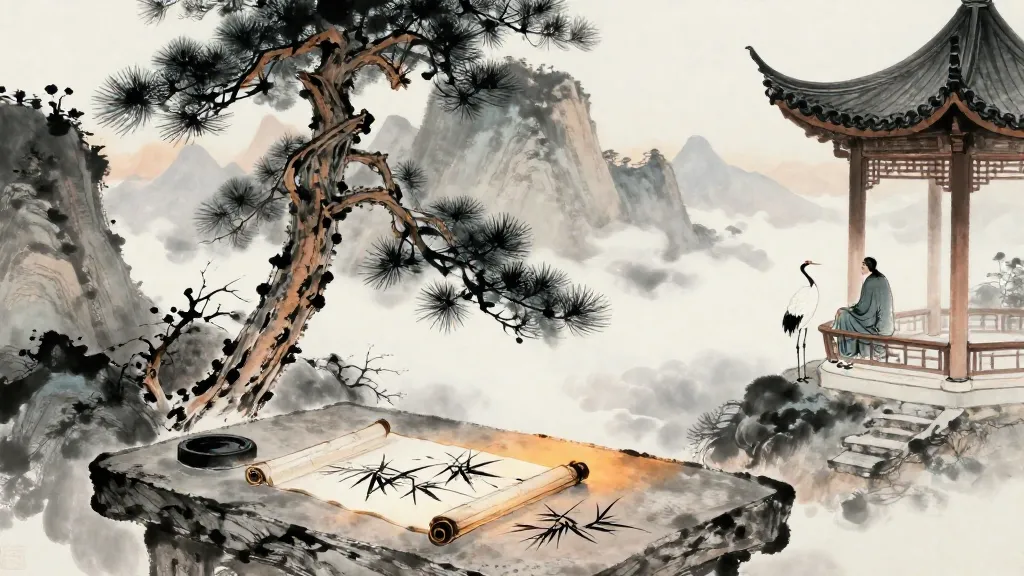
管晏列傳 (Biographies of Guan Zhong and Yan Ying) — Chinese ink painting

Chapter 62 of 130

管晏列傳

Biographies of Guan Zhong and Yan Ying

View:

管仲與鮑叔牙之交

The Friendship of Guan Zhong and Bao Shuya

管仲夷吾者,潁上人也。少時常與鮑叔牙游,鮑叔知其賢。管仲貧困,常欺鮑叔,鮑叔終善遇之,不以為言。已而鮑叔事齊公子小白,管仲事公子糾。及小白立為桓公,公子糾死,管仲囚焉。鮑叔遂進管仲。管仲既用,任政於齊,齊桓公以霸,九合諸侯,一匡天下,管仲之謀也。

Guan Zhong, whose personal name was Yiwu, was a man of Yingshang. In his youth he often spent time with Bao Shuya, and Bao Shu recognized his ability. Guan Zhong was poor and frequently took advantage of Bao Shu in their dealings, yet Bao Shu always treated him well and never raised the matter. In time, Bao Shu entered the service of Prince Xiaobai of Qi, while Guan Zhong served Prince Jiu. When Xiaobai was installed as Duke Huan, Prince Jiu was killed and Guan Zhong was imprisoned. Bao Shu then recommended Guan Zhong. Once employed, Guan Zhong took charge of Qi's government. Duke Huan of Qi rose to hegemony, convened the lords nine times, and brought order to All-Under-Heaven — all through Guan Zhong's counsel.

Notes

1person管仲Guǎn Zhòng

Guan Zhong (管仲, d. 645 BC), personal name Yiwu (夷吾), was chief minister of Qi under Duke Huan. He is credited with making Qi the first of the Five Hegemons of the Spring and Autumn period. The philosophical text Guanzi is attributed to him.

2person鮑叔牙Bào Shūyá

Bao Shuya (鮑叔牙) was Guan Zhong's lifelong friend. His willingness to recommend Guan Zhong over himself became a famous example of selfless friendship (管鮑之交).

3person齊桓公Qí Huán Gōng

Duke Huan of Qi (齊桓公, r. 685–643 BC) was the first of the Five Hegemons. Under Guan Zhong's guidance, he convened the lords and maintained order in the name of the Zhou king.

4place

Yingshang (潁上) is in modern Yingshang County, Anhui province, near the Ying River.

管仲論知己

Guan Zhong on His True Friend

管仲曰:「吾始困時,嘗與鮑叔賈,分財利多自與,鮑叔不以我為貪,知我貧也。吾嘗為鮑叔謀事而更窮困,鮑叔不以我為愚,知時有利不利也。吾嘗三仕三見逐於君,鮑叔不以我為不肖,知我不遭時也。吾嘗三戰三走,鮑叔不以我怯,知我有老母也。公子糾敗,召忽死之,吾幽囚受辱,鮑叔不以我為無恥,知我不羞小節而恥功名不顯於天下也。生我者父母,知我者鮑子也。」

Guan Zhong said: "When I was poor, I once went into trade with Bao Shu and took the larger share of the profits. Bao Shu did not consider me greedy — he knew I was poor. I once made plans for Bao Shu that only left him worse off. Bao Shu did not consider me foolish — he knew that circumstances can be favorable or not. I was three times appointed to office and three times dismissed by the ruler. Bao Shu did not consider me unworthy — he knew I had not met the right moment. I fought in three battles and fled three times. Bao Shu did not consider me a coward — he knew I had an aged mother. When Prince Jiu was defeated, Shao Hu died for him, while I submitted to imprisonment and disgrace. Bao Shu did not consider me shameless — he knew that I felt no shame over small proprieties, only shame that my name and achievements had not yet shone across All-Under-Heaven. Those who gave me life were my parents; the one who understood me was Bao Shu."

Notes

1person召忽Shào Hū

Shao Hu (召忽) was a fellow retainer of Prince Jiu who killed himself when Jiu was defeated, following the ethic that a loyal minister dies with his lord.

鮑叔薦管仲與知人之名

Bao Shu's Recommendation and His Fame for Judging Men

鮑叔既進管仲,以身下之。子孫世祿於齊,有封邑者十餘世,常為名大夫。天下不多管仲之賢而多鮑叔能知人也。

After Bao Shu recommended Guan Zhong, he placed himself beneath him. His descendants received hereditary stipends in Qi, holding fiefs for more than ten generations and always serving as distinguished ministers. All-Under-Heaven did not so much praise Guan Zhong's ability as praise Bao Shu's capacity for knowing men.

管仲治齊之道

Guan Zhong's Governance of Qi

管仲既任政相齊,以區區之齊在海濱,通貨積財,富國彊兵,與俗同好惡。故其稱曰:「倉廩實而知禮節,衣食足而知榮辱,上服度則六親固。四維不張,國乃滅亡。下令如流水之原,令順民心。」故論卑而易行。俗之所欲,因而予之;俗之所否,因而去之。

其為政也,善因禍而為福,轉敗而為功。貴輕重,慎權衡。桓公實怒少姬,南襲蔡,管仲因而伐楚,責包茅不入貢於周室。桓公實北征山戎,而管仲因而令燕修召公之政。於柯之會,桓公欲背曹沫之約,管仲因而信之,諸侯由是歸齊。故曰:「知與之為取,政之寶也。」

Once Guan Zhong was appointed chief minister of Qi, he took that small state on the seacoast and opened trade, accumulated wealth, enriched the state and strengthened its armies, aligning policy with the people's own preferences. Hence his famous dictum: "When the granaries are full, men learn propriety; when they have enough food and clothing, they learn honor and shame. When those above observe proper measure, the six bonds of kinship hold firm. If the four cardinal virtues are not upheld, the state will perish. Issue orders like water flowing from its source — let commands follow the people's hearts." His principles were simple and easy to carry out. What the people desired, he gave them; what they rejected, he abolished.

In governance, he excelled at turning misfortune into advantage and converting defeat into achievement. He valued the art of leverage and was careful in weighing options. When Duke Huan, truly angry at Lady Shao Ji, marched south and attacked Cai, Guan Zhong seized the opportunity to campaign against Chu, demanding why they had not sent the ritual rush-wrapping as tribute to the Zhou royal house. When Duke Huan truly marched north against the Shanrong, Guan Zhong used the occasion to order Yan to revive the governance of the Duke of Shao. At the Ke assembly, when Duke Huan wished to go back on his agreement with Cao Mo, Guan Zhong held him to it, and the lords rallied to Qi as a result. Hence it is said: "To know that giving is the means of taking — that is the treasure of statecraft."

Notes

1context

The 'four cardinal virtues' (四維) in Guan Zhong's thought are propriety (禮), righteousness (義), integrity (廉), and shame (恥). This is distinct from the Confucian cardinal virtues.

2person曹沫Cáo Mò

Cao Mo (曹沫) was a general of Lu who, at the Ke assembly (681 BC), held Duke Huan at knifepoint and forced him to return territories seized from Lu. Guan Zhong insisted the duke honor the coerced agreement.

3place

Cai (蔡) was a small state in modern Shangcai County, Henan. The 'attack on Cai' in 656 BC was the pretext for Guan Zhong's famous confrontation with Chu.

管仲之富與晏子之始

Guan Zhong's Wealth and the Arrival of Yan Ying

管仲富擬於公室,有三歸、反坫,齊人不以為侈。管仲卒,齊國遵其政,常彊於諸侯。後百餘年而有晏子焉。

Guan Zhong's wealth rivaled that of the ducal house. He had the Three Returns and the reversed altar-stand — yet the people of Qi did not consider him extravagant. After Guan Zhong died, Qi continued to follow his policies and remained constantly powerful among the lords. More than a hundred years later came Yan Ying.

Notes

1context

The 'Three Returns' (三歸) and 'reversed altar-stand' (反坫) were luxuries typically reserved for the ruler. Confucius criticized Guan Zhong for these in the Analects (3.22), yet Sima Qian notes the Qi people accepted them.

晏平仲事齊三世

Yan Pingzhong Serves Three Dukes of Qi

晏平仲嬰者,萊之夷維人也。事齊靈公、莊公、景公,以節儉力行重於齊。既相齊,食不重肉,妾不衣帛。其在朝,君語及之,即危言;語不及之,即危行。國有道,即順命;無道,即衡命。以此三世顯名於諸侯。

Yan Pingzhong, whose name was Ying, was a man of Yiwei in Lai. He served Duke Ling, Duke Zhuang, and Duke Jing of Qi, and was valued in Qi for his frugality and vigorous conduct. As chief minister of Qi, he did not eat two meat dishes at a meal, and his concubines did not wear silk. At court, when the ruler addressed him on a matter, he spoke forthright words; when he was not addressed, he demonstrated forthright conduct. When the state had the Way, he carried out his orders faithfully; when it lacked the Way, he weighed them against principle. Through this he maintained his renown among the lords across three reigns.

Notes

1person晏嬰Yàn Yīng

Yan Ying (晏嬰, d. 500 BC), styled Pingzhong (平仲), was chief minister of Qi under three dukes. He was famous for his frugality, sharp wit, and moral courage. The Yanzi Chunqiu (晏子春秋) is a collection of anecdotes about him.

2place

Lai (萊) was an ancient state absorbed by Qi, located in the area of modern Huangxian (now Longkou), Shandong. Yiwei (夷維) was a settlement within it.

晏子贖越石父

Yan Ying Ransoms Yue Shifu

越石父賢,在縲紲中。晏子出,遭之塗,解左驂贖之,載歸。弗謝,入閨。久之,越石父請絕。晏子戄然,攝衣冠謝曰:「嬰雖不仁,免子於戹,何子求絕之速也?」石父曰:「不然。吾聞君子詘於不知己而信於知己者。方吾在縲紲中,彼不知我也。夫子既已感寤而贖我,是知己;知己而無禮,固不如在縲紲之中。」晏子於是延入為上客。

Yue Shifu was a worthy man held in chains. Yan Ying went out, encountered him on the road, unhitched his left trace-horse to ransom him, and took him home in his carriage. Without a word of greeting, Yan Ying went inside. After a long time, Yue Shifu asked to sever their relationship. Yan Ying was startled. He straightened his cap and robes, apologized, and said: "Though I am not a humane man, I freed you from hardship — why do you seek to break with me so quickly?" Shifu said: "Not so. I have heard that a gentleman suffers disregard from those who do not know him but finds fulfillment with those who do. While I was in chains, they did not know me. But you, sir, awakened to my worth and ransomed me — that makes you one who knows me. To know me and yet show no courtesy is surely worse than remaining in chains." Yan Ying then invited him in and treated him as his most honored guest.

Notes

1person越石父Yuè Shífù

Yue Shifu (越石父) was a worthy man of Qi who had fallen into servitude. His exchange with Yan Ying became a classic illustration of the concept of 'knowing' (知己) — recognizing another's true worth.

晏子御者之妻

The Wife of Yan Ying's Charioteer

晏子為齊相,出,其御之妻從門間而闚其夫。其夫為相御,擁大蓋,策駟馬,意氣揚揚甚自得也。既而歸,其妻請去。夫問其故。妻曰:「晏子長不滿六尺,身相齊國,名顯諸侯。今者妾觀其出,志念深矣,常有以自下者。今子長八尺,乃為人仆御,然子之意自以為足,妾是以求去也。」其後夫自抑損。晏子怪而問之,御以實對。晏子薦以為大夫。

When Yan Ying was chief minister of Qi, he went out, and his charioteer's wife peeked through the gate to watch her husband. Her husband, driving the minister's carriage, held the great canopy aloft and whipped the four-horse team, swelling with self-satisfaction. When he returned home, his wife asked to leave him. He asked why. She said: "Yan Ying is not even six feet tall, yet he serves as chief minister of Qi and his name is known among all the lords. Today when I watched him go out, his thoughts ran deep and he constantly carried himself with humility. You are eight feet tall, yet you are merely a man's driver — and you act as though that were quite enough. That is why I wish to leave." After that, the husband restrained himself and became self-effacing. Yan Ying found the change strange and asked about it. The charioteer told him the truth. Yan Ying recommended him for appointment as a senior minister.

Notes

1context

The 'six feet' (六尺) here uses the ancient Chinese foot (尺), which was approximately 23 cm in the Spring and Autumn period, making six feet about 138 cm (4'6"). This anecdote emphasizes Yan Ying's humility despite his small stature.

太史公論管晏

The Grand Historian's Assessment of Guan Zhong and Yan Ying

太史公曰:吾讀管氏牧民、山高、乘馬、輕重、九府,及晏子春秋,詳哉其言之也。既見其著書,欲觀其行事,故次其傳。至其書,世多有之,是以不論,論其軼事。

管仲世所謂賢臣,然孔子小之。豈以為周道衰微,桓公既賢,而不勉之至王,乃稱霸哉?語曰「將順其美,匡救其惡,故上下能相親也」。豈管仲之謂乎?

方晏子伏莊公屍哭之,成禮然後去,豈所謂「見義不為無勇」者邪?至其諫說,犯君之顏,此所謂「進思盡忠,退思補過」者哉!假令晏子而在,余雖為之執鞭,所忻慕焉。

The Grand Historian says: I have read the Guanzi chapters "Shepherding the People," "Mountain Heights," "Riding the Horse," "Light and Heavy," and "Nine Treasuries," as well as the Yanzi Chunqiu — how detailed their words are! Having seen their writings, I wished to observe their actual deeds, and so I arranged this biography. As for their books, the world has many copies, so I will not discuss them here but rather record their lesser-known episodes.

Guan Zhong is universally called a worthy minister, yet Confucius belittled him. Was it because, with the Way of Zhou in decline and Duke Huan already capable, Guan Zhong did not urge him toward true kingship but stopped at hegemony? The saying goes: "Encourage his virtues, correct his faults, and so ruler and minister may be close." Does this not describe Guan Zhong?

When Yan Ying threw himself upon the corpse of Duke Zhuang and wept, completing the rites of mourning before departing — was this not what is meant by "to see what is right and not act on it is cowardice"? And his remonstrances, confronting the ruler to his face — is this not what is meant by "in office, think only of giving your utmost loyalty; in retirement, think only of mending faults"? If Yan Ying were alive today, I would gladly serve as his whip-bearer — that is how much I admire him.

Notes

1person齊莊公Qí Zhuāng Gōng

Duke Zhuang of Qi (齊莊公, r. 553–548 BC) was assassinated by Cui Zhu (崔杼) in 548 BC. Yan Ying went to the scene, mourned properly, and departed — neither joining the assassins nor dying pointlessly.

2context

Sima Qian's closing wish to 'serve as whip-bearer' (執鞭) for Yan Ying mirrors Confucius's remark about wealth-seeking, creating a deliberate echo with the Bo Yi chapter that precedes this one.

Edition & Source

Text
《史記》 Shiji
Edition
中華古詩文古書籍網 transcription
Commentary
裴駰《史記集解》、司馬貞《史記索隱》、張守節《史記正義》(Three Commentaries)