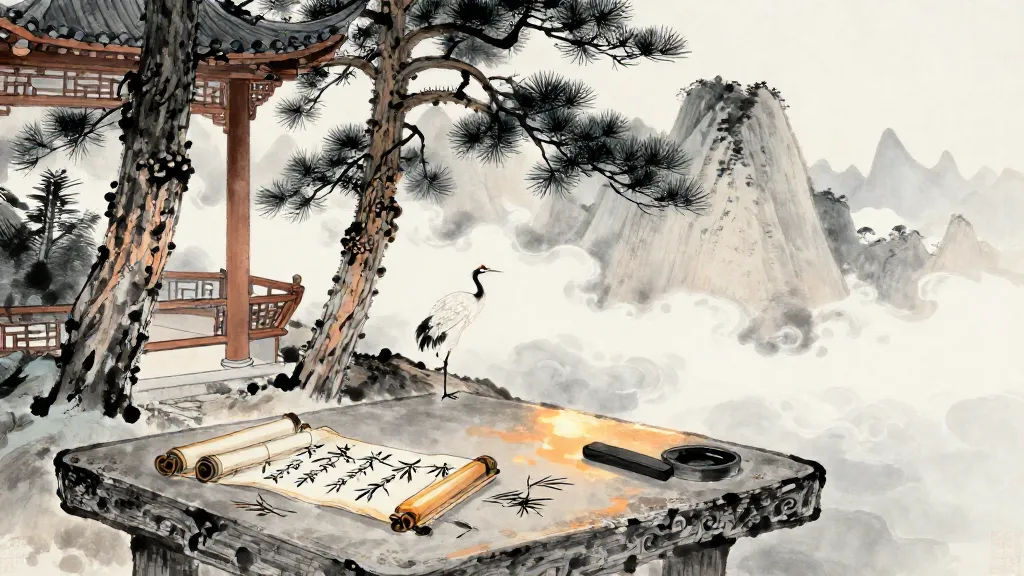
老子韓非列傳 (Biographies of Laozi and Han Fei) — Chinese ink painting

Chapter 63 of 130

老子韓非列傳

Biographies of Laozi and Han Fei

View:

老子其人與孔子問禮

Laozi the Man and Confucius Asks About Ritual

老子者,楚苦縣厲鄉曲仁里人也,姓李氏,名耳,字聃,周守藏室之史也。

孔子適周,將問禮於老子。老子曰:「子所言者,其人與骨皆已朽矣,獨其言在耳。且君子得其時則駕,不得其時則蓬累而行。吾聞之,良賈深藏若虛,君子盛德容貌若愚。去子之驕氣與多欲,態色與淫志,是皆無益於子之身。吾所以告子,若是而已。」孔子去,謂弟子曰:「鳥,吾知其能飛;魚,吾知其能游;獸,吾知其能走。走者可以為罔,游者可以為綸,飛者可以為矰。至於龍,吾不能知其乘風雲而上天。吾今日見老子,其猶龍邪!」

Laozi was a man of Quren village, Li township, Ku district in Chu. His surname was Li, his given name Er, and his courtesy name Dan. He served as keeper of the archives at the Zhou court.

Confucius traveled to Zhou intending to ask Laozi about ritual. Laozi said: "The men you speak of — their bones have long since rotted, and only their words remain. Moreover, when a gentleman meets his moment, he rides forth; when the moment does not come, he drifts along like tumbling weeds. I have heard it said: a good merchant hides his goods deep and appears to have nothing; a gentleman of abundant virtue has the bearing of a fool. Strip away your arrogance and your many desires, your affected manner and your excessive ambitions — none of these profit you. That is all I have to tell you." After Confucius departed, he told his disciples: "Birds — I know they can fly. Fish — I know they can swim. Beasts — I know they can run. What runs can be caught in nets, what swims can be caught on lines, what flies can be brought down with arrows. But the dragon — I cannot fathom how it rides wind and cloud up to heaven. Today I have met Laozi. He is like a dragon!"

Notes

1person老子Lǎozǐ

Laozi (老子), personal name Li Er (李耳), courtesy name Dan (聃), is the legendary founder of Daoism and supposed author of the Dao De Jing. His historicity is debated; Sima Qian himself notes multiple contradictory accounts.

2place

Ku district (苦縣) in Chu was in the area of modern Luyi County, Henan province. It is traditionally regarded as Laozi's birthplace.

3context

The 'archives' (守藏室) of the Zhou court were the royal repository of documents and records. This position gave Laozi access to the full range of Zhou learning and may explain the breadth of knowledge attributed to him.

老子著書與隱去

Laozi Writes His Book and Vanishes

老子脩道德,其學以自隱無名為務。居周久之,見周之衰,乃遂去。至關,關令尹喜曰:「子將隱矣,彊為我著書。」於是老子乃著書上下篇,言道德之意五千餘言而去,莫知其所終。

或曰:老萊子亦楚人也,著書十五篇,言道家之用,與孔子同時雲。

蓋老子百有六十餘歲,或言二百餘歲,以其脩道而養壽也。

Laozi cultivated the Way and its Virtue. His teaching made self-concealment and anonymity its central aim. He lived at the Zhou court for a long time, but seeing the decline of Zhou, he departed. When he reached the pass, the Keeper of the Pass, Yin Xi, said: "You are about to go into seclusion. I insist that you write a book for me." Thereupon Laozi wrote a book in two parts, setting forth the meaning of the Way and its Virtue in over five thousand words, and departed. No one knows where he ended his days.

Some say that Lao Laizi was also a man of Chu who wrote fifteen chapters on the practical application of Daoist thought and was a contemporary of Confucius.

It is said that Laozi lived over one hundred and sixty years — some say over two hundred — because he cultivated the Way and thereby nourished his longevity.

Notes

1person尹喜Yǐn Xǐ

Yin Xi (尹喜), the Keeper of the Pass (關令), was traditionally stationed at Hangu Pass (函谷關). According to legend, he recognized Laozi by a purple aura approaching from the east and persuaded him to write the Dao De Jing before departing.

2place

The 'pass' (關) is traditionally identified as Hangu Pass (函谷關), located in modern Lingbao, Henan province, the strategic gateway between the Central Plains and the west.

老子身後與後人

The Question of Laozi's Identity and His Descendants

自孔子死之後百二十九年,而史記周太史儋見秦獻公曰:「始秦與周合,合五百歲而離,離七十歲而霸王者出焉。」或曰儋即老子,或曰非也,世莫知其然否。老子,隱君子也。

老子之子名宗,宗為魏將,封於段乾。宗子注,注子宮,宮玄孫假,假仕於漢孝文帝。而假之子解為膠西王卬太傅,因家於齊焉。

世之學老子者則絀儒學,儒學亦絀老子。「道不同不相為謀」,豈謂是邪?李耳無為自化,清靜自正。

One hundred and twenty-nine years after Confucius died, the records state that the Grand Historian Dan of Zhou had an audience with Duke Xian of Qin and said: "Once Qin and Zhou were united. After five hundred years they will separate, and seventy years after the separation, a hegemon-king will arise." Some say Dan was Laozi; others say not. The world does not know the truth of it. Laozi was a reclusive gentleman.

Laozi's son was named Zong. Zong served as a general of Wei and was enfeoffed at Duangan. Zong's son was Zhu; Zhu's son was Gong; Gong's great-great-grandson was Jia. Jia served Emperor Wen of Han. Jia's son, Jie, became Grand Tutor to King Ang of Jiaoxi, and the family settled in Qi.

Those in the world who study Laozi deprecate Confucian learning, and the Confucians likewise deprecate Laozi. "Those whose ways differ do not plan together" — is this not what it means? Li Er taught non-action and spontaneous transformation, stillness and spontaneous rectification.

Notes

1person太史儋Tàishǐ Dān

Grand Historian Dan (太史儋) of Zhou visited Qin in 374 BC. The confusion between him and Laozi reflects the deep uncertainty about Laozi's dates — if they were the same person, Laozi would have lived an impossibly long time.

2person秦獻公Qín Xiàn Gōng

Duke Xian of Qin (秦獻公, r. 384–362 BC) was the Qin ruler who initiated reforms that would later be continued by his grandson Duke Xiao and the Legalist minister Shang Yang.

莊子其人

Zhuangzi the Man

莊子者,蒙人也,名周。周嘗為蒙漆園吏,與梁惠王、齊宣王同時。其學無所不闚,然其要本歸於老子之言。故其著書十餘萬言,大抵率寓言也。作漁父、盜跖、胠篋,以詆訿孔子之徒,以明老子之術。畏累虛、亢桑子之屬,皆空語無事實。然善屬書離辭,指事類情,用剽剝儒、墨,雖當世宿學不能自解免也。其言洸洋自恣以適己,故自王公大人不能器之。

Zhuangzi was a man of Meng, named Zhou. He once served as an official of the lacquer garden at Meng, and was a contemporary of King Hui of Liang and King Xuan of Qi. His learning penetrated every field, but its essentials always traced back to Laozi's teachings. He wrote over a hundred thousand words, most of them parables. He composed "The Old Fisherman," "Robber Zhi," and "Rifling Trunks" to ridicule the followers of Confucius and to illuminate Laozi's methods. The "Wei Lei Xu" and "Kang Sang Zi" chapters and the like are all empty words without factual basis. Yet he was skilled at stringing together words and phrases, pointing to things and drawing parallels, and used these to flay the Confucians and Mohists — even the most established scholars of the age could not defend themselves against him. His words surged and flowed unchecked, pleasing only himself, and so from kings and great lords on down, none could put him to use.

Notes

1person莊周Zhuāng Zhōu

Zhuangzi (莊子, c. 369–286 BC), personal name Zhuang Zhou (莊周), was one of the greatest Chinese philosophers and prose stylists. The text bearing his name is a foundational work of Daoist thought.

2place

Meng (蒙) was in the state of Song, near modern Shangqiu, Henan province.

3person梁惠王Liáng Huì Wáng

King Hui of Liang (梁惠王, r. 369–319 BC), also known as King Hui of Wei, was the ruler who famously conversed with Mencius. His overlapping dates with Zhuangzi place Zhuangzi in the mid-4th century BC.

莊子拒楚相位

Zhuangzi Refuses the Chancellorship of Chu

楚威王聞莊周賢,使使厚幣迎之,許以為相。莊周笑謂楚使者曰:「千金,重利;卿相,尊位也。子獨不見郊祭之犧牛乎?養食之數歲,衣以文繡,以入大廟。當是之時,雖欲為孤豚,豈可得乎?子亟去,無污我。我寧遊戲污瀆之中自快,無為有國者所羈,終身不仕,以快吾志焉。」

King Wei of Chu, hearing that Zhuang Zhou was a worthy, sent envoys with lavish gifts to invite him and promised to make him chancellor. Zhuang Zhou laughed and told the Chu envoys: "A thousand in gold is a handsome profit; a chancellorship is an honored position. But have you not seen the sacrificial ox at the suburban altar? It is fed and fattened for several years, draped in embroidered cloth, and led into the great temple. At that moment, even if it wished to be a solitary piglet, how could it? Leave at once — do not defile me. I would rather play and take my pleasure in a muddy ditch than be bridled by the ruler of a state. I will never hold office — that is what pleases my spirit."

Notes

1person楚威王Chǔ Wēi Wáng

King Wei of Chu (楚威王, r. 339–329 BC) was a powerful ruler who expanded Chu's territory. This anecdote, also found in the Zhuangzi text itself, encapsulates Zhuangzi's rejection of political power.

申不害事韓

Shen Buhai Serves Han

申不害者,京人也,故鄭之賤臣。學術以乾韓昭侯,昭侯用為相。內脩政教,外應諸侯,十五年。終申子之身,國治兵彊,無侵韓者。

申子之學本於黃老而主刑名。著書二篇,號曰申子。

Shen Buhai was a man of Jing, formerly a minor official of Zheng. He used his learning to gain an audience with Marquis Zhao of Han, who appointed him chancellor. He reformed domestic governance and managed foreign relations with the other lords for fifteen years. Throughout Shen Buhai's lifetime, the state was well-ordered, the army was strong, and no one dared to attack Han.

Shen Buhai's learning was rooted in the Yellow Emperor-Laozi tradition but focused on the matching of titles and performance. He wrote two chapters of a book called the Shenzi.

Notes

1person申不害Shēn Bùhài

Shen Buhai (申不害, d. 337 BC) was chancellor of Han for fifteen years under Marquis Zhao. He is known as the theorist of 'methods' (術, shu) — techniques of bureaucratic control, particularly the doctrine that titles must match actual performance (刑名).

2person韓昭侯Hán Zhāo Hóu

Marquis Zhao of Han (韓昭侯, r. 362–333 BC) was the ruler who employed Shen Buhai's Legalist reforms to strengthen the small state of Han.

3place

Jing (京) was originally part of Zheng, located near modern Xingyang, Henan province. After Zheng was conquered by Han in 375 BC, it became part of Han.

韓非其人與著書

Han Fei the Man and His Writings

韓非者,韓之諸公子也。喜刑名法術之學,而其歸本於黃老。非為人口吃,不能道說,而善著書。與李斯俱事荀卿,斯自以為不如非。

非見韓之削弱,數以書諫韓王,韓王不能用。於是韓非疾治國不務脩明其法制,執勢以御其臣下,富國彊兵而以求人任賢,反舉浮淫之蠹而加之於功實之上。以為儒者用文亂法,而俠者以武犯禁。寬則寵名譽之人,急則用介冑之士。今者所養非所用,所用非所養。悲廉直不容於邪枉之臣,觀往者得失之變,故作孤憤、五蠹、內外儲、說林、說難十餘萬言。

Han Fei was a prince of the Han royal house. He took delight in the study of title-and-performance, law, and technique, and his thought was ultimately rooted in the Yellow Emperor-Laozi tradition. Han Fei had a stutter and could not argue persuasively in speech, but he excelled at writing. He and Li Si both studied under Xun Qing; Li Si considered himself inferior to Han Fei.

Han Fei saw that Han was growing weaker. He repeatedly submitted written memorials to the King of Han, but the king could not put them to use. Han Fei was angered that in governing the state they did not devote themselves to clarifying the legal system, wielding authority to control their ministers, enriching the state and strengthening the army by seeking out and employing the capable. Instead, they elevated frivolous parasites and placed them above men of real achievement. He held that the Confucians used their writings to subvert the law, and the swordsmen used their martial prowess to violate the prohibitions. In lenient times, the court favored men of reputation; in emergencies, it called upon men in armor. Those it nurtured were not those it used; those it used were not those it had nurtured. Grieving that honest and upright men found no place among crooked ministers, and observing the patterns of success and failure in the past, he wrote 'The Solitary Indignation,' 'The Five Vermin,' 'Inner and Outer Collections of Sayings,' 'Forest of Persuasions,' and 'The Difficulty of Persuasion' — over a hundred thousand words in all.

Notes

1person韓非Hán Fēi

Han Fei (韓非, c. 280–233 BC) was the greatest theorist of Legalism. A prince of Han, he synthesized the doctrines of Shang Yang (法, law), Shen Buhai (術, technique), and Shen Dao (勢, positional advantage) into a unified political philosophy.

2person李斯Lǐ Sī

Li Si (李斯, c. 284–208 BC), fellow student of Han Fei under Xunzi, became the chief minister of Qin who helped the First Emperor unify China. He later engineered Han Fei's death.

3person荀子Xúnzǐ

Xun Qing (荀卿), i.e. Xunzi (荀子, c. 310–235 BC), was a major Confucian philosopher who, paradoxically, trained the two most famous Legalists: Han Fei and Li Si.

說難

The Difficulty of Persuasion

然韓非知說之難,為說難書甚具,終死於秦,不能自脫。

說難曰:

凡說之難,非吾知之有以說之難也;又非吾辯之難能明吾意之難也;又非吾敢橫失能盡之難也。凡說之難,在知所說之心,可以吾說當之。

所說出於為名高者也,而說之以厚利,則見下節而遇卑賤,必棄遠矣。所說出於厚利者也,而說之以名高,則見無心而遠事情,必不收矣。所說實為厚利而顯為名高者也,而說之以名高,則陽收其身而實疏之;若說之以厚利,則陰用其言而顯棄其身。此之不可不知也。

Yet Han Fei understood the difficulty of persuasion — he wrote a thorough treatise on it — and still he died in Qin, unable to save himself.

The 'Difficulty of Persuasion' says:

The difficulty of persuasion does not lie in the difficulty of having the knowledge with which to persuade; nor does it lie in the difficulty of making my arguments clear enough to express my meaning; nor does it lie in the difficulty of daring to speak freely and exhaustively. The difficulty of persuasion lies entirely in knowing the mind of the one being persuaded, so that I can fit my argument to it.

If the person being persuaded is motivated by a desire for a lofty reputation, and you appeal to him with generous profits, he will see you as base in principle and treat you with contempt, and will certainly send you away. If the person is motivated by generous profits, and you appeal to him with a lofty reputation, he will see you as impractical and detached from reality, and will certainly not employ you. If the person is truly motivated by profit but outwardly displays a desire for reputation, and you appeal to him with reputation, he will publicly accept you but privately keep you at a distance; and if you appeal to him with profit, he will secretly adopt your advice but publicly discard you. One cannot fail to understand this.

Notes

1context

The 'Difficulty of Persuasion' (說難) is one of Han Fei's most famous essays. Sima Qian quotes it at length because of its tragic irony: Han Fei analyzed the dangers of persuasion with perfect clarity, yet fell victim to exactly those dangers.

說難續:言語之危

The Difficulty of Persuasion (continued): The Perils of Speech

夫事以密成,語以泄敗。未必其身泄之也,而語及其所匿之事,如是者身危。貴人有過端,而說者明言善議以推其惡者,則身危。周澤未渥也而語極知,說行而有功則德亡,說不行而有敗則見疑,如是者身危。夫貴人得計而欲自以為功,說者與知焉,則身危。彼顯有所出事,乃自以為也故,說者與知焉,則身危。彊之以其所必不為,止之以其所不能已者,身危。故曰:與之論大人,則以為間己;與之論細人,則以為粥權。論其所愛,則以為藉資;論其所憎,則以為嘗己。徑省其辭,則不知而屈之;汎濫博文,則多而久之。順事陳意,則曰怯懦而不盡;慮事廣肆,則曰草野而倨侮。此說之難,不可不知也。

Affairs succeed through secrecy; they fail through disclosure. It may not be you yourself who leaks, but if your words touch on what is being concealed, you are in danger. When a powerful man has a fault and the persuader openly discusses and publicizes his failing, the persuader is in danger. When the relationship is not yet deep and the persuader speaks with the familiarity of complete understanding — if the advice works and succeeds, the merit is forgotten; if it fails, suspicion falls on the adviser — in such cases the persuader is in danger. When a powerful man devises a plan and wishes to claim credit for it himself, and the persuader also knows of it, the persuader is in danger. When the powerful man openly undertakes some action and considers it his own doing, and the persuader also knows the true reason, the persuader is in danger. Pressing him to do what he will certainly refuse, or restraining him from what he cannot stop doing — this is dangerous. Hence it is said: if you discuss great men with him, he thinks you are making invidious comparisons; if you discuss lesser men, he thinks you are trading on your access. If you discuss those he loves, he thinks you are exploiting the connection; if you discuss those he hates, he thinks you are testing him. If your words are concise and direct, he thinks you ignorant and dismisses you; if they are broad and ornate, he finds you tedious and long-winded. If you present ideas by following his inclinations, he calls you timid and not forthcoming; if you range widely and ambitiously, he calls you crude and arrogant. These are the difficulties of persuasion that one cannot fail to understand.

說難續:說之成功與寓言

The Difficulty of Persuasion (continued): Success in Persuasion and Parables

凡說之務,在知飾所說之所敬,而滅其所醜。彼自知其計,則毋以其失窮之;自勇其斷,則毋以其敵怒之;自多其力,則毋以其難概之。規異事與同計,譽異人與同行者,則以飾之無傷也。有與同失者,則明飾其無失也。大忠無所拂悟,辭言無所擊排,乃後申其辯知焉。此所以親近不疑,知盡之難也。得曠日彌久,而周澤既渥,深計而不疑,交爭而不罪,乃明計利害以致其功,直指是非以飾其身,以此相持,此說之成也。

伊尹為庖,百里奚為虜,皆所由乾其上也。故此二子者,皆聖人也,猶不能無役身而涉世如此其汙也,則非能仕之所設也。

宋有富人,天雨牆壞。其子曰「不築且有盜」,其鄰人之父亦云,暮而果大亡其財,其家甚知其子而疑鄰人之父。昔者鄭武公欲伐胡,乃以其子妻之。因問群臣曰:「吾欲用兵,誰可伐者?」關其思曰:「胡可伐。」乃戮關其思,曰:「胡,兄弟之國也,子言伐之,何也?」胡君聞之,以鄭為親己而不備鄭。鄭人襲胡,取之。此二說者,其知皆當矣,然而甚者為戮,薄者見疑。非知之難也,處知則難矣。

The key to persuasion lies in knowing how to embellish what the person being persuaded respects, and to minimize what he finds shameful. If he is proud of his own plan, do not press him on its flaws; if he is proud of his decisiveness, do not provoke him by pointing out opposition; if he is proud of his strength, do not overwhelm him with difficulties. When citing different matters that share the same logic, or praising different men who acted the same way, embellish your points so that no offense is given. If he has made the same kind of mistake, make clear that the case involves no mistake. When the greatest loyalty rubs against nothing and one's words provoke no resistance, only then can one fully deploy one's eloquence and insight. This is how to become close without arousing suspicion — the full difficulty of being truly understood. Once many days have passed and the relationship has deepened, one may devise deep plans without suspicion and dispute openly without being condemned. Then one may lay out costs and benefits to achieve results, and directly distinguish right from wrong to polish one's own position. When the relationship sustains this, persuasion succeeds.

Yi Yin served as a cook, and Baili Xi served as a slave — these were the paths by which they gained access to their rulers. These two were sages, yet even they could not avoid debasing themselves in entering the world. Such are the things that cannot be avoided in the pursuit of office.

There was a rich man in Song whose wall collapsed in the rain. His son said, 'If you do not rebuild it, there will be theft.' The father of a neighbor said the same thing. That night, a great amount of property was indeed stolen. The family considered the son wise but suspected the neighbor's father. Long ago, Duke Wu of Zheng wished to attack Hu, so he married his daughter to the lord of Hu. Then he asked his ministers: 'I wish to use force — who should I attack?' Guan Qisi said: 'Hu is worth attacking.' The duke executed Guan Qisi, saying: 'Hu is a brother state — how dare you suggest attacking it?' The lord of Hu heard of this and, believing Zheng to be friendly, did not guard against it. The men of Zheng attacked Hu and took it. In both these cases, the judgment was correct, yet in the serious case the speaker was executed and in the lighter case he was suspected. It is not that knowing is difficult — what is difficult is knowing what to do with what one knows.

Notes

1person伊尹Yī Yǐn

Yi Yin (伊尹) was the legendary minister who helped King Tang overthrow the Xia and found the Shang dynasty. He is said to have first gained Tang's attention by serving as a cook.

2person百里奚Bǎilǐ Xī

Baili Xi (百里奚) was a minister of Duke Mu of Qin who had been ransomed from slavery for the price of five sheepskins, earning him the nickname 'the five-sheepskin minister' (五羖大夫).

3person鄭武公Zhèng Wǔ Gōng

Duke Wu of Zheng (鄭武公, r. 770–744 BC) was an early Spring and Autumn-period ruler known for ruthless cunning.

說難續:彌子瑕與逆鱗

The Difficulty of Persuasion (continued): Mi Zixia and the Reverse Scale

昔者彌子瑕見愛於衛君。衛國之法,竊駕君車者罪至刖。既而彌子之母病,人聞,往夜告之,彌子矯駕君車而出。君聞之而賢之曰:「孝哉,為母之故而犯刖罪!」與君遊果園,彌子食桃而甘,不盡而奉君。君曰:「愛我哉,忘其口而念我!」及彌子色衰而愛弛,得罪於君。君曰:「是嘗矯駕吾車,又嘗食我以其餘桃。」故彌子之行未變於初也,前見賢而後獲罪者,愛憎之至變也。故有愛於主,則知當而加親;見憎於主,則罪當而加疏。故諫說之士不可不察愛憎之主而後說之矣。

夫龍之為蟲也,可擾狎而騎也。然其喉下有逆鱗徑尺,人有嬰之,則必殺人。人主亦有逆鱗,說之者能無嬰人主之逆鱗,則幾矣。

In former times, Mi Zixia was beloved by the lord of Wei. The law of Wei prescribed amputation of the foot for anyone who secretly drove the lord's chariot. When Mi Zixia's mother fell ill and someone came at night to tell him, Mi Zixia forged authorization and drove the lord's chariot out. The lord heard of it and praised him: "How filial! For his mother's sake he risked the punishment of amputation!" While strolling with the lord in the fruit garden, Mi Zixia bit into a peach, found it sweet, and offered the uneaten half to the lord. The lord said: "How he loves me! He forgets his own appetite and thinks of me!" But when Mi Zixia's beauty faded and the lord's affection cooled, Mi Zixia gave offense to the lord. The lord said: "This is the man who once forged authorization to drive my chariot, and once fed me his leftover peach." Mi Zixia's actions had not changed from the beginning, yet earlier he was praised and later he was condemned — the extremes of love and hatred had shifted. Therefore, when one is loved by the ruler, one's judgment is deemed sound and one is drawn closer; when one is hated, one's faults are deemed real and one is pushed away. Therefore those who would remonstrate and advise must first observe the love and hatred of the ruler before speaking.

The dragon is a creature that can be tamed, handled, and even ridden. Yet beneath its throat there are reverse-growing scales a foot across, and if anyone touches them, the dragon will certainly kill that person. The ruler of men also has reverse scales. If the persuader can avoid touching the ruler's reverse scales, he is close to success.

Notes

1person彌子瑕Mí Zǐxiá

Mi Zixia (彌子瑕) was a favorite of Duke Ling of Wei (衛靈公). The 'leftover peach' (餘桃) became a famous metaphor for how the same act is interpreted differently depending on whether one is in or out of favor.

2translation

逆鱗 ('reverse scales') became a standard idiom meaning the taboo subject that must never be raised with a ruler. The 'reverse scale' metaphor appears throughout later Chinese political writing.

韓非之死

The Death of Han Fei

人或傳其書至秦。秦王見孤憤、五蠹之書,曰:「嗟乎,寡人得見此人與之遊,死不恨矣!」李斯曰:「此韓非之所著書也。」秦因急攻韓。韓王始不用非,及急,乃遣非使秦。秦王悅之,未信用。李斯、姚賈害之,毀之曰:「韓非,韓之諸公子也。今王欲並諸侯,非終為韓不為秦,此人之情也。今王不用,久留而歸之,此自遺患也,不如以過法誅之。」秦王以為然,下吏治非。李斯使人遺非藥,使自殺。韓非欲自陳,不得見。秦王後悔之,使人赦之,非已死矣。

Someone transmitted Han Fei's writings to Qin. The King of Qin read 'The Solitary Indignation' and 'The Five Vermin' and exclaimed: "If I could meet this man and spend time with him, I would die without regret!" Li Si said: "This is the work of Han Fei." Qin thereupon launched an urgent assault on Han. The King of Han, who had never employed Han Fei, now in desperation sent him as envoy to Qin. The King of Qin was pleased with him but had not yet decided to trust and employ him. Li Si and Yao Jia, jealous of Han Fei, slandered him, saying: "Han Fei is a prince of the Han royal house. Now Your Majesty wishes to annex the lords. Han Fei will always serve Han's interests, not Qin's — that is human nature. If Your Majesty does not employ him but keeps him long and then sends him home, you are leaving yourself a future threat. It would be better to execute him on some pretext." The King of Qin agreed and turned Han Fei over to the judicial officials. Li Si sent someone to deliver poison to Han Fei, ordering him to kill himself. Han Fei wished to present his case in person but was denied an audience. The King of Qin later regretted it and sent someone to pardon him, but Han Fei was already dead.

Notes

1person秦王政Qín Wáng Zhèng

The 'King of Qin' is Ying Zheng (嬴政), the future First Emperor of Qin (秦始皇, r. 247–210 BC as king, 221–210 BC as emperor). His admiration for Han Fei's writings is deeply ironic given that he was manipulated into killing the author.

2person姚賈Yáo Jiǎ

Yao Jia (姚賈) was a Qin minister who, along with Li Si, conspired against Han Fei. He was himself of humble origins and vulnerable to charges of disloyalty, which may have motivated his eagerness to destroy Han Fei.

太史公論老莊申韓

The Grand Historian's Assessment

申子、韓子皆著書,傳於後世,學者多有。余獨悲韓子為說難而不能自脫耳。

太史公曰:老子所貴道,虛無,因應變化於無為,故著書辭稱微妙難識。莊子散道德,放論,要亦歸之自然。申子卑卑,施之於名實。韓子引繩墨,切事情,明是非,其極慘礉少恩。皆原於道德之意,而老子深遠矣。

The writings of Shen Buhai and Han Fei were transmitted to later generations, and scholars possess many copies. I alone grieve that Han Fei wrote the 'Difficulty of Persuasion' yet could not save himself.

The Grand Historian says: What Laozi valued was the Way — emptiness and non-being, adapting and responding to change through non-action. Thus his writing is called subtle, profound, and difficult to fathom. Zhuangzi scattered the Way and its Virtue into free-ranging discourse, but in essentials he too returned to the natural. Shen Buhai was plodding and methodical, applying himself to the matching of titles and realities. Han Fei drew the plumb-line and ink-cord of strict standards, cut close to the facts of things, and made right and wrong plain — but at the extreme, his doctrine was harsh and unforgiving. All of them originated from the meaning of the Way and its Virtue, but Laozi's vision was the most profound and far-reaching.

Notes

1context

Sima Qian's grouping of these four thinkers — Laozi, Zhuangzi, Shen Buhai, and Han Fei — in one chapter reflects the Han-era understanding that Legalism derived from Daoist roots. The idea that 'non-action' (無為) could generate both Zhuangzi's mysticism and Han Fei's authoritarianism was central to the Huang-Lao synthesis.

Edition & Source

Text
《史記》 Shiji
Edition
中華古詩文古書籍網 transcription
Commentary
裴駰《史記集解》、司馬貞《史記索隱》、張守節《史記正義》(Three Commentaries)