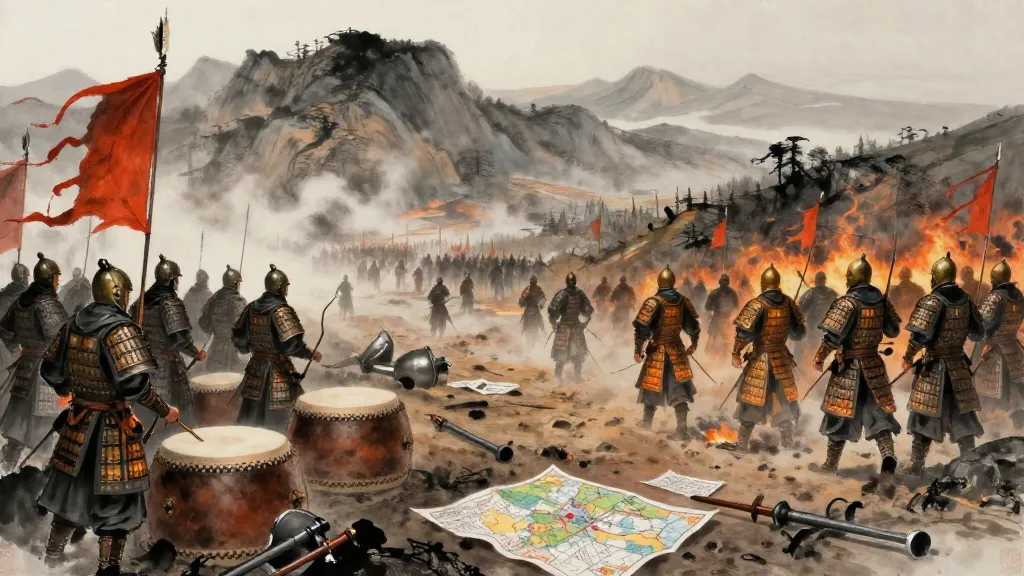
司馬穰苴列傳 (Biography of Sima Rangju) — Chinese ink painting

Chapter 64 of 130

司馬穰苴列傳

Biography of Sima Rangju

View:

穰苴為將

Rangju Is Appointed General

司馬穰苴者,田完之苗裔也。齊景公時,晉伐阿、甄,而燕侵河上,齊師敗績。景公患之。晏嬰乃薦田穰苴曰:「穰苴雖田氏庶孽,然其人文能附眾,武能威敵,原君試之。」景公召穰苴,與語兵事,大說之,以為將軍,將兵扞燕晉之師。穰苴曰:「臣素卑賤,君擢之閭伍之中,加之大夫之上,士卒未附,百姓不信,人微權輕,原得君之寵臣,國之所尊,以監軍,乃可。」於是景公許之,使莊賈往。

Sima Rangju was a descendant of Tian Wan. In the time of Duke Jing of Qi, Jin attacked A and Zhen while Yan raided the Yellow River frontier, and Qi's army suffered a devastating defeat. Duke Jing was troubled. Yan Ying then recommended Tian Rangju, saying: "Though Rangju is a lesser branch of the Tian clan, he is a man whose civil abilities can rally the people and whose martial abilities can overawe the enemy. I ask that you give him a trial." Duke Jing summoned Rangju and discussed military matters with him. Greatly pleased, he appointed Rangju general and gave him command of troops to fend off the armies of Yan and Jin. Rangju said: "I am of humble and lowly origin. You have raised me from the ranks of common folk and placed me above the senior officials. The soldiers are not yet loyal to me, the people do not yet trust me, and my person is insignificant and my authority light. I request one of your favored ministers, someone the state holds in esteem, to serve as supervisor of the army — only then will it work." Duke Jing agreed and sent Zhuang Jia.

Notes

1person司馬穰苴Sīmǎ Rángjū

Sima Rangju (司馬穰苴) was a military commander of the state of Qi during the Spring and Autumn period. He was a descendant of Tian Wan (田完), the progenitor of the Tian clan that eventually usurped the ruling house of Qi. He was later honored with the title Sima (Marshal), and his military principles were compiled as the Sima Fa (司馬法).

2person齊景公Qí Jǐng Gōng

Duke Jing of Qi (齊景公, r. 547–490 BC) was one of the longest-reigning rulers of Qi. His chief minister was the celebrated Yan Ying (晏嬰).

3person晏嬰Yàn Yīng

Yan Ying (晏嬰, d. 500 BC), styled Zhongping (仲平), was the chief minister of Qi under Duke Jing. Famous for his frugality and frank counsel, he is the subject of the Yanzi Chunqiu.

斬莊賈立軍法

Executing Zhuang Jia to Establish Military Discipline

穰苴既辭,與莊賈約曰:「旦日日中會於軍門。」穰苴先馳至軍,立表下漏待賈。賈素驕貴,以為將己之軍而己為監,不甚急;親戚左右送之,留飲。日中而賈不至。穰苴則仆表決漏,入,行軍勒兵,申明約束。約束既定,夕時,莊賈乃至。穰苴曰:「何後期為?」賈謝曰:「不佞大夫親戚送之,故留。」穰苴曰:「將受命之日則忘其家,臨軍約束則忘其親,援枹鼓之急則忘其身。今敵國深侵,邦內騷動,士卒暴露於境,君寢不安席,食不甘味,百姓之命皆懸於君,何謂相送乎!」

召軍正問曰:「軍法期而後至者云何?」對曰:「當斬。」莊賈懼,使人馳報景公,請救。既往,未及反,於是遂斬莊賈以徇三軍。三軍之士皆振栗。久之,景公遣使者持節赦賈,馳入軍中。穰苴曰:「將在軍,君令有所不受。」問軍正曰:「馳三軍法何?」正曰:「當斬。」使者大懼。穰苴曰:「君之使不可殺之。」乃斬其仆,車之左駙,馬之左驂,以徇三軍。遣使者還報,然後行。

Having accepted the commission, Rangju made an appointment with Zhuang Jia: "Tomorrow at noon, meet at the army gate." Rangju rode ahead to the camp, set up a sundial marker and started the water clock, and waited for Jia. Jia had always been arrogant due to his privileged position. Considering that it was his own army and he was merely the supervisor, he felt no urgency. His relatives and attendants gave him a farewell banquet, and he lingered to drink. Noon came and Jia had not arrived. Rangju then knocked down the sundial, emptied the water clock, entered the camp, marshaled the troops, and proclaimed the regulations. Once the regulations were established, at evening Zhuang Jia finally arrived. Rangju said: "Why are you late?" Jia offered excuses: "My relatives and fellow officials gave me a send-off, so I stayed." Rangju said: "On the day a general receives his commission, he forgets his family. When he enters camp and establishes regulations, he forgets his kin. When the drumbeat sounds the charge, he forgets himself. Now the enemy has invaded deep into our territory, the state is in turmoil, soldiers are exposed on the frontier, our lord cannot sleep at ease or eat with appetite, and the lives of the people all hang in the balance — how can you speak of send-off banquets?"

He summoned the provost marshal and asked: "Under military law, what is the penalty for arriving late to an appointed assembly?" The reply: "Beheading." Zhuang Jia was terrified and sent a man racing to Duke Jing to beg for rescue. Before the messenger could return, Rangju had already beheaded Zhuang Jia and paraded his head before the three armies. Every soldier in the three armies trembled. After some time, Duke Jing sent an envoy bearing the staff of authority to pardon Jia — he galloped into the camp. Rangju said: "When a general is with his army, there are commands of the ruler that he need not obey." He asked the provost marshal: "What is the law for galloping through the army camp?" The marshal replied: "Beheading." The envoy was terrified. Rangju said: "The ruler's envoy cannot be killed." So instead he beheaded the envoy's charioteer, cut the left side rail of the chariot and the left trace-horse, and paraded these before the three armies. He sent the envoy back to report, and then set out on the march.

Notes

1context

The execution of Zhuang Jia is one of the most famous episodes of military discipline in Chinese history. It established the principle that military law must apply equally regardless of rank or connections — a core tenet later codified in the Sima Fa.

2translation

「將在軍,君令有所不受」(When a general is with his army, there are commands of the ruler he need not obey) became one of the most quoted maxims in Chinese military literature, establishing the precedent for field commanders' autonomy.

大勝歸齊

Victory and Return to Qi

士卒次舍井灶飲食問疾醫藥,身自拊循之。悉取將軍之資糧享士卒,身與士卒平分糧食。最比其羸弱者,三日而後勒兵。病者皆求行,爭奮出為之赴戰。晉師聞之,為罷去。燕師聞之,度水而解。於是追擊之,遂取所亡封內故境而引兵歸。未至國,釋兵旅,解約束,誓盟而後入邑。景公與諸大夫郊迎,勞師成禮,然後反歸寢。既見穰苴,尊為大司馬。田氏日以益尊於齊。

In the encampments, Rangju personally oversaw the wells, stoves, food and drink, and inquiries after the sick and their medicine. He distributed all of the general's personal provisions to the soldiers and shared his own rations equally with them, giving special attention to the weakest among them. After three days, he mustered the troops. The sick all begged to march, competing eagerly to go into battle for him. When the Jin army heard of this, they withdrew. When the Yan army heard of this, they retreated across the river and dispersed. Rangju then pursued and attacked them, recovering all the lost territory within Qi's borders, and led his army home. Before reaching the capital, he disbanded the military formation, dissolved the regulations, and had the troops take a covenant before entering the city. Duke Jing, together with his senior officials, came out to the suburbs to welcome them, and the ritual of rewarding the army was completed. Only then did Rangju return to his residence. After receiving him, Duke Jing honored him as Grand Marshal. The Tian clan grew ever more exalted in Qi from this time.

Notes

1context

Rangju's practice of sharing hardships with common soldiers — eating the same food, personally caring for the sick — became a model for later Chinese military commanders. Sun Tzu's Art of War expresses similar principles about treating soldiers as one's own children.

穰苴之死與兵法傳世

The Death of Rangju and the Legacy of His Military Treatise

已而大夫鮑氏、高、國之屬害之,譖於景公。景公退穰苴,苴發疾而死。田乞、田豹之徒由此怨高、國等。其後及田常殺簡公,盡滅高子、國子之族。至常曾孫和,因自立為齊威王,用兵行威,大放穰苴之法,而諸侯朝齊。

齊威王使大夫追論古者司馬兵法而附穰苴於其中,因號曰司馬穰苴兵法。

太史公曰:余讀司馬兵法,閎廓深遠,雖三代征伐,未能竟其義,如其文也,亦少襃矣。若夫穰苴,區區為小國行師,何暇及司馬兵法之揖讓乎?世既多司馬兵法,以故不論,著穰苴之列傳焉。

Before long, the senior officials of the Bao, Gao, and Guo clans grew jealous of Rangju and slandered him to Duke Jing. Duke Jing dismissed Rangju, who fell ill and died. Tian Qi, Tian Bao, and their followers harbored resentment against the Gao and Guo clans because of this. Later, when Tian Chang killed Duke Jian, he wiped out the clans of Gao and Guo entirely. By the time of Chang's great-grandson He, who established himself as Duke Wei of Qi, the state employed military force and exercised authority on a grand scale, broadly following Rangju's methods, and the lords all paid court to Qi.

Duke Wei of Qi ordered his officials to compile and comment on the ancient Marshal's Art of War and appended Rangju's teachings to it, giving it the name The Art of War of Marshal Rangju.

The Grand Historian remarks: When I read the Marshal's Art of War, I find it vast and profound. Even the campaigns of the Three Dynasties could not exhaust its meaning, and its language is also somewhat embellished. As for Rangju himself, he merely led the army of a minor state in a single campaign — how could he have had occasion for the elevated courtesies described in the Marshal's Art of War? Since the world already possesses the Marshal's Art of War in abundance, I shall not discuss it further, but instead set down the biography of Rangju.

Notes

1person田常Tián Cháng

Tian Chang (田常, also written 陳成子), also known as Tian Chengzi, was a powerful minister of Qi who assassinated Duke Jian in 481 BC and effectively took control of the state. His descendants eventually replaced the Jiang-surnamed ruling house of Qi entirely.

2person齊威王Qí Wēi Wáng

Duke Wei of Qi (齊威王, r. 356–320 BC) was the first ruler of the Tian-surnamed Qi dynasty to achieve major power status. Under his reign, Qi defeated Wei at the battles of Guiling and Maling and became the dominant state in eastern China.

3context

The Sima Fa (司馬法, Marshal's Art of War) is one of the Seven Military Classics of China. The original ancient text predated Rangju, but Rangju's own teachings were later incorporated. Only fragments survive today.

Edition & Source

Text
《史記》 Shiji
Edition
中華古詩文古書籍網 transcription
Commentary
裴駰《史記集解》、司馬貞《史記索隱》、張守節《史記正義》(Three Commentaries)