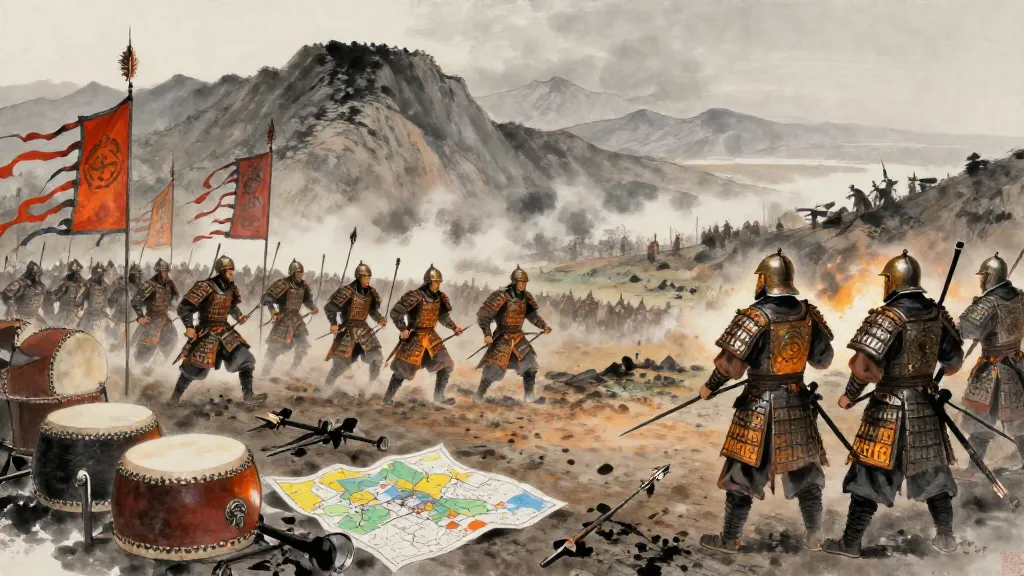
孫子吳起列傳 (Biographies of Sunzi and Wu Qi) — Chinese ink painting

Chapter 65 of 130

孫子吳起列傳

Biographies of Sunzi and Wu Qi

View:

孫武練兵宮女

Sun Wu Drills the Palace Women

孫子武者,齊人也。以兵法見於吳王闔廬。闔廬曰:「子之十三篇,吾盡觀之矣,可以小試勒兵乎?」對曰:「可。」闔廬曰:「可試以婦人乎?」曰:「可。」於是許之,出宮中美女,得百八十人。孫子分為二隊,以王之寵姬二人各為隊長,皆令持戟。令之曰:「汝知而心與左右手背乎?」婦人曰:「知之。」孫子曰:「前,則視心;左,視左手;右,視右手;後,即視背。」婦人曰:「諾。」約束既布,乃設鈇鉞,即三令五申之。於是鼓之右,婦人大笑。孫子曰:「約束不明,申令不熟,將之罪也。」復三令五申而鼓之左,婦人復大笑。孫子曰:「約束不明,申令不熟,將之罪也;既已明而不如法者,吏士之罪也。」乃欲斬左右隊長。吳王從台上觀,見且斬愛姬,大駭。趣使使下令曰:「寡人已知將軍能用兵矣。寡人非此二姬,食不甘味,願勿斬也。」孫子曰:「臣既已受命為將,將在軍,君命有所不受。」遂斬隊長二人以徇。用其次為隊長,於是復鼓之。婦人左右前後跪起皆中規矩繩墨,無敢出聲。於是孫子使使報王曰:「兵既整齊,王可試下觀之,唯王所欲用之,雖赴水火猶可也。」吳王曰:「將軍罷休就舍,寡人不願下觀。」孫子曰:「王徒好其言,不能用其實。」於是闔廬知孫子能用兵,卒以為將。西破強楚,入郢,北威齊晉,顯名諸侯,孫子與有力焉。

Sun Wu, known as Sunzi, was a man of Qi. He presented his art of war to King Helu of Wu. Helu said: "I have read all thirteen chapters of your work. Can we make a small test of drilling troops?" Sunzi replied: "We can." Helu said: "Can we try it with women?" He said: "We can." The king agreed and brought out one hundred and eighty beautiful women from the palace. Sunzi divided them into two companies and made the king's two favorite concubines captains of each, ordering all of them to hold halberds. He instructed them: "Do you know where your chest is, and your left hand, right hand, and back?" The women said: "We do." Sunzi said: "When I say 'forward,' look toward your chest; 'left,' look toward your left hand; 'right,' your right hand; 'rear,' look toward your back." The women said: "Understood." After the rules had been proclaimed and the executioner's axe set up, he repeated the orders three times and explained them five times. Then he beat the drum for a right turn. The women burst out laughing. Sunzi said: "If the rules are not clear and the orders not thoroughly explained, that is the general's fault." He repeated the orders three times and explained them five times, then beat the drum for a left turn. The women again burst out laughing. Sunzi said: "If the rules are not clear and the orders not thoroughly explained, that is the general's fault. But when they have been made clear and are still not followed, that is the fault of the officers." He then moved to behead the two company captains. The King of Wu, watching from a terrace, saw that his beloved concubines were about to be executed and was horrified. He urgently dispatched a messenger with the order: "I already know the general can command troops. Without these two concubines, my food has no flavor. I beg you not to execute them." Sunzi said: "I have already received my appointment as general. When a general is with his army, there are orders from the sovereign that he need not accept." He executed the two captains as a warning. He appointed the next in line as captains and beat the drum again. The women turned left, right, forward, back, knelt, and rose all in perfect accord with the rules, and none dared make a sound. Sunzi then sent a messenger to report to the king: "The troops are in order. Your Majesty may come down to inspect them. They can be used however you wish — they would march through fire and water." The king said: "Let the general return to his quarters and rest. I do not wish to come down to inspect." Sunzi said: "The king merely enjoys the words but cannot put them into practice." At this, Helu recognized that Sunzi could truly command armies, and ultimately appointed him general. To the west, Sunzi shattered mighty Chu and entered its capital Ying; to the north, he overawed Qi and Jin. His name became illustrious among the lords, and Sunzi's contribution was essential to all of it.

Notes

1person孫武Sūn Wǔ

Sun Wu (孫武), known as Sunzi (孫子, c. 544–496 BC), was a military strategist from Qi who served the state of Wu. He is the author of The Art of War (孫子兵法), the world's most influential military treatise.

2person闔廬Hé Lǘ

King Helu of Wu (吳王闔廬, r. 514–496 BC) seized the throne by having his predecessor assassinated. Under the guidance of Sun Wu and Wu Zixu, he built Wu into a major power that conquered Chu.

3place

Ying (郢) was the capital of Chu, located near modern Jiangling, Hubei province. Wu's capture of Ying in 506 BC was one of the most dramatic military campaigns of the Spring and Autumn period.

4translation

The phrase '將在軍,君命有所不受' ('When a general is with his army, there are orders from the sovereign that he need not accept') became one of the most quoted military maxims in Chinese history, establishing the principle of autonomous field command.

孫臏與龐涓

Sun Bin and Pang Juan

孫武既死,後百餘歲有孫臏。臏生阿鄄之間,臏亦孫武之後世子孫也。孫臏嘗與龐涓俱學兵法。龐涓既事魏,得為惠王將軍,而自以為能不及孫臏,乃陰使召孫臏。臏至,龐涓恐其賢於己,疾之,則以法刑斷其兩足而黥之,欲隱勿見。

After Sun Wu died, more than a hundred years later there was Sun Bin. Bin was born in the area between E and Juan, and was a descendant of Sun Wu. Sun Bin once studied the art of war together with Pang Juan. When Pang Juan entered the service of Wei and became a general under King Hui, he knew in his heart that his ability was no match for Sun Bin's, and so he secretly sent for Sun Bin. When Bin arrived, Pang Juan, fearing that Bin would outshine him and consumed with jealousy, had him punished by the law: his kneecaps were cut off and his face was tattooed, intending to keep him hidden away and prevent him from being seen.

Notes

1person孫臏Sūn Bìn

Sun Bin (孫臏, d. c. 316 BC) was a descendant of Sun Wu and one of the greatest strategists of the Warring States period. His name 'Bin' (臏, 'kneecap') refers to the mutilation he suffered. His military text, the Sun Bin Bingfa, was lost for centuries until bamboo-strip copies were discovered at Yinqueshan in 1972.

2person龐涓Páng Juān

Pang Juan (龐涓, d. 341 BC) was a general of Wei and Sun Bin's former fellow student. His jealousy and cruelty toward Sun Bin led to his own destruction at the Battle of Maling.

3place

E (阿) and Juan (鄄) were towns in the area of modern Heze, Shandong province, then part of the state of Qi.

田忌賽馬與圍魏救趙

Tian Ji's Horse Race and Besieging Wei to Rescue Zhao

齊使者如梁,孫臏以刑徒陰見,說齊使。齊使以為奇,竊載與之齊。齊將田忌善而客待之。忌數與齊諸公子馳逐重射。孫子見其馬足不甚相遠,馬有上、中、下輩。於是孫子謂田忌曰:「君弟重射,臣能令君勝。」田忌信然之,與王及諸公子逐射千金。及臨質,孫子曰:「今以君之下駟與彼上駟,取君上駟與彼中駟,取君中駟與彼下駟。」既馳三輩畢,而田忌一不勝而再勝,卒得王千金。於是忌進孫子於威王。威王問兵法,遂以為師。

其後魏伐趙,趙急,請救於齊。齊威王欲將孫臏,臏辭謝曰:「刑餘之人不可。」於是乃以田忌為將,而孫子為師,居輜車中,坐為計謀。田忌欲引兵之趙,孫子曰:「夫解雜亂紛糾者不控卷,救鬥者不搏撠,批亢搗虛,形格勢禁,則自為解耳。今梁趙相攻,輕兵銳卒必竭於外,老弱罷於內。君不若引兵疾走大梁,據其街路,旻其方虛,彼必釋趙而自救。是我一舉解趙之圍而收弊於魏也。」田忌從之,魏果去邯鄲,與齊戰於桂陵,大破梁軍。

An envoy from Qi came to the Wei capital. Sun Bin, as a mutilated convict, arranged a secret meeting and persuaded the Qi envoy. The envoy considered him remarkable and smuggled him back to Qi in his carriage. The Qi general Tian Ji treated him well and kept him as a guest. Tian Ji frequently raced horses with the princes of Qi, betting heavily. Sunzi observed that the horses' speeds did not differ greatly and that they fell into three classes: top, middle, and bottom. He told Tian Ji: "Just bet heavily, my lord — I can make you win." Tian Ji believed him and bet a thousand in gold against the king and the princes. At the starting line, Sunzi said: "Now race your bottom horses against their top horses, your top horses against their middle horses, and your middle horses against their bottom horses." When the three heats were finished, Tian Ji had lost one and won two, and came away with the king's thousand in gold. Tian Ji then presented Sunzi to King Wei. King Wei questioned him on the art of war and made him his military adviser.

Afterward, Wei attacked Zhao, and Zhao was in dire straits and asked Qi for rescue. King Wei of Qi wanted to appoint Sun Bin as commander, but Bin declined, saying: "A mutilated man cannot serve." So Tian Ji was made commander and Sunzi was made adviser, riding in a supply wagon and devising strategy from his seat. Tian Ji wanted to lead the army directly to Zhao. Sunzi said: "To untangle a knot, you do not clench your fist; to break up a fight, you do not wade in swinging. Strike where the enemy is overextended, press where he is empty — the situation will resolve itself. Now Wei and Zhao are fighting each other. Wei's best troops and sharpest soldiers must be exhausted in the field, with only the old and weak left at home. You should march the army straight for Daliang, seize the roads, and strike where they are exposed. Wei will have to abandon Zhao and rush to defend itself. In a single move, we relieve Zhao's siege and exploit Wei's weakness." Tian Ji followed this plan. Wei indeed withdrew from Handan and fought Qi at Guiling, where the Wei army was routed.

Notes

1person田忌Tián Jì

Tian Ji (田忌) was a Qi general and member of the Tian ruling clan. He was Sun Bin's patron and commanded the Qi forces at Guiling (354 BC) and Maling (341 BC).

2person齊威王Qí Wēi Wáng

King Wei of Qi (齊威王, r. 356–320 BC) was the Qi ruler who recognized Sun Bin's talent and made Qi the dominant military power of the mid-4th century BC.

3place

Daliang (大梁) was the capital of Wei, located at modern Kaifeng, Henan province.

4place

Guiling (桂陵) was the site of the 354 BC battle where Qi routed Wei. Located near modern Heze, Shandong.

5context

The strategy of 'besieging Wei to rescue Zhao' (圍魏救趙) became one of the Thirty-Six Stratagems and remains a standard concept in Chinese strategic thought: instead of reinforcing the point of attack, strike the attacker's undefended home base.

馬陵之戰與龐涓之死

The Battle of Maling and the Death of Pang Juan

後十三歲,魏與趙攻韓,韓告急於齊。齊使田忌將而往,直走大梁。魏將龐涓聞之,去韓而歸,齊軍既已過而西矣。孫子謂田忌曰:「彼三晉之兵素悍勇而輕齊,齊號為怯,善戰者因其勢而利導之。兵法,百里而趣利者蹶上將,五十里而趣利者軍半至。使齊軍入魏地為十萬灶,明日為五萬灶,又明日為三萬灶。」龐涓行三日,大喜,曰:「我固知齊軍怯,入吾地三日,士卒亡者過半矣。」乃棄其步軍,與其輕銳倍日並行逐之。孫子度其行,暮當至馬陵。馬陵道陝,而旁多阻隘,可伏兵,乃斫大樹白而書之曰「龐涓死於此樹之下」。於是令齊軍善射者萬弩,夾道而伏,期曰「暮見火舉而俱發」。龐涓果夜至斫木下,見白書,乃鑽火燭之。讀其書未畢,齊軍萬弩俱發,魏軍大亂相失。龐涓自知智窮兵敗,乃自剄,曰:「遂成豎子之名!」齊因乘勝盡破其軍,虜魏太子申以歸。孫臏以此名顯天下,世傳其兵法。

Thirteen years later, Wei and Zhao attacked Han. Han sent an urgent appeal to Qi. Qi sent Tian Ji as commander, and he marched straight for Daliang. When the Wei general Pang Juan heard this, he abandoned the Han campaign and turned back, but the Qi army had already crossed into Wei territory heading west. Sunzi told Tian Ji: "The soldiers of the Three Jin are naturally fierce and brave, and they look down on Qi as cowardly. A good commander exploits this perception and turns it to advantage. The Art of War says: 'He who rushes a hundred li to seize an advantage will lose his leading general; he who rushes fifty li will arrive with only half his force.' Have the Qi army build cooking-fires for a hundred thousand men on the first day inside Wei territory, for fifty thousand the next day, and for thirty thousand the day after." After marching for three days, Pang Juan was elated and said: "I always knew the Qi army was cowardly — in three days inside our territory, more than half their soldiers have deserted." He abandoned his infantry and pressed forward with only his light, elite troops, doubling the pace to pursue them. Sunzi calculated the rate of march and judged that Pang Juan would reach Maling by nightfall. The Maling road was narrow with many defiles and obstructions on either side — ideal for an ambush. He had a great tree stripped of its bark and wrote on the white wood: "Pang Juan dies beneath this tree." He then ordered ten thousand Qi crossbowmen to hide on both sides of the road, with the signal: "When you see fire raised at dusk, all fire together." Pang Juan indeed arrived that night at the stripped tree and, seeing the white writing, struck a light to read it. Before he could finish reading, the ten thousand Qi crossbows fired as one. The Wei army fell into chaos and scattered. Pang Juan, knowing his wits were exhausted and his army destroyed, cut his own throat, saying: "So I have made that brat's name after all!" Qi exploited the victory to destroy the remaining Wei forces and captured Crown Prince Shen of Wei. Through this, Sun Bin's name became famous across All-Under-Heaven, and his art of war was transmitted through the generations.

Notes

1place

Maling (馬陵) was the site of the decisive 341 BC battle. Its exact location is debated, with candidates in modern Shandong near Fan County or Juancheng.

2context

The Three Jin (三晉) refers to the three states of Han, Zhao, and Wei, which were formed when the old state of Jin was partitioned in 403 BC. Here it refers specifically to Wei's military tradition.

3translation

Pang Juan's dying words '遂成豎子之名' ('So I have made that brat's name') express his bitter recognition that his own destruction had elevated Sun Bin to legendary status.

吳起殺妻求將

Wu Qi Kills His Wife to Obtain Command

吳起者,衛人也,好用兵。嘗學於曾子,事魯君。齊人攻魯,魯欲將吳起,吳起取齊女為妻,而魯疑之。吳起於是欲就名,遂殺其妻,以明不與齊也。魯卒以為將。將而攻齊,大破之。

魯人或惡吳起曰:「起之為人,猜忍人也。其少時,家累千金,游仕不遂,遂破其家,鄉黨笑之,吳起殺其謗己者三十餘人,而東出衛郭門。與其母訣,齧臂而盟曰:『起不為卿相,不復入衛。』遂事曾子。居頃之,其母死,起終不歸。曾子薄之,而與起絕。起乃之魯,學兵法以事魯君。魯君疑之,起殺妻以求將。夫魯小國,而有戰勝之名,則諸侯圖魯矣。且魯衛兄弟之國也,而君用起,則是棄衛。」魯君疑之,謝吳起。

Wu Qi was a man of Wei who loved the art of war. He once studied under Zengzi and served the ruler of Lu. When Qi attacked Lu, Lu wished to appoint Wu Qi as commander, but since Wu Qi had taken a woman of Qi as his wife, Lu had doubts about him. Wu Qi, desiring to make a name for himself, killed his wife to prove he had no ties to Qi. Lu then appointed him commander. He led the army against Qi and routed them.

Some in Lu spoke ill of Wu Qi, saying: "Wu Qi is a suspicious and ruthless man. In his youth, his family had a fortune of a thousand in gold, but his attempts to win office came to nothing and he squandered it all. When the people of his village mocked him, Wu Qi killed over thirty of his detractors and fled east through the outer wall of the Wei capital. Parting from his mother, he bit his arm and swore: 'Unless I become a chancellor or a minister, I will never return to Wei.' He then studied under Zengzi. Before long his mother died, but he did not go home to mourn her. Zengzi despised him for this and severed their relationship. Wu Qi went to Lu and studied the art of war to serve the ruler of Lu. When the ruler had doubts about him, he killed his wife to obtain the command. But Lu is a small state — if it gains a reputation for military victory, the other lords will target it. Moreover, Lu and Wei are brother states, and by employing Wu Qi, the ruler is abandoning Wei." The ruler of Lu grew suspicious and dismissed Wu Qi.

Notes

1person吳起Wú Qǐ

Wu Qi (吳起, c. 440–381 BC) was one of the most brilliant military commanders and political reformers of the Warring States period. He served Lu, Wei, and Chu successively. His military treatise, the Wuzi (吳子), is one of the Seven Military Classics.

2person曾子Zēngzǐ

Zengzi (曾子, 505–435 BC) was one of Confucius's most devoted disciples, known for his emphasis on filial piety. Wu Qi's refusal to mourn his mother was a fundamental violation of Zengzi's teachings.

吳起事魏與吮疽

Wu Qi Serves Wei and Sucks a Soldier's Wound

吳起於是聞魏文侯賢,欲事之。文侯問李克曰:「吳起何如人哉?」李克曰:「起貪而好色,然用兵司馬穰苴不能過也。」於是魏文侯以為將,擊秦,拔五城。

起之為將,與士卒最下者同衣食。臥不設席,行不騎乘,親裹贏糧,與士卒分勞苦。卒有病疽者,起為吮之。卒母聞而哭之。人曰:「子卒也,而將軍自吮其疽,何哭為?」母曰:「非然也。往年吳公吮其父,其父戰不旋踵,遂死於敵。吳公今又吮其子,妾不知其死所矣。是以哭之。」

Wu Qi then heard that Marquis Wen of Wei was a worthy ruler and wished to serve him. Marquis Wen asked Li Ke: "What kind of man is Wu Qi?" Li Ke said: "Wu Qi is greedy and lustful, but in the use of arms, even Sima Rangju could not surpass him." Marquis Wen of Wei thereupon appointed him general. He attacked Qin and took five cities.

As a commander, Wu Qi ate and dressed the same as the lowest-ranking soldiers. He slept without a mat, marched without riding, personally carried surplus rations, and shared every hardship with his troops. When a soldier had an infected abscess, Wu Qi sucked the pus from it with his own mouth. The soldier's mother, hearing of this, wept. Someone said: "Your son is only a common soldier, yet the general himself sucked his wound — why do you weep?" The mother said: "It is not that. Last year Lord Wu sucked his father's wound, and his father fought without ever turning back and died facing the enemy. Now Lord Wu has sucked the son's wound as well — I do not know where my son will die. That is why I weep."

Notes

1person魏文侯Wèi Wén Hóu

Marquis Wen of Wei (魏文侯, r. 445–396 BC) was the first ruler of Wei after the partition of Jin. He was renowned for employing talented men, including Wu Qi, Li Ke, and Ximen Bao.

2person李克Lǐ Kè

Li Ke (李克), also known as Li Kui (李悝), was a Legalist reformer and minister of Wei who helped establish its legal code and agricultural policies.

3person司馬穰苴Sīmǎ Rángjū

Sima Rangju (司馬穰苴) was a famous military commander of Qi in the late Spring and Autumn period, whose methods are recorded in the Sima Fa (司馬法), another of the Seven Military Classics.

在德不在險

Security Lies in Virtue, Not in Terrain

文侯以吳起善用兵,廉平,盡能得士心,乃以為西河守,以拒秦、韓。

魏文侯既卒,起事其子武侯。武侯浮西河而下,中流,顧而謂吳起曰:「美哉乎山河之固,此魏國之寶也!」起對曰:「在德不在險。昔三苗氏左洞庭,右彭蠡,德義不修,禹滅之。夏桀之居,左河濟,右泰華,伊闕在其南,羊腸在其北,修政不仁,湯放之。殷紂之國,左孟門,右太行,常山在其北,大河經其南,修政不德,武王殺之。由此觀之,在德不在險。若君不修德,舟中之人盡為敵國也。」武侯曰:「善。」

Marquis Wen, recognizing that Wu Qi was skilled in the use of arms, incorruptible, fair, and able to win the complete devotion of his soldiers, appointed him governor of the West River region to hold against Qin and Han.

After Marquis Wen died, Wu Qi served his son, Marquis Wu. Marquis Wu was sailing down the West River and, in midstream, turned to Wu Qi and said: "How magnificent is the security of these mountains and rivers! This is the treasure of Wei!" Wu Qi replied: "Security lies in virtue, not in terrain. Of old, the Three Miao had Lake Dongting to their left and Lake Pengli to their right, yet they did not cultivate virtue and righteousness, and Yu destroyed them. Jie of Xia had his capital with the Yellow River and the Ji River to the left, Mount Taihua to the right, Yique to the south, and the Sheep-Gut road to the north, yet his governance was not humane, and Tang banished him. King Zhou of Yin had Mengmen to the left and the Taihang Mountains to the right, Mount Chang to the north and the Great River running past the south, yet his governance lacked virtue, and King Wu slew him. From this we can see: security lies in virtue, not in terrain. If Your Lordship does not cultivate virtue, every person in this boat will become your enemy." Marquis Wu said: "Well spoken."

Notes

1person魏武侯Wèi Wǔ Hóu

Marquis Wu of Wei (魏武侯, r. 395–370 BC) was the son of Marquis Wen. His reign saw the beginning of Wei's decline, partly due to his inability to retain talented men like Wu Qi.

2place

The West River (西河) region was the area west of the Yellow River in modern northern Shaanxi, a strategic frontier zone between Wei and Qin.

3translation

Wu Qi's dictum '在德不在險' ('security lies in virtue, not in terrain') became one of the most quoted maxims in Chinese political thought, asserting the primacy of good governance over strategic geography.

吳起與田文爭位

Wu Qi Disputes Precedence with Tian Wen

吳起為西河守,甚有聲名。魏置相,相田文。吳起不悅,謂田文曰:「請與子論功,可乎?」田文曰:「可。」起曰:「將三軍,使士卒樂死,敵國不敢謀,子孰與起?」文曰:「不如子。」起曰:「治百官,親萬民,實府庫,子孰與起?」文曰:「不如子。」起曰:「守西河而秦兵不敢東鄉,韓趙賓從,子孰與起?」文曰:「不如子。」起曰:「此三者,子皆出吾下,而位加吾上,何也?」文曰:「主少國疑,大臣未附,百姓不信,方是之時,屬之於子乎?屬之於我乎?」起默然良久,曰:「屬之子矣。」文曰:「此乃吾所以居子之上也。」吳起乃自知弗如田文。

Wu Qi, as governor of the West River, had a formidable reputation. When Wei appointed a chancellor, the post went to Tian Wen. Wu Qi was displeased and said to Tian Wen: "Let us compare our achievements — would that be acceptable?" Tian Wen said: "It would." Wu Qi said: "In commanding the three armies so that soldiers gladly face death and enemy states dare not plot against us — how do you compare with me?" Tian Wen said: "I am not your equal." Wu Qi said: "In governing the hundred officials, winning the people's affection, and filling the treasuries — how do you compare with me?" Tian Wen said: "I am not your equal." Wu Qi said: "In holding the West River so that Qin's armies dare not face east, and Han and Zhao defer to us — how do you compare with me?" Tian Wen said: "I am not your equal." Wu Qi said: "In all three areas you are beneath me, yet your rank is above mine. Why?" Tian Wen said: "The ruler is young, the state is uncertain, the great ministers are not yet loyal, and the common people do not yet trust the government. At such a time, should authority be entrusted to you, or to me?" Wu Qi was silent for a long while, then said: "To you." Tian Wen said: "That is why I am placed above you." Wu Qi then understood that he was truly inferior to Tian Wen.

Notes

1person田文Tián Wén

Tian Wen (田文) was chancellor of Wei under Marquis Wu. Not to be confused with the more famous Lord Mengchang (孟嘗君), also named Tian Wen, who was a Qi noble of a later generation.

吳起去魏相楚

Wu Qi Leaves Wei and Becomes Chancellor of Chu

田文既死,公叔為相,尚魏公主,而害吳起。公叔之僕曰:「起易去也。」公叔曰:「柰何?」其僕曰:「吳起為人節廉而自喜名也。君因先與武侯言曰:『夫吳起賢人也,而侯之國小,又與彊秦壤界,臣竊恐起之無留心也。』武侯即曰:『柰何?』君因謂武侯曰:『試延以公主,起有留心則必受之。無留心則必辭矣。以此卜之。』君因召吳起而與歸,即令公主怒而輕君。吳起見公主之賤君也,則必辭。」於是吳起見公主之賤魏相,果辭魏武侯。武侯疑之而弗信也。吳起懼得罪,遂去,即之楚。

After Tian Wen died, Gongshu became chancellor. He had married a Wei princess and was jealous of Wu Qi. Gongshu's servant said: "Wu Qi is easy to get rid of." Gongshu said: "How?" The servant said: "Wu Qi is a man of austere integrity who prizes his reputation. First, tell Marquis Wu: 'Wu Qi is a man of great ability, but your lordship's state is small and borders powerful Qin — I secretly fear Wu Qi has no intention of staying.' When Marquis Wu asks what to do, tell him: 'Test him by offering him a princess in marriage. If he intends to stay, he will certainly accept; if not, he will certainly refuse. This will tell you.' Then invite Wu Qi to your home and have the princess treat you with contempt in his presence. When Wu Qi sees the princess demeaning the chancellor, he will certainly refuse the offer." And so it happened: Wu Qi saw how the princess treated the Wei chancellor with contempt, and he indeed declined Marquis Wu's offer. Marquis Wu grew suspicious and ceased to trust him. Wu Qi, fearing punishment, left and went to Chu.

Notes

1person公叔Gōngshū

Gongshu (公叔) was Wu Qi's successor as the leading figure in Wei. His scheme to drive Wu Qi away was a catastrophic loss for Wei and a gain for Chu.

吳起變法楚國與殉難

Wu Qi's Reforms in Chu and His Martyrdom

楚悼王素聞起賢,至則相楚。明法審令,捐不急之官,廢公族疏遠者,以撫養戰鬥之士。要在彊兵,破馳說之言從橫者。於是南平百越;北並陳蔡,卻三晉;西伐秦。諸侯患楚之彊。故楚之貴戚盡欲害吳起。及悼王死,宗室大臣作亂而攻吳起,吳起走之王屍而伏之。擊起之徒因射刺吳起,並中悼王。悼王既葬,太子立,乃使令尹盡誅射吳起而並中王屍者。坐射起而夷宗死者七十餘家。

King Dao of Chu had long heard of Wu Qi's abilities. Upon his arrival, he was made chancellor of Chu. He clarified the laws and tightened the regulations, eliminated unnecessary offices, cut off the allowances of distant royal kinsmen, and used the savings to nurture combat troops. His priority was to strengthen the army and to break the influence of the itinerant persuaders with their alliance-building schemes. He pacified the Hundred Yue peoples to the south; to the north, he absorbed Chen and Cai and pushed back the Three Jin; to the west, he campaigned against Qin. The other lords grew alarmed at Chu's strength. The noble kinsmen of Chu all wished to destroy Wu Qi. When King Dao died, the royal clansmen and great ministers rose in revolt and attacked Wu Qi. Wu Qi fled to the king's corpse and threw himself upon it. Those who shot and stabbed Wu Qi also struck the dead king's body. After King Dao was buried and the crown prince was installed, he ordered the Chief Minister to execute all those who had shot Wu Qi and in doing so had struck the royal corpse. More than seventy families were condemned and wiped out for the crime of shooting at Wu Qi.

Notes

1person楚悼王Chǔ Dào Wáng

King Dao of Chu (楚悼王, r. 401–381 BC) was the ruler who backed Wu Qi's sweeping reforms. His death triggered the immediate reversal of those reforms and Wu Qi's assassination.

2context

Wu Qi's final stratagem — throwing himself upon the king's corpse — ensured that his killers would also desecrate the royal body, a capital crime. Even in death, he engineered the destruction of his enemies. The law of Chu prescribed clan extermination for defiling the king's body.

3place

Chen (陳) and Cai (蔡) were formerly independent states in modern Henan that had been intermittently controlled by Chu. Wu Qi's annexation made the incorporation permanent.

太史公論孫吳

The Grand Historian's Assessment of Sunzi and Wu Qi

太史公曰:世俗所稱師旅,皆道孫子十三篇,吳起兵法,世多有,故弗論,論其行事所施設者。語曰:「能行之者未必能言,能言之者未必能行。」孫子籌策龐涓明矣,然不能蚤救患於被刑。吳起說武侯以形勢不如德,然行之於楚,以刻暴少恩亡其軀。悲夫!

The Grand Historian says: Whenever the world speaks of military affairs, all cite Sunzi's thirteen chapters. Wu Qi's art of war is also widely available, and so I will not discuss their texts but rather their actual deeds and measures. The saying goes: "Those who can act may not be able to speak, and those who can speak may not be able to act." Sun Bin's stratagems against Pang Juan were brilliant, yet he could not save himself from mutilation early in his career. Wu Qi lectured Marquis Wu that security lay in virtue rather than terrain, yet in his own practice in Chu he was harsh, severe, and sparing of mercy, and it cost him his life. How sad!

Notes

1context

Sima Qian's closing observation highlights the tragic gap between theory and practice: Sun Bin understood strategy perfectly yet suffered mutilation; Wu Qi preached virtue-based governance yet governed through severity. This ironic pattern — matching that of Han Fei in chapter 63 — is one of Sima Qian's recurring themes.

Edition & Source

Text
《史記》 Shiji
Edition
中華古詩文古書籍網 transcription
Commentary
裴駰《史記集解》、司馬貞《史記索隱》、張守節《史記正義》(Three Commentaries)