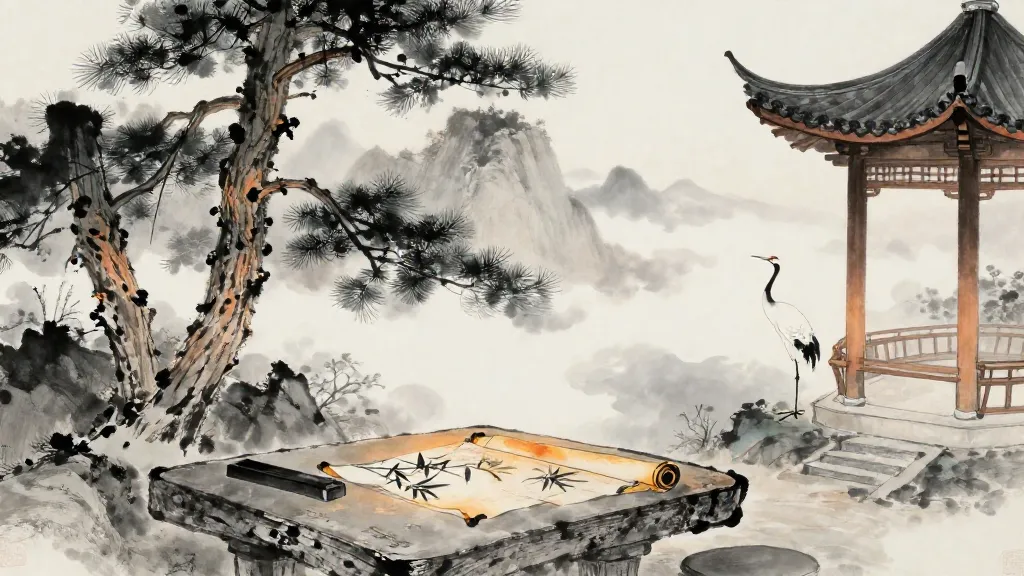
仲尼弟子列傳(下) (Biographies of the Disciples of Confucius — Part 2: The Broader Circle) — Chinese ink painting

Chapter 67 of 130

仲尼弟子列傳(下)

Biographies of the Disciples of Confucius — Part 2: The Broader Circle

View:

子游、子夏、子張、曾參

Ziyou, Zixia, Zizhang, and Zengzi

言偃,吳人,字子游。少孔子四十五歲。

子游既已受業,為武城宰。孔子過,聞弦歌之聲。孔子莞爾而笑曰:「割雞焉用牛刀?」子游曰:「昔者偃聞諸夫子曰,君子學道則愛人,小人學道則易使。」孔子曰:「二三子,偃之言是也。前言戲之耳。」

卜商字子夏。少孔子四十四歲。孔子既沒,子夏居西河教授,為魏文侯師。其子死,哭之失明。

顓孫師,陳人,字子張。少孔子四十八歲。

曾參,南武城人,字子輿。少孔子四十六歲。孔子以為能通孝道,故授之業。作孝經。死於魯。

Yan Yan, a man of Wu, styled Ziyou, was forty-five years younger than Confucius.

After completing his studies, Ziyou became magistrate of Wucheng. When Confucius passed through and heard the sound of stringed instruments and singing, he smiled gently and said: 'Why use an ox-slaughtering knife to kill a chicken?' Ziyou said: 'I once heard you, Master, say: When a gentleman studies the Way, he comes to love others; when a common man studies the Way, he becomes easy to employ.' Confucius said: 'My disciples, Yan's words are correct. My earlier remark was only a joke.'

Bu Shang, styled Zixia, was forty-four years younger than Confucius. After Confucius's death, Zixia settled at the Western River and taught, serving as teacher to Marquis Wen of Wei. When his son died, he wept until he lost his sight.

Zhuansun Shi, a man of Chen, styled Zizhang, was forty-eight years younger than Confucius.

Zeng Shen, a man of South Wucheng, styled Ziyu, was forty-six years younger than Confucius. Confucius considered him capable of fully understanding the Way of filial piety, so he transmitted the teachings to him. He composed the Classic of Filial Piety. He died in Lu.

Notes

1person子夏Zǐ Xià

Zixia (子夏, Bu Shang 卜商, 507–? BC) was one of the most influential of Confucius's later disciples. As teacher to Marquis Wen of Wei, he transmitted Confucian learning to the next generation and is traditionally credited with transmitting the Spring and Autumn Annals and the Classic of Poetry.

2person曾參Zēng Shēn

Zengzi (曾子, Zeng Shen 曾參, 505–435 BC) was the disciple most associated with filial piety. He is traditionally credited with composing the Classic of Filial Piety (孝經) and the Great Learning (大學). He became the transmitter of Confucius's moral philosophy to later generations.

其他著名弟子

Other Notable Disciples

澹臺滅明,武城人,字子羽。少孔子三十九歲。狀貌甚惡。欲事孔子,孔子以為材薄。既已受業,退而修行,行不由徑,非公事不見卿大夫。南遊至江,從弟子三百人。孔子聞之,曰:「吾以言取人,失之宰予;以貌取人,失之子羽。」

宓不齊字子賤。少孔子三十歲。子賤為單父宰,反命於孔子,曰:「此國有賢不齊者五人,教不齊所以治者。」孔子曰:「惜哉不齊所治者小,所治者大則庶幾矣。」

原憲字子思。孔子卒,原憲遂亡在草澤中。子貢相衛,而結駟連騎,排藜藿入窮閻,過謝原憲。憲攝敝衣冠見子貢。子貢恥之,曰:「夫子豈病乎?」原憲曰:「吾聞之,無財者謂之貧,學道而不能行者謂之病。若憲,貧也,非病也。」子貢慚,不懌而去,終身恥其言之過也。

商瞿,魯人,字子木。少孔子二十九歲。孔子傳易於瞿,瞿傳楚人馯臂子弘,弘傳江東人矯子庸疵,疵傳燕人周子家豎,豎傳淳于人光子乘羽,羽傳齊人田子莊何,何傳東武人王子中同,同傳菑川人楊何。何元朔中以治易為漢中大夫。

有若少孔子四十三歲。孔子既沒,弟子思慕,有若狀似孔子,弟子相與共立為師,師之如夫子時也。

Dantai Mieming, a man of Wucheng, styled Ziyu, was thirty-nine years younger than Confucius. His appearance was extremely ugly. He wished to study under Confucius, who judged his material to be poor. After completing his studies, he withdrew and cultivated his conduct. He never took shortcuts, and would not see high officials except on public business. He traveled south to the Yangtze and gathered 300 disciples. When Confucius heard of this, he said: 'I judged men by their words and erred with Zai Yu; I judged men by their appearance and erred with Ziyu.'

Fu Buqi, styled Zijian, was thirty years younger than Confucius. When Zijian served as magistrate of Shanfu and reported back to Confucius, he said: 'In this district there are five men more capable than Buqi — they taught me how to govern.' Confucius said: 'What a pity that Buqi's jurisdiction is small. If he governed something larger, he would be close to perfection.'

Yuan Xian, styled Zisi. After Confucius died, Yuan Xian withdrew and lived in hiding among the marshes. Zigong was serving as minister of Wey, riding in a carriage drawn by four matched horses with a mounted escort. He pushed through the brambles and weeds to the mean alley and called on Yuan Xian. Xian came out in his tattered clothes and cap to see Zigong. Zigong was embarrassed for him and asked: 'Master, are you ill?' Yuan Xian said: 'I have heard that lacking wealth is called poverty, but studying the Way and being unable to practice it is called illness. As for Xian — I am poor, not ill.' Zigong was ashamed and departed unhappily, regretting his tactless words for the rest of his life.

Shang Qu, a man of Lu, styled Zimu, was twenty-nine years younger than Confucius. Confucius transmitted the Changes (Yi) to Qu. Qu transmitted it to Han Bi Zihong of Chu; Zihong to Jiao Ziyong Ci of the Jiangdong region; Ci to Zhou Zijia Shu of Yan; Shu to Guang Zicheng Yu of Chunyu; Yu to Tian Zizhuang He of Qi; He to Wang Zizhong Tong of Dongwu; Tong to Yang He of Zichuan. In the Yuanshuo era, Yang He served as Grand Palace Grandee of the Han on account of his mastery of the Changes.

You Ruo was forty-three years younger than Confucius. After Confucius died, the disciples, longing for their teacher, noted that You Ruo resembled Confucius in appearance. They installed him as their teacher and attended upon him as they had the Master.

Notes

1person原憲Yuán Xiàn

Yuan Xian (原憲, styled Zisi 子思) embodied voluntary poverty as a principled choice. His exchange with the wealthy Zigong — 'I am poor, not ill' — became a classic statement about the difference between material poverty and spiritual failure.

2context

The transmission chain of the Yijing (Book of Changes) traced here — from Confucius through Shang Qu to Yang He in the Han dynasty — is one of the most important intellectual genealogies in Chinese thought, establishing the line of transmission for what became one of the most studied classics.

弟子名錄與太史公論贊

Register of Disciples and the Grand Historian's Assessment

自子石已右三十五人,顯有年名及受業見於書傳。其四十有二人,無年及不見書傳者紀於左:

厓季字子產。公祖句茲字子之。秦祖字子南。漆雕哆字子斂。顏高字子驕。漆雕徒父。壤駟赤字子徒。商澤。石作蜀字子明。任不齊字選。公良孺字子正。後處字子裡。秦厓字開。公夏首字乘。奚容箴字子皙。公肩定字子中。顏祖字襄。鄡單字子家。句井疆。罕父黑字子索。秦商字子丕。申黨字周。顏之仆字叔。榮旂字子祈。縣成字子祺。左人郢字行。燕伋字思。鄭國字子徒。秦非字子之。施之常字子恆。顏噲字子聲。步叔乘字子車。原亢籍。樂欬字子聲。廉絜字庸。叔仲會字子期。顏何字厓。狄黑字皙。邦巽字子斂。孔忠。公西輿如字子上。公西葴字子上。

太史公曰:學者多稱七十子之徒,譽者或過其實,毀者或損其真,鈞之未睹厥容貌,則論言弟子籍,出孔氏古文近是。余以弟子名姓文字悉取論語弟子問並次為篇,疑者闕焉。

From Zishi and above, thirty-five disciples whose birth years and names are recorded and whose studies are found in transmitted texts. The forty-two who have no recorded birth years and do not appear in transmitted texts are listed below:

[A list of 42 names with their courtesy names follows, including Ran Ji styled Zichan, Gongzu Juzi styled Zizhi, Qin Zu styled Zinan, Qidiao Duo styled Zilian, and many others.]

The Grand Historian remarks: Scholars frequently speak of the seventy disciples and their followers. Those who praise them sometimes exaggerate; those who denigrate them sometimes diminish the truth. Since we can no longer see their faces, the most reliable source for discussing the register of disciples is the ancient text from the Kong family. I have taken the disciples' names and courtesy names entirely from the Analerta's disciple passages and arranged them in this chapter, leaving out what is doubtful.

Notes

1context

This chapter is the earliest biographical account of Confucius's disciples. The list of 77 disciples (35 well-documented plus 42 lesser-known) established the canonical roster that was used for centuries in Confucian temples. Sima Qian's cautious methodology — relying on the Analects and the Kong family archive, and marking doubtful entries — demonstrates his historiographical rigor.

Edition & Source

Text
《史記》 Shiji
Edition
中華古詩文古書籍網 transcription
Commentary
裴駰《史記集解》、司馬貞《史記索隱》、張守節《史記正義》(Three Commentaries)