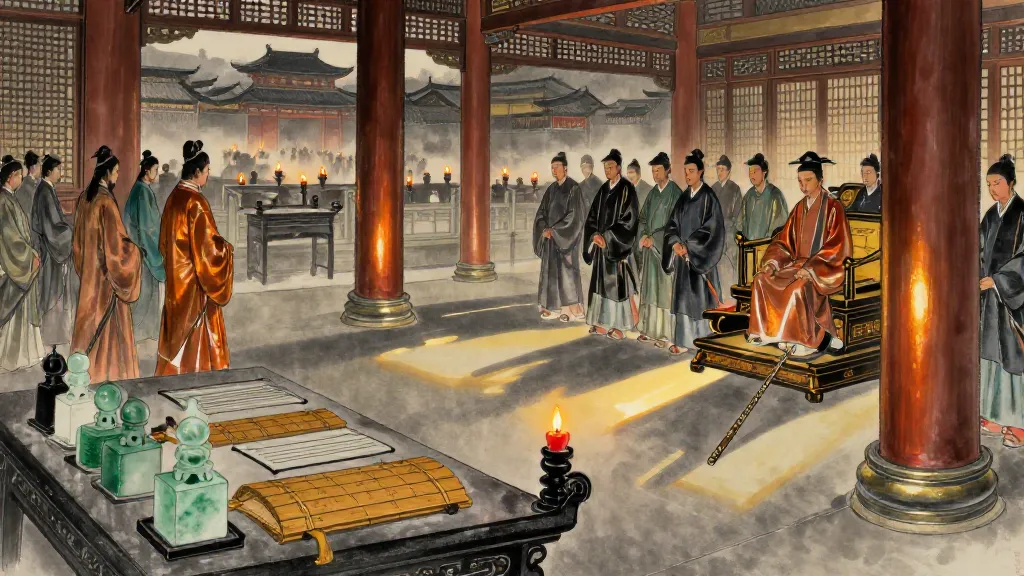
商君列傳 (Biography of Lord Shang) — Chinese ink painting

Chapter 68 of 130

商君列傳

Biography of Lord Shang

View:

公叔座薦鞅於魏

Gongshu Zuo Recommends Yang to Wei

商君者,衛之諸庶孽公子也,名鞅,姓公孫氏,其祖本姬姓也。鞅少好刑名之學,事魏相公叔座為中庶子。公叔座知其賢,未及進。會座病,魏惠王親往問病,曰:「公叔病有如不可諱,將柰社稷何?」公叔曰:「座之中庶子公孫鞅,年雖少,有奇才,原王舉國而聽之。」王嘿然。王且去,座屏人言曰:「王即不聽用鞅,必殺之,無令出境。」王許諾而去。公叔座召鞅謝曰:「今者王問可以為相者,我言若,王色不許我。我方先君後臣,因謂王即弗用鞅,當殺之。王許我。汝可疾去矣,且見禽。」鞅曰:「彼王不能用君之言任臣,又安能用君之言殺臣乎?」卒不去。惠王既去,而謂左右曰:「公叔病甚,悲乎,欲令寡人以國聽公孫鞅也,豈不悖哉!」

Lord Shang was a scion of the ducal house of Wei — a son born of a concubine — named Yang, of the Gongsun clan, whose ancestors bore the Ji surname. In his youth, Yang was devoted to the study of law and statecraft. He served as a household retainer under Gongshu Zuo, the chancellor of Wei. Gongshu Zuo recognized his talent but had not yet found the occasion to recommend him. Then Gongshu Zuo fell ill. King Hui of Wei came in person to inquire after him and said: "If your illness should prove fatal, what will become of the state?" Gongshu Zuo replied: "My retainer Gongsun Yang is young, but he possesses extraordinary ability. I beg Your Majesty to entrust the entire state to him." The king was silent. As the king was about to leave, Gongshu Zuo dismissed his attendants and said privately: "If Your Majesty will not employ Yang, then you must kill him — do not let him leave the country." The king agreed and departed. Gongshu Zuo then summoned Yang and apologized: "The king just asked me who could serve as chancellor. I named you, but the king's expression showed he would not consent. I put my ruler's interests before my retainer's, so I then told the king that if he would not use you, he should kill you. The king agreed. You must flee at once — you are about to be seized." Yang replied: "If the king cannot follow your advice to employ me, how could he follow your advice to kill me?" In the end, he did not leave. After King Hui departed, he said to his attendants: "Gongshu Zuo is gravely ill — how pitiful. He wants me to entrust the state to Gongsun Yang. Is that not absurd?"

Notes

1person公孫鞅Gōngsūn Yāng

Gongsun Yang (公孫鞅), later known as Lord Shang (商君) or Shang Yang (商鞅, c. 390–338 BC), was the Legalist reformer who transformed the state of Qin into a military powerhouse. Originally from the minor state of Wey (衛, distinct from the major state of Wei 魏), he was a distant descendant of the Ji royal house of Zhou.

2person公叔座Gōngshū Zuò

Gongshu Zuo (公叔座, d. c. 361 BC) was chancellor of Wei under King Hui. His deathbed recommendation of Shang Yang — and the king's dismissal of it — is one of the famous missed opportunities in Warring States history.

3person魏惠王Wèi Huì Wáng

King Hui of Wei (魏惠王, r. 369–319 BC), also known as King Hui of Liang after Wei moved its capital to Daliang (modern Kaifeng). His failure to retain Shang Yang is paired with his later loss of Sun Bin to Qi — two strategic blunders that cost Wei its hegemony.

4context

The 'study of law and statecraft' (刑名之學) refers to the Legalist school of thought focused on matching titles to performance (名實) and codifying penal law. Its key antecedent thinkers included Shen Buhai and Li Kui.

衛鞅說孝公以霸道

Wei Yang Persuades Duke Xiao with the Way of Hegemony

公叔既死,公孫鞅聞秦孝公下令國中求賢者,將修繆公之業,東復侵地,乃遂西入秦,因孝公寵臣景監以求見孝公。孝公既見衛鞅,語事良久,孝公時時睡,弗聽。罷而孝公怒景監曰:「子之客妄人耳,安足用邪!」景監以讓衛鞅。衛鞅曰:「吾說公以帝道,其志不開悟矣。」後五日,復求見鞅。鞅復見孝公,益愈,然而未中旨。罷而孝公復讓景監,景監亦讓鞅。鞅曰:「吾說公以王道而未入也。請復見鞅。」鞅復見孝公,孝公善之而未用也。罷而去。孝公謂景監曰:「汝客善,可與語矣。」鞅曰:「吾說公以霸道,其意欲用之矣。誠復見我,我知之矣。」衛鞅復見孝公。公與語,不自知躂之前於席也。語數日不厭。景監曰:「子何以中吾君?吾君之驩甚也。」鞅曰:「吾說君以帝王之道比三代,而君曰:『久遠,吾不能待。且賢君者,各及其身顯名天下,安能邑邑待數十百年以成帝王乎?』故吾以彊國之術說君,君大說之耳。然亦難以比德於殷周矣。」

After Gongshu Zuo died, Gongsun Yang heard that Duke Xiao of Qin had issued a decree throughout the realm seeking men of talent, intending to restore the legacy of Duke Mu and recover the territories lost in the east. Yang accordingly traveled west into Qin and, through the duke's favorite retainer Jing Jian, secured an audience with Duke Xiao. When Duke Xiao first met Wei Yang, they spoke at length, but the duke kept dozing off and did not listen. Afterward, Duke Xiao rebuked Jing Jian: "Your guest is a fool — what use could he possibly be?" Jing Jian relayed the rebuke to Wei Yang. Yang said: "I spoke to the duke about the Way of the Emperors, but his mind could not grasp it." Five days later, he requested another audience. Yang saw Duke Xiao again and spoke more fully, yet still did not hit the mark. Afterward, the duke again rebuked Jing Jian, and Jing Jian in turn rebuked Yang. Yang said: "I spoke to the duke about the Way of Kings, but it did not penetrate. Let me see him once more." Yang saw Duke Xiao again. The duke found his ideas good but did not yet employ him. After Yang left, the duke told Jing Jian: "Your guest is good — I can talk with him." Yang said: "I spoke to the duke about the Way of Hegemony. He wants to use it. If he truly grants me another audience, I know what to do." Wei Yang saw Duke Xiao once more. The duke was so absorbed in conversation that he unconsciously edged forward on his mat. They talked for several days without tiring of it. Jing Jian asked: "How did you win over my lord? His delight is extraordinary." Yang replied: "I spoke to the duke of the Way of Emperors and Kings, comparing it to the Three Dynasties, but the duke said: 'That is too distant — I cannot wait. A worthy ruler should make his name famous in his own lifetime. How can one sit idle for decades or centuries waiting to become an emperor or king?' So I spoke to him of the techniques for strengthening the state, and the duke was greatly pleased. But by this path it will be hard to match the virtue of Yin and Zhou."

Notes

1person秦孝公Qín Xiào Gōng

Duke Xiao of Qin (秦孝公, r. 361–338 BC) was the ruler who empowered Shang Yang's reforms. His famous 'Decree Seeking the Worthy' (求賢令) is one of the most celebrated recruitment proclamations in Chinese history.

2person景監Jǐng Jiān

Jing Jian (景監) was a palace attendant and favorite of Duke Xiao who served as intermediary for Shang Yang's audiences. Sima Qian later notes that gaining access through a court favorite was not a path to true honor.

3context

The four audiences represent a descending hierarchy of political philosophy: the Way of Emperors (帝道, sage-rule through virtue), the Way of Kings (王道, benevolent governance), the Way of Hegemony (霸道, power through institutional strength), and finally the techniques of state-strengthening (彊國之術, Legalist reform). Duke Xiao's preference for immediate results over long-term virtue is central to Sima Qian's moral judgment.

變法之議

The Debate on Reforming the Law

孝公既用衛鞅,鞅欲變法,恐天下議己。衛鞅曰:「疑行無名,疑事無功。且夫有高人之行者,固見非於世;有獨知之慮者,必見敖於民。愚者闇於成事,知者見於未萌。民不可與慮始而可與樂成。論至德者不和於俗,成大功者不謀於眾。是以聖人苟可以彊國,不法其故;苟可以利民,不循其禮。」孝公曰:「善。」甘龍曰:「不然。聖人不易民而教,知者不變法而治。因民而教,不勞而成功;緣法而治者,吏習而民安之。」衛鞅曰:「龍之所言,世俗之言也。常人安於故俗,學者溺於所聞。以此兩者居官守法可也,非所與論於法之外也。三代不同禮而王,五伯不同法而霸。智者作法,愚者制焉;賢者更禮,不肖者拘焉。」杜摯曰:「利不百,不變法;功不十,不易器。法古無過,循禮無邪。」衛鞅曰:「治世不一道,便國不法古。故湯武不循古而王,夏殷不易禮而亡。反古者不可非,而循禮者不足多。」孝公曰:「善。」以衛鞅為左庶長,卒定變法之令。

Once Duke Xiao had decided to employ Wei Yang, Yang wished to reform the laws but feared criticism. Wei Yang said: "He who hesitates in action wins no reputation; he who doubts in his undertakings achieves no results. Moreover, one whose conduct rises above the common is sure to be condemned by the world, and one whose insight stands alone will certainly be mocked by the people. The foolish cannot see a thing until it is accomplished; the wise perceive it before it has begun to sprout. One cannot deliberate beginnings with the people, but one can share the joy of completion with them. He who discourses on the highest virtue finds no harmony with convention; he who achieves the greatest deeds does not take counsel with the crowd. Therefore the sage, if he can strengthen the state, does not follow precedent; if he can benefit the people, he does not observe old rites." Duke Xiao said: "Good." Gan Long objected: "Not so. The sage teaches without changing the people; the wise man governs without altering the law. Teach in accordance with the people and you succeed without effort; govern in accordance with existing law and officials are practiced and the people at ease." Wei Yang replied: "What Gan Long says is the talk of the common world. Ordinary men are comfortable with old customs; scholars are mired in what they have heard. These two types may hold office and keep to the rules, but they are not the ones to discuss what lies beyond the rules. The Three Dynasties each had different rites, yet each became king; the Five Hegemons each had different laws, yet each achieved hegemony. The wise create law; the foolish are ruled by it. The worthy reform rites; the unworthy are bound by them." Du Zhi said: "Unless the benefit is a hundredfold, do not change the law; unless the gain is tenfold, do not alter the instruments. Following antiquity incurs no fault; observing rites invites no error." Wei Yang replied: "There is no single Way to govern the age; there is no need to imitate antiquity to benefit the state. Tang and Wu did not follow the ancients, yet they became kings; Xia and Yin did not change their rites, yet they perished. Those who depart from antiquity cannot be condemned, and those who adhere to rites cannot be praised." Duke Xiao said: "Good." He appointed Wei Yang as Left Chief of the Multitudes and finalized the decree to reform the laws.

Notes

1person甘龍Gān Lóng

Gan Long (甘龍) was a conservative Qin minister who argued against legal reform. He and Du Zhi represent the traditionalist opposition that Shang Yang had to overcome.

2person杜摯Dù Zhì

Du Zhi (杜摯) was another conservative minister at the Qin court who opposed the reforms.

3context

The 'Three Dynasties' (三代) are the Xia, Shang (Yin), and Zhou — the idealized golden ages of antiquity. The 'Five Hegemons' (五霸) are traditionally Duke Huan of Qi, Duke Wen of Jin, Duke Mu of Qin, King Zhuang of Chu, and Duke Xiang of Song (though lists vary).

4translation

Left Chief of the Multitudes (左庶長) was a Qin military-administrative rank, the tenth of the eventual twenty ranks in Qin's merit-based system. It carried both civil and military authority.

新法施行

The New Laws Put into Effect

令民為什伍,而相牧司連坐。不告奸者腰斬,告奸者與斬敵首同賞,匿奸者與降敵同罰。民有二男以上不分異者,倍其賦。有軍功者,各以率受上爵;為私鬥者,各以輕重被刑大小。僇力本業,耕織致粟帛多者復其身。事末利及怠而貧者,舉以為收孥。宗室非有軍功論,不得為屬籍。明尊卑爵秩等級,各以差次名田宅,臣妾衣服以家次。有功者顯榮,無功者雖富無所芬華。

令既具,未布,恐民之不信,已乃立三丈之木於國都市南門,募民有能徙置北門者予十金。民怪之,莫敢徙。復曰「能徙者予五十金」。有一人徙之,輒予五十金,以明不欺。卒下令。

令行於民期年,秦民之國都言初令之不便者以千數。於是太子犯法。衛鞅曰:「法之不行,自上犯之。」將法太子。太子,君嗣也,不可施刑,刑其傅公子虔,黥其師公孫賈。明日,秦人皆趨令。行之十年,秦民大說,道不拾遺,山無盜賊,家給人足。民勇於公戰,怯於私鬥,鄉邑大治。秦民初言令不便者有來言令便者,衛鞅曰「此皆亂化之民也」,盡遷之於邊城。其後民莫敢議令。

He ordered the people to be organized into groups of five and ten households, mutually responsible for surveillance, with collective punishment for the group. Those who failed to report crimes were cut in half at the waist; those who reported crimes received the same reward as for taking an enemy head in battle; those who harbored criminals received the same punishment as for surrendering to the enemy. Families with two or more adult sons who did not divide into separate households had their taxes doubled. Those who won military merit received noble rank according to a fixed scale; those who engaged in private brawls received punishments proportional to the severity. Those who devoted themselves to the fundamental occupations of farming and weaving and produced large quantities of grain and cloth were exempted from corvée labor. Those who pursued secondary profits from trade or who became poor through idleness were seized together with their wives and children and made bond-servants. Members of the ducal clan who lacked military merit were removed from the register of nobility. Distinctions of rank and status were made explicit: fields, residences, servants, and clothing were all assigned according to rank. Those with merit were honored with glory; those without merit, however wealthy, could claim no distinction.

When the laws were fully drafted but not yet promulgated, Yang feared the people would not trust them. He had a thirty-foot timber erected at the south gate of the capital marketplace and offered a reward of ten units of gold to anyone who could move it to the north gate. The people thought it strange, and no one dared try. He then said: "Anyone who moves it will receive fifty units of gold." One man moved it, and he was immediately given fifty gold — to make clear that there would be no deception. Only then were the laws promulgated.

After the laws had been in force for a full year, people from throughout Qin who came to the capital to complain that the new laws were inconvenient numbered in the thousands. At that point, the crown prince violated the law. Wei Yang said: "The law fails to be enforced because those above are the first to break it." He prepared to punish the crown prince. But the crown prince was the ruler's heir and could not be subjected to punishment, so instead he punished the prince's tutor Gongzi Qian by cutting off his nose, and branded the prince's teacher Gongsun Jia. The next day, all the people of Qin obeyed the laws. After ten years in force, the people of Qin were greatly pleased: nothing was picked up from the roads, there were no bandits in the mountains, every household had enough, and every person was provided for. The people were brave in public warfare and timid in private brawls, and the towns and villages were well governed. Some who had initially complained that the laws were inconvenient now came to say they were convenient. Wei Yang said: "These are all people who disrupt good order" — and banished every one of them to the frontier. After that, no one dared to criticize the laws.

Notes

1context

The mutual-surveillance system (什伍連坐) was the cornerstone of Shang Yang's social control. Groups of five and ten households were collectively responsible for each other's conduct, effectively turning neighbors into monitors. This system persisted in various forms throughout imperial Chinese history.

2person公子虔Gōngzǐ Qián

Gongzi Qian (公子虔) was a prince of Qin who served as tutor to the crown prince. He was punished twice under the new laws — first by nose-cutting — and nursed a bitter grudge against Shang Yang. He would later play a key role in Shang Yang's downfall.

3context

The 'timber at the south gate' (南門徙木) became a famous parable about establishing governmental credibility. The point was that by keeping a seemingly absurd promise, the government demonstrated that all its promises — including threats of punishment — would be fulfilled.

4context

Shang Yang's banishment of those who praised the laws as well as those who had criticized them illustrates a core Legalist principle: the people should obey the law without comment. Any public discourse about the law, whether favorable or unfavorable, was considered subversive because it implied the people had a right to evaluate state policy.

遷都咸陽與破魏

Moving the Capital to Xianyang and Defeating Wei

於是以鞅為大良造。將兵圍魏安邑,降之。居三年,作為築冀闕宮庭於鹹陽,秦自雍徙都之。而令民父子兄弟同室內息者為禁。而集小鄉邑聚為縣,置令、丞,凡三十一縣。為田開阡陌封疆,而賦稅平。平斗桶權衡丈尺。行之四年,公子虔復犯約,劓之。居五年,秦人富彊,天子致胙於孝公,諸侯畢賀。

其明年,齊敗魏兵於馬陵,虜其太子申,殺將軍龐涓。其明年,衛鞅說孝公曰:「秦之與魏,譬若人之有腹心疾,非魏並秦,秦即並魏。何者?魏居領厄之西,都安邑,與秦界河而獨擅山東之利。利則西侵秦,病則東收地。今以君之賢聖,國賴以盛。而魏往年大破於齊,諸侯畔之,可因此時伐魏。魏不支秦,必東徙。東徙,秦據河山之固,東鄉以制諸侯,此帝王之業也。」孝公以為然,使衛鞅將而伐魏。魏使公子卬將而擊之。軍既相距,衛鞅遺魏將公子卬書曰:「吾始與公子驩,今俱為兩國將,不忍相攻,可與公子面相見,盟,樂飲而罷兵,以安秦魏。」魏公子卬以為然。會盟已,飲,而衛鞅伏甲士而襲虜魏公子卬,因攻其軍,盡破之以歸秦。魏惠王兵數破於齊秦,國內空,日以削,恐,乃使使割河西之地獻於秦以和。而魏遂去安邑,徙都大梁。梁惠王曰:「寡人恨不用公叔座之言也。」衛鞅既破魏還,秦封之於商十五邑,號為商君。

Yang was then appointed Grand Master of Works. He led troops to besiege Anyi, the Wei capital, and forced its surrender. Three years later, he built gate-towers and a palace compound at Xianyang, and Qin moved its capital there from Yong. He issued a prohibition against fathers and sons or brothers dwelling together in the same room. He consolidated the small townships into counties, appointing magistrates and vice-magistrates for each — thirty-one counties in all. He opened up the field boundaries, abolishing the old ridge-path system, and equalized taxation. He standardized the measures for capacity, weight, and length. After four years in force, Gongzi Qian again violated the laws, and his nose was cut off. After five years, the people of Qin were rich and strong. The Son of Heaven sent sacrificial meat to Duke Xiao, and all the lords sent congratulations.

The following year, Qi defeated the Wei army at Maling, captured Crown Prince Shen, and killed General Pang Juan. The year after that, Wei Yang persuaded Duke Xiao: "The relationship between Qin and Wei is like a man with a disease in his vitals — either Wei will swallow Qin or Qin will swallow Wei. Why? Wei sits west of the strategic passes, with its capital at Anyi, bordering Qin across the Yellow River while monopolizing the resources east of the mountains. When Wei is strong, it invades Qin from the west; when Wei is weak, it consolidates territory in the east. Now, thanks to Your Lordship's sagacity, the state thrives. Wei was badly beaten by Qi last year, and the lords have turned against it. This is the moment to attack Wei. If Wei cannot withstand Qin, it must retreat eastward. Once it does, Qin will hold the security of the Yellow River and the mountains, face east, and command the lords — this is the enterprise of an emperor." Duke Xiao agreed and sent Wei Yang to lead the campaign against Wei. Wei sent Prince Ang to command against him. When the two armies faced each other, Wei Yang sent a letter to Prince Ang: "You and I were once friends. Now we are both generals of rival states, and I cannot bear to attack you. Let us meet face to face, swear an oath, drink in good cheer, and withdraw our armies to bring peace to Qin and Wei." Prince Ang agreed. After the oath ceremony and drinking, Wei Yang had armed soldiers spring from ambush to seize Prince Ang, then attacked his army and routed it completely before returning to Qin. King Hui of Wei, his forces repeatedly broken by Qi and Qin, his country hollowed out and shrinking by the day, was frightened. He sent envoys to cede the territory west of the Yellow River to Qin and sue for peace. Wei then abandoned Anyi and moved its capital to Daliang. King Hui of Liang said: "I regret that I did not heed the words of Gongshu Zuo." After Wei Yang's victory over Wei, Qin enfeoffed him with fifteen towns in the Shang region, and he was titled Lord Shang.

Notes

1translation

Grand Master of Works (大良造) was the highest of Qin's sixteen original ranks, combining supreme military and civil authority. It was later superseded when the twenty-rank system was fully developed.

2place

Xianyang (咸陽) was Qin's new capital, strategically located north of the Wei River in modern Xianyang, Shaanxi — adjacent to modern Xi'an. It would later become the capital of the unified Qin empire.

3place

Anyi (安邑) was the old capital of Wei, located near modern Xia County (夏縣), Shanxi. The loss of the Yellow River's west bank and the forced move to Daliang (modern Kaifeng, Henan) marked Wei's permanent decline as a great power.

4place

Maling (馬陵) was the site of the famous battle in 341 BC where Sun Bin of Qi ambushed and destroyed the Wei army under Pang Juan. The battle is detailed in Shiji chapter 65 (Biography of Sun Bin).

5person公子卬Gōngzǐ Áng

Prince Ang (公子卬) was a Wei prince and general whom Shang Yang had known during his time serving in Wei. Shang Yang's betrayal of their personal friendship through a false truce became one of the charges against his character.

6context

The abolition of the ridge-path field system (開阡陌封疆) was one of Shang Yang's most consequential reforms. The old system divided fields into a grid of paths (阡 north-south, 陌 east-west) associated with the well-field (井田) communal land system. Opening these boundaries allowed private ownership and free sale of land, transforming the agrarian economy.

趙良之諫

The Admonition of Zhao Liang

商君相秦十年,宗室貴戚多怨望者。趙良見商君。商君曰:「鞅之得見也,從孟蘭皋,今鞅請得交,可乎?」趙良曰:「仆弗敢原也。孔丘有言曰:『推賢而戴者進,聚不肖而王者退。』仆不肖,故不敢受命。仆聞之曰:『非其位而居之曰貪位,非其名而有之曰貪名。』仆聽君之義,則恐仆貪位貪名也。故不敢聞命。」商君曰:「子不說吾治秦與?」趙良曰:「反聽之謂聰,內視之謂明,自勝之謂彊。虞舜有言曰:『自卑也尚矣。』君不若道虞舜之道,無為問仆矣。」商君曰:「始秦戎翟之教,父子無別,同室而居。今我更制其教,而為其男女之別,大築冀闕,營如魯衛矣。子觀我治秦也,孰與五羖大夫賢?」趙良曰:「千羊之皮,不如一狐之掖;千人之諾諾,不如一士之諤諤。武王諤諤以昌,殷紂墨墨以亡。君若不非武王乎,則仆請終日正言而無誅,可乎?」商君曰:「語有之矣,貌言華也,至言實也,苦言藥也,甘言疾也。夫子果肯終日正言,鞅之藥也。鞅將事子,子又何辭焉!」趙良曰:「夫五羖大夫,荊之鄙人也。聞秦繆公之賢而原望見,行而無資,自粥於秦客,被褐食牛。期年,繆公知之,舉之牛口之下,而加之百姓之上,秦國莫敢望焉。相秦六七年,而東伐鄭,三置晉國之君,一救荊國之禍。發教封內,而巴人致貢;施德諸侯,而八戎來服。由余聞之,款關請見。五羖大夫之相秦也,勞不坐乘,暑不張蓋,行於國中,不從車乘,不操干戈,功名藏於府庫,德行施於後世。五羖大夫死,秦國男女流涕,童子不歌謠,舂者不相杵。此五羖大夫之德也。今君之見秦王也,因嬖人景監以為主,非所以為名也。相秦不以百姓為事,而大築冀闕,非所以為功也。刑黥太子之師傅,殘傷民以駿刑,是積怨畜禍也。教之化民也深於命,民之效上也捷於令。今君又左建外易,非所以為教也。君又南面而稱寡人,日繩秦之貴公子。詩曰:『相鼠有體,人而無禮,人而無禮,何不遄死。』以詩觀之,非所以為壽也。公子虔杜門不出已八年矣,君又殺祝懽而黥公孫賈。詩曰:『得人者興,失人者崩。』此數事者,非所以得人也。君之出也,後車十數,從車載甲,多力而駢脅者為驂乘,持矛而操闟戟者旁車而趨。此一物不具,君固不出。書曰:『恃德者昌,恃力者亡。』君之危若朝露,尚將欲延年益壽乎?則何不歸十五都,灌園於鄙,勸秦王顯岩穴之士,養老存孤,敬父兄,序有功,尊有德,可以少安。君尚將貪商於之富,寵秦國之教,畜百姓之怨,秦王一旦捐賓客而不立朝,秦國之所以收君者,豈其微哉?亡可翹足而待。」商君弗從。

Lord Shang had served as chancellor of Qin for ten years, and many among the ducal clan and great families resented him. Zhao Liang came to see Lord Shang. Lord Shang said: "I first came to know you through Meng Langgao. Now I wish to form a friendship with you — may I?" Zhao Liang replied: "I dare not presume. Confucius once said: 'He who advances by promoting the worthy will prosper; he who rules by gathering the unworthy will decline.' I am unworthy, and therefore dare not accept your offer. I have heard it said: 'To occupy a position that is not yours is greed for position; to claim a reputation that is not yours is greed for reputation.' If I were to accept your friendship, I fear I would be guilty of both. Therefore I dare not comply."

Lord Shang said: "Are you not pleased with my governance of Qin?" Zhao Liang replied: "Listening to contrary views is called perceptiveness; looking within oneself is called clarity; conquering oneself is called strength. Emperor Shun once said: 'To humble oneself is the highest.' My lord would do better to follow the way of Shun — there is no need to question me."

Lord Shang said: "When I first came, Qin followed the customs of the Rong and Di barbarians — fathers and sons made no distinction, living together in the same room. Now I have reformed their customs, established the separation of men and women, built great gate-towers, and made the capital as fine as Lu or Wei. Looking at my governance of Qin, how do I compare with the Minister of Five Ram-Skins?"

Zhao Liang said: "A thousand sheepskins are not worth one fox's armpit fur; a thousand men's 'yes, yes' is not worth one honest man's blunt counsel. King Wu prospered through blunt counsel; King Zhou of Yin perished through silence. If my lord does not fault King Wu, then let me speak frankly all day without punishment — may I?"

Lord Shang said: "There is a saying: 'Flattering words are flowery; truthful words are plain; bitter words are medicine; sweet words are disease.' If you will truly speak frankly all day long, that is my medicine. I will serve you as my teacher — why refuse?"

Zhao Liang said: "The Minister of Five Ram-Skins was a rustic man from Chu. When he heard of Duke Mu of Qin's virtue, he wished to see him, but had no money for the journey, so he sold himself as a slave to a Qin traveler, wearing coarse cloth and feeding cattle. After a year, Duke Mu learned of him, raised him up from among the cattle, and placed him above the people. No one in Qin dared look down on him. He served as Qin's chancellor for six or seven years: he attacked Zheng in the east, three times installed rulers of Jin, and once rescued Chu from disaster. He issued decrees within the borders and the people of Ba sent tribute; he extended virtue to the lords and the Eight Rong tribes submitted. Youyu heard of it and knocked at the pass to request an audience. When the Minister of Five Ram-Skins served as Qin's chancellor, he did not ride in a carriage when tired, did not raise a canopy when it was hot, traveled through the country without carriages or armed escorts, and did not carry shields or spears. His merit was stored in the state treasury; his virtue was bestowed upon later generations. When the Minister of Five Ram-Skins died, men and women throughout Qin wept, children stopped their songs, and those pounding grain stopped keeping time. Such was his virtue.

"Now consider, my lord: you gained access to the King of Qin through the favorite Jing Jian — that is no path to honor. As chancellor, you did not concern yourself with the welfare of the common people but built great gate-towers — that is no path to merit. You mutilated and branded the crown prince's tutor and teacher, and you maim the people with cruel punishments — that is storing up resentment and breeding disaster. The influence of example transforms the people more deeply than commands; the people model themselves on their superiors more quickly than they obey orders. Now you rule through contrived schemes and forced change — that is no path to moral influence. You sit facing south and style yourself 'I,' daily constraining Qin's noble princes. The Odes say: 'The rat at least has a body; a man without propriety — a man without propriety, why does he not quickly die?' Judged by the Odes, this is no path to long life. Gongzi Qian has shut his door and not ventured out for eight years now; you have also killed Zhu Huan and branded Gongsun Jia. The Odes say: 'He who wins the people will rise; he who loses the people will fall.' These several things are no way to win people.

"When you go out, dozens of carriages follow behind, your escort carriages are loaded with armor, men of great strength with barrel chests serve as your outriders, and men carrying spears and halberds trot alongside your chariot. If even one of these is missing, you will not leave your door. The Documents say: 'He who relies on virtue will flourish; he who relies on force will perish.' Your danger is like the morning dew. Do you still hope to prolong your years? Then why not return the fifteen towns, retire to water your garden in the countryside, and urge the King of Qin to honor the recluses of cliff and cave, nourish the old, care for the orphaned, respect fathers and elder brothers, reward merit, and honor virtue? Then you might find a measure of safety. But you insist on coveting the wealth of Shang, monopolizing the governance of Qin, and hoarding the resentment of the people. If one day the King of Qin dismisses his guests and no longer holds court, those in Qin who would seize you — will they be few? Your destruction can be awaited on tiptoe."

Lord Shang did not heed him.

Notes

1person趙良Zhào Liáng

Zhao Liang (趙良) was a Qin scholar or recluse who dared to speak truth to Shang Yang. His speech is one of the great set-piece admonitions in the Shiji, structured as a point-by-point indictment disguised as friendly advice.

2person百里奚Bǎilǐ Xī

The Minister of Five Ram-Skins (五羖大夫) is Baili Xi (百里奚), who served Duke Mu of Qin (r. 659–621 BC). According to tradition, Duke Mu ransomed him from Chu for the price of five ram-skins, hence his epithet. He exemplifies the Confucian ideal of a humble minister who governs through virtue rather than coercion — the deliberate antithesis of Shang Yang.

3context

Zhao Liang's speech systematically contrasts Baili Xi (who rose through virtue) with Shang Yang (who rose through a court favorite), Baili Xi's frugal governance with Shang Yang's palatial building, Baili Xi's popular love with Shang Yang's popular hatred. The rhetorical structure makes the contrast inescapable without ever being explicit.

商君之死

The Death of Lord Shang

後五月而秦孝公卒,太子立。公子虔之徒告商君欲反,發吏捕商君。商君亡至關下,欲舍客舍。客人不知其是商君也,曰:「商君之法,舍人無驗者坐之。」商君喟然嘆曰:「嗟乎,為法之敝一至此哉!」去之魏。魏人怨其欺公子卬而破魏師,弗受。商君欲之他國。魏人曰:「商君,秦之賊。秦彊而賊入魏,弗歸,不可。」遂內秦。商君既復入秦,走商邑,與其徒屬發邑兵北出擊鄭。秦發兵攻商君,殺之於鄭黽池。秦惠王車裂商君以徇,曰:「莫如商鞅反者!」遂滅商君之家。

Five months later, Duke Xiao of Qin died and the crown prince took the throne. Gongzi Qian's associates accused Lord Shang of plotting rebellion, and officers were dispatched to arrest him. Lord Shang fled to a border pass and tried to lodge at an inn. The innkeeper, not knowing who he was, said: "Lord Shang's law requires that anyone who shelters a guest without identification papers be punished." Lord Shang sighed deeply and said: "Alas — so the harm of the laws has come to this!" He left for Wei. But the people of Wei, resenting him for deceiving Prince Ang and destroying their army, refused to receive him. Lord Shang wished to go to another state. The Wei people said: "Lord Shang is a criminal of Qin. For a powerful state like Qin to have its criminal enter Wei and not be returned is unacceptable." They sent him back to Qin. Having re-entered Qin, Lord Shang fled to his fief of Shang, rallied his followers and retainers, and raised the fief's troops to march north and attack Zheng. Qin dispatched an army against Lord Shang and killed him at Zheng Mianchi. King Hui of Qin had Lord Shang's body torn apart by chariots and displayed it, declaring: "Let no one rebel as Shang Yang did!" His entire clan was exterminated.

Notes

1context

The scene at the inn is one of the most famous ironies in Chinese literature: the architect of Qin's legal system is trapped by his own laws. The phrase 作法自斃 ('destroyed by one's own laws') became a proverb derived from this episode.

2person秦惠王Qín Huì Wáng

King Hui of Qin (秦惠王, also known as King Huiwen 秦惠文王, r. 337–311 BC) was the former crown prince whose tutor Shang Yang had punished. His accession made Shang Yang's downfall inevitable.

3context

Chariot-tearing (車裂) was one of the most severe forms of execution, reserved for traitors. The body was tied to chariots or oxen that were driven in different directions. Despite Shang Yang's personal destruction, his institutional reforms remained in force — subsequent Qin rulers continued every one of his policies.

太史公論贊

The Grand Historian's Appraisal

太史公曰:商君,其天資刻薄人也。跡其欲乾孝公以帝王術,挾持浮說,非其質矣。且所因由嬖臣,及得用,刑公子虔,欺魏將卬,不師趙良之言,亦足發明商君之少恩矣。余嘗讀商君開塞耕戰書,與其人行事相類。卒受惡名於秦,有以也夫!

The Grand Historian remarks: Lord Shang was by nature a harsh and merciless man. When one traces his attempts to win over Duke Xiao with the arts of emperors and kings, one sees that he relied on inflated rhetoric — that was not his true nature. Moreover, he gained access through a court favorite; once in power, he punished Gongzi Qian, deceived the Wei general Ang, and refused to heed Zhao Liang's words. All of this is sufficient to reveal how little human feeling Lord Shang possessed. I once read Lord Shang's writings on Opening and Blocking and on Agriculture and Warfare — they are perfectly consistent with his actions. That he ended by earning an evil name in Qin was well deserved indeed!

Notes

1context

Sima Qian's judgment is deeply ambivalent. He acknowledges Shang Yang's effectiveness but condemns his character. The 'Opening and Blocking' (開塞) and 'Agriculture and Warfare' (耕戰) are chapters of the Book of Lord Shang (商君書), the Legalist text attributed to Shang Yang. Sima Qian's point is that Shang Yang's cruel governance was not a deviation from his philosophy but a faithful expression of it.

Edition & Source

Text
《史記》 Shiji
Edition
中華古詩文古書籍網 transcription
Commentary
裴駰《史記集解》、司馬貞《史記索隱》、張守節《史記正義》(Three Commentaries)