蘇秦列傳 (Biography of Su Qin) — Chinese ink painting

Chapter 69 of 130

蘇秦列傳

Biography of Su Qin

View:

蘇秦出身與苦學

Su Qin's Origins and Arduous Study

蘇秦者,東周雒陽人也。東事師於齊,而習之於鬼谷先生。

出遊數歲,大困而歸。兄弟嫂妹妻妾竊皆笑之,曰:「周人之俗,治產業,力工商,逐什二以為務。今子釋本而事口舌,困,不亦宜乎!」蘇秦聞之而慚,自傷,乃閉室不出,出其書遍觀之。曰:「夫士業已屈首受書,而不能以取尊榮,雖多亦奚以為!」於是得周書陰符,伏而讀之。期年,以出揣摩,曰:「此可以說當世之君矣。」求說周顯王。顯王左右素習知蘇秦,皆少之。弗信。

Su Qin was a man of Luoyang in East Zhou. He travelled east to study under a master in Qi, where he received instruction from Master Guigu.

After roaming abroad for several years, he returned home in abject poverty. His brothers, sisters-in-law, sisters, wife, and concubines all secretly laughed at him, saying: "The custom of Zhou people is to manage estates, exert oneself in trade and industry, and pursue a twenty-percent profit as one's occupation. Now you have abandoned this foundation to chase after the art of the tongue — is it any wonder you are destitute?"

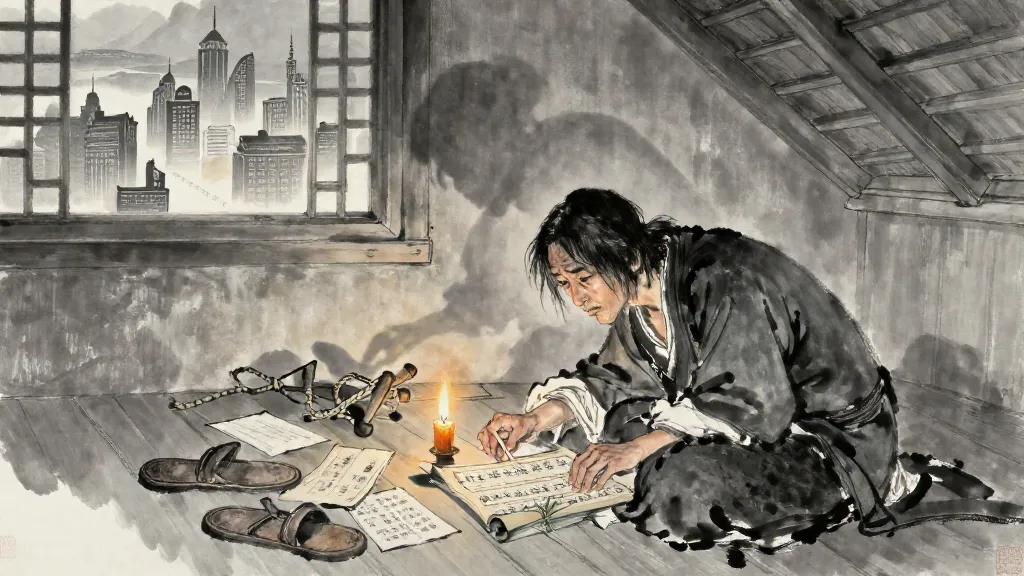
Su Qin heard this and was deeply ashamed. Wounded in spirit, he shut himself in his room and would not come out, but brought out all his books and read through them. He said: "A scholar who has already bowed his head and devoted himself to study, yet cannot use it to win honour and distinction — what use are even a great many books?"

Thereupon he obtained the Zhou text Yinfu, and bent over it in study. After a full year he emerged, having mastered the art of appraisal, and declared: "With this I can persuade the rulers of the present age." He sought an audience to persuade King Xian of Zhou. But those around the king had long known Su Qin and all thought little of him. He was not believed.

Notes

1place

Luoyang (雒陽) was the capital of the Eastern Zhou kingdom. The character 雒 is an older form; later standardised as 洛陽.

2person鬼谷先生Guǐgǔ Xiānshēng

Master Guigu (鬼谷先生) is a semi-legendary figure said to have taught both Su Qin and Zhang Yi the arts of diplomacy and persuasion. The name means 'Master of Ghost Valley.' His historicity is debated.

3context

The Yinfu (陰符, 'Secret Talisman') is a text attributed to the Zhou dynasty, concerned with the arts of strategic calculation and reading the patterns of events. The phrase 揣摩 (chuǎimó, 'appraisal') refers to the techniques of sizing up a ruler's psychology described in the Guiguzi tradition.

4context

逐什二 ('pursuing twenty percent') refers to the conventional merchant's profit margin. Su Qin's family were traders who regarded the diplomatic arts as impractical compared to commerce.

說秦惠王不用

Rejected by King Hui of Qin

乃西至秦。秦孝公卒。說惠王曰:「秦四塞之國,被山帶渭,東有關河,西有漢中,南有巴蜀,北有代馬,此天府也。以秦士民之眾,兵法之教,可以吞天下,稱帝而治。」秦王曰:「毛羽未成,不可以高蜚;文理未明,不可以併兼。」方誅商鞅,疾辯士,弗用。

He then travelled west to Qin. Duke Xiao of Qin had just died. Su Qin addressed King Hui, saying: "Qin is a state enclosed by four natural barriers — backed by mountains, belted by the Wei River, with the pass and the Yellow River to the east, Hanzhong to the west, Ba and Shu to the south, and Dai horses to the north. This is a heaven-endowed storehouse. With Qin's multitude of soldiers and people and its disciplined military training, you could swallow All-Under-Heaven, assume the title of Emperor, and rule."

The King of Qin replied: "When a bird's plumage is not yet fully grown, it cannot fly high; when the principles of governance are not yet clear, one cannot annex others."

He had just executed Shang Yang and loathed persuader-rhetoricians. He refused to employ Su Qin.

Notes

1context

四塞之國 ('a state enclosed by four barriers') refers to Qin's formidable natural defences: the Xiao and Hangu passes to the east, mountains to the north and south, and the Ba-Shu highlands to the west.

2person秦惠王Qín Huì Wáng

King Hui of Qin (秦惠王, r. 337–311 BC), also known as King Huiwen (秦惠文王), was the son of Duke Xiao. He executed the reformer Shang Yang upon taking power but retained most of Shang Yang's institutional reforms.

3person商鞅Shāng Yāng

Shang Yang (商鞅, d. 338 BC) was the Legalist reformer whose laws transformed Qin into a military powerhouse. King Hui had him executed by chariot-tearing upon accession, partly due to personal grudges and aristocratic opposition.

趙奉陽君拒見

Turned Away by Lord Fengyang of Zhao

乃東之趙。趙肅侯令其弟成為相,號奉陽君。奉陽君弗說之。

He then travelled east to Zhao. Lord Su of Zhao had appointed his younger brother Cheng as chancellor, with the title Lord Fengyang. Lord Fengyang was not pleased by Su Qin's proposals and refused to engage him.

Notes

1person趙肅侯Zhào Sù Hóu

Lord Su of Zhao (趙肅侯, r. 349–326 BC) was the ruler of Zhao during Su Qin's early career. His brother Zhao Cheng (趙成), given the title Lord Fengyang (奉陽君), held the chancellorship and effectively controlled access to the court.

說燕文侯合縱

Persuading King Wen of Yan to Join the Vertical Alliance

去游燕,歲餘而後得見。說燕文侯曰:「燕東有朝鮮、遼東,北有林胡、樓煩,西有雲中、九原,南有呼沱、易水,地方二千餘里,帶甲數十萬,車六百乘,騎六千匹,粟支數年。南有碣石、雁門之饒,北有棗栗之利,民雖不佃作而足於棗栗矣。此所謂天府者也。

「夫安樂無事,不見覆軍殺將,無過燕者。大王知其所以然乎?夫燕之所以不犯寇被甲兵者,以趙之為蔽其南也。秦趙五戰,秦再勝而趙三勝。秦趙相斃,而王以全燕制其後,此燕之所以不犯寇也。且夫秦之攻燕也,逾雲中、九原,過代、上谷,彌地數千里,雖得燕城,秦計固不能守也。秦之不能害燕亦明矣。今趙之攻燕也,發號出令,不至十日而數十萬之軍軍於東垣矣。渡呼沱,涉易水,不至四五日而距國都矣。故曰秦之攻燕也,戰於千里之外;趙之攻燕也,戰於百里之內。夫不憂百里之患而重千里之外,計無過於此者。是故原大王與趙從親,天下為一,則燕國必無患矣。」

文侯曰:「子言則可,然吾國小,西迫彊趙,南近齊,齊、趙彊國也。子必欲合從以安燕,寡人請以國從。」

Su Qin departed and travelled to Yan. After more than a year, he finally obtained an audience. He addressed King Wen of Yan:

"Yan has Chaoxian and Liaodong to the east, the Linhu and Loufan peoples to the north, Yunzhong and Jiuyuan to the west, and the Hutuo and Yi Rivers to the south. Its territory spans over two thousand li. It has several hundred thousand armoured troops, six hundred war chariots, six thousand cavalry horses, and grain reserves for several years. To the south lie the riches of Jieshi and Yanmen; to the north, the bounty of dates and chestnuts. Even if the people did not farm, the dates and chestnuts would suffice for their needs. This is what is called a heaven-endowed storehouse.

"Now, for living in peace and security, free from the disaster of armies destroyed and generals slain, no state surpasses Yan. Does Your Majesty know why this is so? The reason Yan has not suffered invasion and the calamity of war is that Zhao serves as a shield to its south. Qin and Zhao have fought five times: Qin won twice and Zhao won three times. Qin and Zhao exhausted each other, while Your Majesty held intact Yan in reserve behind them — this is why Yan has not suffered invasion.

"Moreover, if Qin were to attack Yan, it would have to cross Yunzhong and Jiuyuan, pass through Dai and Shanggu — a distance spanning thousands of li. Even if Qin captured Yan's cities, by its own calculations it could never hold them. That Qin cannot harm Yan is perfectly clear.

"But if Zhao were to attack Yan, it need only issue the order, and within ten days an army of several hundred thousand would be massed at Dongyuan. They would cross the Hutuo, ford the Yi River, and within four or five days be at the gates of the capital.

"Therefore I say: when Qin attacks Yan, the battle is fought a thousand li away; when Zhao attacks Yan, the battle is fought within a hundred li. To ignore the danger at a hundred li while worrying about a threat a thousand li distant — no strategy could be more mistaken. For this reason, I pray that Your Majesty form a vertical alliance with Zhao. If All-Under-Heaven unites as one, then Yan shall surely have no cause for concern."

King Wen said: "What you say is well-reasoned. However, my state is small — pressed by mighty Zhao to the west and close to Qi to the south. Qi and Zhao are both powerful states. If you are truly determined to forge a vertical alliance to secure Yan, then I place my state at your disposal for the alliance."

Notes

1person燕文侯Yān Wén Hóu

King Wen of Yan (燕文侯) is also referred to in other sources as Duke Wen of Yan (燕文公, r. 361–333 BC). The Shiji uses the title 侯 (marquis/lord) here rather than 公 (duke) or 王 (king).

2context

Su Qin's strategic argument to Yan rests on a simple geographic insight: Zhao, not Qin, is Yan's real threat, because Zhao borders Yan directly. Therefore Yan's security depends on keeping Zhao as an ally rather than an enemy — which the vertical alliance achieves.

3context

合縱 (hézòng, 'vertical alliance') refers to the north-south coalition of the six states east of the mountains (山東六國) against Qin in the west. The term 'vertical' (縱/從) describes the north-south geographic axis of the allied states, in contrast to 連衡 (liánhéng, 'horizontal alliance'), which describes the east-west axis of individual states allying with Qin.

4place

Chaoxian (朝鮮) here refers to the ancient Joseon territory in the Liaodong region (modern southern Manchuria and northern Korea), not the later Korean state. Yan controlled or claimed influence over these northeastern frontier areas.

說趙肅侯合縱

Persuading Lord Su of Zhao to Join the Vertical Alliance

於是資蘇秦車馬金帛以至趙。而奉陽君已死,即因說趙肅侯曰:「天下卿相人臣及布衣之士,皆高賢君之行義,皆原奉教陳忠於前之日久矣。雖然,奉陽君妒而君不任事,是以賓客游士莫敢自盡於前者。今奉陽君捐館舍,君乃今復與士民相親也,臣故敢進其愚慮。

「竊為君計者,莫若安民無事,且無庸有事於民也。安民之本,在於擇交,擇交而得則民安,擇交而不得則民終身不安。請言外患:齊秦為兩敵而民不得安,倚秦攻齊而民不得安,倚齊攻秦而民不得安。故夫謀人之主,伐人之國,常苦出辭斷絕人之交也。原君慎勿出於口。請別白黑所以異,陰陽而已矣。君誠能聽臣,燕必致旃裘狗馬之地,齊必致魚鹽之海,楚必致橘柚之園,韓、魏、中山皆可使致湯沐之奉,而貴戚父兄皆可以受封侯。夫割地包利,五伯之所以覆軍禽將而求也;封侯貴戚,湯武之所以放弒而爭也。今君高拱而兩有之,此臣之所以為君原也。

「今大王與秦,則秦必弱韓、魏;與齊,則齊必弱楚、魏。魏弱則割河外,韓弱則效宜陽,宜陽效則上郡絕,河外割則道不通,楚弱則無援。此三策者,不可不孰計也。

「夫秦下軹道,則南陽危;劫韓包周,則趙氏自操兵;據衛取卷,則齊必入朝秦。秦欲已得乎山東,則壁舉兵而鄉趙矣。秦甲渡河逾漳,據番吾,則兵必戰於邯鄲之下矣。此臣之所為君患也。

「當今之時,山東之建國莫彊於趙。趙地方二千餘里,帶甲數十萬,車千乘,騎萬匹,粟支數年。西有常山,南有河漳,東有清河,北有燕國。燕固弱國,不足畏也。秦之所害於天下者莫如趙,然而秦不敢舉兵伐趙者,何也?畏韓、魏之議其後也。然則韓、魏,趙之南蔽也。秦之攻韓、魏也,無有名山大川之限,稍蠶食之,傅國都而止。韓、魏不能支秦,必入臣於秦。秦無韓、魏之規,則禍必中於趙矣。此臣之所為君患也。

「臣聞堯無三夫之分,舜無咫尺之地,以有天下;禹無百人之聚,以王諸侯;湯武之士不過三千,車不過三百乘,卒不過三萬,立為天子:誠得其道也。是故明主外料其敵之彊弱,內度其士卒賢不肖,不待兩軍相當而勝敗存亡之機固已形於胸中矣,豈揜於眾人之言而以冥冥決事哉!

「臣竊以天下之地圖案之,諸侯之地五倍於秦,料度諸侯之卒十倍於秦,六國為一,並力西鄉而攻秦,秦必破矣。今西面而事之,見臣於秦。夫破人之與破於人也,臣人之與臣於人也,豈可同日而論哉!

「夫衡人者,皆欲割諸侯之地以予秦。秦成,則高台榭,美宮室,聽竽瑟之音,前有樓闕軒轅,後有長姣美人,國被秦患而不與其憂。是故夫衡人日夜務以秦權恐愒諸侯以求割地,故原大王孰計之也。

「臣聞明主絕疑去讒,屏流言之跡,塞朋黨之門,故尊主廣地彊兵之計臣得陳忠於前矣。故竊為大王計,莫如一韓、魏、齊、楚、燕、趙以從親,以畔秦。令天下之將相會於洹水之上,通質,刳白馬而盟。要約曰:『秦攻楚,齊、魏各出銳師以佐之,韓絕其糧道,趙涉河漳,燕守常山之北。秦攻韓魏,則楚絕其後,齊出銳師而佐之,趙涉河漳,燕守雲中。秦攻齊,則楚絕其後,韓守城皋,魏塞其道,趙涉河漳、博關,燕出銳師以佐之。秦攻燕,則趙守常山,楚軍武關,齊涉勃海,韓、魏皆出銳師以佐之。秦攻趙,則韓軍宜陽,楚軍武關,魏軍河外,齊涉清河,燕出銳師以佐之。諸侯有不如約者,以五國之兵共伐之。』六國從親以賓秦,則秦甲必不敢出於函谷以害山東矣。如此,則霸王之業成矣。」

趙王曰:「寡人年少,立國日淺,未嘗得聞社稷之長計也。今上客有意存天下,安諸侯寡人敬以國從。」乃飾車百乘,黃金千溢,白璧百雙,錦繡千純,以約諸侯。

Thereupon Yan furnished Su Qin with chariots, horses, gold, and silk, and he travelled to Zhao. Lord Fengyang had already died. Su Qin then addressed Lord Su of Zhao directly:

"All the ministers, officials, and commoner-scholars under heaven have long admired Your Lordship's righteous conduct and wished to present themselves before you to offer their loyal counsel. Nevertheless, Lord Fengyang was jealous and kept Your Lordship from managing affairs — and for this reason no visiting scholar dared speak freely in your presence. Now Lord Fengyang has departed this life, and Your Lordship may once again draw close to the scholars and people. Therefore your servant ventures to present his humble thoughts.

"In my private estimation, the best course for Your Lordship is to bring peace to the people and keep them free from trouble — and certainly not to needlessly burden them with affairs. The foundation of bringing peace to the people lies in choosing alliances wisely. If alliances are chosen well, the people will be at peace; if chosen poorly, the people will never know peace in their lives.

"Allow me to speak of the external threats. If Qi and Qin are both enemies, the people cannot be at peace. If you lean on Qin to attack Qi, the people cannot be at peace. If you lean on Qi to attack Qin, the people cannot be at peace. Those who plot against other rulers and attack other states always strive to issue pretexts that sever others' alliances. I pray that Your Lordship never let such words leave your lips.

"Let me distinguish black from white, for the difference amounts to this: yin and yang, nothing more. If Your Lordship will truly heed your servant, Yan will certainly present its furs, dogs, and horses; Qi will certainly present its fish and salt from the sea; Chu will certainly present the bounty of its orange and pomelo groves; Han, Wei, and Zhongshan can all be made to deliver revenue for your sustenance. And your noble kinsmen, fathers, and brothers may all receive fiefdoms as marquises.

"Now, seizing territory and monopolising profit — this is what the Five Hegemons waged war and captured generals to obtain. Enfeoffing kinsmen as nobles — this is what Tang and Wu overthrew tyrants and risked their lives to achieve. Today Your Lordship may sit with folded hands and possess both at once. This is what your servant wishes for Your Lordship.

"If Your Majesty allies with Qin, then Qin will surely weaken Han and Wei. If you ally with Qi, then Qi will surely weaken Chu and Wei. If Wei is weakened, it will cede the lands beyond the Yellow River. If Han is weakened, it will surrender Yiyang. Once Yiyang is surrendered, the Shang Commandery will be cut off. Once the lands beyond the river are ceded, the roads will be impassable. If Chu is weakened, you will have no ally to rely on. These three contingencies must be carefully considered.

"If Qin descends through Zhidao, then Nanyang will be imperilled. If it coerces Han and encircles Zhou, then Zhao will have to take up arms itself. If it occupies Wei and seizes Juan, then Qi will certainly submit to Qin's court. Once Qin has obtained what it desires from east of the mountains, it will muster its full forces and turn toward Zhao. When Qin's armoured troops cross the Yellow River and the Zhang, and occupy Fanwu, then battle will surely be joined beneath the walls of Handan itself. This is what your servant fears on Your Lordship's behalf.

"At the present time, among the established states east of the mountains, none is stronger than Zhao. Zhao's territory spans over two thousand li. It has several hundred thousand armoured troops, a thousand war chariots, ten thousand cavalry horses, and grain reserves for several years. To the west lies Changshan, to the south the Yellow River and the Zhang, to the east the Qing River, and to the north the state of Yan. Yan is inherently a weak state and not to be feared.

"Of all states under heaven, the one Qin considers most dangerous is Zhao. Yet the reason Qin does not dare raise an army to attack Zhao is this: it fears that Han and Wei will strike at its rear. Thus Han and Wei serve as Zhao's southern shield. But when Qin attacks Han and Wei, there are no great mountains or rivers to block its advance — it merely nibbles away at their territory, piece by piece, until it reaches the capital. If Han and Wei cannot withstand Qin, they will submit as Qin's vassals. Once Qin is free from the constraint of Han and Wei, disaster will inevitably fall upon Zhao. This is what your servant fears on Your Lordship's behalf.

"Your servant has heard that Yao possessed no more than three men's share of land, and Shun had not a foot of territory, yet they came to possess All-Under-Heaven. Yu had no assembly of even a hundred men, yet he reigned as king over the feudal lords. The soldiers of Tang and Wu numbered no more than three thousand, their chariots no more than three hundred, their troops no more than thirty thousand, yet they established themselves as Sons of Heaven — for they had truly found the Way.

"Therefore the wise ruler gauges externally the strength and weakness of his enemies, and measures internally the ability and deficiency of his own officers. Without waiting for two armies to meet, the decisive moment of victory or defeat, survival or ruin, has already taken shape in his mind. How could he be swayed by the opinions of the crowd and decide affairs in darkness?

"Your servant has privately examined the map of All-Under-Heaven: the territories of the feudal lords are five times that of Qin; by estimation, the combined soldiers of the feudal lords are ten times those of Qin. If the six states unite as one, join their forces, and march westward to attack Qin, Qin will surely be destroyed. Yet now they face west and serve Qin, presenting themselves as its subjects. To be the one who destroys others versus being destroyed by others, to make others your subjects versus being made a subject — how can these be spoken of in the same breath?

"Those who advocate the horizontal alliance all seek to carve up the feudal lords' territory and hand it to Qin. When Qin achieves its aims, its advocates build lofty terraces and beautify their palaces, listen to the music of reed-organs and zithers, with grand towers and gateways before them and tall, lovely women behind them — while the states suffer Qin's depredations and these men share none of their sorrow. Thus the horizontal alliance advocates labour day and night to wield Qin's power as a threat, intimidating the feudal lords into ceding territory. I therefore pray that Your Majesty deliberate carefully.

"Your servant has heard that the wise ruler cuts through doubt, banishes slander, blocks the tracks of rumour, and seals the gates of factionalism. It is for this reason that your servant is able to present his loyal counsel on how to honour the sovereign, expand territory, and strengthen the army.

"Therefore, in my private estimation, the best course for Your Majesty is to unite Han, Wei, Qi, Chu, Yan, and Zhao in a vertical alliance, and thereby break with Qin. Command the generals and ministers of All-Under-Heaven to convene at the Huan River. Exchange hostages, slaughter a white horse, and swear an oath. The covenant shall read:

'If Qin attacks Chu, Qi and Wei shall each dispatch elite forces to assist, Han shall cut Qin's supply lines, Zhao shall cross the Yellow River and Zhang, and Yan shall guard the north of Changshan. If Qin attacks Han and Wei, Chu shall cut off its rear, Qi shall dispatch elite forces to assist, Zhao shall cross the Yellow River and Zhang, and Yan shall guard Yunzhong. If Qin attacks Qi, Chu shall cut off its rear, Han shall hold Chenggao, Wei shall block its routes, Zhao shall cross the Yellow River, Zhang, and Boguan, and Yan shall dispatch elite forces to assist. If Qin attacks Yan, Zhao shall hold Changshan, Chu shall station troops at Wuguan, Qi shall cross the Bohai, and Han and Wei shall each dispatch elite forces to assist. If Qin attacks Zhao, Han shall station troops at Yiyang, Chu shall station troops at Wuguan, Wei shall station troops beyond the Yellow River, Qi shall cross the Qing River, and Yan shall dispatch elite forces to assist. Any feudal lord who fails to honour the covenant shall be attacked by the combined armies of the other five states.'

"If the six states form a vertical alliance and hold Qin in check, then Qin's armoured troops will surely never dare emerge from Hangu Pass to threaten the states east of the mountains. Thus shall the enterprise of a hegemon-king be accomplished."

The King of Zhao said: "I am young in years and have occupied the throne but a short time. Never before have I heard of a long-term strategy for the altars of soil and grain. Now that our honoured guest intends to preserve All-Under-Heaven and bring peace to the feudal lords, I respectfully commit my state to the alliance."

He thereupon furnished a retinue of a hundred decorated chariots, a thousand yi of gold, a hundred pairs of white jade discs, and a thousand bolts of brocade and embroidery, to be used in securing the covenant of the feudal lords.
Notes

1context

This is the longest and most elaborate of Su Qin's persuasion speeches. As Zhao is the pivotal state in the vertical alliance — the geographical centre connecting north and south — Su Qin deploys his full rhetorical arsenal: flattery, threat analysis, historical precedent, strategic mapping, and a detailed mutual defence pact.

2context

五伯 (Five Hegemons) traditionally refers to five Spring and Autumn period lords who achieved hegemony: Duke Huan of Qi, Duke Wen of Jin, Duke Mu of Qin, King Zhuang of Chu, and Duke Xiang of Song (though the list varies by source).

3context

The mutual defence covenant (要約) is structured as a comprehensive collective security pact. Each of the five possible Qin attack scenarios is paired with a coordinated multi-state response, with each state assigned a specific military role based on its geographic position. The final clause — punishing any state that breaks the covenant — makes defection costly.

4context

蠶食 (cánshí, 'silkworm-eating') is a vivid metaphor for gradual territorial encroachment, depicting Qin as a silkworm consuming a mulberry leaf bite by bite. This became a standard idiom (蠶食鯨吞, 'nibbling like a silkworm, swallowing like a whale').

5place

The Huan River (洹水) flows through modern Anyang, Henan — a central location accessible to all six states. It was a traditional meeting place for interstate diplomacy.

6context

衡人 (héngrén, 'horizontal alliance advocates') refers to diplomats who promoted individual alliances between each eastern state and Qin. Su Qin portrays them as self-serving traitors who profit from the states' submission to Qin.

激怒張儀入秦

Provoking Zhang Yi to Enter Qin

是時周天子致文武之胙於秦惠王。惠王使犀首攻魏,禽將龍賈,取魏之雕陰,且欲東兵。蘇秦恐秦兵之至趙也,乃激怒張儀,入之於秦。

At this time, the Son of Heaven of Zhou presented the sacrificial meat of Kings Wen and Wu to King Hui of Qin. King Hui dispatched Xiushou to attack Wei. Xiushou captured the general Long Jia and seized Wei's Diaoyin, and Qin was preparing to march its armies eastward.

Su Qin, fearing that Qin's forces would reach Zhao, deliberately provoked Zhang Yi into a fury and engineered his entry into Qin.

Notes

1context

The Zhou Son of Heaven's presentation of the sacrificial meats of Kings Wen and Wu (文武之胙) to Qin was a highly significant symbolic act — it implied Zhou's recognition of Qin as a legitimate successor to the royal mandate. This alarmed the other states.

2person犀首(公孫衍)Xīshǒu (Gōngsūn Yǎn)

Xiushou (犀首, 'Rhinoceros Head') was the sobriquet of Gongsun Yan (公孫衍), a prominent Qin general and later a rival advocate of the vertical alliance. The nickname may refer to a rhinoceros-horn helmet or headpiece.

3person張儀Zhāng Yí

Zhang Yi (張儀, d. 309 BC) was Su Qin's fellow student under Master Guigu and the chief architect of Qin's horizontal alliance (連衡) strategy. According to the Shiji, Su Qin deliberately humiliated Zhang Yi so that he would travel to Qin in anger and serve as Su Qin's counterpart there — a claim modern scholars consider unlikely.

說韓宣王合縱

Persuading King Xuan of Han to Join the Vertical Alliance

於是說韓宣王曰:「韓北有鞏、成皋之固,西有宜陽、商阪之塞,東有宛、穰、洧水,南有陘山,地方九百餘里,帶甲數十萬,天下之彊弓勁弩皆從韓出。谿子、少府時力、距來者,皆射六百步之外。韓卒超足而射,百發不暇止,遠者括蔽洞胸,近者鏑弇心。韓卒之劍戟皆出於冥山、棠谿、墨陽、合賻、鄧師、宛馮、龍淵、太阿,皆陸斷牛馬,水截鵠雁,當敵則斬堅甲鐵幕,革抉簠芮,無不畢具。以韓卒之勇,被堅甲,蹠勁弩,帶利劍,一人當百,不足言也。夫以韓之勁與大王之賢,乃西面事秦,交臂而服,羞社稷而為天下笑,無大於此者矣。是故原大王孰計之。

「大王事秦,秦必求宜陽、成皋。今茲效之,明年又復求割地。與則無地以給之,不與則棄前功而受後禍。且大王之地有盡而秦之求無已,以有盡之地而逆無已之求,此所謂市怨結禍者也,不戰而地已削矣。臣聞鄙諺曰:『寧為雞口,無為牛後。』今西面交臂而臣事秦,何異於牛後乎?夫以大王之賢,挾彊韓之兵,而有牛後之名,臣竊為大王羞之。」

於是韓王勃然作色,攘臂瞋目,按劍仰天太息曰:「寡人雖不肖,必不能事秦。今主君詔以趙王之教,敬奉社稷以從。」

Su Qin then addressed King Xuan of Han:

"Han has the strongholds of Gong and Chenggao to the north, the passes of Yiyang and Shangban to the west, Wan, Rang, and the Wei River to the east, and Mount Xing to the south. Its territory spans over nine hundred li, and it has several hundred thousand armoured troops.

"All the mighty bows and powerful crossbows under heaven come from Han. The Xiezi, the Shaofu Shili, and the Julai — all can shoot beyond six hundred paces. Han's soldiers draw the bow with a leaping stance and fire without pause, a hundred shots in succession. At long range their bolts pierce through the chest; at close range the arrowheads bury themselves in the heart.

"The swords and halberds of Han's soldiers all come from the famous forges of Mingshan, Tangxi, Moyang, Hefu, Dengshi, Wanfeng, Longyuan, and Tai'e. On land they cleave oxen and horses; on water they sever swans and geese. Against the enemy they slash through hard armour and iron curtains. Leather armguards and ceremonial vessels — all are fully equipped.

"With the valour of Han's soldiers, clad in heavy armour, treading powerful crossbows, and bearing sharp swords — one man is a match for a hundred; this is no exaggeration.

"Yet with Han's might and Your Majesty's virtue, you now face west and serve Qin, folding your arms in submission, bringing shame to the altars of soil and grain and making yourself the laughingstock of All-Under-Heaven. Nothing could be more disgraceful than this. For this reason, I pray that Your Majesty deliberate carefully.

"If Your Majesty serves Qin, Qin will certainly demand Yiyang and Chenggao. Surrender them this year, and next year Qin will demand still more territory. Give, and you will have no land left to give. Refuse, and you throw away your prior concessions and invite fresh disaster. Moreover, Your Majesty's territory has a limit, but Qin's demands have none. To meet limitless demands with limited territory — this is what is called 'purchasing enmity and accumulating disaster.' Without even fighting, your territory will already have been whittled away.

"Your servant has heard a common saying: 'Better to be a rooster's beak than a bull's rump.' To face west, fold your arms, and serve Qin as a vassal — how does this differ from being the bull's rump? With Your Majesty's virtue and the strength of Han's army, to bear the name of 'bull's rump' — your servant is privately ashamed on Your Majesty's behalf."

At this the King of Han flushed with anger. He bared his arms, glared with fury, gripped his sword, and looked up to heaven with a great sigh, saying: "Though I am unworthy, I will never consent to serve Qin. Now that you, my lord, convey the instruction of the King of Zhao, I respectfully commit my altars of soil and grain to the alliance."

Notes

1person韓宣王Hán Xuān Wáng

King Xuan of Han (韓宣王, also known as Marquis Xuan 韓宣惠王, r. 332–312 BC) ruled during the period when Han was under growing pressure from Qin's eastward expansion.

2context

Han was famous throughout the Warring States period for its weapons industry. The crossbow names Xiezi (谿子), Shaofu Shili (少府時力), and Julai (距來) appear to be specific models or brands of crossbow produced in Han's arsenals. The sword-forge names — Tangxi (棠谿), Longyuan (龍淵), Tai'e (太阿) and others — were celebrated across All-Under-Heaven and appear in many texts of the period.

3context

寧為雞口,無為牛後 ('Better to be a rooster's beak than a bull's rump') is one of the most famous proverbs in classical Chinese. It means it is better to be the leader of a small group than a subordinate in a large one. Su Qin uses it to shame Han into rejecting vassalage under Qin.

4context

Su Qin's speech to Han focuses heavily on military prowess rather than strategic geography (in contrast to his speeches to Yan and Zhao). This is because Han's territory was relatively small — its strength lay in its weapons industry and the quality of its soldiers, not in geographic scale.

說魏襄王合縱

Persuading King Xiang of Wei to Join the Vertical Alliance

又說魏襄王曰:「大王之地,南有鴻溝、陳、汝南、許、郾、昆陽、召陵、舞陽、新都、新郪,東有淮、潁、棗、無胥,西有長城之界,北有河外、卷、衍、酸棗,地方千里。地名雖小,然而田舍廬廡之數,曾無所芻牧。人民之眾,車馬之多,日夜行不絕,輷輷殷殷,若有三軍之眾。臣竊量大王之國不下楚。然衡人怵王交彊虎狼之秦以侵天下,卒有秦患,不顧其禍。夫挾彊秦之勢以內劫其主,罪無過此者。魏,天下之彊國也;王,天下之賢王也。今乃有意西面而事秦,稱東籓,築帝宮,受冠帶,祠春秋,臣竊為大王恥之。

「臣聞越王句踐戰敝卒三千人,禽夫差於乾遂;武王卒三千人,革車三百乘,制紂於牧野:豈其士卒眾哉,誠能奮其威也。今竊聞大王之卒,武士二十萬,蒼頭二十萬,奮擊二十萬,廝徒十萬,車六百乘,騎五千匹。此其過越王句踐、武王遠矣,今乃聽於群臣之說而欲臣事秦。夫事秦必割地以效實,故兵未用而國已虧矣。凡群臣之言事秦者,皆奸人,非忠臣也。夫為人臣,割其主之地以求外交,偷取一時之功而不顧其後,破公家而成私門,外挾彊秦之勢以內劫其主,以求割地,原大王孰察之。

「周書曰:『釂釂不絕,蔓蔓柰何?豪氂不伐,將用斧柯。』前慮不定,後有大患,將柰之何?大王誠能聽臣,六國從親,專心併力壹意,則必無彊秦之患。故敝邑趙王使臣效愚計,奉明約,在大王之詔詔之。」

魏王曰:「寡人不肖,未嘗得聞明教。今主君以趙王之詔詔之,敬以國從。」

Su Qin then addressed King Xiang of Wei:

"Your Majesty's territory has the Hong Canal, Chen, Runan, Xu, Yan, Kunyang, Zhaoling, Wuyang, Xindu, and Xinqi to the south; the Huai and Ying Rivers, Zao, and Wuxu to the east; the Long Wall as its western boundary; and Hewai, Juan, Yan, and Suanzao to the north. The territory spans a thousand li. Though each place-name may sound small, the farmsteads, houses, and buildings are so densely packed that there is not even room left for grazing pasture. The populace is vast and the chariots and horses so numerous that they travel without ceasing day and night, rumbling and thundering as though an entire army were on the march. In my private estimation, Your Majesty's state is no less than Chu.

"Yet the horizontal alliance advocates have frightened Your Majesty into befriending the tiger-and-wolf state of mighty Qin, inviting the destruction of All-Under-Heaven. Ultimately, when the calamity of Qin arrives, these men give no thought to the disaster. To wield mighty Qin's power to internally coerce one's own sovereign — no crime exceeds this.

"Wei is a mighty state under heaven; Your Majesty is a worthy king under heaven. Yet now you intend to face west and serve Qin, to be styled an eastern vassal, to build an imperial palace for Qin, to receive Qin's ceremonial cap and sash, and to offer seasonal sacrifices to Qin. Your servant is privately ashamed on Your Majesty's behalf.

"Your servant has heard that King Goujian of Yue, with three thousand battle-weary soldiers, captured Fu Chai at Gansu; and that King Wu, with three thousand soldiers and three hundred leather-covered chariots, subdued the tyrant Zhou at Muye. Was it because their troops were numerous? No — it was because they were truly able to rouse their authority to its fullest.

"Now, your servant has heard that Your Majesty's forces include two hundred thousand warriors, two hundred thousand grey-capped infantry, two hundred thousand shock troops, a hundred thousand labourers and camp-followers, six hundred war chariots, and five thousand cavalry horses. This far surpasses King Goujian of Yue and King Wu. Yet now you heed the counsel of your ministers and intend to submit as Qin's vassal. To serve Qin means you must cede territory as a token of good faith — thus before your armies are even deployed, your state has already been diminished.

"Any minister who counsels serving Qin is a traitor, not a loyal servant. For a subject to carve up his lord's territory in pursuit of foreign alliances, to snatch a moment's advantage with no thought for the future, to ruin the public house to build up his private house, and to wield mighty Qin's power externally to coerce his own sovereign internally and demand the cession of territory — I pray that Your Majesty examine this closely.

"The Book of Zhou says: 'If you do not cut the trickle, the spreading vine — what then? If you do not fell the fine hair, you will need an axe-handle.' If prior deliberations are not settled, great calamity follows — and then what will you do?

"If Your Majesty will truly heed your servant, the six states shall form a vertical alliance, unite their hearts, combine their strength, and act with single purpose — then you shall surely be free from the menace of mighty Qin. Therefore our humble city, the King of Zhao, has sent your servant to present this humble plan and offer a clear covenant. It awaits Your Majesty's command."

The King of Wei said: "I am unworthy and have never before received such enlightened instruction. Now that you, my lord, convey the command of the King of Zhao, I respectfully commit my state to the alliance."

Notes

1person魏襄王Wèi Xiāng Wáng

King Xiang of Wei (魏襄王, r. 318–296 BC) is the ruler addressed here, though some scholars believe the chronology of this passage better fits his predecessor King Hui of Wei (魏惠王). The Shiji's dating of Su Qin's career is notoriously problematic.

2context

Su Qin's description of Wei emphasises population density and economic vitality rather than geographic scale (Wei's territory of 'a thousand li' is smaller than Zhao's or Yan's 'two thousand li'). The image of ceaseless traffic 'rumbling and thundering' (輷輷殷殷) conveys that Wei's strength lies in its concentrated wealth and manpower.

3context

The Zhou Book (周書) quotation uses two metaphors for the danger of inaction: an unchecked trickle becomes an uncontrollable flood (蔓蔓), and a sapling left uncut will require an axe. Both warn that Qin's encroachment, if not resisted early, will become impossible to reverse.

4context

蒼頭 ('grey-capped') refers to a class of Wei soldiers who wore grey or dark cloth headwraps as a uniform marker, distinguishing them from the regular 武士 (warriors) and 奮擊 (shock troops). The four-tier breakdown of Wei's forces totals 700,000 men — an enormous figure likely exaggerated for rhetorical effect.

說齊宣王合縱

Persuading King Xuan of Qi to Join the Vertical Alliance

因東說齊宣王曰:「齊南有泰山,東有琅邪,西有清河,北有勃海,北所謂四塞之國也。齊地方二千餘里,帶甲數十萬,粟如丘山。三軍之良,五家之兵,進如鋒矢,戰如雷霆,解如風雨。即有軍役,未嘗倍泰山,絕清河,涉勃海也。臨菑之中七萬戶,臣竊度之,不下戶三男子,三七二十一萬,不待發於遠縣,而臨菑之卒固已二十一萬矣。臨菑甚富而實,其民無不吹竽鼓瑟,彈琴擊築,鬥雞走狗,六博蹋鞠者。臨菑之塗,車轂擊,人肩摩,連衽成帷,舉袂成幕,揮汗成雨,家殷人足,志高氣揚。夫以大王之賢與齊之彊,天下莫能當。今乃西面而事秦,臣竊為大王羞之。

「且夫韓、魏之所以重畏秦者,為與秦接境壤界也。兵出而相當,不出十日而戰勝存亡之機決矣。韓、魏戰而勝秦,則兵半折,四境不守;戰而不勝,則國已危亡隨其後。是故韓、魏之所以重與秦戰,而輕為之臣也。今秦之攻齊則不然。倍韓、魏之地,過衛陽晉之道,徑乎亢父之險,車不得方軌,騎不得比行,百人守險,千人不敢過也。秦雖欲深入,則狼顧,恐韓、魏之議其後也。是故恫疑虛猲,驕矜而不敢進,則秦之不能害齊亦明矣。

「夫不深料秦之無柰齊何,而欲西面而事之,是群臣之計過也。今無臣事秦之名而有彊國之實,臣是故原大王少留意計之。」

齊王曰:「寡人不敏,僻遠守海,窮道東境之國也,未嘗得聞餘教。今足下以趙王詔詔之,敬以國從。」

Su Qin then travelled east and addressed King Xuan of Qi:

"Qi has Mount Tai to the south, Langya to the east, the Qing River to the west, and the Bohai Sea to the north — this is what is called a state enclosed by four natural barriers. Qi's territory spans over two thousand li, with several hundred thousand armoured troops and grain piled high as hills.

"The finest soldiers of the three armies and the troops of the five district-families advance like the point of an arrow, fight like a thunderclap, and disperse like wind and rain. Whenever there has been military service, they have never needed to go beyond Mount Tai, cross the Qing River, or traverse the Bohai.

"Within the city of Linzi there are seventy thousand households. By my private estimate, each household has no fewer than three adult males — three times seventy thousand gives two hundred and ten thousand. Without even summoning men from the distant counties, the garrison of Linzi alone already amounts to two hundred and ten thousand soldiers.

"Linzi is exceedingly wealthy and prosperous. Its people all play the yu reed-organ and beat the se zither, strum the qin and strike the zhu, stage cockfights and race dogs, and play liubo and kick balls. On the roads of Linzi, chariot hubs collide and men's shoulders brush against one another. Linked lapels form curtains, raised sleeves form canopies, and flicked sweat falls like rain. Every household is prosperous, every person content, with lofty ambitions and high spirits.

"With Your Majesty's virtue and Qi's might, nothing under heaven can withstand you. Yet now you face west and serve Qin — your servant is privately ashamed on Your Majesty's behalf.

"Moreover, the reason Han and Wei are so deeply afraid of Qin is that they share a direct border with it. Once armies march out and engage, within ten days the issue of victory or defeat, survival or ruin, is decided. If Han and Wei fight and defeat Qin, half their forces are destroyed and they cannot defend their four borders. If they fight and fail to defeat Qin, their states face imminent ruin. This is why Han and Wei would rather submit to Qin lightly than fight Qin in earnest.

"But if Qin were to attack Qi, the situation would be entirely different. It would have to pass through Han and Wei's territory, cross the roads of Wei and Jin, and traverse the narrow defile of Kangfu — where chariots cannot travel side by side and horsemen cannot ride abreast. A hundred men defending the pass could hold off a thousand. Even if Qin wished to penetrate deep into Qi, it would glance behind like a wolf, fearing that Han and Wei would strike at its rear. Thus Qin can only threaten and bluster, posture arrogantly but dare not advance. That Qin cannot harm Qi is perfectly clear.

"To fail to reckon deeply that Qin can do nothing to Qi, and instead wish to face west and serve it — this is a miscalculation by Your Majesty's ministers. If you neither bear the name of Qin's vassal and yet possess the substance of a strong state — for this reason I pray that Your Majesty give the matter some thought."

The King of Qi said: "I am slow-witted, tucked away in a remote corner guarding the seacoast — a state at the end of the road on the eastern frontier. I have never before received such instruction. Now that you, sir, convey the command of the King of Zhao, I respectfully commit my state to the alliance."

Notes

1person齊宣王Qí Xuān Wáng

King Xuan of Qi (齊宣王, r. 319–301 BC) was one of the most powerful rulers of the mid-Warring States period, patron of the Jixia Academy, and husband of the famously virtuous Queen Zhongli Chun.

2place

Linzi (臨菑/臨淄) was the capital of Qi, located in modern Zibo, Shandong. It was one of the largest and wealthiest cities in the Warring States world. The vivid description of its bustling streets — colliding hubs, brushing shoulders, linked lapels, raised sleeves, and sweat like rain — became a stock literary passage quoted across later Chinese literature.

3context

五家之兵 ('troops of the five families') refers to Qi's distinctive military organisation. The population was grouped into units of five households (五家) for conscription purposes, a system attributed to the reforms of Guan Zhong under Duke Huan of Qi.

4context

蹋鞠 (tàjū) refers to an ancient ball-kicking game, a precursor to the sport later known as cuju (蹴鞠), which some historians consider an early form of football/soccer. It was especially popular in Qi.

5context

Su Qin's argument to Qi is unique among his speeches: rather than urging Qi to fear Qin, he argues that Qi has nothing to fear from Qin at all — precisely because of the geographic buffer of Han and Wei. The implication is that Qi need not debase itself by submitting to a state that cannot reach it.

說楚威王合縱

Persuading King Wei of Chu to Join the Vertical Alliance

乃西南說楚威王曰:「楚,天下之彊國也;王,天下之賢王也。西有黔中、巫郡,東有夏州、海陽,南有洞庭、蒼梧,北有陘塞、郇陽,地方五千餘里,帶甲百萬,車千乘,騎萬匹,粟支十年。此霸王之資也。夫以楚之彊與王之賢,天下莫能當也。今乃欲西面而事秦,則諸侯莫不西面而朝於章台之下矣。

「秦之所害莫如楚,楚彊則秦弱,秦彊則楚弱,其勢不兩立。故為大王計,莫如從親以孤秦。大王不從,秦必起兩軍,一軍出武關,一軍下黔中,則鄢郢動矣。

「臣聞治之其未亂也,為之其未有也。患至而後憂之,則無及已。故原大王蚤孰計之。

「大王誠能聽臣,臣請令山東之國奉四時之獻,以承大王之明詔,委社稷,奉宗廟,練士厲兵,在大王之所用之。大王誠能用臣之愚計,則韓、魏、齊、燕、趙、衛之妙音美人必充後宮,燕、代橐駝良馬必實外廄。故從合則楚王,衡成則秦帝。今釋霸王之業,而有事人之名,臣竊為大王不取也。

「夫秦,虎狼之國也,有吞天下之心。秦,天下之仇讎也。衡人皆欲割諸侯之地以事秦,此所謂養仇而奉讎者也。夫為人臣,割其主之地以外交彊虎狼之秦,以侵天下,卒有秦患,不顧其禍。夫外挾彊秦之威以內劫其主,以求割地,大逆不忠,無過此者。故從親則諸侯割地以事楚,衡合則楚割地以事秦,此兩策者相去遠矣,二者大王何居焉?故敝邑趙王使臣效愚計,奉明約,在大王詔之。」

Su Qin then travelled southwest and addressed King Wei of Chu:

"Chu is the mightiest state under heaven; Your Majesty is the worthiest king under heaven. To the west lie Qianzhong and Wu Commandery, to the east Xiazhou and Haiyang, to the south Dongting and Cangwu, and to the north the Xing Passes and Xunyang. Your territory spans over five thousand li, with a million armoured troops, a thousand war chariots, ten thousand cavalry horses, and grain reserves for ten years. These are the resources of a hegemon-king.

"With Chu's might and Your Majesty's virtue, nothing under heaven can withstand you. Yet now you intend to face west and serve Qin — if so, then all the feudal lords will likewise face west and pay court beneath the Zhang Terrace.

"Of all the states, the one Qin considers most threatening is Chu. When Chu is strong, Qin is weak; when Qin is strong, Chu is weak — their positions cannot coexist. Therefore, the best strategy for Your Majesty is to form a vertical alliance and isolate Qin.

"If Your Majesty does not join the alliance, Qin will surely raise two armies — one emerging from Wuguan, the other descending on Qianzhong — and then Yan and Ying will tremble.

"Your servant has heard: govern before disorder arrives; act before the situation arises. If you wait until calamity has come to worry about it, then it is already too late. Therefore I pray that Your Majesty deliberate carefully and early.

"If Your Majesty will truly heed your servant, I shall cause the states east of the mountains to present their seasonal tribute, to receive Your Majesty's wise commands, to entrust their altars of soil and grain, to honour your ancestral temples, and to train their soldiers and sharpen their weapons — all at Your Majesty's disposal.

"If Your Majesty will truly adopt your servant's humble plan, then the exquisite music and beautiful women of Han, Wei, Qi, Yan, Zhao, and Wey shall fill your rear palace, and the camels and fine horses of Yan and Dai shall fill your outer stables.

"Therefore: if the vertical alliance succeeds, Chu reigns as king; if the horizontal alliance succeeds, Qin reigns as emperor. To abandon the enterprise of a hegemon-king and instead bear the name of another's servant — your servant privately considers this a course Your Majesty would not choose.

"Qin is a tiger-and-wolf state with the ambition of swallowing All-Under-Heaven. Qin is the common enemy of All-Under-Heaven. The horizontal alliance advocates all seek to carve up the feudal lords' territory and hand it to Qin — this is what is called 'feeding the foe and serving the enemy.'

"For a subject to carve up his lord's territory to forge external ties with the tiger-and-wolf state of mighty Qin, to bring ruin upon All-Under-Heaven, and ultimately when the calamity of Qin arrives, to give no thought to the disaster — to wield mighty Qin's authority externally to coerce one's own sovereign internally and demand the cession of territory — no act of disloyalty and treason exceeds this.

"Therefore: if the vertical alliance is formed, the feudal lords will cede territory to serve Chu; if the horizontal alliance prevails, Chu will cede territory to serve Qin. These two strategies are worlds apart — which of the two will Your Majesty choose? Therefore our humble city, the King of Zhao, has sent your servant to present this humble plan and offer a clear covenant. It awaits Your Majesty's command."

Notes

1person楚威王Chǔ Wēi Wáng

King Wei of Chu (楚威王, r. 339–329 BC) presided over Chu at the height of its power. Under his rule, Chu defeated Yue to the east and competed with Qi for supremacy over the eastern seaboard.

2context

Su Qin's speech to Chu is the most flattering of all six — he positions Chu not merely as a member of the alliance but as its potential leader and primary beneficiary ('if the vertical alliance succeeds, Chu reigns as king'). This is because Chu, as the largest state, had the least obvious reason to join a defensive coalition.

3place

Yan and Ying (鄢郢) were the two principal capitals of Chu. Ying (郢, near modern Jingzhou, Hubei) was the main capital; Yan (鄢, modern Yicheng, Hubei) was a secondary capital. Both were later destroyed by Qin general Bai Qi in 278 BC.

4place

Zhang Terrace (章台) was a grand palace in the Qin capital Xianyang, symbolising Qin's imperial pretensions. 'Paying court beneath the Zhang Terrace' means submitting to Qin's authority.

5context

從合則楚王,衡成則秦帝 ('if the vertical alliance succeeds, Chu reigns as king; if the horizontal alliance succeeds, Qin reigns as emperor') is one of the most celebrated formulations in Warring States diplomatic rhetoric, reducing the entire strategic choice to a binary outcome.

說楚威王(下):秦乃虎狼之國

Persuading King Wei of Chu (Part 2): Qin Is a Tiger-Wolf State

夫秦,虎狼之國也,有吞天下之心。秦,天下之仇讎也。衡人皆欲割諸侯之地以事秦,此所謂養仇而奉讎者也。夫為人臣,割其主之地以外交彊虎狼之秦,以侵天下,卒有秦患,不顧其禍。夫外挾彊秦之威以內劫其主,以求割地,大逆不忠,無過此者。故從親則諸侯割地以事楚,衡合則楚割地以事秦,此兩策者相去遠矣,二者大王何居焉?故敝邑趙王使臣效愚計,奉明約,在大王詔之。

Qin is a tiger-wolf state with ambitions to devour All-Under-Heaven. Qin is the sworn enemy of the world. The Horizontal Alliance advocates all seek to carve up the states' territory to serve Qin — this is what is called nourishing one's enemy and serving one's foe. To be a minister, to cede one's sovereign's land to befriend the tiger-wolf might of Qin, to let Qin ravage the world, and when Qin's menace finally arrives to take no thought of the disaster — to exploit Qin's power externally while coercing one's sovereign internally, demanding cessions of territory — there is no greater treachery and disloyalty than this.

Therefore: if the Vertical Alliance holds, the states will cede territory to serve Chu. If the Horizontal Alliance prevails, Chu will cede territory to serve Qin. These two strategies lead to opposite ends. Which will Your Majesty choose?

Thus our humble state of Zhao has sent me to present this unworthy plan and offer a solemn covenant. The decision rests with Your Majesty's command.

Notes

1context

The phrase 虎狼之國 ('tiger-wolf state') became one of the most famous epithets for Qin in Chinese political rhetoric. It recurs throughout the Zhanguoce and Shiji whenever opponents characterize Qin's aggressive expansionism.

2context

Su Qin's argument to Chu reverses the polarity of the other speeches: to Yan, Zhao, Han, Wei, and Qi, he argued that joining the alliance would protect them from Qin. To Chu — the largest and strongest of the six — he argues that the alliance will make the other states subordinate to Chu, offering Chu hegemony rather than mere safety.

3translation

衡人 ('Horizontal men') refers to advocates of the Horizontal Alliance (連衡/連橫), the Qin-centered strategy of bilateral deals between Qin and individual states, as opposed to the Vertical Alliance (合從/合縱) of the six eastern states banding together against Qin. The terms derive from geography: the six states were arrayed roughly north-south (縱, vertical), while Qin's alliances cut east-west (橫, horizontal).

楚王應從

The King of Chu Agrees to the Alliance

楚王曰:「寡人之國西與秦接境,秦有舉巴蜀並漢中之心。秦,虎狼之國,不可親也。而韓、魏迫於秦患,不可與深謀,與深謀恐反人以入於秦,故謀未發而國已危矣。寡人自料以楚當秦,不見勝也;內與群臣謀,不足恃也。寡人臥不安席,食不甘味,心搖搖然如縣旌而無所終薄。今主君欲一天下,收諸侯,存危國,寡人謹奉社稷以從。」

The King of Chu said: "My state borders Qin on the west. Qin harbors designs on Ba, Shu, and Hanzhong. Qin is a tiger-wolf state — one cannot draw close to it. Yet Han and Wei are so beset by Qin's menace that one cannot confide in them deeply; confide in them, and I fear they will betray me to Qin — so that the plan is exposed before it is even launched, and the state is already in danger.

I have calculated that Chu alone cannot prevail against Qin. When I deliberate with my ministers at court, their counsel is not to be relied upon. I lie in bed and cannot rest; I eat and cannot taste the food. My heart sways back and forth like a pennant hanging in the wind, with nowhere to settle.

Now you, sir, wish to unite All-Under-Heaven, rally the states, and preserve those in peril. I respectfully commit my altars of soil and grain to the alliance."

Notes

1context

The King of Chu's speech is the most revealing of all the rulers' responses. Unlike the others, who merely agree with polite formulae, the Chu king openly confesses his strategic anxieties — he cannot trust Han and Wei, cannot match Qin alone, and cannot rely on his own ministers. The vivid image of his heart swaying like a pennant (縣旌) conveys genuine desperation.

2context

The Chu king's fear that Han and Wei might betray plans to Qin proved prescient. The Vertical Alliance would ultimately collapse precisely because states on the Qin border — especially Han and Wei — could not resist Qin's pressure and broke ranks.

3place

Ba (巴) and Shu (蜀) correspond to modern Sichuan. Hanzhong (漢中) is in modern southern Shaanxi. Qin conquered Shu in 316 BC, gaining the agricultural wealth that would fuel its eventual unification of China.

合從成:六國並力

The Vertical Alliance Formed: Six States United

於是六國從合而併力焉。蘇秦為從約長,並相六國。

Thereupon the six states joined the Vertical Alliance and combined their strength. Su Qin became Chief of the Alliance Covenant, simultaneously serving as chancellor to all six states.

Notes

1context

Sima Qian compresses the climax of Su Qin's career into two sentences of extraordinary brevity. The contrast with the preceding pages of elaborate persuasion speeches is deliberate: the achievement itself needs no elaboration.

2context

並相六國 ('simultaneously chancellor of six states') — Su Qin held the seal of chief minister from Yan, Zhao, Han, Wei, Qi, and Chu at once. Whether this was literally true is debated by historians; the Mawangdui silk manuscripts (馬王堆帛書) discovered in 1973 present a significantly different account of Su Qin's career, placing his main activities later and connecting him primarily with Yan and Qi.

衣錦還鄉:過雒陽

Returning in Glory: Passing Through Luoyang

北報趙王,乃行過雒陽,車騎輜重,諸侯各發使送之甚眾,疑於王者。周顯王聞之恐懼,除道,使人郊勞。蘇秦之昆弟妻嫂側目不敢仰視,俯伏侍取食。蘇秦笑謂其嫂曰:「何前倨而後恭也?」嫂委蒲服,以面掩地而謝曰:「見季子位高金多也。」蘇秦喟然嘆曰:「此一人之身,富貴則親戚畏懼之,貧賤則輕易之,況眾人乎!且使我有雒陽負郭田二頃,吾豈能佩六國相印乎!」於是散千金以賜宗族朋友。初,蘇秦之燕,貸人百錢為資,乃得富貴,以百金償之。遍報諸所嘗見德者。其從者有一人獨未得報,乃前自言。蘇秦曰:「我非忘子。子之與我至燕,再三欲去我易水之上,方是時,我困,故望子深,是以後子。子今亦得矣。」

He traveled north to report to the King of Zhao, and his route took him through Luoyang. His carriages, cavalry, and baggage trains — augmented by the many envoys each state had dispatched to escort him — were so grand that they rivaled a king's procession. When King Xian of Zhou heard of it, he was filled with alarm. He had the roads swept clean and sent officials to welcome Su Qin in the suburbs.

Su Qin's brothers, their wives, and his sister-in-law averted their eyes and dared not look up at him. They prostrated themselves to serve his food. Su Qin laughed and said to his sister-in-law: "Why were you so haughty before, and so humble now?"

His sister-in-law threw herself flat on the ground, pressing her face to the earth, and said: "Because I see that your position is high and your gold is plentiful."

Su Qin sighed deeply: "It is the same person — yet when rich and noble, one's own kin cower in fear; when poor and lowly, they treat one with contempt. How much more so the world at large! Besides, had I owned two qing of farmland outside Luoyang's walls, could I ever have worn the seals of six states' chancellor?"

He then distributed a thousand jin of gold among his clan and friends. When Su Qin had first set out for Yan, he had borrowed a hundred coins from someone as traveling funds. Now, having become wealthy, he repaid the man a hundred jin of gold. He rewarded every person who had ever shown him kindness.

One of his attendants alone had received nothing, and came forward to speak of it. Su Qin said: "I have not forgotten you. When you accompanied me to Yan, you tried again and again to leave me at the Yi River. At that time I was in desperate straits, and so I resented you deeply — that is why I placed you last. But now you too shall receive your share."

Notes

1context

The phrase 前倨而後恭 ('haughty before, humble after') became a proverbial expression in Chinese, used to describe sycophantic behavior that shifts with a person's fortunes.

2context

Su Qin's lament — 'had I owned two qing of farmland, could I ever have worn the seals of six states?' — is one of the most famous reflections on ambition in Chinese literature. Poverty drove him to study and persuade; comfort would have kept him a farmer. The irony is that his family's contempt became the fuel for his achievement.

3person周顯王Zhōu Xiǎn Wáng

King Xian of Zhou (周顯王, r. 368–321 BC) was a late Zhou king with virtually no real power. That he swept the roads and sent officials to greet Su Qin — a commoner from his own capital — measures how completely real power had shifted from the Son of Heaven to the strategists and states.

4context

The episode with the attendant at the Yi River shows Su Qin's unsentimental view of loyalty: he valued only those who remained faithful when his prospects were bleakest. The attendant who wavered was punished last — not with exclusion, but with the humiliation of having to ask.

5translation

A qing (頃) was a unit of land area equal to roughly 100 mu or about 11.4 acres / 4.6 hectares. Two qing of suburban farmland would have been enough for a comfortable living as a minor landowner — exactly the kind of settled prosperity Su Qin's family expected of him.

封武安君:從約十五年

Enfeoffed as Lord Wuan: The Alliance Holds Fifteen Years

蘇秦既約六國從親,歸趙,趙肅侯封為武安君,乃投從約書於秦。秦兵不敢闚函谷關十五年。

Having bound the six states in the Vertical Alliance, Su Qin returned to Zhao. Duke Su of Zhao enfeoffed him as Lord Wuan. The covenant document was then sent to Qin. For fifteen years, Qin's armies did not dare peer beyond Hangu Pass.

Notes

1person武安君Wǔ Ān Jūn

The title 武安君 ('Lord of Martial Peace') was one of the most prestigious lordships a state could confer. Ironically, the same title would later be given to Bai Qi (白起), Qin's great general — the very instrument of the military aggression Su Qin sought to contain.

2place

Hangu Pass (函谷關) was the fortified gateway between Qin and the eastern states, located in modern Lingbao, Henan. 'Not daring to peer beyond Hangu Pass' means Qin was completely deterred from eastward aggression.

3context

The figure of fifteen years is likely an exaggeration. Historical records suggest the alliance was fragile and began fracturing within a few years, though the exact chronology is disputed.

從約解:齊魏伐趙

The Alliance Dissolves: Qi and Wei Attack Zhao

其後秦使犀首欺齊、魏,與共伐趙,欲敗從約。齊、魏伐趙,趙王讓蘇秦。蘇秦恐,請使燕,必報齊。蘇秦去趙而從約皆解。

Afterward, Qin sent Xishou to deceive Qi and Wei into jointly attacking Zhao, seeking to shatter the alliance covenant. Qi and Wei attacked Zhao, and the King of Zhao reproached Su Qin. Su Qin, alarmed, requested permission to go as envoy to Yan, promising he would assuredly repay Qi's treachery. Once Su Qin left Zhao, the entire alliance dissolved.

Notes

1person公孫衍Gōngsūn Yǎn

Xishou (犀首, 'Rhinoceros Head') was the sobriquet of Gongsun Yan (公孫衍), a Wei-born strategist who served Qin. He was one of the foremost advocates of the Horizontal Alliance and Su Qin's chief rival.

2context

The alliance's collapse was swift and inglorious: the very states Su Qin had bound together turned on each other at Qin's manipulation. This validated the Chu king's earlier fear that Han and Wei could not be trusted, and confirmed Qin's fundamental strategy of divide and conquer.

為燕復十城於齊

Recovering Ten Cities from Qi for Yan

秦惠王以其女為燕太子婦。是歲,文侯卒,太子立,是為燕易王。易王初立,齊宣王因燕喪伐燕,取十城。易王謂蘇秦曰:「往日先生至燕,而先王資先生見趙,遂約六國從。今齊先伐趙,次至燕,以先生之故為天下笑,先生能為燕得侵地乎?」蘇秦大慚,曰:「請為王取之。」

蘇秦見齊王,再拜,俯而慶,仰而吊。齊王曰:「是何慶弔相隨之速也?」蘇秦曰:「臣聞飢人所以飢而不食烏喙者,為其愈充腹而與餓死同患也。今燕雖弱小,即秦王之少婿也。大王利其十城而長與彊秦為仇。今使弱燕為雁行而彊秦敝其後,以招天下之精兵,是食烏喙之類也。」齊王愀然變色曰:「然則柰何?」蘇秦曰:「臣聞古之善制事者,轉禍為福,因敗為功。大王誠能聽臣計,即歸燕之十城。燕無故而得十城,必喜;秦王知以己之故而歸燕之十城,亦必喜。此所謂棄仇讎而得石交者也。夫燕、秦俱事齊,則大王號令天下,莫敢不聽。是王以虛辭附秦,以十城取天下。此霸王之業也。」王曰:「善。」於是乃歸燕之十城。

King Hui of Qin had given his daughter in marriage to the Crown Prince of Yan. That year, Duke Wen of Yan died and the Crown Prince succeeded him — this was King Yi of Yan. When King Yi had just taken the throne, King Xuan of Qi exploited the mourning period to attack Yan and seized ten cities.

King Yi said to Su Qin: "In the past, sir, you came to Yan and my late father furnished you with resources to visit Zhao, whereupon you bound the six states in the Vertical Alliance. Now Qi has first attacked Zhao and next struck Yan. On your account we are the laughingstock of the world. Can you recover our lost territory?"

Su Qin was deeply ashamed. "Allow me to recover it for Your Majesty," he said.

Su Qin went to see the King of Qi. He bowed twice, then bent down as if offering congratulations and looked up as if offering condolences.

The King of Qi said: "How can congratulations and condolences follow each other so quickly?"

Su Qin said: "I have heard that when a starving man refuses to eat wolfsbane, it is because though it fills the belly, the harm is the same as starving to death. Now Yan may be small and weak, but its prince is the son-in-law of the King of Qin. Your Majesty profits from ten cities but creates a lasting enmity with mighty Qin. To make weak Yan your advance guard while mighty Qin assaults your rear, and thereby draw the elite forces of the world against you — this is of the same kind as eating wolfsbane."

The King of Qi's expression changed with alarm: "Then what should I do?"

Su Qin said: "I have heard that the ancients who were skilled at managing affairs could turn disaster into fortune and convert defeat into success. If Your Majesty will heed my plan, return the ten cities to Yan. Yan will have gained ten cities for nothing and will be delighted. The King of Qin, knowing it was on his account that the cities were returned, will also be delighted. This is what is called casting off enmity and gaining allies as solid as stone. If Yan and Qin both serve Qi, then Your Majesty can issue commands to the world and none will dare disobey. Your Majesty trades empty words to attach Qin and ten cities to gain the whole world. This is the enterprise of a hegemon-king."

The king said: "Excellent." Thereupon he returned the ten cities to Yan.

Notes

1context

The 'bowing to congratulate then looking up to condole' (俯而慶,仰而吊) was a theatrical opening gambit. Su Qin was congratulating Qi on gaining the cities while simultaneously mourning the disaster that would follow — a rhetorical device designed to seize the king's attention.

2translation

烏喙 (wū huì, 'crow's beak') is aconite or wolfsbane, a poisonous plant. The metaphor: a starving man refuses wolfsbane because though it fills the stomach, it kills — just as ten cities seem profitable but will bring Qin's wrath down on Qi.

3context

轉禍為福,因敗為功 ('turn disaster to fortune, convert defeat to success') became a proverbial expression. Su Qin's argument is a masterpiece of reframing: he turns Qi's aggression into a mistake while making the surrender of conquered territory appear to be a shrewd strategic move.

4context

This episode reveals Su Qin's true loyalty: despite serving as chancellor of all six states, his primary allegiance was to Yan, the state that first backed him. The alliance's purpose had always been, at its core, to protect Yan.

忠信之辯:蘇秦自辯於燕王

The Debate on Loyalty: Su Qin Defends Himself Before the King of Yan

人有毀蘇秦者曰:「左右賣國反覆之臣也,將作亂。」蘇秦恐得罪歸,而燕王不復官也。蘇秦見燕王曰:「臣,東周之鄙人也,無有分寸之功,而王親拜之於廟而禮之於廷。今臣為王卻齊之兵而得十城,宜以益親。今來而王不官臣者,人必有以不信傷臣於王者。臣之不信,王之福也。臣聞忠信者,所以自為也;進取者,所以為人也。且臣之說齊王,曾非欺之也。臣棄老母於東周,固去自為而行進取也。今有孝如曾參,廉如伯夷,信如尾生。得此三人者以事大王,何若?」王曰:「足矣。」蘇秦曰:「孝如曾參,義不離其親一宿於外,王又安能使之步行千里而事弱燕之危王哉?廉如伯夷,義不為孤竹君之嗣,不肯為武王臣,不受封侯而餓死首陽山下。有廉如此,王又安能使之步行千里而行進取於齊哉?信如尾生,與女子期於梁下,女子不來,水至不去,抱柱而死。有信如此,王又安能使之步行千里卻齊之彊兵哉?臣所謂以忠信得罪於上者也。」燕王曰:「若不忠信耳,豈有以忠信而得罪者乎?」蘇秦曰:「不然。臣聞客有遠為吏而其妻私於人者,其夫將來,其私者憂之,妻曰'勿憂,吾已作藥酒待之矣'。居三日,其夫果至,妻使妾舉藥酒進之。妾欲言酒之有藥,則恐其逐主母也,欲勿言乎,則恐其殺主父也。於是乎詳僵而棄酒。主父大怒,笞之五十。故妾一僵而覆酒,上存主父,下存主母,然而不免於笞,惡在乎忠信之無罪也?夫臣之過,不幸而類是乎!」燕王曰:「先生復就故官。」益厚遇之。

Someone slandered Su Qin, saying: "He is a treacherous minister who sells out states and shifts allegiances. He will surely cause trouble."

Su Qin was afraid of being punished. When he returned, the King of Yan would not restore him to office. Su Qin sought an audience and said:

"I am a humble man from East Zhou, without the slightest merit. Yet Your Majesty personally received me at the ancestral temple and honored me at court. Now I have driven back Qi's army and recovered ten cities for Your Majesty — this should have drawn us closer. Yet I return and Your Majesty will not give me office. Someone must have used accusations of faithlessness to harm me in Your Majesty's eyes.

"But my faithlessness is Your Majesty's good fortune. I have heard that loyalty and faithfulness serve oneself; bold enterprise serves others. Moreover, when I persuaded the King of Qi, I did not actually deceive him. I abandoned my aged mother in East Zhou — I set aside what served myself to pursue what would serve others.

"Now suppose you had three men: one filial as Zengzi, one incorruptible as Bo Yi, one faithful as Wei Sheng. With these three men serving Your Majesty, how would that be?"

The king said: "That would suffice."

Su Qin said: "One as filial as Zengzi would on principle never spend a single night away from his parents. How could Your Majesty make him walk a thousand li to serve the endangered king of weak Yan? One as incorruptible as Bo Yi refused to inherit the lordship of Guzhu, refused to serve King Wu, refused enfeoffment, and starved to death below Mount Shouyang. With such incorruptibility, how could Your Majesty make him walk a thousand li to undertake bold enterprise against Qi? One as faithful as Wei Sheng made an appointment with a woman beneath a bridge. She did not come. The waters rose. He would not leave. He embraced the pillar and drowned. With such faithfulness, how could Your Majesty make him walk a thousand li to drive back Qi's mighty army?

"I am one who has been punished precisely for being loyal and faithful."

The King of Yan said: "You are simply not loyal or faithful. How could anyone be punished for loyalty and faithfulness?"

Su Qin said: "Not so. I have heard of a man who served as an official far from home. His wife took a lover. When the husband was about to return, the lover was anxious. The wife said: 'Do not worry. I have already prepared poisoned wine for him.' Three days later the husband arrived. The wife ordered a maidservant to bring the poisoned wine. The maid wanted to say the wine was poisoned, but feared the mistress would be driven out. She wanted to say nothing, but feared the master would be killed. So she pretended to stumble and spilled the wine. The master flew into a rage and gave her fifty strokes of the rod.

"By that single stumble and the spilled wine, the maid preserved the master above and the mistress below — yet she did not escape the rod. Where, then, is the principle that loyalty and faithfulness go unpunished? My offense, alas, is of just this kind."

The King of Yan said: "Let the master resume his former office." And he treated Su Qin with even greater generosity.

Notes

1person曾參Zēng Shēn

Zengzi (曾參, 505–435 BC) was one of Confucius's most devoted disciples, legendary for his filial piety. Bo Yi (伯夷) was a prince of the Shang-era state of Guzhu who refused to serve the Zhou conquerors and starved himself rather than eat Zhou grain. Wei Sheng (尾生) was proverbial for keeping his word to the point of absurdity.

2context

Su Qin's argument is a brilliant inversion of conventional morality: absolute virtue — filial piety, incorruptibility, faithfulness — makes a man useless as a political operative. The diplomat must be willing to leave his mother, to bend the truth, to break promises. The parable of the maidservant clinches the argument: genuine loyalty to a greater cause may look like faithlessness from any single perspective.

3context

This passage is one of the Shiji's most sophisticated reflections on the paradox of political service. Sima Qian — who himself suffered punishment for what he considered loyal speech — may have found particular resonance in the maidservant parable.

蘇秦之死:反間與車裂

The Death of Su Qin: Double Agent and Dismemberment

易王母,文侯夫人也,與蘇秦私通。燕王知之,而事之加厚。蘇秦恐誅,乃說燕王曰:「臣居燕不能使燕重,而在齊則燕必重。」燕王曰:「唯先生之所為。」於是蘇秦詳為得罪於燕而亡走齊,齊宣王以為客卿。

齊宣王卒,湣王即位,說湣王厚葬以明孝,高宮室大苑囿以明得意,欲破敝齊而為燕。燕易王卒,燕噲立為王。其後齊大夫多與蘇秦爭寵者,而使人刺蘇秦,不死,殊而走。齊王使人求賊,不得。蘇秦且死,乃謂齊王曰:「臣即死,車裂臣以徇於市,曰'蘇秦為燕作亂於齊',如此則臣之賊必得矣。」於是如其言,而殺蘇秦者果自出,齊王因而誅之。燕聞之曰:「甚矣,齊之為蘇生報仇也!」

King Yi's mother — the consort of the late Duke Wen — had a secret affair with Su Qin. The King of Yan knew of it, yet treated Su Qin with even greater favor. Su Qin, fearing execution, persuaded the king: "While I remain in Yan, I cannot make Yan powerful. But if I am in Qi, Yan will surely become powerful." The King of Yan said: "Do as you see fit, sir."

Su Qin then staged a falling-out with Yan and fled to Qi. King Xuan of Qi appointed him as a guest minister.

When King Xuan died and King Min succeeded, Su Qin encouraged King Min to hold lavish funerals to demonstrate filial piety and to build lofty palaces and great parks to display his satisfaction — all with the aim of exhausting and weakening Qi on Yan's behalf.

King Yi of Yan died, and King Kuai succeeded him. In time, many Qi grandees who competed with Su Qin for favor sent someone to assassinate him. Su Qin was stabbed but did not die immediately; mortally wounded, he fled.

The King of Qi sent men to find the assassin but could not. As Su Qin lay dying, he said to the King of Qi: "When I am dead, dismember my body by chariots and parade it through the marketplace, proclaiming: 'Su Qin conspired against Qi on behalf of Yan.' If you do this, my assassin will certainly come forward."

The king did as he said. The murderer did indeed reveal himself, and the King of Qi had him executed.

When Yan heard of it, they said: "How extraordinary — that Qi should avenge Master Su's death!"

Notes

1context

Su Qin's final stratagem is perhaps his most remarkable: he used his own corpse as bait. By having himself publicly condemned as a Yan spy, he made the assassin — who had killed a 'traitor' — believe he would be rewarded for coming forward. The trap worked perfectly.

2context

車裂 ('dismemberment by chariots') was one of the most severe punishments in ancient China, reserved for treason. Su Qin requested it be applied to his own dead body as part of the ruse. The irony: the punishment proclaimed him a traitor, when in fact he had been a loyal Yan agent all along.

3context

Yan's exclamation — marveling that Qi avenged Su Qin — carries dramatic irony. Qi did not know it was avenging a man who had spent years secretly undermining Qi on Yan's behalf. The 'vengeance' was itself Su Qin's final act of service to Yan.

4context

Su Qin's strategy of encouraging King Min's extravagance (厚葬, 高宮室) to weaken Qi from within was a form of economic warfare through sabotage-by-counsel. This foreshadows the eventual Yan-led five-state coalition attack on Qi in 284 BC under Yue Yi.

蘇代繼業:為燕說齊

Su Dai Inherits the Mission: Serving Yan Against Qi

蘇秦既死,其事大泄。齊後聞之,乃恨怒燕。燕甚恐。蘇秦之弟曰代,代弟蘇厲,見兄遂,亦皆學。及蘇秦死,代乃求見燕王,欲襲故事。曰:「臣,東周之鄙人也。竊聞大王義甚高,鄙人不敏,釋鉏耨而乾大王。至於邯鄲,所見者絀於所聞於東周,臣竊負其志。及至燕廷,觀王之群臣下吏,王,天下之明王也。」燕王曰:「子所謂明王者何如也?」對曰:「臣聞明王務聞其過,不欲聞其善,臣請謁王之過。夫齊、趙者,燕之仇讎也;楚、魏者,燕之援國也。今王奉仇讎以伐援國,非所以利燕也。王自慮之,此則計過,無以聞者,非忠臣也。」王曰:「夫齊者固寡人之讎,所欲伐也,直患國敝力不足也。子能以燕伐齊,則寡人舉國委子。」對曰:「凡天下戰國七,燕處弱焉。獨戰則不能,有所附則無不重。南附楚,楚重;西附秦,秦重;中附韓、魏,韓、魏重。且苟所附之國重,此必使王重矣。今夫齊,長主而自用也。南攻楚五年,畜聚竭;西困秦三年,士卒罷敝;北與燕人戰,覆三軍,得二將。然而以其餘兵南面舉五千乘之大宋,而包十二諸侯。此其君欲得,其民力竭,惡足取乎!且臣聞之,數戰則民勞,久師則兵敝矣。」燕王曰:「吾聞齊有清濟、濁河可以為固,長城、鉅防足以為塞,誠有之乎?」對曰:「天時不與,雖有清濟、濁河,惡足以為固!民力罷敝,雖有長城、鉅防,惡足以為塞!且異日濟西不師,所以備趙也;河北不師,所以備燕也。今濟西河北盡已役矣,封內敝矣。夫驕君必好利,而亡國之臣必貪於財。王誠能無羞從子母弟以為質,寶珠玉帛以事左右,彼將有德燕而輕亡宋,則齊可亡已。」燕王曰:「吾終以子受命於天矣。」燕乃使一子質於齊。而蘇厲因燕質子而求見齊王。齊王怨蘇秦,欲囚蘇厲。燕質子為謝,已遂委質為齊臣。

After Su Qin's death, his secret activities were fully exposed. When Qi eventually learned the truth, they turned on Yan with furious resentment. Yan was deeply alarmed.

Su Qin's younger brother was named Dai, and Dai's younger brother was Su Li. Having watched their elder brother succeed, both had also taken up the study of persuasion. When Su Qin died, Su Dai sought an audience with the King of Yan, hoping to carry on his brother's work.

He said: "I am a humble man from East Zhou. I heard that Your Majesty's righteousness is most exalted. Slow-witted as I am, I set aside hoe and mattock to present myself to Your Majesty. When I reached Handan, what I saw fell short of what I had heard in East Zhou, and I was privately disappointed. But when I reached the court of Yan and observed Your Majesty's ministers and officials — Your Majesty is truly the wisest king in the world."

The King of Yan said: "What do you mean by 'wise king'?"

Su Dai replied: "I have heard that a wise king is eager to hear of his faults and does not wish to hear of his merits. Allow me to tell Your Majesty your faults. Qi and Zhao are Yan's enemies. Chu and Wei are Yan's allies. Yet now Your Majesty serves your enemies to attack your allies — this does not benefit Yan. Consider this: it is a strategic error, and those who have not informed you of it are not loyal ministers."

The king said: "Qi is indeed my enemy, and I wish to attack it. My only concern is that the state is weak and our strength insufficient. If you can use Yan to destroy Qi, I will entrust the entire state to you."

Su Dai replied: "Among the seven warring states, Yan is the weakest. Fighting alone, it cannot prevail. But whichever state Yan attaches itself to becomes weightier: attach to Chu in the south, and Chu is strengthened; attach to Qin in the west, and Qin is strengthened; attach to Han and Wei in the center, and they are strengthened. And if the state Yan attaches to becomes weightier, that will assuredly make Your Majesty weightier too.

"Now as for Qi: it has a headstrong ruler who acts on his own counsel. He attacked Chu to the south for five years and exhausted his reserves. He fought Qin to the west for three years and wore out his soldiers. He battled Yan to the north, lost three armies, and had two generals captured. Yet with his remaining forces he marched south to conquer great Song — a state of five thousand chariots — and overawed twelve minor lords. His ruler's ambitions grow, but his people's strength is spent. How can such a state last? Moreover, I have heard it said: frequent wars exhaust the people; prolonged campaigns wear out the army."

The King of Yan said: "I hear that Qi has the clear Ji and the muddy Yellow River for its defenses, and the Long Wall and the Great Dike for its ramparts. Is this true?"

Su Dai replied: "When Heaven's timing is against them, what good are the Ji and the Yellow River as defenses? When the people's strength is spent, what good are the Long Wall and the Great Dike as ramparts? In former times, the region west of the Ji was left ungarrisoned — that was to guard against Zhao. North of the Yellow River was left ungarrisoned — that was to guard against Yan. Now all of these garrisons have been deployed elsewhere. The heartland is depleted.

"An arrogant ruler will assuredly covet gain, and the ministers of a doomed state will assuredly be greedy for wealth. If Your Majesty is willing, without shame, to send a royal son or brother as hostage and to lavish pearls, jade, and silks on Qi's courtiers, they will feel indebted to Yan and think lightly of losing Song. Then Qi can be destroyed."

The King of Yan said: "I shall accept your counsel as if it came from Heaven itself."

Yan then sent a prince as hostage to Qi. Su Li used the Yan hostage prince's presence to seek an audience with the King of Qi. The King of Qi, bearing a grudge against Su Qin, wished to imprison Su Li. The Yan hostage prince interceded on his behalf, and Su Li then submitted himself as a minister of Qi.

Notes

1context

Su Dai's strategy for destroying Qi is a masterwork of long-term subversion: rather than attacking directly, weaken Qi by encouraging its overextension, then use bribes to corrupt its court from within. This is precisely the strategy Yan executed over the following years, culminating in Yue Yi's five-state invasion of Qi in 284 BC.

2context

The 'great Song' (大宋) Qi conquered was the state of Song, which Qi annexed around 286 BC. This alarmed the other states and gave Yan the pretext to form the coalition that would nearly destroy Qi two years later.

3person齊湣王Qí Mǐn Wáng

King Min of Qi (齊湣王, r. 301–284 BC) epitomized the 'headstrong ruler' (長主而自用) Su Dai described. His ambition and arrogance alienated every neighboring state and led to Qi's catastrophic defeat.

子之之亂與蘇氏歸齊

The Zizhi Usurpation and the Su Brothers' Exile to Qi

燕相子之與蘇代婚,而欲得燕權,乃使蘇代侍質子於齊。齊使代報燕,燕王噲問曰:「齊王其霸乎?」曰:「不能。」曰:「何也?」曰:「不信其臣。」於是燕王專任子之,已而讓位,燕大亂。齊伐燕,殺王噲、子之。燕立昭王,而蘇代、蘇厲遂不敢入燕,皆終歸齊,齊善待之。

Yan's chancellor Zizhi had married into the Su family through Su Dai, and he coveted power in Yan. He had Su Dai assigned to attend the Yan hostage prince in Qi.

When Qi sent Su Dai back to report to Yan, King Kuai asked: "Will the King of Qi achieve hegemony?"

Su Dai said: "He cannot."

"Why not?"

"He does not trust his ministers."

At this, King Kuai placed complete trust in Zizhi and eventually abdicated in his favor. Yan fell into chaos. Qi attacked Yan and killed both King Kuai and Zizhi. Yan then enthroned King Zhao.

Su Dai and Su Li, no longer daring to return to Yan, both settled permanently in Qi. Qi treated them well.

Notes

1context

Su Dai's answer — 'he does not trust his ministers' — was a calculated manipulation. King Kuai took it as counsel to trust his own ministers (especially Zizhi), which led directly to the disastrous abdication. Whether Su Dai intended this outcome is ambiguous; the text implies Zizhi was using Su Dai as a tool.

2person子之Zǐ Zhī

Zizhi (子之) was Yan's chancellor who usurped power when King Kuai abdicated to him in 316 BC. The resulting civil war devastated Yan and invited Qi's invasion. King Zhao of Yan (燕昭王, r. 311–279 BC) rebuilt the state with the express goal of avenging Qi's destruction.

3context

The Zizhi affair was one of the great political disasters of the Warring States period. That the Su brothers were entangled in it — Su Dai through his marriage connection to Zizhi — shows how the family's web of alliances could become a trap. Their exile to Qi meant the Su family's decades of service to Yan ended in estrangement.

蘇代過魏與宋

Su Dai Passes Through Wei and Song

蘇代過魏,魏為燕執代。齊使人謂魏王曰:「齊請以宋地封涇陽君,秦必不受。秦非不利有齊而得宋地也,不信齊王與蘇子也。今齊魏不和如此其甚,則齊不欺秦。秦信齊,齊秦合,涇陽君有宋地,非魏之利也。故王不如東蘇子,秦必疑齊而不信蘇子矣。齊秦不合,天下無變,伐齊之形成矣。」於是出蘇代。代之宋,宋善待之。

Su Dai passed through Wei, and Wei arrested him on Yan's behalf. Qi sent someone to say to the King of Wei:

"Qi proposes to enfeoff Lord Jingyang with Song territory. Qin will certainly refuse — not because Qin would not profit from an alliance with Qi and Song territory, but because Qin does not trust the King of Qi or Master Su. Now if Qi and Wei are at such bitter odds, this proves Qi is not deceiving Qin. If Qin trusts Qi, and Qi and Qin combine, and Lord Jingyang gets Song territory — that is not in Wei's interest. Therefore Your Majesty would do better to release Master Su. Then Qin will suspect Qi and distrust Master Su. If Qi and Qin do not combine, there will be no upheaval in the world, and the conditions for attacking Qi will have taken shape."

Wei thereupon released Su Dai. Su Dai went to Song, where he was well treated.

Notes

1person涇陽君Jīng Yáng Jūn

Lord Jingyang (涇陽君) was a younger brother of King Zhaoxiang of Qin, one of several royal kinsmen who held power at court. His name appears frequently in the diplomatic maneuvering of this period.

2context

The argument for releasing Su Dai is a classic example of Warring States 'reverse logic': keeping Su Dai imprisoned would signal Qi-Wei enmity, which would make Qin trust Qi, enabling a Qi-Qin alliance dangerous to Wei. Releasing him would do the opposite. Diplomacy had become a hall of mirrors.

蘇代上燕昭王書:因禍為福

Su Dai's Memorial to King Zhao of Yan: Turning Disaster into Fortune

齊伐宋,宋急,蘇代乃遺燕昭王書曰:

夫列在萬乘而寄質於齊,名卑而權輕;奉萬乘助齊伐宋,民勞而實費;夫破宋,殘楚淮北,肥大齊,讎彊而國害:此三者皆國之大敗也。然且王行之者,將以取信於齊也。齊加不信於王,而忌燕愈甚,是王之計過矣。夫以宋加之淮北,強萬乘之國也,而齊並之,是益一齊也。北夷方七百里,加之以魯、衛,彊萬乘之國也,而齊並之,是益二齊也。夫一齊之彊,燕猶狼顧而不能支,今以三齊臨燕,其禍必大矣。

雖然,智者舉事,因禍為福,轉敗為功。齊紫,敗素也,而賈十倍;越王句踐棲於會稽,復殘彊吳而霸天下:此皆因禍為福,轉敗為功者也。

今王若欲因禍為福,轉敗為功,則莫若挑霸齊而尊之,使使盟於周室,焚秦符,曰「其大上計,破秦;其次,必長賓之」。秦挾賓以待破,秦王必患之。秦五世伐諸侯,今為齊下,秦王之志苟得窮齊,不憚以國為功。然則王何不使辯士以此言說秦王曰:「燕、趙破宋肥齊,尊之為之下者,燕、趙非利之也。燕、趙不利而勢為之者,以不信秦王也。然則王何不使可信者接收燕、趙,令涇陽君、高陵君先於燕、趙?秦有變,因以為質,則燕、趙信秦。秦為西帝,燕為北帝,趙為中帝,立三帝以令於天下。韓、魏不聽則秦伐之,齊不聽則燕、趙伐之,天下孰敢不聽?天下服聽,因驅韓、魏以伐齊,曰'必反宋地,歸楚淮北'。反宋地,歸楚淮北,燕、趙之所利也;並立三帝,燕、趙之所原也。夫實得所利,尊得所原,燕、趙棄齊如脫鵕矣。今不收燕、趙,齊霸必成。諸侯贊齊而王不從,是國伐也;諸侯贊齊而王從之,是名卑也。今收燕、趙,國安而名尊;不收燕、趙,國危而名卑。夫去尊安而取危卑,智者不為也。」秦王聞若說,必若刺心然。則王何不使辯士以此若言說秦?秦必取,齊必伐矣。

夫取秦,厚交也;伐齊,正利也。尊厚交,務正利,聖王之事也。

When Qi attacked Song and Song was in dire straits, Su Dai sent a letter to King Zhao of Yan:

"To rank as a state of ten thousand chariots yet send hostages to Qi — this debases your name and diminishes your authority. To devote the resources of a ten thousand chariot state to helping Qi conquer Song — this exhausts your people and wastes your substance. To destroy Song, devastate Chu's lands north of the Huai, and fatten Qi — this strengthens your enemy and harms your state. These three are all great defeats for a state. Yet Your Majesty has pursued them in order to win Qi's trust. But Qi trusts you no more than before, while its suspicion of Yan grows ever deeper. Your Majesty's strategy has been mistaken.

"If Song's territory and the lands north of the Huai are added to Qi — that makes a state as strong as a state of ten thousand chariots, and Qi absorbs it: that is one additional Qi. If the Northern Yi territories of seven hundred li, plus Lu and Wei, are added — another state as strong as ten thousand chariots, and Qi absorbs that too: that is two additional Qis. A single Qi is already so powerful that Yan looks over its shoulder like a wolf and can barely hold its ground. Now face Yan with three Qis, and the disaster will be immense.

"Nevertheless, when the wise undertake affairs, they turn disaster into fortune and convert defeat into success. Qi's purple dye is made from ruined white silk, yet it sells for ten times the price. King Goujian of Yue was driven to refuge on Mount Kuaiji, yet he went on to destroy mighty Wu and achieve hegemony over the world. These are all cases of turning disaster to fortune and converting defeat to success.

"If Your Majesty now wishes to turn disaster into fortune and convert defeat into success, the best course is to goad Qi into claiming hegemony and to exalt it — send envoys to make a covenant at the Zhou court, burn Qin's tally-sticks, and declare: 'The paramount strategy is to destroy Qin; the next best is to keep Qin permanently as a guest-vassal.' Qin, held in subordination and threatened with destruction, will be deeply alarmed. For five generations Qin has attacked the states; now to be placed beneath Qi — the King of Qin, if he could only bring Qi low, would not hesitate to stake his entire state on it.

"Why does Your Majesty not send a skilled persuader to say to the King of Qin: 'Yan and Zhao helped destroy Song to fatten Qi and submitted to Qi's leadership, not because it profits them, but because they do not trust the King of Qin. Why does Your Majesty not send trusted men to receive Yan and Zhao? Let Lord Jingyang and Lord Gaoling go first to Yan and Zhao. If Qin acts in good faith, they may serve as hostages, and then Yan and Zhao will trust Qin. Qin shall be the Western Emperor, Yan the Northern Emperor, Zhao the Central Emperor. Establish three emperors to command the world. If Han and Wei do not obey, Qin attacks them. If Qi does not obey, Yan and Zhao attack it. Who in the world would dare refuse? Once the world submits, drive Han and Wei to attack Qi, declaring: "Song's territory must be returned; Chu's lands north of the Huai must be given back." Returning Song and the Huai-north lands is in Yan and Zhao's interest. Establishing three emperors is Yan and Zhao's wish. Gaining real profit and honored status — Yan and Zhao will discard Qi as easily as shaking off a fledgling's down.

"'If Qin does not win over Yan and Zhao, Qi's hegemony will certainly be established. If the states rally behind Qi and Your Majesty does not follow, your state will be attacked. If you do follow, your name will be humbled. Win over Yan and Zhao, and your state is secure and your name exalted. Fail to win them, and your state is imperiled and your name debased. To forsake security and honor for peril and disgrace — no wise man would do this.'

"When the King of Qin hears such words, they will pierce his heart. Why does Your Majesty not send a skilled persuader with exactly these arguments? Qin will certainly accept, and Qi will certainly be attacked.

"To win Qin is to gain a powerful ally. To attack Qi is to pursue Yan's true interest. To honor a powerful alliance and pursue one's true interest — this is the enterprise of a sage-king."

Notes

1context

This letter is the strategic blueprint for the five-state coalition that destroyed Qi in 284 BC. Su Dai's plan was executed almost exactly as described: Yan manipulated Qin into leading the attack on Qi, and the coalition under Yue Yi conquered most of Qi's territory. King Min of Qi was killed in flight.

2context

The 'Three Emperors' (三帝) scheme — Qin as Western Emperor, Yan as Northern Emperor, Zhao as Central Emperor — was an audacious proposal to restructure the international order. In 288 BC, Qin and Qi briefly styled themselves Western and Eastern Emperors (西帝, 東帝), so the concept was not purely theoretical.

3translation

齊紫,敗素也,而賈十倍 — 'Qi purple is [made from] ruined white silk, yet sells for ten times the price.' Purple dye was Qi's famous luxury product. Su Dai uses it as a metaphor: destruction (of the white silk) creates something far more valuable, just as Yan's current humiliation before Qi can be converted into Qi's ultimate downfall.

4person高陵君Gāo Líng Jūn

Lord Gaoling (高陵君) was another brother of King Zhaoxiang of Qin, like Lord Jingyang a member of the royal family used as a diplomatic pawn.

燕昭王用蘇代:竟破齊

King Zhao of Yan Employs Su Dai: Qi Is Destroyed

燕昭王善其書,曰:「先人嘗有德蘇氏,子之之亂而蘇氏去燕。燕欲報仇於齊,非蘇氏莫可。」乃召蘇代,復善待之,與謀伐齊。竟破齊,湣王出走。

King Zhao of Yan approved the letter and said: "My predecessors were once indebted to the Su family. During the Zizhi disaster the Su brothers left Yan. But if Yan wishes to take vengeance on Qi, none but the Su family can accomplish it."

He summoned Su Dai, treated him generously once more, and plotted with him to attack Qi. In the end, Qi was destroyed and King Min fled.

Notes

1context

King Zhao of Yan is one of the great figures of the Warring States: he spent nearly thirty years rebuilding Yan from the ashes of the Zizhi catastrophe, recruiting talent (including Yue Yi), and patiently preparing his revenge against Qi. His willingness to recall the Su brothers despite their entanglement with Zizhi shows his pragmatism.

2context

竟破齊,湣王出走 — another sentence of devastating brevity. Sima Qian compresses the entire five-state invasion of 284 BC, Yue Yi's campaign that conquered over seventy Qi cities, and the flight and death of King Min into seven characters. The full story is told in Shiji chapter 80 (Yue Yi liezhuan) and chapter 46 (Tian Jingzhong Wan shijia).

蘇代諫燕王勿入秦

Su Dai Counsels the King of Yan Against Visiting Qin

久之,秦召燕王,燕王欲往,蘇代約燕王曰:「楚得枳而國亡,齊得宋而國亡,齊、楚不得以有枳、宋而事秦者,何也?則有功者,秦之深讎也。秦取天下,非行義也,暴也。秦之行暴,正告天下。

「告楚曰:'蜀地之甲,乘船浮於汶,乘夏水而下江,五日而至郢。漢中之甲,乘船出於巴,乘夏水而下漢,四日而至五渚。寡人積甲宛東下隨,智者不及謀,勇士不及怒,寡人如射隼矣。王乃欲待天下之攻函谷,不亦遠乎!'楚王為是故,十七年事秦。

「秦正告韓曰:'我起乎少曲,一日而斷大行。我起乎宜陽而觸平陽,二日而莫不盡繇。我離兩周而觸鄭,五日而國舉。'韓氏以為然,故事秦。

「秦正告魏曰:'我舉安邑,塞女戟,韓氏太原卷。我下軹,道南陽,封冀,包兩周。乘夏水,浮輕舟,彊弩在前,錟戈在後,決滎口,魏無大梁;決白馬之口,魏無外黃、濟陽;決宿胥之口,魏無虛、頓丘。陸攻則擊河內,水攻則滅大梁。'魏氏以為然,故事秦。

「秦欲攻安邑,恐齊救之,則以宋委於齊。曰:'宋王無道,為木人以寡人,射其面。寡人地絕兵遠,不能攻也。王苟能破宋有之,寡人如自得之。'已得安邑,塞女戟,因以破宋為齊罪。

「秦欲攻韓,恐天下救之,則以齊委於天下。曰:'齊王四與寡人約,四欺寡人,必率天下以攻寡人者三。有齊無秦,有秦無齊,必伐之,必亡之。'已得宜陽、少曲,致藺、石,因以破齊為天下罪。

「秦欲攻魏重楚,則以南陽委於楚。曰:'寡人固與韓且絕矣。殘均陵,塞鄳戹,苟利於楚,寡人如自有之。'魏棄與國而合於秦,因以塞鄳戹為楚罪。

「兵困於林中,重燕、趙,以膠東委於燕,以濟西委於趙。已得講於魏,至公子延,因犀首屬行而攻趙。

「兵傷於譙石,而遇敗於陽馬,而重魏,則以葉、蔡委於魏。已得講於趙,則劫魏,不為割。困則使太后弟穰侯為和,嬴則兼欺舅與母。

「適燕者曰'以膠東',適趙者曰'以濟西',適魏者曰'以葉、蔡',適楚者曰'以塞鄳戹',適齊者曰'以宋',此必令言如循環,用兵如刺蜚,母不能制,舅不能約。」龍賈之戰,岸門之戰,封陵之戰,高商之戰,趙莊之戰,秦之所殺三晉之民數百萬,今其生者皆死秦之孤也。西河之外,上雒之地,三川晉國之禍,三晉之半,秦禍如此其大也。而燕、趙之秦者,皆以爭事秦說其主,此臣之所大患也。」

燕昭王不行。蘇代復重於燕。

Some time later, Qin summoned the King of Yan. The king wished to go. Su Dai counseled him:

"Chu acquired Zhi and lost its state. Qi acquired Song and lost its state. Chu and Qi could not keep Zhi and Song while serving Qin — why? Because those who have achieved successes become Qin's deepest enemies. Qin conquers the world not through righteousness but through violence. And Qin proclaims its violence openly to the world.

"To Chu it declared: 'Our armored troops from Shu will board boats, float down the Min, ride the summer floods down the Yangtze, and reach Ying in five days. Our Hanzhong troops will board boats from Ba, ride the summer floods down the Han, and reach Wuzhu in four days. I will mass troops at Wan, march east through Sui — your wise men will not have time to plan, your brave men will not have time to grow angry. I will be like an archer shooting a falcon. Does Your Majesty really intend to wait for the whole world to attack Hangu Pass? How remote a hope!' For this reason the King of Chu served Qin for seventeen years.

"To Han, Qin declared bluntly: 'If I launch from Shaoqu, in one day I sever the Taihang range. If I launch from Yiyang and strike Pingyang, in two days all will submit. If I leave the two Zhous and strike Zheng, in five days the state is taken.' Han believed it, and served Qin.

"To Wei, Qin declared bluntly: 'I take Anyi and seal Nüji, and Han's Taiyuan is cut off. I descend from Zhi, pass through Nanyang, seal Ji, and encircle the two Zhous. I ride the summer floods in light boats, strong crossbows in front, halberds behind. If I breach the Xingkou dike, Wei loses Daliang. If I breach the Baima dike, Wei loses Waihuang and Jiyang. If I breach the Suxu dike, Wei loses Xu and Dunqiu. By land I strike Henei; by water I drown Daliang.' Wei believed it, and served Qin.

"When Qin wished to attack Anyi but feared Qi would rescue it, it dangled Song before Qi, saying: 'The King of Song is lawless — he carved a wooden figure of me and shot arrows at its face. My territory is too distant and my troops too far away to attack him. If Your Majesty can destroy Song and take it, I shall count it as if I gained it myself.' Once Qin had taken Anyi and sealed Nüji, it turned around and made Qi's conquest of Song into Qi's crime.

"When Qin wished to attack Han but feared the world would rescue it, it offered Qi up to the world, saying: 'The King of Qi has made compacts with me four times and cheated me four times, and three times tried to lead the world against me. It is Qi or Qin — one must perish.' Once Qin had gained Yiyang and Shaoqu and taken Lin and Shi, it made Qi's destruction into the world's crime.

"When Qin wished to attack Wei but needed to placate Chu, it offered Nanyang to Chu, saying: 'I have already broken with Han. I will devastate Junling and seal the Mengè pass — whatever benefits Chu, I shall count as my own.' Wei abandoned its allies and joined Qin. Qin then made the sealing of Mengè into Chu's crime.

"When its army was bogged down at Linzhong, Qin courted Yan and Zhao — offering Jiaodong to Yan and Jixi to Zhao. Once Qin made peace with Wei and reached Prince Yan, it sent Xishou to attack Zhao.

"When its army was bloodied at Qiaoshi and defeated at Yangma, Qin courted Wei — offering Ye and Cai to Wei. Once Qin made peace with Zhao, it coerced Wei and refused to cede the land. In difficulty, Qin sends the Queen Dowager's brother, the Marquis of Rang, to make peace. In victory, it cheats both uncle and mother alike.

"To those sent to Yan it says 'with Jiaodong'; to Zhao, 'with Jixi'; to Wei, 'with Ye and Cai'; to Chu, 'with the Mengè pass'; to Qi, 'with Song.' Qin's words circle round and round like a ring; its armies strike like stabbing a gnat. Neither mother can restrain it nor uncle can bind it.

"The battle of Longjia, the battle of Anmen, the battle of Fengling, the battle of Gaoshang, the battle of Zhaozhuang — the people of the Three Jin that Qin has slaughtered number in the millions. Those who survive today are all orphans of Qin's killing. The lands beyond the West River, the territory of Shangluo, the disaster that struck the Three Rivers region and the old Jin state — half of the Three Jin is gone. Qin's calamity is this vast. Yet those in Yan and Zhao who favor Qin all compete to urge their rulers to serve Qin. This is my gravest concern."

King Zhao of Yan did not go. Su Dai was once again held in high regard in Yan.

Notes

1context

This is one of the longest and most detailed anti-Qin speeches in the Shiji. Su Dai systematically catalogues Qin's strategy of using false promises to isolate and devour each state in turn — a pattern of divide-and-conquer that proved devastatingly effective.

2context

The structural device of listing Qin's threats to each state, followed by 'X believed it, and served Qin' (X氏以為然,故事秦), creates a devastating rhythm: the same trap, repeated five times, and five states fell for it. The implication is clear — if the King of Yan goes to Qin, he will be the sixth.

3translation

言如循環 ('words circling like a ring') describes Qin's diplomatic strategy of making contradictory promises to different states simultaneously. 用兵如刺蜚 ('using troops like stabbing a gnat') suggests lightning strikes that seem trivial individually but accumulate devastating effect.

4person穰侯Ráng Hóu

The Marquis of Rang (穰侯) was Wei Ran (魏冉), half-brother of Queen Dowager Xuan of Qin (宣太后) and one of the most powerful figures at the Qin court. Su Dai's bitter phrase — 'in difficulty it sends the uncle to make peace; in victory it cheats both uncle and mother' — describes how even Qin's own royal family members were expendable tools of state policy.

5context

The Three Jin (三晉) refers to Han, Wei, and Zhao — the three states that emerged from the partition of the old state of Jin in 403 BC. They bore the brunt of Qin's expansion because they occupied the territory between Qin and the eastern states.

蘇氏從約之終

The End of the Su Family's Alliance Diplomacy

燕使約諸侯從親如蘇秦時,或從或不,而天下由此宗蘇氏之從約。代、厲皆以壽死,名顯諸侯。

Yan dispatched envoys to bind the states in a Vertical Alliance as in Su Qin's time. Some joined and some did not, but from this time onward the world looked to the Su family as the founders of the alliance covenant tradition. Both Su Dai and Su Li died of natural causes, their names renowned among the states.

Notes

1context

That Su Dai and Su Li 'died of natural causes' (以壽死) is quietly remarkable in a world where political advisors frequently met violent ends — as Su Qin himself did. Sima Qian notes this as if it were a notable achievement, which in the Warring States context it was.

太史公曰

The Grand Historian's Comment

太史公曰:蘇秦兄弟三人,皆遊說諸侯以顯名,其術長於權變。而蘇秦被反間以死,天下共笑之,諱學其術。然世言蘇秦多異,異時事有類之者皆附之蘇秦。夫蘇秦起閭閻,連六國從親,此其智有過人者。吾故列其行事,次其時序,毋令獨蒙惡聲焉。

The Grand Historian comments:

The three Su brothers all achieved fame by persuading the states, and their art excelled in strategic maneuvering. Yet Su Qin was killed through a counter-intelligence operation, and the whole world mocked him. People were ashamed to study his methods.

However, much that the world attributes to Su Qin is inconsistent. Whenever events from other times resembled his, they were all attached to Su Qin's name.

That Su Qin rose from a common alleyway to unite six states in the Vertical Alliance — in this, his intelligence surpassed other men. I have therefore set out his deeds and arranged them in chronological order, so that he should not bear an evil reputation alone.

Notes

1context

Sima Qian's comment is both an apology and a historiographical confession. He acknowledges that the Su Qin tradition is confused — 'much that the world attributes to Su Qin is inconsistent' (世言蘇秦多異) — and that anecdotes from different periods were wrongly assigned to him. Modern scholarship, especially after the Mawangdui silk manuscripts were discovered in 1973, has confirmed Sima Qian's suspicion: the historical Su Qin's career was likely quite different from the account in this chapter.

2context

The phrase 起閭閻 ('rose from a common alleyway') emphasizes Su Qin's origins as an ordinary commoner with no aristocratic backing — a key theme in the Shiji, which repeatedly celebrates men who rose through talent rather than birth. Sima Qian's determination to rescue Su Qin's reputation (毋令獨蒙惡聲) echoes his broader project of giving voice to those history has misjudged.

3context

反間 ('counter-intelligence' or 'turned spy') — Sima Qian says Su Qin 'was killed through a counter-intelligence operation' (被反間以死), acknowledging that Su Qin's double-agent role for Yan led to his assassination. This is a sympathetic framing: rather than calling him a traitor, Sima Qian presents him as a spy who was caught.

Encomium in Verse

季子周人,師事鬼谷。揣摩既就,陰符伏讀。合從離衡,佩印者六。天王除道,家人扶服。賢哉代、厲,繼榮黨族。

The youngest son, a man of Zhou, Studied under Guigu. When his art of reading men was perfected, He crouched over the Yin Fu and read. He united the Vertical, shattered the Horizontal — Six seals hung from his sash. The Son of Heaven swept the road; His own family groveled in the dust. Worthy were Dai and Li, Who carried on the glory of their clan.

Notes

1context

This verse encomium (贊) is a standard feature at the end of Shiji liezhuan chapters. It compresses the entire biography into a few balanced lines of four-character verse, serving as both summary and literary coda.

2translation

季子 ('youngest son') — Su Qin was the youngest of the three brothers. 鬼谷 is Guigu Xiansheng (鬼谷先生, 'Master of Ghost Valley'), the semi-legendary teacher of both Su Qin and Zhang Yi. 陰符 is the Yin Fu (陰符, 'Secret Talisman'), the Zhou-era text on strategy that Su Qin studied obsessively. 扶服 (also written 匍匐) means to prostrate oneself — referring to his sister-in-law and family's humiliation before his procession.

3context

The final couplet — praising Su Dai and Su Li for continuing the family's renown — gives the chapter a symmetrical close: it began with Su Qin alone, humiliated by his family, and ends with the whole Su clan elevated. The word 黨族 ('clan and kin') deliberately echoes the family who once mocked him.

Edition & Source

Text
《史記》 Shiji
Edition
中華古詩文古書籍網 transcription
Commentary
裴駰《史記集解》、司馬貞《史記索隱》、張守節《史記正義》(Three Commentaries)