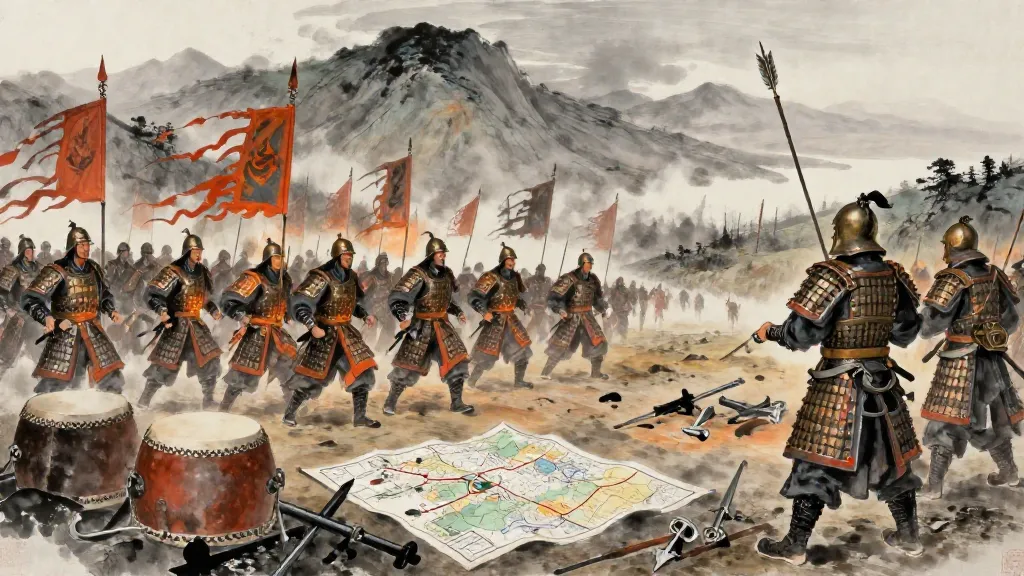
樗里子甘茂列傳 (Biographies of Chulizi and Gan Mao) — Chinese ink painting

Chapter 71 of 130

樗里子甘茂列傳

Biographies of Chulizi and Gan Mao

View:

樗里子:秦之智囊

Chulizi: Qin's 'Bag of Wits'

樗里子者,名疾,秦惠王之弟也,與惠王異母。母,韓女也。樗里子滑稽多智,秦人號曰「智囊」。

秦惠王八年,爵樗里子右更,使將而伐曲沃,盡出其人,取其城,地入秦。秦惠王二十五年,使樗里子為將伐趙,虜趙將軍莊豹,拔藺。明年,助魏章攻楚,敗楚將屈丐,取漢中地。秦封樗里子,號為嚴君。

秦惠王卒,太子武王立,逐張儀、魏章,而以樗里子、甘茂為左右丞相。秦使甘茂攻韓,拔宜陽。使樗里子以車百乘入周。周以卒迎之,意甚敬。楚王怒,讓周,以其重秦客。游騰為周說楚王曰:「知伯之伐仇猶,遺之廣車,因隨之以兵,仇猶遂亡。何則?無備故也。齊桓公伐蔡,號曰誅楚,其實襲蔡。今秦,虎狼之國,使樗里子以車百乘入周,周以仇猶、蔡觀焉,故使長戟居前,彊弩在後,名曰衛疾,而實囚之。且夫周豈能無憂其社稷哉?恐一旦亡國以憂大王。」楚王乃悅。

Chulizi, personal name Ji, was a younger brother of King Hui of Qin, born of a different mother. His mother was a woman from Han. Chulizi was witty and resourceful, and the people of Qin called him the 'Bag of Wits.'

In King Hui's eighth year, Chulizi was granted the rank of Right Geng and sent as commanding general to attack Quwo. He expelled all its inhabitants, seized the city, and its territory was absorbed into Qin. In King Hui's twenty-fifth year, Chulizi was sent as general to attack Zhao; he captured the Zhao general Zhuang Bao and took Lin. The following year, he assisted Wei Zhang in attacking Chu, defeating the Chu general Qu Gai and taking the Hanzhong region. Qin enfeoffed Chulizi with the title Lord of Yan.

King Hui of Qin died and Crown Prince Wu ascended the throne. He expelled Zhang Yi and Wei Zhang and appointed Chulizi and Gan Mao as Left and Right Chancellors. Qin sent Gan Mao to attack Han and take Yiyang. Chulizi was sent with a hundred chariots to enter the Zhou royal domain. Zhou received him with troops drawn up in welcome, showing great respect. The King of Chu was angry and reproached Zhou for according such weight to a Qin guest. You Teng addressed the King of Chu on Zhou's behalf: "When Zhi Bo attacked Chouyou, he first sent them a large cart as a gift, then followed it with troops — Chouyou was destroyed. Why? Because they had no defenses. When Duke Huan of Qi attacked Cai, he announced he was punishing Chu, but in fact he was raiding Cai. Now Qin is a predatory state, and it sends Chulizi with a hundred chariots into Zhou. Zhou took the lessons of Chouyou and Cai to heart, so it placed long halberds in front and powerful crossbows behind — calling it 'guarding Ji' while in reality holding him hostage. How could Zhou not worry about its altars of soil and grain? It fears that one day its state will be destroyed, to Your Majesty's own distress." The King of Chu was then satisfied.

Notes

1person樗里子Chūlǐ Zǐ

Chulizi (樗里子, personal name Ji 疾, d. 300 BC) was a Qin prince and strategist. His nickname 'Bag of Wits' (智囊) passed into Chinese as an idiom for a clever adviser. His tomb in the Wei River valley was said to be flanked by the Weiyang and Changle palaces of the later Han dynasty, fulfilling his prophecy.

2person張儀Zhāng Yí

Zhang Yi (張儀, d. 309 BC) was the foremost proponent of horizontal alliances (連衡) in the Warring States. He served as Qin's chancellor under King Hui and was expelled after King Wu's accession.

樗里子晚年與預言

Chulizi's Later Years and Prophecy

秦武王卒,昭王立,樗里子又益尊重。

昭王元年,樗里子將伐蒲。蒲守恐,請胡衍。胡衍為蒲謂樗里子曰:「公之攻蒲,為秦乎?為魏乎?為魏則善矣,為秦則不為賴矣。夫衛之所以為衛者,以蒲也。今伐蒲入於魏,衛必折而從之。魏亡西河之外而無以取者,兵弱也。今並衛於魏,魏必彊。魏彊之日,西河之外必危矣。且秦王將觀公之事,害秦而利魏,王必罪公。」樗里子曰:「柰何?」胡衍曰:「公釋蒲勿攻,臣試為公入言之,以德衛君。」樗里子曰:「善。」胡衍入蒲,謂其守曰:「樗里子知蒲之病矣,其言曰必拔蒲。衍能令釋蒲勿攻。」蒲守恐,因再拜曰:「原以請。」因效金三百斤,曰:「秦兵苟退,請必言子於衛君,使子為南面。」故胡衍受金於蒲以自貴於衛。於是遂解蒲而去。還擊皮氏,皮氏未降,又去。

昭王七年,樗里子卒,葬於渭南章台之東。曰:「後百歲,是當有天子之宮夾我墓。」樗里子疾室在於昭王廟西渭南陰鄉樗里,故俗謂之樗里子。至漢興,長樂宮在其東,未央宮在其西,武庫正直其墓。秦人諺曰:「力則任鄙,智則樗里。」

When King Wu of Qin died and King Zhao was installed, Chulizi's status grew even more exalted.

In King Zhao's first year, Chulizi led a campaign against Pu. The governor of Pu was afraid and sought out Hu Yan. Hu Yan addressed Chulizi on Pu's behalf: "In attacking Pu, are you acting for Qin or for Wei? If for Wei, that is well and good. If for Qin, it brings no benefit. The reason Wey remains Wey is because of Pu. If you take Pu and give it to Wei, Wey will inevitably submit to Wei. Wei has been unable to recover its former territory west of the Yellow River because its army is weak. Now if you annex Wey into Wei, Wei will grow strong. The day Wei is strong, Qin's territory west of the River will be endangered. Moreover, the King of Qin will be watching your actions — if they harm Qin and benefit Wei, the king will certainly punish you." Chulizi said: "Then what should I do?" Hu Yan said: "Withdraw from Pu and do not attack it. Let me go in and speak on your behalf, to earn the gratitude of the Lord of Wey." Chulizi said: "Good." Hu Yan entered Pu and told the governor: "Chulizi knows Pu's weaknesses. He says he will certainly take it. But I can persuade him to withdraw." The governor was terrified, bowed twice, and said: "Please do so." He offered 300 jin of gold and said: "If Qin's troops withdraw, I will certainly recommend you to the Lord of Wey and ensure you receive a position of authority." Thus Hu Yan received gold from Pu and advanced his own standing in Wey. The siege was lifted, and Chulizi departed. He went on to attack Pishi, but Pishi did not surrender, and he departed again.

In King Zhao's seventh year, Chulizi died and was buried east of the Zhangtai on the south bank of the Wei River. He said: "A hundred years from now, a Son of Heaven's palace will flank my tomb." Chulizi's residence was at Chuli village in the Yin district south of the Wei, west of King Zhao's ancestral temple, which is why people called him Chulizi. When the Han dynasty arose, the Changle Palace stood to the east of his tomb, the Weiyang Palace to its west, and the Arsenal stood directly opposite his grave. A Qin proverb said: "For strength, there is Ren Bi; for wits, there is Chulizi."

Notes

1context

Chulizi's prophecy about palaces flanking his tomb was remarkably fulfilled: the Han dynasty's Changle Palace (長樂宮) and Weiyang Palace (未央宮), the two greatest palaces of the Western Han capital Chang'an, were indeed built on either side of his burial site.

甘茂攻宜陽

Gan Mao Attacks Yiyang

甘茂者,下蔡人也。事下蔡史舉先生,學百家之術。因張儀、樗里子而求見秦惠王。王見而說之,使將,而佐魏章略定漢中地。

惠王卒,武王立。張儀、魏章去,東之魏。蜀侯煇、相壯反,秦使甘茂定蜀。還,而以甘茂為左丞相,以樗里子為右丞相。

秦武王三年,謂甘茂曰:「寡人慾容車通三川,以窺周室,而寡人死不朽矣。」甘茂曰:「請之魏,約以伐韓,而令向壽輔行。」甘茂至,謂向壽曰:「子歸,言之於王曰『魏聽臣矣,然原王勿伐』。事成,盡以為子功。」向壽歸,以告王,王迎甘茂於息壤。甘茂至,王問其故。對曰:「宜陽,大縣也,上黨、南陽積之久矣。名曰縣,其實郡也。今王倍數險,行千里攻之,難。昔曾參之處費,魯人有與曾參同姓名者殺人,人告其母曰『曾參殺人』,其母織自若也。頃之,一人又告之曰『曾參殺人』,其母尚織自若也。頃又一人告之曰『曾參殺人』,其母投杼下機,逾牆而走。夫以曾參之賢與其母信之也,三人疑之,其母懼焉。今臣之賢不若曾參,王之信臣又不如曾參之母信曾參也,疑臣者非特三人,臣恐大王之投杼也。始張儀西並巴蜀之地,北開西河之外,南取上庸,天下不以多張子而以賢先王。魏文侯令樂羊將而攻中山,三年而拔之。樂羊返而論功,文侯示之謗書一篋。樂羊再拜稽首曰:'此非臣之功也,主君之力也。'今臣,羈旅之臣也。樗里子、公孫奭二人者挾韓而議之,王必聽之,是王欺魏王而臣受公仲侈之怨也。」王曰:「寡人不聽也,請與子盟。」卒使丞相甘茂將兵伐宜陽。五月而不拔,樗里子、公孫奭果爭之。武王召甘茂,欲罷兵。甘茂曰:「息壤在彼。」王曰:「有之。」因大悉起兵,使甘茂擊之。斬首六萬,遂拔宜陽。韓襄王使公仲侈入謝,與秦平。

Gan Mao was a man of Xiacai. He studied under Master Shi Ju of Xiacai, learning the arts of the Hundred Schools. Through Zhang Yi and Chulizi, he obtained an audience with King Hui of Qin. The king was pleased upon meeting him, gave him a command, and he assisted Wei Zhang in conquering the Hanzhong region.

King Hui died and King Wu succeeded. Zhang Yi and Wei Zhang departed eastward for Wei. The Marquis of Shu, Hui, and his minister Zhuang rebelled, and Qin sent Gan Mao to pacify Shu. Upon his return, Gan Mao was made Left Chancellor and Chulizi Right Chancellor.

In King Wu's third year, the king told Gan Mao: "I wish to open a chariot road to the Three Rivers region to cast my gaze upon the Zhou royal domain — then I would die without regret." Gan Mao said: "Allow me to go to Wei and arrange a joint attack on Han, with Xiang Shou as my escort." When Gan Mao arrived, he told Xiang Shou: "Return and tell the king: 'Wei has agreed to my terms, but I ask the king not to attack.' If the mission succeeds, the credit will all be yours." Xiang Shou returned and reported this. The king went to meet Gan Mao at Xirang. When Gan Mao arrived, the king asked the reason. He replied: "Yiyang is a major county. Shangdang and Nanyang have been accumulating there for a long time. It is called a county but is really a commandery. Now to cross several mountain barriers and march a thousand li to attack it is difficult. In the past, when Zeng Shen was living at Fei, a man of Lu with the same name killed someone. Someone told his mother: 'Zeng Shen has killed a man.' His mother went on weaving as before. Shortly after, another person told her: 'Zeng Shen has killed a man.' His mother still wove on. When a third person told her: 'Zeng Shen has killed a man,' his mother threw down her shuttle, left the loom, and fled over the wall. Now, given Zeng Shen's virtue and his mother's trust in him, three people's allegations still frightened her. My virtue is not equal to Zeng Shen's, and Your Majesty's trust in me is not equal to Zeng Shen's mother's trust in her son — and those who doubt me are not merely three. I fear Your Majesty may throw down the shuttle. When Zhang Yi annexed Ba and Shu to the west, opened the territory beyond the Western River to the north, and took Shangyong to the south, the world did not credit Zhang Yi but praised the late king. When Marquis Wen of Wei ordered Yue Yang to command the attack on Zhongshan, it took three years to take it. When Yue Yang returned to receive his reward, Marquis Wen showed him a chest full of slander letters. Yue Yang bowed twice to the ground and said: 'This was not my achievement — it was my lord's strength.' Now I am a minister far from home. Chulizi and Gongsun Shi, those two, will side with Han and argue against the campaign. The king will certainly listen to them, and then the king will have deceived the King of Wei while I bear the resentment of Gongzhong Chi." The king said: "I will not listen to them. Let me make a covenant with you." He ultimately sent Chancellor Gan Mao with troops to attack Yiyang. After five months without taking it, Chulizi and Gongsun Shi indeed objected. King Wu recalled Gan Mao, intending to withdraw the troops. Gan Mao said: "Xirang is right there" — meaning the covenant. The king said: "So it is." He thereupon mobilized the full army and sent Gan Mao to press the attack. They beheaded 60,000 and finally took Yiyang. King Xiang of Han sent Gongzhong Chi to submit and make peace with Qin.

Notes

1person甘茂Gān Mào

Gan Mao (甘茂) was a strategist and chancellor of Qin under Kings Hui, Wu, and Zhao. Originally from the minor state of Cai, he rose through talent and connections. The Zeng Shen parable he cites is one of the most famous in Chinese rhetoric.

2place

Yiyang (宜陽) was a strategic stronghold of Han, located in modern Yiyang County, Henan. Its capture in 308 BC opened the route to the Zhou royal domain and the Three Rivers (三川) region of Luoyang.

3translation

'息壤在彼' (Xirang is right there) — Gan Mao reminded the king of their covenant made at Xirang (息壤). This terse phrase became proverbial for holding someone to their word.

甘茂出奔與甘羅出使

Gan Mao's Flight and Gan Luo's Diplomatic Mission

武王竟至周,而卒於周。其弟立,為昭王。王母宣太后,楚女也。楚懷王怨前秦敗楚於丹陽而韓不救,乃以兵圍韓雍氏。韓使公仲侈告急於秦。秦昭王新立,太后楚人,不肯救。公仲因甘茂,茂為韓言於秦昭王曰:「公仲方有得秦救,故敢扞楚也。今雍氏圍,秦師不下殽,公仲且仰首而不朝,公叔且以國南合於楚。楚、韓為一,魏氏不敢不聽,然則伐秦之形成矣。不識坐而待伐孰與伐人之利?」秦王曰:「善。」乃下師於殽以救韓。楚兵去。

甘茂竟言秦昭王,以武遂復歸之韓。向壽、公孫奭爭之,不能得。向壽、公孫奭由此怨,讒甘茂。茂懼,輟伐魏蒲阪,亡去。樗里子與魏講,罷兵。

甘茂之亡秦奔齊,逢蘇代。代為齊使於秦。甘茂曰:「臣得罪於秦,懼而遯逃,無所容跡。臣聞貧人女與富人女會績,貧人女曰:'我無以買燭,而子之燭光幸有餘,子可分我餘光,無損子明而得一斯便焉。'今臣困而君方使秦而當路矣。茂之妻子在焉,願君以餘光振之。」蘇代許諾。遂致使於秦。已,因說秦王曰:「甘茂,非常士也。其居於秦,累世重矣。自殽塞及至鬼谷,其地形險易皆明知之。彼以齊約韓魏反以圖秦,非秦之利也。」秦王曰:「然則柰何?」蘇代曰:「王不若重其贄,厚其祿以迎之,使彼來則置之鬼谷,終身勿出。」秦王曰:「善。」即賜之上卿,以相印迎之於齊。甘茂不往。蘇代謂齊湣王曰:「夫甘茂,賢人也。今秦賜之上卿,以相印迎之。甘茂德王之賜,好為王臣,故辭而不往。今王何以禮之?」齊王曰:「善。」即位之上卿而處之。秦因復甘茂之家以市於齊。

齊使甘茂於楚,楚懷王新與秦合婚而驩。而秦聞甘茂在楚,使人謂楚王曰:「願送甘茂於秦。」楚王問於范蜎曰:「寡人慾置相於秦,孰可?」對曰:「臣不足以識之。」楚王曰:「寡人慾相甘茂,可乎?」對曰:「不可。」於是使使請秦相向壽於秦。秦卒相向壽。而甘茂竟不得復入秦,卒於魏。

甘茂有孫曰甘羅。

甘羅者,甘茂孫也。茂既死後,甘羅年十二,事秦相文信侯呂不韋。

秦始皇帝使剛成君蔡澤於燕,三年而燕王喜使太子丹入質於秦。秦使張唐往相燕,欲與燕共伐趙以廣河間之地。張唐謂文信侯曰:「臣嘗為秦昭王伐趙,趙怨臣,曰:'得唐者與百里之地。'今之燕必經趙,臣不可以行。」文信侯不快,未有以彊也。甘羅曰:「君侯何不快之甚也?」文信侯曰:「吾令剛成君蔡澤事燕三年,燕太子丹已入質矣,吾自請張卿相燕而不肯行。」甘羅曰:「臣請行之。」文信侯叱曰:「去!我身自請之而不肯,女焉能行之?」甘羅曰:「大項橐生七歲為孔子師。今臣生十二歲於茲矣,君其試臣,何遽叱乎?」於是甘羅見張卿曰:「卿之功孰與武安君?」卿曰:「武安君南挫彊楚,北威燕、趙,戰勝攻取,破城墮邑,不知其數,臣之功不如也。」甘羅曰:「應侯之用於秦也,孰與文信侯專?」張卿曰:「應侯不如文信侯專。」甘羅曰:「卿明知其不如文信侯專與?」曰:「知之。」甘羅曰:「應侯欲攻趙,武安君難之,去鹹陽七里而立死於杜郵。今文信侯自請卿相燕而不肯行,臣不知卿所死處矣。」張唐曰:「請因孺子行。」令裝治行。

行有日,甘羅謂文信侯曰:「借臣車五乘,請為張唐先報趙。」文信侯乃入言之於始皇。始皇召見,使甘羅於趙。趙襄王郊迎甘羅。甘羅說趙王曰:「王聞燕太子丹入質秦歟?」曰:「聞之。」曰:「聞張唐相燕歟?」曰:「聞之。」「燕太子丹入秦者,燕不欺秦也。張唐相燕者,秦不欺燕也。燕、秦不相欺者,伐趙,危矣。燕、秦不相欺無異故,欲攻趙而廣河間。王不如齎臣五城以廣河間,請歸燕太子,與彊趙攻弱燕。」趙王立自割五城以廣河間。秦歸燕太子。趙攻燕,得上谷三十城,令秦有十一。

甘羅還報秦,乃封甘羅以為上卿,復以始甘茂田宅賜之。

King Wu ultimately did reach the Zhou domain, but died there. His younger brother succeeded as King Zhao, whose mother, Queen Dowager Xuan, was a woman of Chu. King Huai of Chu bore a grudge because Qin had previously defeated Chu at Danyang and Han had not come to the rescue, so he besieged the Han city of Yongshi. Han sent Gongzhong Chi to appeal urgently to Qin. King Zhao had just taken the throne and his mother was from Chu, so Qin was unwilling to help. Gongzhong Chi turned to Gan Mao, who argued Han's case before King Zhao: "Gongzhong Chi was counting on Qin's rescue when he dared resist Chu. Now Yongshi is besieged and Qin's army has not come down from the Xiao pass. Gongzhong Chi will soon look away and stop attending your court, and Gongshu will take the whole state south to join Chu. If Chu and Han unite, Wei will not dare stand apart — and then the formation for an attack on Qin is complete. Which is more advantageous: sitting and waiting to be attacked, or attacking others?" The king said: "Good." He dispatched an army down the Xiao pass to rescue Han, and the Chu troops withdrew.

Gan Mao eventually persuaded King Zhao to return the town of Wusui to Han. Xiang Shou and Gongsun Shi objected but could not prevail. Bearing a grudge, they slandered Gan Mao. Fearful, Mao abandoned his campaign against Wei's Puban and fled. Chulizi negotiated with Wei and withdrew the troops.

Fleeing Qin for Qi, Gan Mao encountered Su Dai, who was serving as Qi's envoy to Qin. Gan Mao said: "I have offended Qin and fled in fear, with nowhere to shelter. I have heard of a poor girl who joined a spinning circle with rich girls. The poor girl said: 'I have no money for a candle, but your candle has light to spare. Could you share your surplus glow? It costs you nothing and gives me this small convenience.' Now I am in difficulty while you are on mission to Qin and in a position of influence. My wife and children are there — I ask you to share your surplus glow and look after them." Su Dai agreed. He completed his embassy to Qin, then persuaded the King of Qin: "Gan Mao is no ordinary man. His roots in Qin go back generations. He knows every pass from Xiao to the Valley of Ghosts, every terrain's strengths and weaknesses. If he uses Qi to ally with Han and Wei and turns on Qin, that is not in Qin's interest." The king asked what to do. Su Dai said: "You should offer rich gifts and generous salary to lure him back. Once he comes, confine him in the Valley of Ghosts and never let him leave." The king agreed and sent the rank of Senior Minister with the chancellor's seal to fetch him from Qi. Gan Mao did not go. Su Dai then told King Min of Qi: "Gan Mao is a man of talent. Qin has just offered him the rank of Senior Minister with the chancellor's seal to bring him back. But Gan Mao, grateful for Your Majesty's kindness and willing to serve as your minister, has refused. How will Your Majesty honor him?" The King of Qi said: "Good," and appointed him Senior Minister. Qin thereupon returned Gan Mao's family property to curry favor with Qi.

Qi sent Gan Mao as envoy to Chu. King Huai of Chu had recently formed a marriage alliance with Qin and was on friendly terms. When Qin learned that Gan Mao was in Chu, it asked the King of Chu to send Gan Mao to Qin. The King of Chu consulted Fan Xuan about whom to install as Qin's chancellor. Fan Xuan recommended against Gan Mao, advising instead that the malleable Xiang Shou be made chancellor. An envoy was sent to request Qin install Xiang Shou. Qin ultimately made Xiang Shou chancellor. Gan Mao never managed to return to Qin and died in Wei.

Gan Mao had a grandson named Gan Luo.

Gan Luo, grandson of Gan Mao, was twelve years old when, after his grandfather's death, he entered the service of Qin's chancellor, the Marquis of Wenxin, Lu Buwei.

The First Emperor of Qin had sent Lord Gangcheng, Cai Ze, to Yan for three years, after which King Xi of Yan sent Crown Prince Dan to Qin as a hostage. Qin then sent Zhang Tang to serve as chancellor of Yan, planning to ally with Yan to attack Zhao and expand the Hejian territory. Zhang Tang told Lu Buwei: "I once attacked Zhao on behalf of King Zhao of Qin. Zhao bears a grudge and has said: 'Give us a hundred li of land for anyone who delivers Tang.' To reach Yan I must pass through Zhao. I cannot go." Lu Buwei was displeased but had no way to compel him. Gan Luo said: "Why is my lord so unhappy?" Lu Buwei said: "I had Lord Gangcheng work on Yan for three years. Crown Prince Dan is already hostage in Qin. I personally asked Minister Zhang to go serve as chancellor of Yan, and he refuses." Gan Luo said: "Allow me to make him go." Lu Buwei snapped: "Away with you! I asked him personally and he refused — how could you make him go?" Gan Luo said: "Xiang Tuo was seven years old when he served as Confucius's teacher. I am now twelve. My lord might at least try me — why shout?" Gan Luo then went to see Zhang Tang: "How do your achievements compare with Lord Wuan's?" Zhang Tang said: "Lord Wuan defeated mighty Chu in the south, overawed Yan and Zhao in the north, won battles and conquered cities beyond counting. My achievements do not compare." Gan Luo said: "And was the Marquis of Ying's authority in Qin as absolute as the Marquis of Wenxin's?" Zhang Tang said: "The Marquis of Ying was not as absolute." Gan Luo said: "You are certain of this?" Zhang Tang said: "I am." Gan Luo said: "The Marquis of Ying wanted to attack Zhao. Lord Wuan objected, and he was executed at Duyu, seven li from Xianyang. Now the Marquis of Wenxin personally asks you to serve as chancellor of Yan and you refuse. I do not know where you will be executed." Zhang Tang said: "I shall go, at the young man's urging." He ordered his baggage prepared.

A date for departure was set. Gan Luo told Lu Buwei: "Lend me five chariots. Allow me to go ahead to Zhao on Zhang Tang's behalf." Lu Buwei reported this to the First Emperor, who granted Gan Luo an audience and sent him to Zhao. King Xiang of Zhao came out to the suburbs to welcome him. Gan Luo addressed the king: "Has Your Majesty heard that Crown Prince Dan of Yan has entered Qin as a hostage?" The king said: "I have." "And that Zhang Tang is to serve as chancellor of Yan?" "I have." "That Prince Dan entered Qin means Yan will not deceive Qin. That Zhang Tang is to be chancellor means Qin will not deceive Yan. If Yan and Qin do not deceive each other, they will attack Zhao — and you are in danger. The reason Yan and Qin trust each other is precisely that they wish to attack Zhao and expand the Hejian territory. Rather than wait, Your Majesty should give me five cities to expand Hejian. I will arrange for the return of the Yan crown prince, and you can then ally with a strengthened Zhao to attack weakened Yan." The King of Zhao immediately ceded five cities to expand Hejian. Qin returned the crown prince of Yan. Zhao attacked Yan and took thirty cities of Shanggu, giving eleven to Qin.

Gan Luo returned to report. He was enfeoffed as Senior Minister, and Gan Mao's original fields and residence were restored to him.
Notes

1person甘羅Gān Luó

Gan Luo (甘羅) was a twelve-year-old prodigy who used diplomatic skill to gain five cities for Qin without a single battle. His story became a classic example of youthful talent overcoming adult skepticism.

2person呂不韋Lǚ Bùwéi

Lu Buwei (呂不韋, c. 292–235 BC), the Marquis of Wenxin (文信侯), was a merchant who invested in Prince Yiren of Qin, helped him become king, and served as chancellor and regent for the young First Emperor. He compiled the Lushi Chunqiu encyclopedic work.

太史公論贊

The Grand Historian's Assessment

太史公曰:樗里子以骨肉重,固其理,而秦人稱其智,故頗采焉。甘茂起下蔡閭閻,顯名諸侯,重彊齊楚。甘羅年少,然出一奇計,聲稱後世。雖非篤行之君子,然亦戰國之策士也。方秦之彊時,天下尤趨謀詐哉。

The Grand Historian remarks: That Chulizi was valued for his blood ties to the royal house was natural enough, but the people of Qin also acclaimed his intellect, which is why I have included a fair selection of his deeds. Gan Mao rose from the alleyways of Xiacai to make his name among the feudal lords, carrying weight with mighty Qi and Chu. Gan Luo was young, yet produced a single brilliant stratagem that echoed through later ages. Though none of these men could be called gentlemen of steadfast conduct, they were nonetheless the strategic minds of the Warring States era. When Qin was at the height of its power, all under Heaven pursued cunning and deception above all else.

Edition & Source

Text
《史記》 Shiji
Edition
中華古詩文古書籍網 transcription
Commentary
裴駰《史記集解》、司馬貞《史記索隱》、張守節《史記正義》(Three Commentaries)