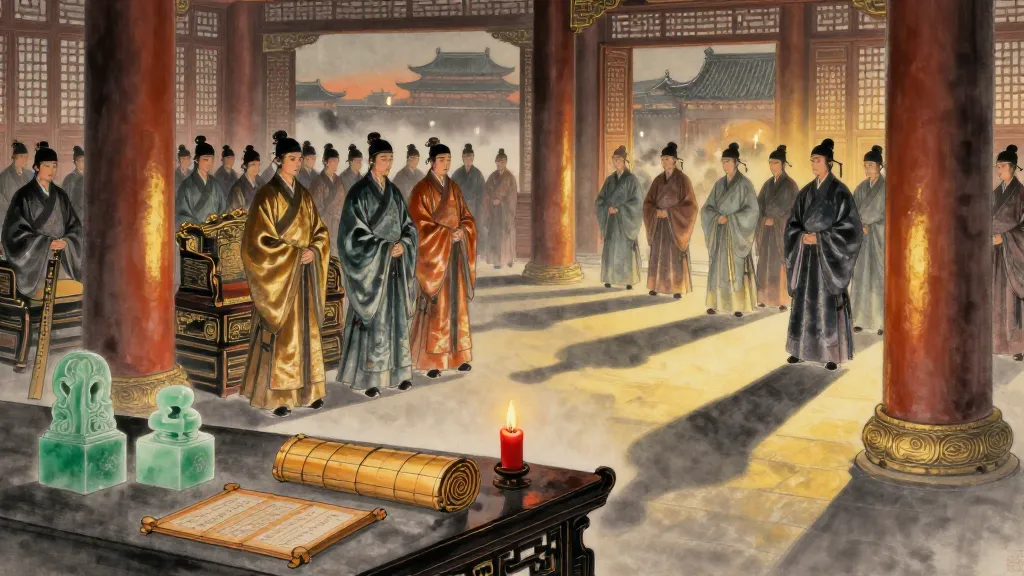
穰侯列傳 (Biography of the Marquis of Rang) — Chinese ink painting

Chapter 72 of 130

穰侯列傳

Biography of the Marquis of Rang

View:

穰侯專權於秦

The Marquis of Rang Monopolizes Power in Qin

穰侯魏厓者,秦昭王母宣太后弟也。其先楚人,姓羋氏。

秦武王卒,無子,立其弟為昭王。昭王母故號為羋八子,及昭王即位,羋八子號為宣太后。宣太后非武王母。武王母號曰惠文后,先武王死。宣太后二弟:其異父長弟曰穰侯,姓魏氏,名厓;同父弟曰羋戎,為華陽君。而昭王同母弟曰高陵君、涇陽君。而魏厓最賢,自惠王、武王時任職用事。武王卒,諸弟爭立,唯魏厓力為能立昭王。昭王即位,以厓為將軍,衛鹹陽。誅季君之亂,而逐武王后出之魏,昭王諸兄弟不善者皆滅之,威振秦國。昭王少,宣太后自治,任魏厓為政。

The Marquis of Rang, Wei Ran, was the younger brother of Queen Dowager Xuan, the mother of King Zhao of Qin. His ancestors were from Chu, of the Mi surname.

King Wu of Qin died without a son, and his younger brother was installed as King Zhao. King Zhao's mother had originally held the rank of Mi Bazi (Consort of the Eighth Rank); when King Zhao ascended the throne, she was titled Queen Dowager Xuan. She was not King Wu's mother — King Wu's mother was titled Queen Huiwen, and she had died before King Wu. Queen Dowager Xuan had two younger brothers: her half-brother (different father) was the Marquis of Rang, surnamed Wei, named Ran; her full brother was Mi Rong, the Lord of Huayang. King Zhao's full brothers included the Lord of Gaoling and the Lord of Jingyang. Among them, Wei Ran was the most capable and had held office and exercised authority since the reigns of King Hui and King Wu. When King Wu died and the various princes contended for the throne, it was Wei Ran alone who had the power to install King Zhao. Upon King Zhao's accession, Ran was appointed general and charged with defending Xianyang. He suppressed the revolt of Lord Ji, expelled King Wu's queen back to Wei, and eliminated all of King Zhao's brothers who posed threats — his authority shook the state of Qin. Since King Zhao was young, Queen Dowager Xuan governed personally and entrusted Wei Ran with the administration of state affairs.

Notes

1person魏冉Wèi Rǎn

Wei Ran (魏冉), the Marquis of Rang (穰侯), was the most powerful minister in Qin during the first half of King Zhao's reign (306–266 BC). As the queen dowager's brother, he wielded enormous influence, serving as chancellor multiple times and accumulating vast personal wealth, particularly through his fief at Tao.

2person宣太后Xuān Tài Hòu

Queen Dowager Xuan (宣太后, Mi Bazi 羋八子) was the first woman to hold long-term regency in Chinese history. She ruled Qin effectively for decades while her son King Zhao was nominally on the throne.

穰侯拜相與舉白起

The Marquis Becomes Chancellor and Promotes Bai Qi

昭王七年,樗里子死,而使涇陽君質於齊。趙人樓緩來相秦,趙不利,乃使仇液之秦,請以魏厓為秦相。仇液將行,其客宋公謂液曰:「秦不聽公,樓緩必怨公。公不若謂樓緩曰『請為公毋急秦』。秦王見趙請相魏厓之不急,且不聽公。公言而事不成,以德樓子;事成,魏厓故德公矣。」於是仇液從之。而秦果免樓緩而魏厓相秦。

欲誅呂禮,禮出奔齊。昭王十四年,魏厓舉白起,使代向壽將而攻韓、魏,敗之伊闕,斬首二十四萬,虜魏將公孫喜。明年,又取楚之宛、葉。魏厓謝病免相,以客卿壽燭為相。其明年,燭免,復相厓,乃封魏厓於穰,復益封陶,號曰穰侯。

In King Zhao's seventh year, Chuli Zi died, and the Lord of Jingyang was sent as a hostage to Qi. The Zhao man Lou Huan came to serve as chancellor of Qin. Zhao found this disadvantageous and sent Qiu Ye to Qin to request that Wei Ran be made Qin's chancellor instead. As Qiu Ye was about to depart, his retainer Song Gong said to him: "If Qin does not listen to you, Lou Huan will certainly resent you. You would do better to tell Lou Huan: 'Allow me to not press Qin on your behalf.' When the King of Qin sees that Zhao is not pressing urgently for Wei Ran's appointment, he will not listen to you. But then you will have spoken without success, earning Lou Huan's gratitude; and if it succeeds, Wei Ran will of course be grateful to you anyway." Qiu Ye followed this advice, and Qin did indeed dismiss Lou Huan and make Wei Ran chancellor.

Ran wished to execute Lu Li, so Li fled to Qi. In King Zhao's fourteenth year, Wei Ran recommended Bai Qi, replacing Xiang Shou as commanding general to attack Han and Wei. He defeated them at Yique, beheading 240,000, and capturing the Wei general Gongsun Xi. The following year, he also took Wan and Ye from Chu. Wei Ran pleaded illness and resigned the chancellorship; the guest minister Shou Zhu was made chancellor instead. The year after that, Zhu was dismissed and Ran was restored as chancellor. He was then enfeoffed at Rang, and additionally given Tao, receiving the title Marquis of Rang.

Notes

1person白起Bái Qǐ

Bai Qi (白起, d. 257 BC), also known as Lord Wuan (武安君), was arguably the most formidable military commander of the Warring States period. He is credited with killing over a million enemy soldiers across his career. Wei Ran's sponsorship of Bai Qi was his greatest contribution to Qin's expansion.

2place

Yique (伊闕, 'The Gates of Yi') is at modern Longmen, south of Luoyang, Henan. The Battle of Yique in 293 BC was one of the most devastating battles of the Warring States, destroying the combined armies of Han and Wei.

3place

Tao (陶) was a major commercial city, corresponding to modern Dingtao County, Heze, Shandong. It was extremely wealthy due to its position at the crossroads of trade routes, making it a prize fief.

圍梁與須賈說穰侯

The Siege of Daliang and Xu Jia's Persuasion of the Marquis

穰侯封四歲,為秦將攻魏。魏獻河東方四百里。拔魏之河內,取城大小六十餘。昭王十九年,秦稱西帝,齊稱東帝。月餘,呂禮來,而齊、秦各復歸帝為王。魏厓復相秦,六歲而免。免二歲,復相秦。四歲,而使白起拔楚之郢,秦置南郡。乃封白起為武安君。白起者,穰侯之所任舉也,相善。於是穰侯之富,富於王室。

昭王三十二年,穰侯為相國,將兵攻魏,走芒卯,入北宅,遂圍大梁。梁大夫須賈說穰侯曰:「臣聞魏之長吏謂魏王曰:『昔梁惠王伐趙,戰勝三梁,拔邯鄲;趙氏不割,而邯鄲復歸。齊人攻衛,拔故國,殺子良;衛人不割,而故地復反。衛、趙之所以國全兵勁而地不並於諸侯者,以其能忍難而重出地也。宋、中山數伐割地,而國隨以亡。臣以為衛、趙可法,而宋、中山可為戒也。秦,貪戾之國也,而毋親。蠶食魏氏,又盡晉國,戰勝暴子,割八縣,地未畢入,兵復出矣。夫秦何厭之有哉!今又走芒卯,入北宅,此非敢攻梁也,且劫王以求多割地。王必勿聽也。今王背楚、趙而講秦,楚、趙怒而去王,與王爭事秦,秦必受之。秦挾楚、趙之兵以復攻梁,則國求無亡不可得也。原王之必無講也。王若欲講,少割而有質;不然,必見欺。』此臣之所聞於魏也,原君之以是慮事也。周書曰『惟命不於常』,此言幸之不可數也。夫戰勝暴子,割八縣,此非兵力之精也,又非計之工也,天幸為多矣。今又走芒卯,入北宅,以攻大梁,是以天幸自為常也。智者不然。臣聞魏氏悉其百縣勝甲以上戍大梁,臣以為不下三十萬。以三十萬之眾守梁七仞之城,臣以為湯、武復生,不易攻也。夫輕背楚、趙之兵,陵七仞之城,戰三十萬之眾,而志必舉之,臣以為自天地始分以至於今,未嘗有者也。攻而不拔,秦兵必罷,陶邑必亡,則前功必棄矣。今魏氏方疑,可以少割收也。原君逮楚、趙之兵未至於梁,亟以少割收魏。魏方疑而得以少割為利,必欲之,則君得所欲矣。楚、趙怒於魏之先己也,必爭事秦,從以此散,而君後擇焉。且君之得地豈必以兵哉!割晉國,秦兵不攻,而魏必效絳安邑。又為陶開兩道,幾盡故宋,衛必效單父。秦兵可全,而君制之,何索而不得,何為而不成!原君熟慮之而無行危。」穰侯曰:「善。」乃罷梁圍。

Four years after being enfeoffed, the Marquis of Rang commanded Qin forces against Wei. Wei surrendered 400 square li of territory east of the Yellow River. He seized Wei's Henei region and took over sixty cities large and small. In King Zhao's nineteenth year, Qin proclaimed itself "Western Emperor" and Qi "Eastern Emperor." After little more than a month, Lu Li came, and both Qi and Qin abandoned their imperial titles and reverted to being kings. Wei Ran served again as Qin's chancellor for six years before being dismissed. After two years, he was restored as chancellor. Four years later, he sent Bai Qi to capture Ying, the Chu capital, and Qin established the Nan Commandery. Bai Qi was then enfeoffed as Lord Wuan. Bai Qi had been recommended and promoted by the Marquis of Rang, and they were on close terms. By this point, the Marquis of Rang's wealth exceeded that of the royal house.

In King Zhao's thirty-second year, the Marquis of Rang served as Chancellor of State and led troops to attack Wei. He routed Mang Mao, entered Beizhai, and then besieged Daliang. The Wei official Xu Jia addressed the Marquis: "I have heard Wei's senior officials tell the King of Wei: 'In the past, King Hui of Liang attacked Zhao, won at Sanliang, and took Handan, but Zhao refused to cede territory and Handan was restored. Qi attacked Wey, took the old capital, and killed Ziliang, but Wey refused to cede territory and the land reverted. The reason Wey and Zhao kept their states intact with strong armies and their territory was not annexed by other lords was that they could endure hardship and valued their land. Song and Zhongshan were repeatedly invaded and ceded territory, and their states followed them into ruin. I consider Wey and Zhao worthy models, and Song and Zhongshan cautionary tales. Qin is a rapacious and violent state with no sense of kinship. It has devoured Wei like a silkworm, consumed the whole of Jin, defeated Baozi in battle, and carved off eight counties — and before that territory was even fully absorbed, its armies came out again. Is there any end to Qin's appetite? Now it has routed Mang Mao and entered Beizhai — this is not merely an attack on our capital but an attempt to coerce the king into ceding more territory. The king must not agree. If the king abandons Chu and Zhao to make terms with Qin, Chu and Zhao will turn hostile and compete to curry Qin's favor, and Qin will accept them. Qin would then use Chu and Zhao's forces to attack Liang again, and the state could not escape destruction. I urge the king to absolutely refuse to negotiate. If the king must negotiate, concede only a little and demand hostages — otherwise, you will certainly be deceived.' This is what I have heard from Wei, and I ask you, my lord, to consider it in your deliberations. The Zhou Documents say: 'Heaven's mandate does not rest in one place forever' — this means that luck cannot be counted on repeatedly. Your victory over Baozi and the seizure of eight counties was not due to superior military skill or brilliant strategy — it owed much to heaven's favor. Now, routing Mang Mao and entering Beizhai to attack Daliang is treating heaven's favor as a sure thing. A wise man does not do this. I hear that Wei has marshaled all soldiers above fighting age from its hundred counties to defend Daliang — no fewer than 300,000, I believe. With 300,000 men defending Liang's walls of seven ren height, I maintain that even Tang and Wu come back to life could not easily take it. To lightly turn your back on the armies of Chu and Zhao, assault walls seven ren high, fight 300,000 men, and be determined to take the city — I believe that from the time heaven and earth were first divided until now, this has never been done. If you attack and fail to take it, Qin's army will be exhausted and your fief of Tao will certainly be lost, and all your previous achievements will be thrown away. Now Wei is wavering and can be won over with modest concessions. I urge you, my lord, before the armies of Chu and Zhao reach Liang, to quickly accept a small cession and secure Wei's allegiance. Wei is wavering and would see a small concession as advantageous; they will certainly agree, and then you, my lord, will get what you want. Chu and Zhao will be angry that Wei acted first, and they will compete to serve Qin — the vertical alliance will collapse, and you can take your pick afterward. Moreover, must you acquire territory only through force? If you carve up Jin's territory, Qin need not attack and Wei will readily offer up Jiang and Anyi. And if you open two roads to Tao, taking nearly all of former Song, Wey will offer up Shanfu. Qin's army can be kept intact while you control the situation — what could you seek and not obtain, what could you attempt and not achieve? I urge you to deliberate carefully and not pursue danger." The Marquis of Rang said: "Good." He lifted the siege of Liang.
Notes

1person須賈Xū Jiǎ

Xu Jia (須賈) was a Wei diplomat. He appears more prominently in the biography of Fan Sui (Ch. 79), where he falsely accused Fan Sui of treason, leading to Fan Sui's near-death beating. When Fan Sui later became Qin's chancellor (under the alias Zhang Lu), Xu Jia was humiliated but spared.

2place

Daliang (大梁) was the capital of Wei, located at modern Kaifeng, Henan. It was one of the greatest cities of the Warring States period.

蘇代書阻伐齊與穰侯之罷

Su Dai's Letter Halts the Attack on Qi, and the Marquis Is Dismissed

明年,魏背秦,與齊從親。秦使穰侯伐魏,斬首四萬,走魏將暴鳶,得魏三縣。穰侯益封。

明年,穰侯與白起客卿胡陽復攻趙、韓、魏,破芒卯於華陽下,斬首十萬,取魏之卷、蔡陽、長社,趙氏觀津。且與趙觀津,益趙以兵,伐齊。齊襄王懼,使蘇代為齊陰遺穰侯書曰:「臣聞往來者言曰『秦將益趙甲四萬以伐齊』,臣竊必之敝邑之王曰『秦王明而熟於計,穰侯智而習於事,必不益趙甲四萬以伐齊』。是何也?夫三晉之相與也,秦之深讎也。百相背也,百相欺也,不為不信,不為無行。今破齊以肥趙。趙,秦之深讎,不利於秦。此一也。秦之謀者,必曰『破齊,弊晉、楚,而後制晉、楚之勝』。夫齊,罷國也,以天下攻齊,如以千鈞之弩決潰筴也,必死,安能弊晉、楚?此二也。秦少出兵,則晉、楚不信也;多出兵,則晉、楚為制於秦。齊恐,不走秦,必走晉、楚。此三也。秦割齊以啖晉、楚,晉、楚案之以兵,秦反受敵。此四也。是晉、楚以秦謀齊,以齊謀秦也,何晉、楚之智而秦、齊之愚?此五也。故得安邑以善事之,亦必無患矣。秦有安邑,韓氏必無上黨矣。取天下之腸胃,與出兵而懼其不反也,孰利?臣故曰秦王明而熟於計,穰侯智而習於事,必不益趙甲四萬以伐齊矣。」於是穰侯不行,引兵而歸。

昭王三十六年,相國穰侯言客卿灶,欲伐齊取剛、壽,以廣其陶邑。於是魏人范睢自謂張祿先生,譏穰侯之伐齊,乃越三晉以攻齊也,以此時奸說秦昭王。昭王於是用范睢。范睢言宣太后專制,穰侯擅權於諸侯,涇陽君、高陵君之屬太侈,富於王室。於是秦昭王悟,乃免相國,令涇陽之屬皆出關,就封邑。穰侯出關,輜車千乘有餘。

穰侯卒於陶,而因葬焉。秦復收陶為郡。

The following year, Wei broke with Qin and entered a vertical alliance with Qi. Qin sent the Marquis of Rang to attack Wei. He beheaded 40,000, routed the Wei general Bao Yuan, and took three Wei counties. The Marquis received additional fiefs.

The next year, the Marquis, together with Bai Qi and the guest minister Hu Yang, attacked Zhao, Han, and Wei again. They defeated Mang Mao below Huayang, beheading 100,000, and took Wei's Juan, Caiyang, and Changshe, along with Zhao's Guanjin. The plan was then to give Guanjin to Zhao, reinforce Zhao with troops, and jointly attack Qi. King Xiang of Qi was alarmed and secretly had Su Dai send a letter to the Marquis of Rang on Qi's behalf: "I have heard travelers say: 'Qin will reinforce Zhao with 40,000 troops to attack Qi.' I ventured to assure my king: 'The King of Qin is perceptive and skilled in calculation; the Marquis of Rang is intelligent and practiced in affairs — they will certainly not reinforce Zhao with 40,000 troops to attack Qi.' Why? The Three Jin states' dealings with one another are always those of deep enemies of Qin. They betray each other a hundred times, deceive each other a hundred times — this is not considered untrustworthy or unprincipled for them. Now to destroy Qi in order to fatten Zhao — Zhao, which is Qin's deepest enemy — would not benefit Qin. This is the first reason. Qin's strategists must say: 'Destroy Qi to exhaust Jin and Chu, then control the aftermath.' But Qi is an exhausted state — to attack Qi with all under Heaven is like using a crossbow of a thousand jun to burst a pustule; Qi will certainly die, but how could this exhaust Jin and Chu? This is the second reason. If Qin commits few troops, Jin and Chu will not trust the alliance; if many, Jin and Chu will fall under Qin's control. When Qi is frightened, it will not flee to Qin but to Jin and Chu. This is the third reason. If Qin carves up Qi to feed Jin and Chu, Jin and Chu will use their new strength against Qin — Qin itself becomes the target. This is the fourth reason. Thus Jin and Chu would be using Qin to scheme against Qi, and using Qi to scheme against Qin — how clever of Jin and Chu, how foolish of Qin and Qi! This is the fifth reason. Therefore, if you secure Anyi and manage it well, you will certainly have no trouble. With Anyi in Qin's hands, Han will inevitably lose Shangdang. Seizing the strategic heartland versus sending armies out and fearing they may not return — which is more advantageous? I therefore say the King of Qin is perceptive and skilled in calculation, and the Marquis of Rang intelligent and practiced in affairs — they will certainly not reinforce Zhao with 40,000 troops to attack Qi." At this, the Marquis did not proceed and withdrew his army.

In King Zhao's thirty-sixth year, the Chancellor of State, the Marquis of Rang, recommended the guest minister Zao and proposed attacking Qi to take Gang and Shou, thereby expanding his fief at Tao. At this point the Wei man Fan Sui, calling himself Master Zhang Lu, criticized the Marquis's plan to attack Qi — arguing that it meant leaping over the Three Jin to strike at distant Qi — and used this as his opening to persuade King Zhao. King Zhao thereupon employed Fan Sui. Fan Sui pointed out that Queen Dowager Xuan monopolized power, the Marquis of Rang dominated foreign affairs among the feudal lords, and the Lords of Jingyang and Gaoling were excessively extravagant, wealthier than the royal house. King Zhao of Qin was awakened. He dismissed the Chancellor of State and ordered the Lords of Jingyang and their like to leave the passes and go to their fiefs. When the Marquis of Rang departed through the passes, his baggage train comprised more than a thousand carriages.

The Marquis of Rang died at Tao and was buried there. Qin subsequently reclaimed Tao as a commandery.

Notes

1person蘇代Sū Dài

Su Dai (蘇代) was a Warring States diplomatic strategist and younger brother of the famous Su Qin. He served various states as a traveling persuader.

2person范睢Fàn Suī

Fan Sui (范睢, also written 范雎), who used the alias Zhang Lu (張祿), became Qin's chancellor after displacing the Marquis of Rang. His 'far-friendship, near-attack' (遠交近攻) strategy — allying with distant states while attacking neighbors — became the foundation of Qin's final conquests.

太史公論贊

The Grand Historian's Assessment

太史公曰:穰侯,昭王親舅也。而秦所以東益地,弱諸侯,嘗稱帝於天下,天下皆西鄉稽首者,穰侯之功也。及其貴極富溢,一夫開說,身折勢奪而以憂死,況於羈旅之臣乎!

The Grand Historian remarks: The Marquis of Rang was King Zhao's maternal uncle. That Qin expanded its territory eastward, weakened the feudal lords, once claimed the imperial title over all under Heaven, and made the whole realm face west and bow — this was the Marquis of Rang's achievement. Yet when his honor reached its peak and his wealth overflowed, a single man opened his mouth in persuasion, and the Marquis's position was broken, his power stripped, and he died in distress. How much more so for a minister who is merely a sojourner and guest!

Notes

1context

Sima Qian's closing observation draws a universal lesson: if even a maternal uncle of the king, at the height of power, could be brought down by one persuasive argument, then any official without blood ties to the ruler is even more vulnerable. The 'single man' is Fan Sui.

Edition & Source

Text
《史記》 Shiji
Edition
中華古詩文古書籍網 transcription
Commentary
裴駰《史記集解》、司馬貞《史記索隱》、張守節《史記正義》(Three Commentaries)