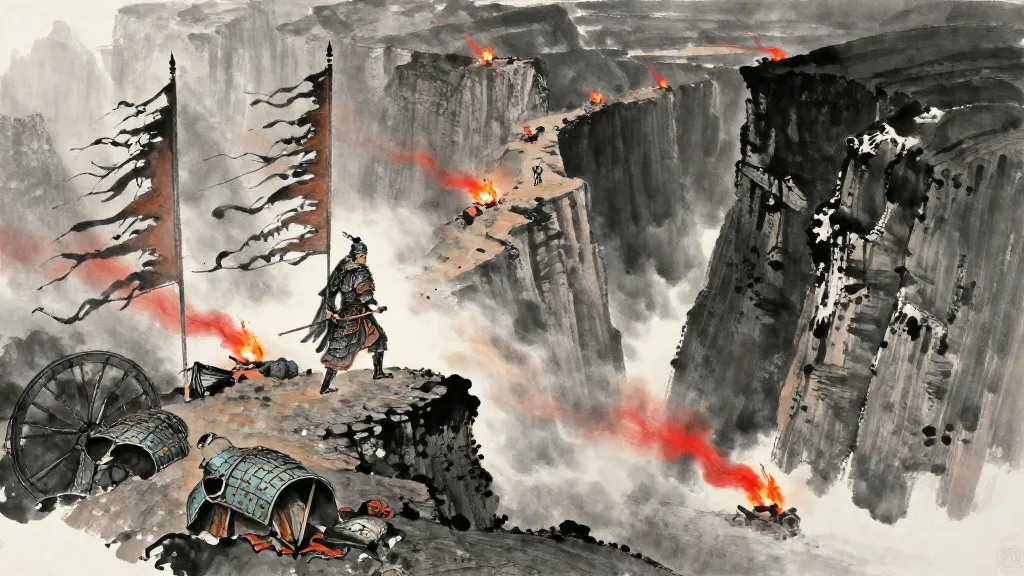
白起早年征戰
Bai Qi's Early Campaigns
白起者,郿人也。善用兵,事秦昭王。昭王十三年,而白起為左庶長,將而擊韓之新城。是歲,穰侯相秦,舉任鄙以為漢中守。其明年,白起為左更,攻韓、魏於伊闕,斬首二十四萬,又虜其將公孫喜,拔五城。起遷為國尉。涉河取韓安邑以東,到乾河。明年,白起為大良造。攻魏,拔之,取城小大六十一。明年,起與客卿錯攻垣城,拔之。後五年,白起攻趙,拔光狼城。後七年,白起攻楚,拔鄢、鄧五城。其明年,攻楚,拔郢,燒夷陵,遂東至竟陵。楚王亡去郢,東走徙陳。秦以郢為南郡。白起遷為武安君。武安君因取楚,定巫、黔中郡。昭王三十四年,白起攻魏,拔華陽,走芒卯,而虜三晉將,斬首十三萬。與趙將賈偃戰,沈其卒二萬人於河中。昭王四十三年,白起攻韓陘城,拔五城,斬首五萬。四十四年,白起攻南陽太行道,絕之。
Bai Qi was a native of Mei. He excelled at warfare and served King Zhao of Qin. In the thirteenth year of King Zhao's reign, Bai Qi held the rank of Left Shuchang and led an attack on Han's city of Xincheng. That year, the Marquis of Rang served as Qin's chancellor and appointed Ren Bi as governor of Hanzhong.
The following year, Bai Qi was promoted to Left Geng and attacked Han and Wei at Yique. He took 240,000 heads, captured their general Gongsun Xi, and seized five cities. He was promoted to National Commandant. He crossed the Yellow River and took the territory east of Han's Anyi as far as the Qian River.
The next year, Bai Qi was made Grand Master of Works. He attacked Wei, took it, and captured sixty-one cities large and small. The year after, Bai Qi and the guest minister Cuo attacked the walled city of Yuan and took it.
Five years later, Bai Qi attacked Zhao and took Guanglang. Seven years after that, he attacked Chu and seized Yan, Deng, and five cities. The following year, he attacked Chu again, captured its capital Ying, burned Yiling, and advanced east as far as Jingling. The King of Chu abandoned Ying and fled east to resettle at Chen. Qin made Ying the seat of Nan Commandery. Bai Qi was enfeoffed as Lord of Wu'an.
Lord Wu'an then continued the conquest of Chu, pacifying the Wu and Qianzhong commanderies. In the thirty-fourth year of King Zhao, Bai Qi attacked Wei, took Huayang, routed Mang Mao, captured generals of the Three Jin, and took 130,000 heads. He fought the Zhao general Jia Yan and drowned 20,000 of his soldiers in the Yellow River.
In the forty-third year of King Zhao, Bai Qi attacked Han's city of Xing and took five cities, beheading 50,000. In the forty-fourth year, he cut the Taihang road through Nanyang, severing it completely.
Notes
King Zhao of Qin (秦昭襄王, r. 306–251 BC) was one of the longest-reigning and most aggressive Qin monarchs. His reign saw Qin's decisive shift from regional power to the dominant state in All-Under-Heaven.
Mei (郿) was in modern Mei County (眉縣), Shaanxi, in the Wei River valley west of the Qin capital Xianyang.
The Battle of Yique (伊闕之戰, 293 BC) was one of the most devastating battles of the Warring States. The 240,000 figure — whether casualties or heads taken — established Bai Qi's fearsome reputation. Yique (modern Longmen, south of Luoyang) was a strategic gorge controlling access to the central plains.
The Marquis of Rang (穰侯) was Wei Ran (魏冉), Queen Dowager Xuan's brother and the power behind the Qin throne for decades. He controlled Qin's military appointments until his fall from power.
Ying (郢) was the Chu capital for centuries, located near modern Jiangling, Hubei. Its fall in 278 BC was a catastrophic blow to Chu — it was during this crisis that the poet Qu Yuan drowned himself in the Miluo River.
The title Lord of Wu'an (武安君) literally means 'Lord Who Pacifies by Force.' It was one of the highest honorific titles a military commander could receive. Ironically, the same title was later given to Li Mu of Zhao, who would be Qin's most formidable opponent.
The Three Jin (三晉) refers to Han, Wei, and Zhao — the three successor states that partitioned the old state of Jin in 403 BC. They shared borders with Qin and bore the brunt of its expansion.