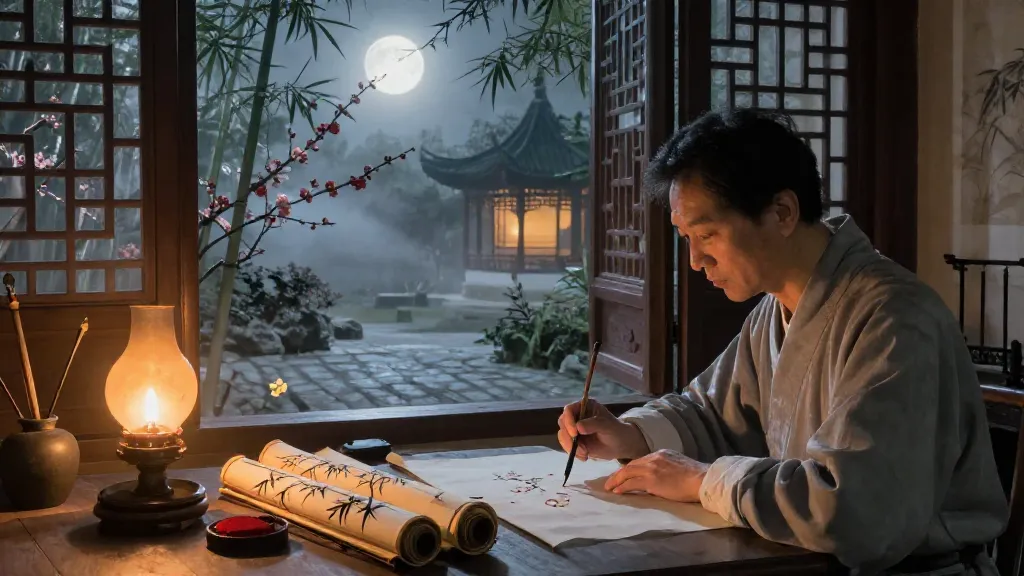
平原君虞卿列傳 (Biographies of Lord Pingyuan and Yu Qing) — Chinese ink painting

Chapter 76 of 130

平原君虞卿列傳

Biographies of Lord Pingyuan and Yu Qing

View:

平原君斬笑躄美人

Lord Pingyuan Beheads the Concubine Who Laughed at the Lame Man

平原君趙勝者,趙之諸公子也。諸子中勝最賢,喜賓客,賓客蓋至者數千人。平原君相趙惠文王及孝成王,三去相,三復位,封於東武城。

平原君家樓臨民家。民家有躄者,槃散行汲。平原君美人居樓上,臨見,大笑之。明日,躄者至平原君門,請曰:"臣聞君之喜士,士不遠千里而至者,以君能貴士而賤妾也。臣不幸有罷癃之病,而君之後宮臨而笑臣,臣原得笑臣者頭。"平原君笑應曰:"諾。"躄者去,平原君笑曰:"觀此豎子,乃欲以一笑之故殺吾美人,不亦甚乎!"終不殺。居歲餘,賓客門下舍人稍稍引去者過半。平原君怪之,曰:"勝所以待諸君者未嘗敢失禮,而去者何多也?"門下一人前對曰:"以君之不殺笑躄者,以君為愛色而賤士,士即去耳。"於是平原君乃斬笑躄者美人頭,自造門進躄者,因謝焉。其後門下乃復稍稍來。是時齊有孟嘗,魏有信陵,楚有春申,故爭相傾以待士。

Lord Pingyuan, Zhao Sheng, was a prince of the Zhao royal house. Among all the princes, Sheng was the most capable. He was fond of retainers, and guests who gathered around him numbered several thousand. Lord Pingyuan served as chancellor under both King Huiwen and King Xiaocheng of Zhao, was dismissed three times and restored three times, and was enfeoffed at Dongwucheng.

Lord Pingyuan's mansion had an upper story that overlooked a common family's dwelling. In that family lived a lame man who limped and shuffled when he went out to draw water. One of Lord Pingyuan's concubines, looking down from the upper story, saw him and burst out laughing. The next day, the lame man came to Lord Pingyuan's gate and said: "I have heard that you are fond of worthy men, and that men travel a thousand li to come to you because you value men and hold women cheap. I have the misfortune of a crippling illness, and your concubine looked down and laughed at me. I wish to have the head of the woman who laughed." Lord Pingyuan laughed and agreed. After the lame man left, Lord Pingyuan said with a laugh: "Look at this wretch — he wants me to kill my concubine over a single laugh. Is that not absurd?" He did not kill her.

Over the next year and more, his retainers and household men gradually drifted away until more than half had left. Lord Pingyuan was puzzled and said: "I have never failed in courtesy toward you all — why have so many left?" One of his men stepped forward and replied: "Because you did not kill the concubine who laughed at the lame man. They consider you a man who prizes beauty over worthy men, and so the worthy men leave." At this, Lord Pingyuan beheaded the concubine, went in person to the lame man's door, and apologized. After that, his retainers gradually returned. At that time, Qi had Lord Mengchang, Wei had Lord Xinling, and Chu had Lord Chunshen — and they all competed to outdo each other in patronizing the worthy.

Notes

1person趙勝Zhào Shèng

Lord Pingyuan (平原君), personal name Zhao Sheng (趙勝, d. 251 BC), was a prince of Zhao and one of the Four Lords of the Warring States. He served as chancellor of Zhao and played a central role in the defense of Handan against Qin's siege (257 BC).

2place

Dongwucheng (東武城) was Lord Pingyuan's fief, located near modern Wucheng County (武城縣), Shandong.

3context

The episode demonstrates the fierce honor economy of the Warring States retainer class. A patron's value was measured not by how he treated his concubines but by whether he subordinated private pleasures to public reputation. Lord Pingyuan's initial refusal to act cost him half his retainers — a devastating political loss.

毛遂自薦

Mao Sui Recommends Himself

秦之圍邯鄲,趙使平原君求救,合從於楚,約與食客門下有勇力文武備具者二十人偕。平原君曰:"使文能取勝,則善矣。文不能取勝,則歃血於華屋之下,必得定從而還。士不外索,取於食客門下足矣。"得十九人,餘無可取者,無以滿二十人。門下有毛遂者,前,自贊於平原君曰:"遂聞君將合從於楚,約與食客門下二十人偕,不外索。今少一人,原君即以遂備員而行矣。"平原君曰:"先生處勝之門下幾年於此矣?"毛遂曰:"三年於此矣。"平原君曰:"夫賢士之處世也,譬若錐之處囊中,其末立見。今先生處勝之門下三年於此矣,左右未有所稱誦,勝未有所聞,是先生無所有也。先生不能,先生留。"毛遂曰:"臣乃今日請處囊中耳。使遂蚤得處囊中,乃穎脫而出,非特其末見而已。"平原君竟與毛遂偕。十九人相與目笑之而未廢也。

When Qin besieged Handan, Zhao sent Lord Pingyuan to seek rescue and forge an alliance with Chu. He agreed to take twenty retainers who possessed both courage and learning. Lord Pingyuan said: "If we can prevail through diplomacy, so much the better. If not, then we will swear a blood oath beneath the painted hall and must return with the alliance secured. We need not look beyond our own household — our retainers will suffice." He selected nineteen men, but could find no one for the twentieth place.

Among his retainers was one Mao Sui, who stepped forward and volunteered: "I have heard that you are going to forge an alliance with Chu and will take twenty men from your household, seeking no one outside. You are still one short. I beg you to include me to fill the number." Lord Pingyuan said: "How many years have you been in my household, sir?" Mao Sui replied: "Three years." Lord Pingyuan said: "A man of true talent in this world is like an awl in a sack — its point shows through at once. You have been in my household for three years, and no one around me has ever spoken your name, nor have I heard anything of you. You have nothing to offer. You cannot go — please stay." Mao Sui replied: "I am asking today to be placed in the sack. Had I been placed in the sack earlier, the entire awl-head would have burst through, not merely the point." Lord Pingyuan took Mao Sui along after all. The other nineteen exchanged glances and smirked, but did not object.

Notes

1person毛遂Máo Suì

Mao Sui (毛遂) was an obscure retainer of Lord Pingyuan who volunteered for the diplomatic mission to Chu and proved decisive. The phrase 毛遂自薦 ('Mao Sui recommends himself') remains one of the most commonly used idioms in Chinese, meaning to volunteer one's services.

2place

Handan (邯鄲) was the capital of Zhao, located in modern Handan, Hebei. The Qin siege of Handan (258–257 BC) was one of the pivotal events of the late Warring States, ultimately repelled by the combined relief forces of Wei and Chu.

3translation

The 'awl in a sack' (錐處囊中) metaphor and Mao Sui's retort about 'the entire awl-head bursting through' (穎脫而出) both became proverbial. The word 穎 (awl-head) also means 'outstanding talent,' creating a pun that works in both languages.

毛遂定從於楚

Mao Sui Secures the Alliance with Chu

毛遂比至楚,與十九人論議,十九人皆服。平原君與楚合從,言其利害,日出而言之,日中不決。十九人謂毛遂曰:"先生上。"毛遂按劍歷階而上,謂平原君曰:"從之利害,兩言而決耳。今日出而言從,日中不決,何也?"楚王謂平原君曰:"客何為者也?"平原君曰:"是勝之舍人也。"楚王叱曰:"胡不下!吾乃與而君言,汝何為者也!"毛遂按劍而前曰:"王之所以叱遂者,以楚國之眾也。今十步之內,王不得恃楚國之眾也,王之命縣於遂手。吾君在前,叱者何也?且遂聞湯以七十里之地王天下,文王以百里之壤而臣諸侯,豈其士卒眾多哉,誠能據其勢而奮其威。今楚地方五千里,持戟百萬,此霸王之資也。以楚之彊,天下弗能當。白起,小豎子耳,率數萬之眾,興師以與楚戰,一戰而舉鄢郢,再戰而燒夷陵,三戰而辱王之先人。此百世之怨而趙之所羞,而王弗知惡焉。合從者為楚,非為趙也。吾君在前,叱者何也?"楚王曰:"唯唯,誠若先生之言,謹奉社稷而以從。"毛遂曰:"從定乎?"楚王曰:"定矣。"毛遂謂楚王之左右曰:"取雞狗馬之血來。"毛遂奉銅槃而跪進之楚王曰:"王當歃血而定從,次者吾君,次者遂。"遂定從於殿上。毛遂左手持槃血而右手招十九人曰:"公相與歃此血於堂下。公等錄錄,所謂因人成事者也。"

By the time Mao Sui reached Chu, he had debated with the nineteen others along the way, and all nineteen acknowledged his superiority. Lord Pingyuan opened negotiations with the King of Chu on the alliance, laying out the advantages and disadvantages. He began speaking at sunrise, and by noon the matter was still unresolved. The nineteen said to Mao Sui: "Go up, sir." Mao Sui gripped his sword and strode up the steps. He said to Lord Pingyuan: "The merits of the alliance can be decided in two sentences. You have been arguing since sunrise, and at noon it is still unresolved — why?"

The King of Chu said to Lord Pingyuan: "Who is this man?" Lord Pingyuan replied: "He is one of my household retainers." The King of Chu shouted: "Get down! I am speaking with your master — who are you to be here?" Mao Sui gripped his sword and stepped forward: "The reason Your Majesty shouts at me is that you rely on Chu's multitudes. But within ten paces, Your Majesty cannot rely on Chu's multitudes. Your Majesty's life hangs from my hand. My lord stands before you — what cause is there for shouting?

"Moreover, I have heard that Tang became king of All-Under-Heaven with a domain of seventy li, and King Wen made the lords his subjects with a territory of a hundred li. Was that because their soldiers were numerous? It was because they seized their advantage and wielded their authority. Now Chu's territory stretches five thousand li and its troops number a million — this is the patrimony of a hegemon-king. With Chu's strength, nothing in the realm can stand against it. And yet Bai Qi, that worthless whelp, led a mere few tens of thousands, raised an army to fight Chu, took Yan and Ying in the first battle, burned Yiling in the second, and humiliated Your Majesty's ancestors in the third. This is a grudge for a hundred generations and a shame that even Zhao feels on your behalf — yet Your Majesty does not resent it? This alliance serves Chu, not Zhao. My lord stands before you — what cause is there for shouting?"

The King of Chu said: "Yes, yes — it is truly as you say, sir. I reverently pledge the state to the alliance." Mao Sui said: "Is the alliance settled?" The king said: "It is settled." Mao Sui called to the king's attendants: "Bring the blood of chicken, dog, and horse." Mao Sui presented a bronze basin and knelt to offer it to the King of Chu: "Your Majesty shall smear the blood and seal the alliance. Next shall be my lord, and next shall be me." The alliance was thus sealed in the hall. Mao Sui held the basin of blood in his left hand and beckoned the nineteen with his right: "Gentlemen, smear this blood here below the hall. You are the sort who accomplish things by riding on the efforts of others."

Notes

1person白起Bái Qǐ

Bai Qi (白起, d. 257 BC) was Qin's most fearsome general, responsible for the destruction of Chu's capital Ying (278 BC) and the massacre at Changping (260 BC). Mao Sui's dismissal of him as a 'worthless whelp' (小豎子) was calculated to shame the King of Chu into action.

2place

Yan (鄢) and Ying (郢) were Chu's capital and secondary capital. Bai Qi's campaign in 278 BC forced Chu to abandon its ancestral heartland and relocate its capital eastward to Chen (modern Huaiyang, Henan). Yiling (夷陵) is near modern Yichang, Hubei.

3context

The blood oath (歃血) was the most solemn form of interstate agreement in the Warring States. The blood of sacrificial animals was smeared on the lips of the parties. Mao Sui's seizure of control of the ceremony — dictating the order of the oath — demonstrated extraordinary audacity.

李同散家救邯鄲

Li Tong Gives Everything to Save Handan

平原君已定從而歸,歸至於趙,曰:"勝不敢復相士。勝相士多者千人,寡者百數,自以為不失天下之士,今乃於毛先生而失之也。毛先生一至楚,而使趙重於九鼎大呂。毛先生以三寸之舌,彊於百萬之師。勝不敢復相士。"遂以為上客。

平原君既返趙,楚使春申君將兵赴救趙,魏信陵君亦矯奪晉鄙軍往救趙,皆未至。秦急圍邯鄲,邯鄲急,且降,平原君甚患之。邯鄲傳舍吏子李同說平原君曰:"君不憂趙亡邪?"平原君曰:"趙亡則勝為虜,何為不憂乎?"李同曰:"邯鄲之民,炊骨易子而食,可謂急矣,而君之後宮以百數,婢妾被綺縠,餘粱肉,而民褐衣不完,糟糠不厭。民困兵盡,或剡木為矛矢,而君器物鍾磬自若。使秦破趙,君安得有此?使趙得全,君何患無有?今君誠能令夫人以下編於士卒之間,分功而作,家之所有盡散以饗士,士方其危苦之時,易德耳。"於是平原君從之,得敢死之士三千人。李同遂與三千人赴秦軍,秦軍為之卻三十里。亦會楚、魏救至,秦兵遂罷,邯鄲復存。李同戰死,封其父為李侯。

Lord Pingyuan, having secured the alliance, returned to Zhao and said: "I will never again presume to judge men. I have judged men by the thousand, by the hundred at least, and thought I had missed no worthy man in the realm — yet I missed Master Mao. Master Mao's single visit to Chu made Zhao weightier than the Nine Cauldrons or the Great Lü Bell. Master Mao's three inches of tongue proved mightier than a million troops. I will never again presume to judge men." He made Mao Sui his most honored guest.

After Lord Pingyuan returned to Zhao, Chu sent Lord Chunshen to lead troops to Zhao's rescue, and Lord Xinling of Wei also commandeered Jin Bi's army to march to Zhao's aid — but neither had yet arrived. Qin pressed the siege of Handan. The city was desperate, on the verge of surrender, and Lord Pingyuan was deeply troubled. Li Tong, the son of a guesthouse clerk in Handan, said to Lord Pingyuan: "Are you not worried about Zhao's destruction?" Lord Pingyuan replied: "If Zhao falls, I become a captive — of course I worry." Li Tong said: "The people of Handan are burning bones for fuel and exchanging children to eat — that is how desperate things are. Yet your inner chambers hold women by the hundreds, your maids and concubines wear fine silks and have surplus grain and meat, while the common people cannot cover themselves in coarse cloth or fill their stomachs with chaff. The people are exhausted and the soldiers spent — some are sharpening sticks into spears and arrows — while your possessions, your bells and chimes, remain just as they were. If Qin destroys Zhao, how will you keep any of this? If Zhao survives, what worry is there that you will lack anything? If you would truly order all the women of your household down to the rank of servant to stand in the lines alongside the soldiers, share the labor, and distribute everything you own to feed the troops — in their time of danger and suffering, gratitude comes easily."

Lord Pingyuan followed his advice and raised three thousand men willing to die. Li Tong led these three thousand against the Qin army and drove it back thirty li. At the same time, the Chu and Wei relief forces arrived. The Qin army withdrew, and Handan was saved. Li Tong died in battle. His father was ennobled as Marquis Li.

Notes

1person李同Lǐ Tóng

Li Tong (李同) was the son of a lowly guesthouse functionary who dared to challenge Lord Pingyuan's complacency during the siege. His willingness to die leading the counterattack — and Lord Pingyuan's willingness to listen — turned the tide at Handan.

2context

The phrase 'burning bones for fuel and exchanging children to eat' (炊骨易子而食) became a stock description of extreme siege conditions. Li Tong's argument — that a lord's private luxury is meaningless if the state falls — echoes the Legalist principle that private wealth must be mobilized for public survival.

3translation

The 'Nine Cauldrons' (九鼎) were the legendary bronze vessels symbolizing sovereign authority over All-Under-Heaven. The 'Great Lü Bell' (大呂) was a famous Zhou dynasty ritual bell. Together they represent supreme political weight.

虞卿謀趙

Yu Qing's Counsel for Zhao

虞卿者,遊說之士也。躡蹻檐簦說趙孝成王。一見,賜黃金百鎰,白璧一雙;再見,為趙上卿,故號為虞卿。

秦趙戰於長平,趙不勝,亡一都尉。趙王召樓昌與虞卿曰:"軍戰不勝,尉復死,寡人使束甲而趨之,何如?"樓昌曰:"無益也,不如發重使為媾。"虞卿曰:"昌言媾者,以為不媾軍必破也。而制媾者在秦。且王之論秦也,欲破趙之軍乎,不邪?"王曰:"秦不遺餘力矣,必且欲破趙軍。"虞卿曰:"王聽臣,發使出重寶以附楚、魏,楚、魏欲得王之重寶,必內吾使。趙使入楚、魏,秦必疑天下之合從,且必恐。如此,則媾乃可為也。"趙王不聽,與平陽君為媾,發鄭硃入秦。秦內之。趙王召虞卿曰:"寡人使平陽君為媾於秦,秦已內鄭硃矣,卿之為奚如?"虞卿對曰:"王不得媾,軍必破矣。天下賀戰者皆在秦矣。鄭硃,貴人也,入秦,秦王與應侯必顯重以示天下。楚、魏以趙為媾,必不救王。秦知天下不救王,則媾不可得成也。"應侯果顯鄭硃以示天下賀戰勝者,終不肯媾。長平大敗,遂圍邯鄲,為天下笑。

Yu Qing was a traveling persuader. He came in straw sandals carrying a rain-parasol to address King Xiaocheng of Zhao. At the first audience he was given a hundred measures of gold and a pair of white jade discs; at the second he was made Senior Minister of Zhao — hence his title "Yu Qing."

When Qin and Zhao fought at Changping, Zhao did not prevail and lost a commandant. The King of Zhao summoned Lou Chang and Yu Qing, saying: "The army has been defeated and the commandant is dead. Should I order the troops to press forward in full armor?" Lou Chang said: "That would be useless. Better to send a senior envoy to negotiate peace." Yu Qing said: "Lou Chang recommends peace because he assumes that without peace the army will be destroyed. But the power to set the terms of peace lies with Qin. Consider this, Your Majesty: does Qin intend to destroy the Zhao army, or not?" The king said: "Qin is holding nothing back — they certainly intend to destroy our army." Yu Qing said: "If Your Majesty will listen to me, send envoys bearing great treasures to win over Chu and Wei. Chu and Wei will want Your Majesty's treasures and will certainly receive our envoys. Once Zhao's envoys have entered Chu and Wei, Qin will suspect an alliance forming and grow fearful. Then, and only then, can peace be negotiated."

The King of Zhao did not listen. He had Lord Pingyang negotiate the peace and sent Zheng Zhu to Qin. Qin received him. The King of Zhao summoned Yu Qing and said: "I have had Lord Pingyang negotiate with Qin, and Qin has already received Zheng Zhu. What do you say now?" Yu Qing replied: "Your Majesty will not obtain peace, and the army will certainly be destroyed. All who congratulate the victorious in battle are now in Qin's camp. Zheng Zhu is a man of high rank. Once he enters Qin, the King of Qin and the Marquis of Ying will certainly parade him prominently to show the realm. Chu and Wei, seeing that Zhao has sued for peace, will certainly not come to Your Majesty's rescue. When Qin knows that no one in the realm will rescue Your Majesty, it will be impossible to reach a settlement." The Marquis of Ying did indeed display Zheng Zhu prominently to all who came to congratulate Qin on its victory, and in the end refused to make peace. The catastrophe at Changping followed, then the siege of Handan — and Zhao became a laughingstock.

Notes

1person虞卿Yú Qīng

Yu Qing (虞卿) was a persuader who rose from poverty to become Senior Minister of Zhao through sheer rhetorical ability. He later sacrificed his position for a friend and spent his final years writing the lost work known as Yu's Spring and Autumn (虞氏春秋).

2place

Changping (長平) was the site of the catastrophic battle of 260 BC in which Qin's general Bai Qi annihilated the Zhao army. According to tradition, over 400,000 Zhao prisoners were buried alive. The site is near modern Gaoping (高平), Shanxi.

3person范雎Fàn Suī

The Marquis of Ying (應侯) is Fan Sui (范雎, also written 范睢), chancellor of Qin, whose 'distant friendship, near attack' (遠交近攻) strategy guided Qin's expansion. His biography is Shiji chapter 79.

4context

Yu Qing's analysis proved devastatingly correct. His argument was that peace negotiations only work when you have leverage — and Zhao's direct approach to Qin, without first securing allies, eliminated all leverage. By publicly receiving Zhao's envoy, Qin signaled to the world that Zhao had already conceded, ensuring no one would come to Zhao's aid.

虞卿論割地

Yu Qing's Argument Against Ceding Territory

秦既解邯鄲圍,而趙王入朝,使趙郝約事於秦,割六縣而媾。虞卿謂趙王曰:"秦之攻王也,倦而歸乎?王以其力尚能進,愛王而弗攻乎?"王曰:"秦之攻我也,不遺餘力矣,必以倦而歸也。"虞卿曰:"秦以其力攻其所不能取,倦而歸,王又以其力之所不能取以送之,是助秦自攻也。來年秦復攻王,王無救矣。"

王以虞卿之言趙郝。趙郝曰:"虞卿誠能盡秦力之所至乎?誠知秦力之所不能進,此彈丸之地弗予,令秦來年復攻王,王得無割其內而媾乎?"王曰:"請聽子割,子能必使來年秦之不復攻我乎?"趙郝對曰:"此非臣之所敢任也。"

王以告虞卿。虞卿對曰:"郝言'不媾,來年秦復攻王,王得無割其內而媾乎'。今媾,郝又以不能必秦之不復攻也。今雖割六城,何益!來年復攻,又割其力之所不能取而媾,此自盡之術也,不如無媾。秦雖善攻,不能取六縣;趙雖不能守,終不失六城。秦倦而歸,兵必罷。我以六城收天下以攻罷秦,是我失之於天下而取償於秦也。吾國尚利,孰與坐而割地,自弱以彊秦哉?今郝曰'秦善韓、魏而攻趙者,必王之事秦不如韓、魏也',是使王歲以六城事秦也,即坐而城盡。來年秦復求割地,王將與之乎?弗與,是棄前功而挑秦禍也;與之,則無地而給之。語曰'彊者善攻,弱者不能守'。今坐而聽秦,秦兵不弊而多得地,是彊秦而弱趙也。以益彊之秦而割愈弱之趙,其計故不止矣。且王之地有盡而秦之求無已,以有盡之地而給無已之求,其勢必無趙矣。"

After Qin lifted the siege of Handan and the King of Zhao went to court, he sent Zhao Hao to negotiate with Qin, proposing to cede six counties for peace. Yu Qing said to the King of Zhao: "When Qin attacked Your Majesty, did it withdraw because it was exhausted? Or does Your Majesty believe that Qin still had the strength to press forward but refrained out of affection?" The king said: "Qin attacked with everything it had. It must have withdrawn from exhaustion." Yu Qing said: "If Qin attacked with all its strength but could not take those lands, and then withdrew from exhaustion — and now Your Majesty hands over the very lands that Qin's full strength could not take — that is helping Qin attack yourself. Next year when Qin attacks again, Your Majesty will have no recourse."

The king relayed Yu Qing's words to Zhao Hao. Zhao Hao said: "Can Yu Qing truly determine the limit of Qin's strength? If he truly knows what Qin cannot take by force, then refusing to give these scraps of territory means that when Qin attacks again next year, will Your Majesty not have to cede interior territory for peace?" The king asked: "I will follow your plan and cede the land — but can you guarantee that Qin will not attack again next year?" Zhao Hao replied: "That is not something I dare guarantee."

The king told Yu Qing of this. Yu Qing replied: "Zhao Hao says: 'Without peace, Qin will attack again next year — will Your Majesty not have to cede interior territory then?' But even with peace, Zhao Hao admits he cannot guarantee Qin will not attack again. So even if we cede six cities now, what is the benefit? Next year Qin attacks again, and we cede more territory that its forces could not take — this is a strategy for self-destruction. Better no peace at all. However good Qin is at attacking, it cannot take six counties; however poor Zhao is at defending, it will not ultimately lose six cities. When Qin withdraws from exhaustion, its army will be spent. We can use those six cities to rally the realm against an exhausted Qin — we lose standing in the world but gain compensation from Qin. Our state still profits. How does that compare with sitting still, ceding territory, weakening ourselves, and strengthening Qin?

"Now Zhao Hao says: 'The reason Qin is friendly to Han and Wei while attacking Zhao is that Your Majesty's service to Qin falls short of Han's and Wei's.' This means Your Majesty would have to cede six cities to Qin every year until every city is gone. If next year Qin demands more territory, will you give it? If you refuse, you throw away the previous concession and invite Qin's wrath. If you give it, there will be no territory left to give. The saying goes: 'The strong are good at attacking; the weak cannot defend.' By sitting and submitting to Qin, Qin's army suffers no attrition while gaining territory — you strengthen Qin and weaken Zhao. The stronger Qin grows while the weaker Zhao becomes, its appetite will never stop. Moreover, Your Majesty's territory is finite, but Qin's demands are without end. To meet demands without end with territory that has an end — the logic leads inevitably to the annihilation of Zhao."

Notes

1context

Yu Qing's argument against appeasement is one of the most rigorous strategic analyses in the Shiji. His central insight — that ceding territory you couldn't defend simply funds the enemy's next attack — anticipated by two millennia the logic used against appeasement in modern geopolitics. The final line (以有盡之地而給無已之求) became proverbial.

虞卿勝樓緩與太史公論

Yu Qing Defeats Lou Huan, and the Grand Historian's Appraisal

趙王計未定,樓緩從秦來,趙王與樓緩計之,曰:"予秦地如毋予,孰吉?"緩辭讓曰:"此非臣之所能知也。"王曰:"雖然,試言公之私。"樓緩對曰:"王亦聞夫公甫文伯母乎?公甫文伯仕於魯,病死,女子為自殺於房中者二人。其母聞之,弗哭也。其相室曰:'焉有子死而弗哭者乎?'其母曰:'孔子,賢人也,逐於魯,而是人不隨也。今死而婦人為之自殺者二人,若是者必其於長者薄而於婦人厚也。'故從母言之,是為賢母;從妻言之,是必不免為妒妻。故其言一也,言者異則人心變矣。今臣新從秦來而言勿予,則非計也;言予之,恐王以臣為為秦也:故不敢對。使臣得為大王計,不如予之。"

虞卿聞之,入見王曰:"此飾說也,王蜰勿予!"樓緩聞之,往見王。王又以虞卿之言告樓緩。樓緩對曰:"不然。虞卿得其一,不得其二。夫秦趙構難而天下皆說,何也?曰'吾且因彊而乘弱矣'。今趙兵困於秦,天下之賀戰勝者則必盡在於秦矣。故不如亟割地為和,以疑天下而慰秦之心。不然,天下將因秦之怒,乘趙之弊,瓜分之。趙且亡,何秦之圖乎?"

虞卿聞之,往見王曰:"危哉樓子之所以為秦者,是愈疑天下,而何慰秦之心哉?獨不言其示天下弱乎?且臣言勿予者,非固勿予而已也。秦索六城於王,而王以六城賂齊。齊,秦之深讎也,得王之六城,並力西擊秦,齊之聽王,不待辭之畢也。則是王失之於齊而取償於秦也。而齊、趙之深讎可以報矣,而示天下有能為也。王以此發聲,兵未窺於境,臣見秦之重賂至趙而反媾於王也。從秦為媾,韓、魏聞之,必盡重王;重王,必出重寶以先於王。則是王一舉而結三國之親,而與秦易道也。"

趙王曰:"善。"則使虞卿東見齊王,與之謀秦。虞卿未返,秦使者已在趙矣。樓緩聞之,亡去。趙於是封虞卿以一城。

平原君以趙孝成王十五年卒。子孫代,後竟與趙俱亡。

虞卿既以魏齊之故,不重萬戶侯卿相之印,與魏齊間行,卒去趙,困於梁。魏齊已死,不得意,乃著書,上采春秋,下觀近世,曰節義、稱號、揣摩、政謀,凡八篇。以刺譏國家得失,世傳之曰虞氏春秋。

太史公曰:平原君,翩翩濁世之佳公子也,然未睹大體。鄙語曰"利令智昏",平原君貪馮亭邪說,使趙陷長平兵四十餘萬眾,邯鄲幾亡。虞卿料事揣情,為趙畫策,何其工也!及不忍魏齊,卒困於大梁,庸夫且知其不可,況賢人乎?然虞卿非窮愁,亦不能著書以自見於後世雲。

While the King of Zhao's plan remained undecided, Lou Huan arrived from Qin. The king consulted him: "Is it better to give Qin the territory or not?" Lou Huan demurred: "That is beyond my ability to judge." The king said: "Even so, tell me your private opinion." Lou Huan replied: "Has Your Majesty heard of the mother of Gongfu Wenbo? Gongfu Wenbo served in Lu and died of illness. Two women killed themselves in his chamber. His mother heard of it and did not weep. Her housekeeper said: 'How can a mother not weep for her dead son?' The mother replied: 'Confucius is a worthy man. He was driven from Lu, and this man did not follow him. Yet now that he is dead, two women have killed themselves for him. A man like that must have been thin toward his elders and thick toward women.' From the mother's perspective, she was a wise mother; from the wives' perspective, she would be called a jealous wife. The same facts, but the speaker's position changes how people judge. Now I have just come from Qin. If I say 'do not give,' it would be poor counsel; if I say 'give,' I fear Your Majesty will think I am working for Qin. Therefore I dare not answer. But if I may advise Your Majesty — better to give."

Yu Qing heard this, went in to see the king, and said: "This is specious rhetoric — Your Majesty must not give!" Lou Huan heard this, came to see the king, and the king relayed Yu Qing's argument. Lou Huan replied: "Not so. Yu Qing sees one side but not the other. When Qin and Zhao are locked in conflict, the whole realm is delighted — why? Because they say: 'We will side with the strong and exploit the weak.' Now that Zhao's army has been broken by Qin, the world's congratulations all go to Qin. Better to quickly cede territory for peace, creating doubt in the realm and soothing Qin's heart. Otherwise, the world will exploit Qin's anger and Zhao's weakness to carve Zhao up. If Zhao is about to perish, what use is scheming against Qin?"

Yu Qing heard this, went to see the king, and said: "Dangerous indeed is Lou Huan's counsel for Qin! This will only deepen the world's suspicion of Zhao — how will it soothe Qin's heart? Does he not see that it shows the world Zhao's weakness? Moreover, when I say 'do not give,' I do not mean merely to refuse and stop there. Qin demands six cities from Your Majesty — give those six cities to Qi instead. Qi is Qin's bitter enemy. With Your Majesty's six cities in hand, Qi will join forces to strike Qin from the west. Qi will agree before you finish speaking. Thus Your Majesty loses territory to Qi but gains compensation from Qin. The deep enmity between Qi and Zhao can be avenged, and the world will see that Zhao can act. If Your Majesty makes this known — before a single soldier crosses the border, I predict that Qin's envoys will arrive in Zhao bearing lavish gifts, suing for peace on your terms. Once Qin sues for peace with Zhao, Han and Wei will hear of it and value Your Majesty greatly; they will send their own treasures to win your favor first. Thus in one move Your Majesty binds three states in alliance and reverses the balance with Qin."

The King of Zhao said: "Good." He sent Yu Qing east to see the King of Qi and plan jointly against Qin. Before Yu Qing returned, Qin's envoys were already in Zhao. Lou Huan heard of this and fled. Zhao enfeoffed Yu Qing with one city.

Lord Pingyuan died in the fifteenth year of King Xiaocheng of Zhao. His descendants succeeded him, but in the end they perished together with Zhao.

As for Yu Qing, because of his loyalty to Wei Qi, he did not value the seal of a marquis with ten thousand households or the position of minister. He traveled in secret with Wei Qi, ultimately left Zhao, and ended up destitute in Daliang. After Wei Qi died, Yu Qing, frustrated in his ambitions, wrote a book drawing on the Spring and Autumn Annals above and observing recent history below, covering topics such as integrity, titles, strategic assessment, and political counsel — eight chapters in all. It criticized the gains and losses of states and was transmitted to later generations as Yu's Spring and Autumn.

The Grand Historian remarks: Lord Pingyuan was an elegant prince in a turbid age, yet he failed to see the larger picture. As the common saying goes: "Profit makes wisdom dim." Lord Pingyuan was greedy for Feng Ting's treacherous advice and thereby led Zhao to bury over four hundred thousand troops at Changping and nearly lose Handan. Yu Qing assessed situations and read intentions with brilliance — what superb strategy he devised for Zhao! Yet when it came to Wei Qi, he could not bear to abandon him, and in the end was trapped in Daliang. Even an ordinary man would know that was folly — how much more a man of wisdom? Still, had Yu Qing not been reduced to poverty and frustration, he could never have written a book to make his name known to later generations.

Notes

1person樓緩Lóu Huǎn

Lou Huan (樓緩) was a Zhao minister who had served in Qin and argued for appeasement. His parable about Gongfu Wenbo's mother was meant to excuse his own conflicted position — but Yu Qing saw through it as rhetorical camouflage for a pro-Qin recommendation.

2person魏齊Wèi Qí

Wei Qi (魏齊) was a former chancellor of Wei who had once humiliated Fan Sui (the Marquis of Ying). When Fan Sui became Qin's chancellor, he demanded Wei Qi's head. Lord Pingyuan sheltered Wei Qi, and Yu Qing ultimately sacrificed his own career for him.

3context

The phrase 利令智昏 ('profit makes wisdom dim') is attributed by Sima Qian to common speech but entered literary Chinese through this passage. Lord Pingyuan's acceptance of Feng Ting's offer of the Shangdang territory — which provoked Qin's wrath and led directly to Changping — is the specific referent.

4person馮亭Féng Tíng

Feng Ting (馮亭) was the governor of Shangdang (上黨) who, when Qin cut off Shangdang from Han, offered the territory to Zhao rather than surrender it to Qin. Lord Pingyuan urged acceptance, triggering the chain of events leading to Changping.

Edition & Source

Text
《史記》 Shiji
Edition
中華古詩文古書籍網 transcription
Commentary
裴駰《史記集解》、司馬貞《史記索隱》、張守節《史記正義》(Three Commentaries)