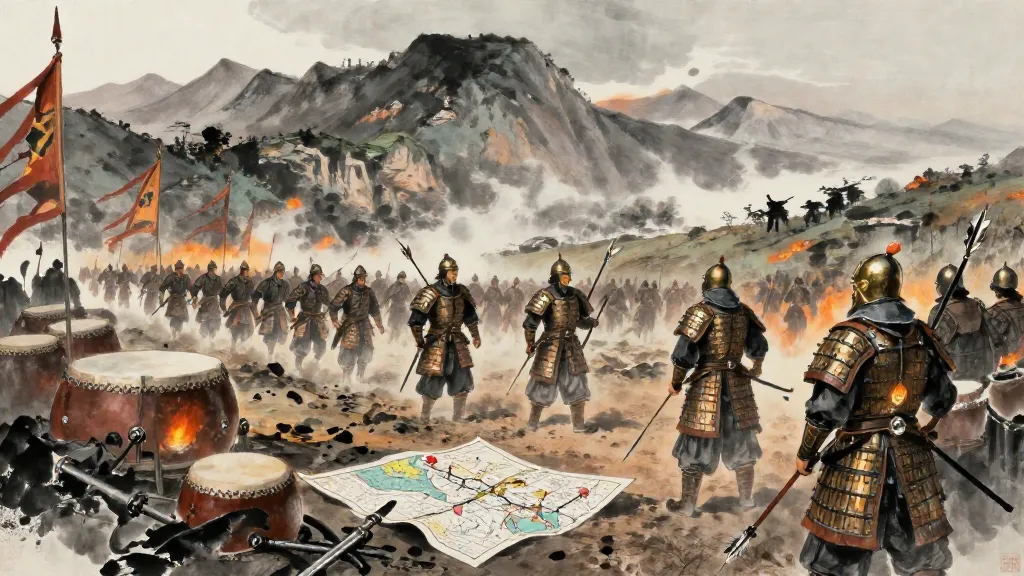
魏公子列傳 (Biography of the Prince of Wei (Lord Xinling)) — Chinese ink painting

Chapter 77 of 130

魏公子列傳

Biography of the Prince of Wei (Lord Xinling)

View:

公子禮士

The Prince's Courtesy to the Worthy

魏公子無忌者,魏昭王子少子而魏安釐王異母弟也。昭王薨,安釐王即位,封公子為信陵君。是時范睢亡魏相秦,以怨魏齊故,秦兵圍大梁,破魏華陽下軍,走芒卯。魏王及公子患之。

公子為人仁而下士,士無賢不肖皆謙而禮交之,不敢以其富貴驕士。士以此方數千里爭往歸之,致食客三千人。當是時,諸侯以公子賢,多客,不敢加兵謀魏十餘年。

公子與魏王博,而北境傳舉烽,言"趙寇至,且入界"。魏王釋博,欲召大臣謀。公子止王曰:"趙王田獵耳,非為寇也。"復博如故。王恐,心不在博。居頃,復從北方來傳言曰:"趙王獵耳,非為寇也。"魏王大驚,曰:"公子何以知之?"公子曰:"臣之客有能深得趙王陰事者,趙王所為,客輒以報臣,臣以此知之。"是後魏王畏公子之賢能,不敢任公子以國政。

The Prince of Wei, Wuji, was the youngest son of King Zhao of Wei and a half-brother of King Anxi of Wei, born of a different mother. When King Zhao died and King Anxi took the throne, he enfeoffed the prince as Lord Xinling. At that time, Fan Sui had fled Wei and become chancellor of Qin. Bearing a grudge against Wei Qi, he directed Qin's forces to besiege Daliang, shatter the Wei army below Huayang, and rout Mang Mao. The King of Wei and the prince were deeply alarmed.

The prince was a man of humanity who humbled himself before the worthy. Whether a man was talented or mediocre, the prince treated him with modesty and courtesy, never presuming upon his own wealth and rank to look down on anyone. Because of this, men from thousands of li around competed to join him, and his retainers numbered three thousand. At that time, the lords, knowing the prince's reputation and the size of his following, did not dare to make war on Wei for over ten years.

Once, the prince was playing a board game with the King of Wei when beacon fires were raised on the northern frontier with the report: "Zhao raiders approaching — about to cross the border." The king set aside the game and wanted to summon his ministers for a council. The prince restrained him: "The King of Zhao is merely hunting — there is no invasion." They resumed the game. The king was frightened and could not concentrate. Shortly afterward, another report came from the north: "The King of Zhao was hunting — there was no invasion." The King of Wei was astonished: "How did you know?" The prince replied: "Among my retainers is one who has deep access to the King of Zhao's confidential affairs. Whatever the King of Zhao does, my man reports it to me at once. That is how I knew." After this, the King of Wei was wary of the prince's ability and never again dared entrust him with the government.

Notes

1person魏無忌Wèi Wújì

Lord Xinling (信陵君), personal name Wei Wuji (魏無忌, d. 243 BC), was a prince of Wei and the most celebrated of the Four Lords of the Warring States. Sima Qian considered him the noblest, and Emperor Gaozu of Han personally honored his tomb.

2person魏安釐王Wèi Ānxī Wáng

King Anxi of Wei (魏安釐王, r. 276–243 BC) was Lord Xinling's half-brother. His suspicion of the prince's popularity was a recurring source of tension and ultimately led to the prince's destruction.

3place

Daliang (大梁) was the capital of Wei, modern Kaifeng (開封), Henan. Built on flat terrain without natural defenses, it was vulnerable to flooding — Qin would eventually destroy it by diverting the Yellow River.

公子迎侯嬴

The Prince Welcomes Hou Ying

魏有隱士曰侯嬴,年七十,家貧,為大梁夷門監者。公子聞之,往請,欲厚遺之。不肯受,曰:"臣脩身絜行數十年,終不以監門困故而受公子財。"公子於是乃置酒大會賓客。坐定,公子從車騎,虛左,自迎夷門侯生。侯生攝敝衣冠,直上載公子上坐,不讓,欲以觀公子。公子執轡愈恭。侯生又謂公子曰:"臣有客在市屠中,原枉車騎過之。"公子引車入巿,侯生下見其客硃亥,俾倪故久立,與其客語,微察公子。公子顏色愈和。當是時,魏將相宗室賓客滿堂,待公子舉酒。巿人皆觀公子執轡。從騎皆竊罵侯生。侯生視公子色終不變,乃謝客就車。至家,公子引侯生坐上坐,遍贊賓客,賓客皆驚。酒酣,公子起,為壽侯生前。侯生因謂公子曰:"今日嬴之為公子亦足矣。嬴乃夷門抱關者也,而公子親枉車騎,自迎嬴於眾人廣坐之中,不宜有所過,今公子故過之。然嬴欲就公子之名,故久立公子車騎巿中,過客以觀公子,公子愈恭。巿人皆以嬴為小人,而以公子為長者能下士也。"於是罷酒,侯生遂為上客。

In Wei there was a recluse named Hou Ying, seventy years old and poor, who served as gatekeeper at the Yimen gate of Daliang. The prince heard of him, went in person to call on him, and wished to present him with generous gifts. Hou Ying refused: "I have cultivated my character and kept my conduct clean for decades. I will not accept your wealth simply because I am poor as a gatekeeper."

The prince then held a grand banquet for all his guests. When everyone was seated, the prince took his carriage and team, left the seat of honor empty on the left side, and went personally to welcome Hou Ying at the Yimen gate. Hou Ying straightened his shabby cap and worn clothes, climbed straight up to the seat of honor, and did not yield — testing the prince. The prince held the reins with even greater deference. Then Hou Ying said: "I have a friend at the butcher's stall in the market. May I trouble you to drive there?" The prince guided the carriage into the market. Hou Ying got down to see his friend Zhu Hai, deliberately lingering and chatting while watching the prince out of the corner of his eye. The prince's expression only grew more pleasant. At that moment, Wei's generals, ministers, and nobles filled the hall, waiting for the prince to raise the toast. The market crowd all watched the prince holding the reins. His attendant riders cursed Hou Ying under their breath. But Hou Ying saw that the prince's expression never changed, and at last took leave of his friend and got into the carriage.

At the banquet, the prince led Hou Ying to the seat of honor and introduced him to all the guests. Everyone was astonished. When the wine was flowing, the prince rose and toasted Hou Ying. Hou Ying then said: "What I have done for you today is sufficient. I am merely a gatekeeper who watches the latch. Yet you, my prince, personally drove your carriage to welcome me before a crowd of distinguished men. There was no reason for you to make a detour to the market, yet you deliberately did so. I wished to establish your reputation, which is why I kept you standing with your carriage in the market, visited my friend, and observed you — and you only became more courteous. The market crowd all thought me a petty man, and they thought the prince a true gentleman who humbles himself before the worthy." The banquet concluded, and Hou Ying became the prince's most honored guest.

Notes

1person侯嬴Hóu Yíng

Hou Ying (侯嬴, d. 257 BC) was a seventy-year-old gatekeeper who became Lord Xinling's chief strategist. His deliberate testing of the prince at the market — and his later strategic plan and ritual suicide — make him one of the most compelling figures in the Shiji.

2person朱亥Zhū Hài

Zhu Hai (朱亥) was a butcher in the Daliang market and a man of extraordinary physical strength. He would later kill General Jin Bi with an iron mace to enable Lord Xinling's seizure of the Wei army.

3context

The 'empty left seat' (虛左) was the position of honor in a Chinese chariot. By leaving it vacant and driving personally to the gate, the prince publicly subordinated himself to a gatekeeper — an act of extreme humility that the market crowd witnessed. Hou Ying's deliberate delay was designed to maximize the public display.

竊符救趙

Stealing the Tiger Tally to Save Zhao

魏安釐王二十年,秦昭王已破趙長平軍,又進兵圍邯鄲。公子姊為趙惠文王弟平原君夫人,數遺魏王及公子書,請救於魏。魏王使將軍晉鄙將十萬眾救趙。秦王使使者告魏王曰:"吾攻趙旦暮且下,而諸侯敢救者,已拔趙,必移兵先擊之。"魏王恐,使人止晉鄙,留軍壁鄴,名為救趙,實持兩端以觀望。平原君使者冠蓋相屬於魏,讓魏公子曰:"勝所以自附為婚姻者,以公子之高義,為能急人之困。今邯鄲旦暮降秦而魏救不至,安在公子能急人之困也!且公子縱輕勝,棄之降秦,獨不憐公子姊邪?"公子患之,數請魏王,及賓客辯士說王萬端。魏王畏秦,終不聽公子。公子自度終不能得之於王,計不獨生而令趙亡,乃請賓客,約車騎百餘乘,欲以客往赴秦軍,與趙俱死。

行過夷門,見侯生,具告所以欲死秦軍狀。辭決而行,侯生曰:"公子勉之矣,老臣不能從。"公子行數里,心不快,曰:"吾所以待侯生者備矣,天下莫不聞,今吾且死而侯生曾無一言半辭送我,我豈有所失哉?"復引車還,問侯生。侯生笑曰:"臣固知公子之還也。"曰:"公子喜士,名聞天下。今有難,無他端而欲赴秦軍,譬若以肉投餒虎,何功之有哉?尚安事客?然公子遇臣厚,公子往而臣不送,以是知公子恨之復返也。"公子再拜,因問。侯生乃屏人間語,曰:"嬴聞晉鄙之兵符常在王臥內,而如姬最幸,出入王臥內,力能竊之。嬴聞如姬父為人所殺,如姬資之三年,自王以下欲求報其父仇,莫能得。如姬為公子泣,公子使客斬其仇頭,敬進如姬。如姬之欲為公子死,無所辭,顧未有路耳。公子誠一開口請如姬,如姬必許諾,則得虎符奪晉鄙軍,北救趙而西卻秦,此五霸之伐也。"公子從其計,請如姬。如姬果盜晉鄙兵符與公子。

In the twentieth year of King Anxi of Wei, King Zhao of Qin, having destroyed the Zhao army at Changping, advanced to besiege Handan. The prince's elder sister was the wife of Lord Pingyuan, younger brother of King Huiwen of Zhao. She sent repeated letters to the King of Wei and to the prince, begging for rescue. The King of Wei dispatched General Jin Bi with a hundred thousand troops to relieve Zhao. But the King of Qin sent word to the King of Wei: "I will take Zhao any day now. Any lord who dares send rescue — after I have taken Zhao, I will turn my army against him first." The King of Wei was frightened and ordered Jin Bi to halt, encamping at Ye — nominally to rescue Zhao, but in fact hedging his bets and waiting to see which way things went.

Lord Pingyuan's envoys came one after another to Wei, their carriage canopies stretching in an unbroken line, and rebuked the prince: "The reason I allied myself to you through marriage was because of your high principles — because you were a man who rushes to aid those in distress. Now Handan is about to fall to Qin and Wei's rescue has not come. Where is the prince who rushes to aid the distressed? Even if you care nothing for me and would abandon me to Qin's mercy, can you not at least pity your own sister?" The prince was distraught. He pleaded with the King of Wei repeatedly, and his guests and persuaders argued the case from every angle. But the king feared Qin and would not listen. The prince judged that he would never obtain the king's consent. Resolving that he could not survive alone while Zhao perished, he assembled his retainers, gathered over a hundred chariots, and prepared to ride with his men straight into the Qin army and die alongside Zhao.

Passing the Yimen gate, he stopped to see Hou Ying and told him everything — his plan to die charging the Qin lines. He bid farewell and set out. Hou Ying said: "Good luck, my prince. This old servant cannot follow." The prince rode several li, then felt uneasy: "I have treated Hou Ying with every courtesy — the whole world knows it. Now I am going to my death and Hou Ying has not offered so much as a word of farewell. Have I somehow failed him?" He turned his carriage back and sought out Hou Ying.

Hou Ying laughed: "I knew you would come back." He said: "You are famed throughout the realm as a patron of the worthy. Now in this crisis, with no other recourse, you plan to charge into the Qin army — that is like throwing meat to a starving tiger. What good will it do? What was the point of gathering retainers? But you have treated me generously, and when you left without my seeing you off, I knew your resentment would bring you back."

The prince bowed twice and asked for his counsel. Hou Ying dismissed the attendants and spoke privately: "I have heard that Jin Bi's tiger tally is kept in the king's bedchamber, and that Lady Ru is the king's most favored consort with free access to the bedchamber — she alone has the ability to steal it. I have heard that Lady Ru's father was murdered and that she sought vengeance for three years. From the king down, everyone tried to find the killer, but no one could. Lady Ru wept to the prince, and the prince sent a retainer to cut off the enemy's head and present it to her. Lady Ru would die for the prince without a second thought — she simply has not had the opportunity. If the prince merely opens his mouth and asks, Lady Ru will certainly agree. Then you will have the tiger tally to seize Jin Bi's army, march north to save Zhao and west to drive back Qin — that is an exploit worthy of the Five Hegemons."

The prince followed his plan and asked Lady Ru. She did indeed steal Jin Bi's tiger tally and gave it to the prince.

Notes

1person晉鄙Jìn Bǐ

Jin Bi (晉鄙) was a senior Wei general who commanded the army encamped at Ye. His refusal to hand over command without the king's direct order would cost him his life.

2context

The tiger tally (虎符) was a bronze tiger figurine split in two halves — one held by the king, the other by the general. Only when the two halves were matched could the army be commanded. Stealing the tally was an act of treason against the king, even if it saved an ally. The episode 竊符救趙 ('stealing the tally to save Zhao') became one of the most famous stories in Chinese history.

3person如姬Rú Jī

Lady Ru (如姬) was King Anxi's favorite consort. Lord Xinling had avenged her father's murder, creating a debt of gratitude that he now called in for the most daring act of his career.

4place

Ye (鄴) was a fortified city near modern Linzhang County (臨漳縣), Hebei, where Jin Bi's army was encamped, ostensibly to rescue Zhao but actually waiting.

朱亥椎殺晉鄙

Zhu Hai Strikes Down Jin Bi with an Iron Mace

公子行,侯生曰:"將在外,主令有所不受,以便國家。公子即合符,而晉鄙不授公子兵而復請之,事必危矣。臣客屠者硃亥可與俱,此人力士。晉鄙聽,大善;不聽,可使擊之。"於是公子泣。侯生曰:"公子畏死邪?何泣也?"公子曰:"晉鄙嚄唶宿將,往恐不聽,必當殺之,是以泣耳,豈畏死哉?"於是公子請硃亥。硃亥笑曰:"臣乃市井鼓刀屠者,而公子親數存之,所以不報謝者,以為小禮無所用。今公子有急,此乃臣效命之秋也。"遂與公子俱。公子過謝侯生。侯生曰:"臣宜從,老不能。請數公子行日,以至晉鄙軍之日,北鄉自剄,以送公子。"公子遂行。

至鄴,矯魏王令代晉鄙。晉鄙合符,疑之,舉手視公子曰:"今吾擁十萬之眾,屯於境上,國之重任,今腳踏車來代之,何如哉?"欲無聽。硃亥袖四十斤鐵椎,椎殺晉鄙,公子遂將晉鄙軍。勒兵下令軍中曰:"父子俱在軍中,父歸;兄弟俱在軍中,兄歸;獨子無兄弟,歸養。"得選兵八萬人,進兵擊秦軍。秦軍解去,遂救邯鄲,存趙。趙王及平原君自迎公子於界,平原君負籣矢為公子先引。趙王再拜曰:"自古賢人未有及公子者也。"當此之時,平原君不敢自比於人。公子與侯生決,至軍,侯生果北鄉自剄。

As the prince was about to depart, Hou Ying said: "A general in the field may refuse his sovereign's orders if it serves the state. But if you match the tallies and Jin Bi still refuses to hand over command and insists on verifying with the king, the plan will be in danger. My friend, the butcher Zhu Hai, should go with you. He is a man of great strength. If Jin Bi complies, all the better. If not, have Zhu Hai strike him down."

At this the prince wept. Hou Ying said: "Are you afraid to die? Why do you weep?" The prince replied: "Jin Bi is a gruff veteran commander. If I go and he does not comply, I will have to kill him — that is why I weep. It is not death I fear."

The prince then went to ask Zhu Hai. Zhu Hai laughed: "I am nothing but a market butcher who chops meat. Yet the prince has personally visited me again and again. The reason I never reciprocated with the usual courtesies is that I considered small gestures beneath notice. Now the prince has a crisis — this is the moment for me to give my life." He went with the prince. The prince stopped to take his leave of Hou Ying. Hou Ying said: "I should go with you, but I am too old. Let me count the days of your march. On the day you reach Jin Bi's army, I will face north and cut my own throat to see you off."

The prince set out. Arriving at Ye, he presented the forged royal order to replace Jin Bi. Jin Bi matched the two halves of the tally — they fitted. But he was suspicious, raised his hand, and looked hard at the prince: "I command a hundred thousand men, encamped on the frontier — this is the weightiest charge in the state. And now you come in a single carriage to take over. What is this?" He was about to refuse. Zhu Hai drew a forty-pound iron mace from his sleeve and struck Jin Bi dead.

The prince took command of Jin Bi's army. He marshaled the troops and issued orders: "Where father and son both serve in the army, the father shall go home. Where brothers both serve, the elder shall go home. Any only son with no brothers shall go home to support his parents." He selected eighty thousand soldiers and advanced to attack the Qin army. The Qin forces withdrew, and Handan was saved — Zhao survived.

The King of Zhao and Lord Pingyuan came in person to welcome the prince at the border. Lord Pingyuan carried the quiver of arrows and walked ahead to escort the prince. The King of Zhao bowed twice and said: "Since ancient times, no worthy man has equaled the prince." At that moment, Lord Pingyuan dared not compare himself to anyone.

When the prince had taken leave of Hou Ying and marched to the army, Hou Ying did indeed face north and cut his own throat.

Notes

1context

Hou Ying's suicide — facing north toward the prince's direction of march and timing it to the day of battle — is one of the most powerful acts of loyalty in the Shiji. He gave his life not from despair but as a ritual affirmation: having crafted the plan that saved Zhao, he took responsibility for the treason it required.

2context

The prince's order releasing fathers, elder brothers, and only sons from the army served a dual purpose: it was humane, and it ensured that only committed, unencumbered soldiers marched into battle. The resulting force of eighty thousand was smaller but more cohesive than the original hundred thousand.

3context

The prince's tears over the necessity of killing Jin Bi — a loyal general who was only doing his duty — distinguish him from the other lords. Sima Qian portrays the prince as acutely aware that his heroism requires moral transgression.

公子留趙

The Prince Remains in Zhao

魏王怒公子之盜其兵符,矯殺晉鄙,公子亦自知也。已卻秦存趙,使將將其軍歸魏,而公子獨與客留趙。趙孝成王德公子之矯奪晉鄙兵而存趙,乃與平原君計,以五城封公子。公子聞之,意驕矜而有自功之色。客有說公子曰:"物有不可忘,或有不可不忘。夫人有德於公子,公子不可忘也;公子有德於人,原公子忘之也。且矯魏王令,奪晉鄙兵以救趙,於趙則有功矣,於魏則未為忠臣也。公子乃自驕而功之,竊為公子不取也。"於是公子立自責,似若無所容者。趙王埽除自迎,執主人之禮,引公子就西階。公子側行辭讓,從東階上。自言罪過,以負於魏,無功於趙。趙王侍酒至暮,口不忍獻五城,以公子退讓也。公子竟留趙。趙王以鄗為公子湯沐邑,魏亦復以信陵奉公子。公子留趙。

公子聞趙有處士毛公藏於博徒,薛公藏於賣漿家,公子欲見兩人,兩人自匿不肯見公子。公子聞所在,乃間步往從此兩人游,甚歡。平原君聞之,謂其夫人曰:"始吾聞夫人弟公子天下無雙,今吾聞之,乃妄從博徒賣漿者游,公子妄人耳。"夫人以告公子。公子乃謝夫人去,曰:"始吾聞平原君賢,故負魏王而救趙,以稱平原君。平原君之游,徒豪舉耳,不求士也。無忌自在大梁時,常聞此兩人賢,至趙,恐不得見。以無忌從之游,尚恐其不我欲也,今平原君乃以為羞,其不足從游。"乃裝為去。夫人具以語平原君。平原君乃免冠謝,固留公子。平原君門下聞之,半去平原君歸公子,天下士復往歸公子,公子傾平原君客。

The King of Wei was furious that the prince had stolen his tally and executed Jin Bi under a forged order. The prince was well aware of this. Having driven back Qin and saved Zhao, he had his officers lead the army back to Wei while he himself remained in Zhao with his retainers.

King Xiaocheng of Zhao, grateful for the prince's seizure of Jin Bi's army to save the state, consulted Lord Pingyuan and proposed to enfeoff the prince with five cities. When the prince heard of this, he grew proud and had an air of self-congratulation. One of his retainers admonished him: "There are things one must not forget, and things one must not fail to forget. When others do you a kindness, you must not forget it. When you do others a kindness, I beg you to forget it. Moreover, you forged the King of Wei's order and seized Jin Bi's army to save Zhao. For Zhao, that is a great service. For Wei, it was not the act of a loyal subject. If you now take pride in it and boast of it, I privately think that is unworthy of you."

The prince immediately reproached himself and looked as though he wished the ground would swallow him. When the King of Zhao swept the path and came personally to receive him with the full rites of a host, guiding the prince to the western staircase, the prince sidestepped and declined, ascending by the eastern staircase instead. He spoke of his own transgressions, said he had betrayed Wei and deserved no credit from Zhao. The King of Zhao attended him at wine until evening but could not bring himself to present the five cities, since the prince's self-effacement made it impossible. The prince remained in Zhao. The King of Zhao gave him the city of Hao as a private estate, and Wei also continued to maintain his fief of Xinling.

The prince heard that in Zhao there were two recluses: Master Mao, hiding among gamblers, and Master Xue, hiding in a beverage-seller's household. The prince wished to meet them, but the two men concealed themselves and refused. When the prince learned where they were, he went on foot privately to befriend them, and they became close. Lord Pingyuan heard of this and told his wife: "At first I heard your brother the prince was without peer in the realm. Now I hear he goes about freely with gamblers and drink-sellers. The prince is a fool." The wife told the prince. The prince took his leave of her and prepared to depart, saying: "At first I heard Lord Pingyuan was a worthy man, and so I betrayed the King of Wei and saved Zhao to uphold Lord Pingyuan's name. But Lord Pingyuan's socializing is mere ostentation — he does not truly seek worthy men. When I was in Daliang, I always heard that these two men were men of talent. When I came to Zhao, I feared I would not be able to meet them. That I personally seek their company, and still worry they might not accept me — and now Lord Pingyuan considers it shameful? He is not worth associating with." He prepared his baggage to leave. His sister relayed everything to Lord Pingyuan. Lord Pingyuan removed his cap, bowed in apology, and begged the prince to stay. Half of Lord Pingyuan's retainers left him and went over to the prince. Men of worth from across the realm flocked to the prince, and the prince eclipsed Lord Pingyuan's following entirely.

Notes

1context

The contrast between Lord Pingyuan's patronage — lavish but superficial — and Lord Xinling's — personal and indifferent to social rank — is one of the central themes of Sima Qian's paired biographies of the Four Lords. Lord Xinling alone seeks out men hiding in the lowest strata of society.

2context

The western staircase (西階) was the host's staircase in a formal reception hall; the eastern staircase was the guest's. By ascending the guest's staircase, the prince symbolically refused to position himself as the recipient of honor.

公子歸魏破秦

The Prince Returns to Wei and Defeats Qin

公子留趙十年不歸。秦聞公子在趙,日夜出兵東伐魏。魏王患之,使使往請公子。公子恐其怒之,乃誡門下:"有敢為魏王使通者,死。"賓客皆背魏之趙,莫敢勸公子歸。毛公、薛公兩人往見公子曰:"公子所以重於趙,名聞諸侯者,徒以有魏也。今秦攻魏,魏急而公子不恤,使秦破大梁而夷先王之宗廟,公子當何面目立天下乎?"語未及卒,公子立變色,告車趣駕歸救魏。

魏王見公子,相與泣,而以上將軍印授公子,公子遂將。魏安釐王三十年,公子使使遍告諸侯。諸侯聞公子將,各遣將將兵救魏。公子率五國之兵破秦軍於河外,走蒙驁。遂乘勝逐秦軍至函谷關,抑秦兵,秦兵不敢出。當是時,公子威振天下,諸侯之客進兵法,公子皆名之,故世俗稱魏公子兵法。

The prince remained in Zhao for ten years without returning. Qin, knowing the prince was in Zhao, launched unceasing attacks eastward against Wei day and night. The King of Wei was distressed and sent envoys to request the prince's return. The prince, fearing the king's anger, warned his household: "Anyone who communicates with the King of Wei's envoys will be put to death." His retainers all sided with him against Wei, and none dared urge him to go home.

Master Mao and Master Xue went to see the prince and said: "The reason you are valued in Zhao and your name is known among the lords is solely because Wei exists. Now Qin is attacking Wei, Wei is in desperate straits, and you show no concern. If Qin destroys Daliang and razes your ancestors' ancestral temples, with what face will you stand before the world?" Before they had finished speaking, the prince's expression changed instantly. He ordered his carriage prepared and raced home to save Wei.

The King of Wei received the prince, and the two wept together. The king presented the prince with the seal of Supreme Commander. In the thirtieth year of King Anxi of Wei, the prince sent envoys to all the lords. When the lords heard that the prince was in command, each dispatched a general with troops to aid Wei. The prince led the combined armies of five states, shattered the Qin army beyond the Yellow River, and routed Meng Ao. He then pressed the pursuit all the way to Hangu Pass, pinning down the Qin forces so they dared not emerge. At that time, the prince's prestige shook the entire realm. Retainers of the various lords presented military texts to the prince, and he put his name on all of them — hence the common title "Military Methods of the Prince of Wei."

Notes

1person蒙驁Méng Áo

Meng Ao (蒙驁, d. 240 BC) was a Qin general who conducted numerous campaigns against the eastern states. He was the grandfather of Meng Tian, the general who built the Great Wall under the First Emperor.

2context

The battle at 'beyond the Yellow River' (河外) in 247 BC was the last great coalition victory against Qin. Five states — Wei, Zhao, Han, Chu, and Yan — participated. It was also the last time any commander managed to drive Qin's forces back to Hangu Pass.

3context

The Military Methods of the Prince of Wei (魏公子兵法) was a compilation of strategic texts attributed to Lord Xinling, now lost. The attribution reflects his contemporary reputation as the greatest military patron of the age.

公子之死與太史公論

The Prince's Death and the Grand Historian's Appraisal

秦王患之,乃行金萬斤於魏,求晉鄙客,令毀公子於魏王曰:"公子亡在外十年矣,今為魏將,諸侯將皆屬,諸侯徒聞魏公子,不聞魏王。公子亦欲因此時定南面而王,諸侯畏公子之威,方欲共立之。"秦數使反間,偽賀公子得立為魏王未也。魏王日聞其毀,不能不信,後果使人代公子將。公子自知再以毀廢,乃謝病不朝,與賓客為長夜飲,飲醇酒,多近婦女。日夜為樂飲者四歲,竟病酒而卒。其歲,魏安釐王亦薨。

秦聞公子死,使蒙驁攻魏,拔二十城,初置東郡。其後秦稍蠶食魏,十八歲而虜魏王,屠大梁。

高祖始微少時,數聞公子賢。及即天子位,每過大梁,常祠公子。高祖十二年,從擊黥布還,為公子置守冢五家,世世歲以四時奉祠公子。

太史公曰:吾過大梁之墟,求問其所謂夷門。夷門者,城之東門也。天下諸公子亦有喜士者矣,然信陵君之接岩穴隱者,不恥下交,有以也。名冠諸侯,不虛耳。高祖每過之而令民奉祠不絕也。

The King of Qin was alarmed. He spent ten thousand catties of gold in Wei, sought out former associates of Jin Bi, and had them slander the prince to the King of Wei: "The prince has been abroad for ten years. Now as Wei's general, all the lords' generals are under his command. The lords know only the Prince of Wei — they have never heard of the King of Wei. The prince is looking for an opportunity to declare himself king. The lords, in awe of his power, are preparing to jointly install him." Qin repeatedly sent agents to sow discord, feigning congratulations that the prince had become King of Wei. The King of Wei heard these slanders daily and could not help but believe them. In the end he sent someone to replace the prince as commander.

The prince knew that he had been brought down by slander for the second time. He pleaded illness and stopped attending court. He spent his days and nights in long drinking bouts with his retainers, consuming strong wine and keeping the company of women. He continued this debauchery for four years and died of drink. That same year, King Anxi of Wei also died.

When Qin heard that the prince was dead, it sent Meng Ao to attack Wei. He took twenty cities, and Qin established the Eastern Commandery for the first time. Afterward, Qin gradually devoured Wei. Eighteen years later, Qin captured the King of Wei and sacked Daliang.

Emperor Gaozu of Han, when he was still a young man of no account, had often heard of the prince's virtue. After he became Son of Heaven, whenever he passed through Daliang he would sacrifice at the prince's tomb. In the twelfth year of his reign, returning from the campaign against Qing Bu, he assigned five households to maintain the prince's tomb, with orders that offerings be made in every season of every year for all time.

The Grand Historian remarks: I passed by the ruins of Daliang and inquired about what they called the Yimen gate. The Yimen was the eastern gate of the city. Among the princes of the realm, there have been others who were fond of worthy men. But Lord Xinling went to recluses in their cliff-dwellings and hiding places and was not ashamed to associate with men far below his station — there was good reason for it. His name stood above all the lords, and that was no empty reputation. Emperor Gaozu, whenever he passed by, ordered the people to make offerings without ceasing.

Notes

1context

Qin's use of gold to sow discord (反間計) is the same technique that destroyed Zhao's general Lian Po and led to the Changping disaster. The pattern — spreading gold, buying slanders, provoking a king's suspicion of his best commander — was devastatingly effective against states whose kings feared their own ablest servants.

2person漢高祖Hàn Gāozǔ

Emperor Gaozu of Han (漢高祖, Liu Bang 劉邦, r. 202–195 BC) was a commoner from Pei who overthrew the Qin dynasty and founded the Han. His veneration of Lord Xinling — a prince of the destroyed state of Wei — reflected both personal admiration and a political message about honoring loyalty.

3context

The prince's death from drink is Sima Qian's most poignant portrait of wasted greatness. Having twice been brought down by royal suspicion despite saving his state, the prince abandoned himself to excess — not from weakness of character but from the knowledge that virtue and ability, in a system where kings feared their best servants, led only to destruction. The note that Wei was conquered just eighteen years later makes clear what the prince's removal cost.

Edition & Source

Text
《史記》 Shiji
Edition
中華古詩文古書籍網 transcription
Commentary
裴駰《史記集解》、司馬貞《史記索隱》、張守節《史記正義》(Three Commentaries)