廉頗藺相如列傳 (Biographies of Lian Po and Lin Xiangru) — Chinese ink painting

Chapter 81 of 130

廉頗藺相如列傳

Biographies of Lian Po and Lin Xiangru

View:

完璧歸趙

Returning the Jade Intact to Zhao

廉頗者,趙之良將也。趙惠文王十六年,廉頗為趙將伐齊,大破之,取陽晉,拜為上卿,以勇氣聞於諸侯。藺相如者,趙人也,為趙宦者令繆賢舍人。

趙惠文王時,得楚和氏璧。秦昭王聞之,使人遺趙王書,原以十五城請易璧。趙王與大將軍廉頗諸大臣謀:欲予秦,秦城恐不可得,徒見欺;欲勿予,即患秦兵之來。計未定,求人可使報秦者,未得。宦者令繆賢曰:"臣舍人藺相如可使。"王問:"何以知之?"對曰:"臣嘗有罪,竊計欲亡走燕,臣舍人相如止臣,曰:'君何以知燕王?'臣語曰:'臣嘗從大王與燕王會境上,燕王私握臣手,曰"原結友"。以此知之,故欲往。'相如謂臣曰:'夫趙彊而燕弱,而君幸於趙王,故燕王欲結於君。今君乃亡趙走燕,燕畏趙,其勢必不敢留君,而束君歸趙矣。君不如肉袒伏斧質請罪,則幸得脫矣。'臣從其計,大王亦幸赦臣。臣竊以為其人勇士,有智謀,宜可使。"於是王召見,問藺相如曰:"秦王以十五城請易寡人之璧,可予不?"相如曰:"秦彊而趙弱,不可不許。"王曰:"取吾璧,不予我城,柰何?"相如曰:"秦以城求璧而趙不許,曲在趙。趙予璧而秦不予趙城,曲在秦。均之二策,寧許以負秦曲。"王曰:"誰可使者?"相如曰:"王必無人,臣原奉璧往使。城入趙而璧留秦;城不入,臣請完璧歸趙。"趙王於是遂遣相如奉璧西入秦。

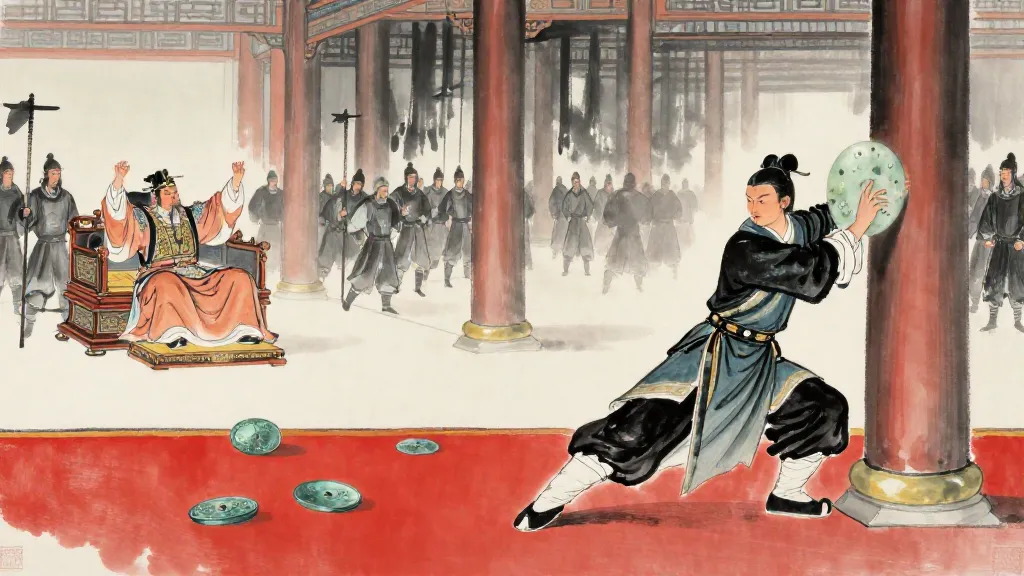
秦王坐章台見相如,相如奉璧奏秦王。秦王大喜,傳以示美人及左右,左右皆呼萬歲。相如視秦王無意償趙城,乃前曰:"璧有瑕,請指示王。"王授璧,相如因持璧卻立,倚柱,怒髮上沖冠,謂秦王曰:"大王欲得璧,使人發書至趙王,趙王悉召群臣議,皆曰'秦貪,負其彊,以空言求璧,償城恐不可得'。議不欲予秦璧。臣以為布衣之交尚不相欺,況大國乎!且以一璧之故逆彊秦之驩,不可。於是趙王乃齋戒五日,使臣奉璧,拜送書於庭。何者?嚴大國之威以修敬也。今臣至,大王見臣列觀,禮節甚倨;得璧,傳之美人,以戲弄臣。臣觀大王無意償趙王城邑,故臣復取璧。大王必欲急臣,臣頭今與璧俱碎於柱矣!"相如持其璧睨柱,欲以擊柱。秦王恐其破璧,乃辭謝固請,召有司案圖,指從此以往十五都予趙。相如度秦王特以詐詳為予趙城,實不可得,乃謂秦王曰:"和氏璧,天下所共傳寶也,趙王恐,不敢不獻。趙王送璧時,齋戒五日,今大王亦宜齋戒五日,設九賓於廷,臣乃敢上璧。"秦王度之,終不可彊奪,遂許齋五日,舍相如廣成傳。相如度秦王雖齋,決負約不償城,乃使其從者衣褐,懷其璧,從徑道亡,歸璧於趙。

秦王齋五日後,乃設九賓禮於廷,引趙使者藺相如。相如至,謂秦王曰:"秦自繆公以來二十餘君,未嘗有堅明約束者也。臣誠恐見欺於王而負趙,故令人持璧歸,間至趙矣。且秦彊而趙弱,大王遣一介之使至趙,趙立奉璧來。今以秦之彊而先割十五都予趙,趙豈敢留璧而得罪於大王乎?臣知欺大王之罪當誅,臣請就湯鑊,唯大王與群臣孰計議之。"秦王與群臣相視而嘻。左右或欲引相如去,秦王因曰:"今殺相如,終不能得璧也,而絕秦趙之驩,不如因而厚遇之,使歸趙,趙王豈以一璧之故欺秦邪!"卒廷見相如,畢禮而歸之。

相如既歸,趙王以為賢大夫使不辱於諸侯,拜相如為上大夫。秦亦不以城予趙,趙亦終不予秦璧。

Lian Po was a distinguished general of Zhao. In the sixteenth year of King Huiwen of Zhao, Lian Po led Zhao's forces against Qi, inflicted a major defeat, and captured Yangjin. He was appointed Senior Minister and became renowned among the states for his valor. Lin Xiangru was a man of Zhao who served as a retainer in the household of Miao Xian, the chief eunuch.

During the reign of King Huiwen, Zhao came into possession of the He Shi Bi — the jade disc of Master He, originally from Chu. King Zhao of Qin heard of this and sent a letter to the King of Zhao, offering to exchange fifteen cities for the jade.

The King of Zhao consulted with General Lian Po and his senior ministers. To give the jade to Qin risked getting nothing in return — being cheated outright. To refuse risked a Qin invasion. They could reach no decision and could find no one suitable to send as envoy to Qin.

The chief eunuch Miao Xian said: "My retainer Lin Xiangru would be suitable." The king asked how he knew. Miao Xian replied: "I once committed an offense and secretly planned to flee to Yan. Xiangru stopped me, saying: 'How do you know the King of Yan?' I said I had once accompanied Your Majesty to a border meeting with the King of Yan, and the Yan king had secretly clasped my hand and said he wished to be friends. Xiangru told me: 'Zhao is strong and Yan is weak. The King of Yan wished to befriend you only because you enjoy Zhao's king's favor. If you flee to Yan, Yan will fear Zhao and will not dare shelter you — they will bind you and send you back. You would do better to bare your shoulders, present yourself at the chopping block, and beg forgiveness. Then you may be pardoned.' I followed his advice, and Your Majesty pardoned me. I believe this man has both courage and wisdom — he is suitable for the mission."

The king summoned Lin Xiangru and asked: "The King of Qin offers fifteen cities for my jade. Should I agree?"

Xiangru said: "Qin is strong and Zhao is weak. You cannot refuse."

"But if he takes my jade and does not give the cities?"

"If Qin offers cities for the jade and Zhao refuses, Zhao is in the wrong. If Zhao gives the jade and Qin withholds the cities, Qin is in the wrong. Weighing both options, it is better to agree and put Qin in the wrong."

"Who can serve as envoy?"

"If Your Majesty has no one else, I am willing to take the jade as your envoy. If the cities come to Zhao, the jade stays in Qin. If the cities do not come, I will return the jade intact to Zhao."

The King of Zhao sent Lin Xiangru west with the jade.

The King of Qin received Xiangru at the Zhangtai Palace. Xiangru presented the jade. The King of Qin was delighted. He passed it to his consorts and attendants, and they all cried 'ten thousand years!' Xiangru saw that the King of Qin had no intention of honoring the exchange. He stepped forward and said: "There is a flaw in the jade. Allow me to point it out."

The king handed the jade back. Xiangru took it and stepped back to lean against a pillar. His hair bristled with rage beneath his cap. He said to the King of Qin:

"Your Majesty desired this jade and sent a letter to the King of Zhao. Zhao's king summoned all his ministers to deliberate. They all said: 'Qin is greedy. Relying on its strength, it demands the jade with empty promises — we will never see those cities.' They were prepared to refuse. But I argued that even common people do not cheat each other in their dealings — how much more should great states keep faith. Moreover, to offend mighty Qin over a single jade would be unwise. So the King of Zhao fasted for five days, sent me with the jade, and bowed to present his letter in the court. Why? To show respect for a great state's authority.

"Yet when I arrived, Your Majesty received me in a side gallery with casual ceremony. Upon getting the jade, you passed it to your women to toy with — mocking me. I saw that Your Majesty had no intention of giving Zhao the cities, so I took the jade back. If Your Majesty presses me, my head and this jade will shatter together against this pillar!"

Xiangru held the jade up, eyeing the pillar as if about to smash it. The King of Qin, fearing the jade would be destroyed, apologized profusely and begged him to stop. He summoned officials to consult maps and pointed out fifteen cities to be given to Zhao.

Xiangru judged this a feint — the king was merely pretending. He said: "The He Shi Bi is a treasure known to all the world. The King of Zhao was afraid and dared not refuse to present it. He fasted for five days before sending it. Your Majesty should also fast for five days and receive the jade in a formal ceremony with the Nine Guests protocol. Only then will I dare present it."

The King of Qin calculated that he could not take the jade by force, and agreed to fast for five days, lodging Xiangru at the Guangcheng guesthouse. Xiangru was certain the king would break his word. He had a servant dress in rough clothes, hide the jade inside his garments, and slip away by a back road to return the jade to Zhao.

After the five days of fasting, the King of Qin held a formal ceremony with the Nine Guests protocol and summoned the Zhao envoy Lin Xiangru.

Xiangru said: "From Duke Mu onward, Qin has had over twenty rulers, and not one has ever kept a firm agreement. I genuinely feared Your Majesty would cheat me and betray Zhao, so I sent the jade back. It has already reached Zhao by a secret route. Qin is strong and Zhao is weak. If Your Majesty sends a single envoy to Zhao, Zhao will deliver the jade immediately. But if mighty Qin first cedes the fifteen cities, would Zhao dare keep the jade and offend Your Majesty? I know that deceiving Your Majesty deserves death. I submit myself to the boiling cauldron. I ask only that Your Majesty and your ministers consider the matter carefully."

The King of Qin and his ministers looked at each other and laughed bitterly. Some attendants wanted to drag Xiangru away, but the king said: "If we kill Xiangru now, we will never get the jade, and we will destroy all goodwill between Qin and Zhao. Better to treat him generously and send him home. Would the King of Zhao really cheat Qin over a single jade?" He received Xiangru with full ceremony and sent him back.

When Xiangru returned, the King of Zhao considered him a worthy minister who had not disgraced Zhao before the other states, and appointed him Senior Grand Master. Qin did not give the cities to Zhao. Zhao did not give the jade to Qin.

Notes

1context

The He Shi Bi (和氏璧) was a legendary jade disc, said to have been discovered in a rock by Bian He (卞和) of Chu. Its story — in which Bian He had both feet cut off by two successive Chu kings who refused to believe his rock contained jade — is told in the Hanfeizi. By the Warring States period it had become the most famous treasure in the world. It was later said to have been carved into the Imperial Seal (傳國玉璽) of the Qin and Han dynasties.

2person趙惠文王Zhào Huì Wén Wáng

King Huiwen of Zhao (趙惠文王, r. 298–266 BC) was a capable ruler who maintained Zhao as a major military power despite its increasingly precarious position between Qin and the eastern states.

3person秦昭襄王Qín Zhāo Xiāng Wáng

King Zhao of Qin (秦昭襄王, r. 306–251 BC) was the same ruler under whom Bai Qi served. His demand for the jade was a test of Zhao's resolve — the fifteen cities were never seriously offered.

4context

The idiom 完璧歸趙 ('returning the jade intact to Zhao') derives from this episode and means to return something to its rightful owner undamaged. Lin Xiangru's feat established him as the exemplar of courage in diplomacy — achieving through nerve and wit what armies could not.

5context

The Nine Guests (九賓) ceremony was the most formal diplomatic protocol, reserved for receiving envoys of the highest rank. By demanding it, Xiangru was both stalling for time and forcing Qin to treat Zhao as an equal.

6context

The phrase 怒髮上沖冠 ('his hair bristled with rage beneath his cap') became one of the most famous descriptions of fury in Chinese literature. It was later quoted by Yue Fei in his poem 滿江紅.

澠池之會

The Meeting at Mianchi

其後秦伐趙,拔石城。明年,復攻趙,殺二萬人。

秦王使使者告趙王,欲與王為好會於西河外澠池。趙王畏秦,欲毋行。廉頗、藺相如計曰:"王不行,示趙弱且怯也。"趙王遂行,相如從。廉頗送至境,與王訣曰:"王行,度道里會遇之禮畢,還,不過三十日。三十日不還,則請立太子為王。以絕秦望。"王許之,遂與秦王會澠池。秦王飲酒酣,曰:"寡人竊聞趙王好音,請奏瑟。"趙王鼓瑟。秦御史前書曰"某年月日,秦王與趙王會飲,令趙王鼓瑟"。藺相如前曰:"趙王竊聞秦王善為秦聲,請奏盆鮓秦王,以相娛樂。"秦王怒,不許。於是相如前進鮓,因跪請秦王。秦王不肯擊鮓。相如曰:"五步之內,相如請得以頸血濺大王矣!"左右欲刃相如,相如張目叱之,左右皆靡。於是秦王不懌,為一擊鮓。相如顧召趙御史書曰"某年月日,秦王為趙王擊鮓"。秦之群臣曰:"請以趙十五城為秦王壽"。藺相如亦曰:"請以秦之鹹陽為趙王壽。"秦王竟酒,終不能加勝於趙。趙亦盛設兵以待秦,秦不敢動。

Afterward, Qin attacked Zhao and took Shicheng. The following year, Qin attacked again and killed twenty thousand.

The King of Qin sent envoys to the King of Zhao, proposing a friendly meeting at Mianchi, west of the Yellow River. The King of Zhao feared Qin and wanted to decline. Lian Po and Lin Xiangru counseled: "If Your Majesty does not go, it will show Zhao to be weak and cowardly."

The King of Zhao went, with Xiangru attending him. Lian Po escorted the king to the border and took his leave, saying: "Counting the distance and the time needed for the ceremonies, Your Majesty should return within thirty days. If you have not returned in thirty days, I request permission to enthrone the Crown Prince as king — to cut off any hope Qin might have of holding you hostage." The king agreed.

At the Mianchi meeting, the King of Qin was deep in his cups when he said: "I hear the King of Zhao is fond of music. Please play the se for us."

The King of Zhao played the se. The Qin recorder stepped forward and wrote: "On such-and-such a date, the King of Qin drank with the King of Zhao and commanded the King of Zhao to play the se."

Lin Xiangru stepped forward: "The King of Zhao hears that the King of Qin excels at Qin-style music. Please strike the fou for the King of Zhao, so we may entertain each other."

The King of Qin was furious and refused. Xiangru advanced, knelt, and offered the fou to the King of Qin. The king would not strike it.

Xiangru said: "Within five paces, I can spatter Your Majesty with the blood from my neck!"

The attendants moved to kill Xiangru. Xiangru opened his eyes wide and roared at them. They all shrank back. The King of Qin, displeased, struck the fou once.

Xiangru turned and summoned the Zhao recorder to write: "On such-and-such a date, the King of Qin struck the fou for the King of Zhao."

Qin's ministers said: "We request that the King of Zhao offer fifteen of Zhao's cities as a toast to the King of Qin."

Xiangru replied: "We request that Qin's capital Xianyang be offered as a toast to the King of Zhao."

The banquet ended. Qin was unable to gain any advantage over Zhao. Zhao had also deployed its army in strength to await Qin, and Qin did not dare make a move.

Notes

1place

Mianchi (澠池) was in modern Mianchi County, Henan, on the south bank of the Yellow River. It was a common meeting point between Qin and the eastern states because it lay near the border.

2context

The se (瑟) was a large stringed zither, an instrument of refinement. The fou (缶/鮓) was a clay pot used as a percussion instrument — far less dignified. The King of Qin's demand that the King of Zhao play was a deliberate humiliation: the recorder's note framed Zhao's king as Qin's subordinate, 'commanded' to perform. Xiangru's counter-move was brilliant: by forcing the King of Qin to strike an even less dignified instrument 'for' the King of Zhao, he reversed the humiliation.

3context

Lian Po's contingency plan — to enthrone the Crown Prince if the king was held hostage — shows his strategic thinking extended beyond the battlefield. By removing Qin's leverage (the king's person), he made the meeting safer for Zhao. This detail also foreshadows the theme of the general and the diplomat working as complementary halves of Zhao's defense.

4context

The exchange of 'toasts' (壽) escalated into a contest of diplomatic brinkmanship. Qin's demand for fifteen cities was a transparent extortion attempt. Xiangru's counter-demand for Xianyang — Qin's own capital — was absurd in military terms but diplomatically perfect: it showed that Zhao would match any escalation, making the game not worth playing.

將相和:負荊請罪

The Reconciliation of General and Minister: Bearing Thorns to Apologize

既罷歸國,以相如功大,拜為上卿,位在廉頗之右。廉頗曰:"我為趙將,有攻城野戰之大功,而藺相如徒以口舌為勞,而位居我上,且相如素賤人,吾羞,不忍為之下。"宣言曰:"我見相如,必辱之。"相如聞,不肯與會。相如每朝時,常稱病,不欲與廉頗爭列。已而相如出,望見廉頗,相如引車避匿。於是舍人相與諫曰:"臣所以去親戚而事君者,徒慕君之高義也。今君與廉頗同列,廉君宣惡言而君畏匿之,恐懼殊甚,且庸人尚羞之,況於將相乎!臣等不肖,請辭去。"藺相如固止之,曰:"公之視廉將軍孰與秦王?"曰:"不若也。"相如曰:"夫以秦王之威,而相如廷叱之,辱其群臣,相如雖駑,獨畏廉將軍哉?顧吾念之,彊秦之所以不敢加兵於趙者,徒以吾兩人在也。今兩虎共鬥,其勢不俱生。吾所以為此者,以先國家之急而後私讎也。"廉頗聞之,肉袒負荊,因賓客至藺相如門謝罪。曰:"鄙賤之人,不知將軍寬之至此也。"卒相與驩,為刎頸之交。

After they returned home, the king elevated Lin Xiangru for his great service and appointed him Senior Minister, ranked above Lian Po.

Lian Po said: "I am Zhao's general. I have won glory in siege warfare and pitched battles. Lin Xiangru has achieved nothing but clever talk, yet he is placed above me. Besides, Xiangru is a man of low birth. I am ashamed and refuse to serve beneath him." He declared openly: "When I see Xiangru, I will humiliate him."

Xiangru heard this and avoided all encounters. At every court audience he pleaded illness to avoid standing in rank with Lian Po. Whenever he went out and spotted Lian Po's carriage in the distance, he would turn his own carriage aside and hide.

His retainers confronted him: "We left our families to serve you because we admired your sense of honor. Now you share equal rank with Lian Po, and when he publicly insults you, you hide and cower. Even an ordinary man would be ashamed of this — how much more so a general and a minister! We are unworthy servants. We wish to resign."

Lin Xiangru firmly stopped them. He said: "How does General Lian compare with the King of Qin?"

"He does not compare."

"I faced the King of Qin in his own court, berated him, and humiliated his ministers. Dull as I may be, would I fear General Lian? But consider this: the reason mighty Qin does not dare attack Zhao is solely because the two of us are here. If two tigers fight, they cannot both survive. I act as I do because I put the nation's crisis before my private grudge."

When Lian Po heard this, he bared his shoulders, bound thorn branches to his back, and went with attendants to Lin Xiangru's gate to beg forgiveness.

He said: "This coarse and petty man did not know that your generosity reached so far."

They became the deepest of friends — friends who would die for each other.

Notes

1context

The idiom 負荊請罪 ('bearing thorns to apologize') derives directly from this passage. It means to humble oneself completely and admit wrongdoing. The thorn branches symbolize the punishment Lian Po believed he deserved. This episode is among the most frequently taught texts in Chinese schools.

2context

The phrase 將相和 ('the general and the minister reconcile') became the title of a famous Beijing opera based on this episode. Lin Xiangru's reasoning — that internal conflict between Zhao's two strongest figures would invite Qin's aggression — established an enduring political principle: the state's interest must override personal honor.

3context

The term 刎頸之交 ('friends who would cut their own throats for each other') entered the language from this passage. It describes the highest form of loyalty between equals — a bond so strong that each would die for the other.

4context

Lian Po's initial contempt — calling Xiangru a man of low birth who succeeded merely through 'clever talk' (口舌之勞) — reflects the aristocratic military culture's disdain for diplomacy. Xiangru's response reframes the issue: it is not about who is braver, but about what Zhao needs. His willingness to appear weak to preserve national strength is itself a form of courage.

趙奢破秦於閼與

Zhao She Defeats Qin at Eyu

是歲,廉頗東攻齊,破其一軍。居二年,廉頗復伐齊幾,拔之。後三年,廉頗攻魏之防陵、安陽,拔之。後四年,藺相如將而攻齊,至平邑而罷。其明年,趙奢破秦軍閼與下。

趙奢者,趙之田部吏也。收租稅而平原君家不肯出租,奢以法治之,殺平原君用事者九人。平原君怒,將殺奢。奢因說曰:"君於趙為貴公子,今縱君家而不奉公則法削,法削則國弱,國弱則諸侯加兵,諸侯加兵是無趙也,君安得有此富乎?以君之貴,奉公如法則上下平,上下平則國彊,國彊則趙固,而君為貴戚,豈輕於天下邪?"平原君以為賢,言之於王。王用之治國賦,國賦大平,民富而府庫實。

秦伐韓,軍於閼與。王召廉頗而問曰:"可救不?"對曰:"道遠險狹,難救。"又召樂乘而問焉,樂乘對如廉頗言。又召問趙奢,奢對曰:"其道遠險狹,譬之猶兩鼠斗於穴中,將勇者勝。"王乃令趙奢將,救之。

兵去邯鄲三十里,而令軍中曰:"有以軍事諫者死。"秦軍軍武安西,秦軍鼓譟勒兵,武安屋瓦盡振。軍中候有一人言急救武安,趙奢立斬之。堅壁,留二十八日不行,復益增壘。秦間來入,趙奢善食而遣之。間以報秦將,秦將大喜曰:"夫去國三十里而軍不行,乃增壘,閼與非趙地也。"趙奢既已遣秦間,卷甲而趨之,二日一夜至,今善射者去閼與五十里而軍。軍壘成,秦人聞之,悉甲而至。軍士許歷請以軍事諫,趙奢曰:"內之。"許歷曰:"秦人不意趙師至此,其來氣盛,將軍必厚集其陣以待之。不然,必敗。"趙奢曰:"請受令。"許歷曰:"請就鈇質之誅。"趙奢曰:"胥後令邯鄲。"許歷復請諫,曰:"先據北山上者勝,後至者敗。"趙奢許諾,即發萬人趨之。秦兵後至,爭山不得上,趙奢縱兵擊之,大破秦軍。秦軍解而走,遂解閼與之圍而歸。

趙惠文王賜奢號為馬服君,以許歷為國尉。趙奢於是與廉頗、藺相如同位。

That year, Lian Po attacked Qi to the east and destroyed one of its armies. Two years later, he attacked Qi's city of Ji and took it. Three years after that, he attacked Wei's cities of Fangling and Anyang and took them. Four years later, Lin Xiangru led a campaign against Qi, reaching Pingyi before withdrawing. The following year, Zhao She defeated a Qin army below Eyu.

Zhao She was a tax official in Zhao's agricultural department. When he was collecting taxes, the household of Lord Pingyuan refused to pay. Zhao She enforced the law and executed nine of Lord Pingyuan's stewards. Lord Pingyuan was furious and was about to have Zhao She killed.

Zhao She said: "My lord, you are Zhao's most honored prince. If your household flouts the law, the law weakens. If the law weakens, the state weakens. If the state weakens, the other states will attack. If the other states attack, there will be no Zhao — and how then would you keep your wealth? But if someone of your eminence obeys the law, then high and low are in balance. If high and low are in balance, the state is strong. If the state is strong, Zhao is secure. And as a royal kinsman, would you then count for less in the world?"

Lord Pingyuan recognized his worth and recommended him to the king. The king put him in charge of national revenues. Revenue collection became orderly, the people grew prosperous, and the treasury filled.

Qin attacked Han and positioned its army at Eyu. The king summoned Lian Po and asked: "Can we rescue it?" Lian Po replied: "The road is long, dangerous, and narrow. It would be difficult." He summoned Yue Cheng and asked the same; Yue Cheng agreed with Lian Po.

He then asked Zhao She, who said: "The road is long, dangerous, and narrow — it is like two rats fighting in a hole. The braver commander will win." The king appointed Zhao She to lead the relief force.

Thirty li from Handan, Zhao She halted and issued an order: "Anyone who offers advice on military matters will be executed." Qin's army was positioned west of Wu'an. The Qin troops beat their drums and shouted battle cries so loudly that the roof tiles of Wu'an shook. A scout in Zhao She's army urged an immediate rescue of Wu'an. Zhao She had him executed on the spot.

He fortified his position and remained stationary for twenty-eight days, adding more ramparts. A Qin spy infiltrated the camp; Zhao She fed him well and sent him back. The spy reported to the Qin commander, who was delighted: "He stopped thirty li from his own capital and will not advance — he is just building more walls. Eyu will not be Zhao's."

Once the spy was gone, Zhao She rolled up his armor and marched at speed, arriving in a day and two nights. He positioned his best archers fifty li from Eyu and built fortifications. When the Qin forces learned of his arrival, they mustered their full strength and came.

A soldier named Xu Li requested permission to offer military advice. Zhao She said: "Let him in."

Xu Li said: "The Qin forces do not expect Zhao's army to be here. They will come with fierce momentum. You must concentrate your formation in depth to receive them, or you will be defeated."

Zhao She said: "I accept your advice."

Xu Li said: "I submit myself to the executioner's blade."

Zhao She said: "Wait until we are back in Handan for that."

Xu Li pressed further: "Whoever seizes the northern hill first will win. Whoever arrives second will lose."

Zhao She agreed and immediately sent ten thousand men racing for the hill. The Qin forces arrived second and could not take the high ground. Zhao She unleashed his full army and routed the Qin forces. The Qin army broke and fled. The siege of Eyu was lifted.

King Huiwen of Zhao bestowed on Zhao She the title Lord of Mafu, and appointed Xu Li as National Commandant. From then on, Zhao She stood equal in rank with Lian Po and Lin Xiangru.

Notes

1place

Eyu (閼與) was a fortress in modern Heshun County, Shanxi, in mountainous terrain where narrow defiles negated Qin's numerical advantage.

2person趙奢Zhào Shē

Zhao She (趙奢) rose from tax collector to great general. His title Lord of Mafu (馬服君) gave the surname 'Ma' to his descendants — the famous Ma clan of later Chinese history. His son Zhao Kuo, who inherited none of his father's practical judgment, would lose the Battle of Changping.

3context

Zhao She's 'two rats in a hole' metaphor is a masterpiece of strategic argument. Lian Po and Yue Cheng focused on the terrain — long, narrow, dangerous — and concluded the mission was impossible. Zhao She agreed about the terrain but drew the opposite conclusion: precisely because the ground was constricted, the outcome would depend on command courage rather than force ratios. This reframing turned a disadvantage into a neutral factor.

4context

Zhao She's deception — halting, building walls, feeding the spy well — is a textbook application of Sun Tzu's principle that 'all warfare is deception.' By appearing passive, he lulled the Qin commander into complacency. His sudden forced march reversed the entire strategic situation.

5context

The incident with Xu Li reveals Zhao She's command philosophy. He issued a death penalty for unsolicited advice to maintain absolute discipline, but was wise enough to listen when a soldier had genuinely critical intelligence. Xu Li's willingness to risk execution to share his assessment — and Zhao She's willingness to accept it — won the battle.

趙括代將與長平之敗

Zhao Kuo Takes Command and the Defeat at Changping

後四年,趙惠文王卒,子孝成王立。七年,秦與趙兵相距長平,時趙奢已死,而藺相如病篤,趙使廉頗將攻秦,秦數敗趙軍,趙軍固壁不戰。秦數挑戰,廉頗不肯。趙王信秦之間。秦之間言曰:"秦之所惡,獨畏馬服君趙奢之子趙括為將耳。"趙王因以括為將,代廉頗。藺相如曰:"王以名使括,若膠柱而鼓瑟耳。括徒能讀其父書傳,不知合變也。"趙王不聽,遂將之。

趙括自少時學兵法,言兵事,以天下莫能當。嘗與其父奢言兵事,奢不能難,然不謂善。括母問奢其故,奢曰:"兵,死地也,而括易言之。使趙不將括即已,若必將之,破趙軍者必括也。"及括將行,其母上書言於王曰:"括不可使將。"王曰:"何以?"對曰:"始妾事其父,時為將,身所奉飯飲而進食者以十數,所友者以百數,大王及宗室所賞賜者盡以予軍吏士大夫,受命之日,不問家事。今括一旦為將,東向而朝,軍吏無敢仰視之者,王所賜金帛,歸藏於家,而日視便利田宅可買者買之。王以為何如其父?父子異心,原王勿遣。"王曰:"母置之,吾已決矣。"括母因曰:"王終遣之,即有如不稱,妾得無隨坐乎?"王許諾。

趙括既代廉頗,悉更約束,易置軍吏。秦將白起聞之,縱奇兵,詳敗走,而絕其糧道,分斷其軍為二,士卒離心。四十餘日,軍餓,趙括出銳卒自博戰,秦軍射殺趙括。括軍敗,數十萬之眾遂降秦,秦悉阬之。趙前後所亡凡四十五萬。明年,秦兵遂圍邯鄲,歲餘,幾不得脫。賴楚、魏諸侯來救,乃得解邯鄲之圍。趙王亦以括母先言,竟不誅也。

Four years later, King Huiwen of Zhao died and his son King Xiaocheng succeeded him. In the seventh year of the new reign, Qin and Zhao confronted each other at Changping. Zhao She had already died and Lin Xiangru was gravely ill. Zhao sent Lian Po to command against Qin.

Qin defeated Zhao's forces several times. Lian Po fortified his position and refused to engage. Qin challenged him repeatedly; he would not come out. The King of Zhao believed Qin's planted disinformation. Qin's agents spread the rumor: "The only man Qin fears as Zhao's commander is Zhao Kuo, son of Lord Mafu."

The king replaced Lian Po with Zhao Kuo. Lin Xiangru said: "Your Majesty appoints Kuo on the strength of his reputation — it is like gluing down the bridge-pegs of a se and trying to play it. Kuo can only recite his father's writings. He does not understand how to adapt to real conditions." The king would not listen.

From youth, Zhao Kuo had studied military theory and debated warfare, claiming no one in the world could match him. He had once discussed strategy with his father. Zhao She could not refute his arguments, yet would not praise him.

Zhao Kuo's mother asked Zhao She why. He said: "War is a matter of life and death, and Kuo treats it lightly. If Zhao does not appoint him as general, so be it. But if it does, the one who destroys Zhao's army will be Kuo."

When Zhao Kuo was about to depart, his mother petitioned the king: "Kuo must not be made general."

"Why not?"

"When I served his father as his wife, your father was general. He personally served food and drink to dozens of men. He considered hundreds his friends. Everything Your Majesty and the royal house bestowed on him, he gave away to his officers and soldiers. From the day he received his commission, he never asked about household affairs.

"Now Kuo has been general for one day, and he holds audience facing east while none of his officers dare look up at him. The gold and silk Your Majesty has given him, he takes home and stores. Every day he looks for bargain farmland and houses to buy. Does Your Majesty think he is like his father? Father and son have different hearts. I beg you not to send him."

The king said: "Madam, let it rest. My mind is made up."

The mother said: "If Your Majesty sends him and he fails, may I at least be spared from sharing his punishment?" The king agreed.

When Zhao Kuo replaced Lian Po, he immediately changed all the standing orders and replaced the officers. The Qin commander Bai Qi heard this and released surprise forces, feigned retreat, and cut Zhao's supply lines, splitting their army in two. The soldiers lost heart.

For over forty days the army starved. Zhao Kuo led his best troops in a desperate charge. Qin archers killed him. His army collapsed. Hundreds of thousands surrendered to Qin. Qin buried them all alive. Zhao's total losses, front and rear, amounted to 450,000.

The following year, Qin besieged Handan. For over a year, Zhao nearly fell. Only relief forces from Chu, Wei, and the other states saved the capital.

The King of Zhao, remembering Zhao Kuo's mother's earlier warning, did not punish her.

Notes

1context

Lin Xiangru's metaphor — 膠柱鼓瑟 ('gluing the bridge-pegs and playing the se') — means to apply rigid theory without adapting to circumstances. If the pegs are fixed, the instrument cannot be tuned. It became an idiom for rigid, doctrinaire thinking.

2context

Zhao She's assessment of his own son is one of the most psychologically acute passages in the Shiji. He does not say Kuo is unintelligent — he cannot even refute the young man's arguments. The problem is not knowledge but character: Kuo treats warfare as an intellectual exercise rather than a grave responsibility involving the lives of hundreds of thousands.

3context

The mother's petition establishes the contrast between father and son through concrete details: Zhao She gave away his rewards and ate with his soldiers; Zhao Kuo hoards gifts and buys real estate. The portrait anticipates Wang Jian's strategy in ch. 73 — Wang Jian requested estates precisely to appear harmless, whereas Zhao Kuo's greed was genuine and revealed his unfitness.

4context

The idiom 紙上談兵 ('discussing war on paper'), though not in the original text, derives from Zhao Kuo's story. It describes someone who can theorize brilliantly but fails in practice — one of the most commonly invoked warnings in Chinese political culture.

5context

This is the same Battle of Changping (260 BC) narrated from Bai Qi's perspective in Shiji ch. 73. The ch. 81 account emphasizes Zhao's side: the political failures that led to Lian Po's replacement, the warnings that went unheeded, and the mother's foresight. Together the two chapters form a complete picture of the catastrophe.

廉頗晚年

Lian Po's Later Years

自邯鄲圍解五年,而燕用栗腹之謀,曰"趙壯者盡於長平,其孤未壯",舉兵擊趙。趙使廉頗將,擊,大破燕軍於鄗,殺栗腹,遂圍燕。燕割五城請和,乃聽之。趙以尉文封廉頗為信平君,為假相國。

廉頗之免長平歸也,失勢之時,故客盡去。及復用為將,客又復至。廉頗曰:"客退矣!"客曰:"吁!君何見之晚也?夫天下以市道交,君有勢,我則從君,君無勢則去,此固其理也,有何怨乎?"居六年,趙使廉頗伐魏之繁陽,拔之。

趙孝成王卒,子悼襄王立,使樂乘代廉頗。廉頗怒,攻樂乘,樂乘走。廉頗遂奔魏之大梁。其明年,趙乃以李牧為將而攻燕,拔武遂、方城。

廉頗居梁久之,魏不能信用。趙以數困於秦兵,趙王思復得廉頗,廉頗亦思復用於趙。趙王使使者視廉頗尚可用否。廉頗之仇郭開多與使者金,令毀之。趙使者既見廉頗,廉頗為之一飯斗米,肉十斤,被甲上馬,以示尚可用。趙使還報王曰:"廉將軍雖老,尚善飯,然與臣坐,頃之三遺矢矣。"趙王以為老,遂不召。

楚聞廉頗在魏,陰使人迎之。廉頗一為楚將,無功,曰:"我思用趙人。"廉頗卒死於壽春。

Five years after the siege of Handan was lifted, Yan adopted the plan of Li Fu, who argued: "Zhao's fighting men all perished at Changping, and the orphans have not yet grown up." Yan raised its army and attacked Zhao.

Zhao sent Lian Po to command. He crushed Yan's army at Hao, killed Li Fu, and besieged the Yan capital. Yan ceded five cities to buy peace. Zhao then sealed Lian Po as Lord Xinping at Wei Wen, with the title of Acting Chancellor.

When Lian Po had been dismissed after Changping and lost his position, all his retainers left him. When he was restored to command, they all returned. Lian Po said: "Leave, all of you!"

The retainers said: "Sir, how slow you are to understand! The world deals in the way of the market. When you have power, we follow you. When you have none, we leave. This is simply how it works. What is there to resent?"

Six years later, Zhao sent Lian Po to attack Wei's city of Fanyang, and he took it.

King Xiaocheng of Zhao died and was succeeded by King Daoxiang, who sent Yue Cheng to replace Lian Po. Lian Po was furious and attacked Yue Cheng, who fled. Lian Po then fled to Wei's capital Daliang.

The following year, Zhao appointed Li Mu as general. He attacked Yan and captured Wusui and Fangcheng.

Lian Po lived in Daliang for a long time, but Wei would not entrust him with responsibility. Zhao, hard-pressed by Qin's armies, thought about recalling Lian Po. Lian Po too wished to serve Zhao again.

The King of Zhao sent an envoy to assess whether Lian Po was still fit for service. Lian Po's enemy Guo Kai bribed the envoy heavily and instructed him to deliver a damaging report.

When the envoy met Lian Po, the old general ate a peck of rice and ten jin of meat at a single meal, then donned his armor and mounted his horse to demonstrate that he was still capable.

The envoy returned and reported: "General Lian, though old, still eats heartily. But while sitting with me, he had to relieve himself three times."

The King of Zhao concluded that Lian Po was too old, and did not recall him.

Chu heard that Lian Po was in Wei and secretly sent men to bring him south. Lian Po served one term as a Chu general but achieved nothing. He said: "I long to command Zhao's soldiers."

Lian Po died in Shouchun.

Notes

1context

The retainers' speech — 'the world deals in the way of the market' (天下以市道交) — is one of the Shiji's most brutally honest observations about political life. It articulates what modern political science calls transactional loyalty: people attach themselves to power, not to persons. Lian Po's outrage shows he expected something more; the retainers' response shows that such expectations are naive.

2person郭開Guō Kāi

Guo Kai (郭開) was a favored courtier of Zhao who later also played a role in the destruction of Li Mu. He bribed the envoy to report that Lian Po was incontinent — a small act of personal malice that cost Zhao its greatest living general.

3context

Lian Po's demonstration — eating enormous quantities and mounting a warhorse in full armor — and the envoy's damning detail about incontinence create one of the Shiji's most poignant scenes. The old general did everything in his power to prove his fitness, only to be undone by a bribed messenger's single devastating lie. His final words — 'I long to command Zhao's soldiers' — express both patriotism and the tragedy of exile.

4place

Shouchun (壽春) was the late Chu capital, in modern Shou County, Anhui. That Lian Po died in Chu rather than Zhao underlines the waste of his final years.

5place

Daliang (大梁) was the Wei capital, in modern Kaifeng, Henan. It was one of the great cities of the Warring States period.

李牧破匈奴

Li Mu Defeats the Xiongnu

李牧者,趙之北邊良將也。常居代雁門,備匈奴。以便宜置吏,市租皆輸入莫府,為士卒費。日擊數牛饗士,習射騎,謹烽火,多間諜,厚遇戰士。為約曰:"匈奴即入盜,急入收保,有敢捕虜者斬。"匈奴每入,烽火謹,輒入收保,不敢戰。如是數歲,亦不亡失。然匈奴以李牧為怯,雖趙邊兵亦以為吾將怯。趙王讓李牧,李牧如故。趙王怒,召之,使他人代將。

歲餘,匈奴每來,出戰。出戰,數不利,失亡多,邊不得田畜。復請李牧。牧杜門不出,固稱疾。趙王乃復彊起使將兵。牧曰:"王必用臣,臣如前,乃敢奉令。"王許之。

李牧至,如故約。匈奴數歲無所得。終以為怯。邊士日得賞賜而不用,皆原一戰。於是乃具選車得千三百乘,選騎得萬三千匹,百金之士五萬人,彀者十萬人,悉勒習戰。大縱畜牧,人民滿野。匈奴小入,詳北不勝,以數千人委之。單于聞之,大率眾來入。李牧多為奇陳,張左右翼擊之,大破殺匈奴十餘萬騎。滅襜襤,破東胡,降林胡,單于奔走。其後十餘歲,匈奴不敢近趙邊城。

Li Mu was a distinguished general of Zhao's northern frontier. He was permanently stationed at Dai and Yanmen to defend against the Xiongnu. He appointed officers at his own discretion, and all market taxes went directly into his military treasury to fund his soldiers. Every day he slaughtered several oxen to feast the troops. He drilled them in archery and horsemanship, maintained strict beacon-fire signals, deployed numerous spies, and treated his warriors generously.

He issued standing orders: "When the Xiongnu raid, retreat immediately into the fortifications. Anyone who tries to engage or capture prisoners will be executed."

Whenever the Xiongnu came, the beacon fires were lit, the troops withdrew into their forts, and they did not fight. This went on for several years without a single loss. But the Xiongnu concluded that Li Mu was a coward. Even Zhao's own border troops thought their commander was timid.

The King of Zhao rebuked Li Mu. Li Mu continued as before. The king grew angry, recalled him, and appointed a replacement.

For over a year, whenever the Xiongnu raided, the new commander went out to fight. He suffered repeated defeats with heavy losses. The border population could no longer farm or raise livestock. The king asked Li Mu to return. Li Mu shut his doors, refused to come out, and declared himself ill.

The king forced him to accept command. Li Mu said: "If Your Majesty insists on using me, I must be allowed to follow my previous methods." The king agreed.

Li Mu returned and restored his old policies. For several years the Xiongnu gained nothing. They continued to regard him as a coward.

But Li Mu's border soldiers, who had received daily rewards without being used, were now eager to fight. Li Mu selected 1,300 war chariots, 13,000 cavalry horses, 50,000 soldiers who had earned the Hundred-Gold distinction, and 100,000 archers. He drilled them all intensively.

Then he released vast herds of livestock and let the people spread across the open fields. When a small Xiongnu raiding party came, he feigned defeat and abandoned several thousand men to them. The Chanyu heard the news and invaded in full force.

Li Mu deployed his army in elaborate formations, extending both wings to envelop the enemy, and struck. He annihilated over 100,000 Xiongnu cavalry. He destroyed the Zhanlan, broke the Donghu, and forced the Linhu to submit. The Chanyu fled.

For more than ten years afterward, the Xiongnu did not dare approach Zhao's border cities.

Notes

1person李牧Lǐ Mù

Li Mu (李牧, d. 229 BC) is considered one of the four greatest generals of the Warring States period alongside Bai Qi, Wang Jian, and Lian Po. He was equally effective against the Xiongnu nomads in the north and the Qin armies in the south — a rare versatility.

2place

Dai (代) and Yanmen (雁門) were Zhao's northern frontier commanderies, in modern northern Shanxi. Yanmen Pass ('Gate of the Wild Geese') was one of the most important passes in the Great Wall line.

3context

Li Mu's strategy against the Xiongnu is remarkably similar to Wang Jian's strategy against Chu (ch. 73): prolonged defensive patience to build up the troops' morale and readiness, followed by a single decisive engagement. Both generals endured accusations of cowardice — from their own side — before proving that patience was the key to annihilation.

4context

The Xiongnu (匈奴) were the dominant nomadic confederation on China's northern steppe. Li Mu's victory — the first major Chinese defeat of the Xiongnu in recorded history — prefigured the later campaigns of the Han dynasty generals Wei Qing and Huo Qubing by over a century.

5context

The Zhanlan (襜襤), Donghu (東胡, 'Eastern Hu'), and Linhu (林胡, 'Forest Hu') were nomadic peoples neighboring or allied with the Xiongnu. Their destruction or submission in a single campaign indicates the scale of Li Mu's victory.

李牧抗秦與趙之亡

Li Mu Resists Qin and the Fall of Zhao

趙悼襄王元年,廉頗既亡入魏,趙使李牧攻燕,拔武遂、方城。居二年,龐暖破燕軍,殺劇辛。後七年,秦破殺趙將扈輒於武遂,斬首十萬。趙乃以李牧為大將軍,擊秦軍於宜安,大破秦軍,走秦將桓齮。封李牧為武安君。居三年,秦攻番吾,李牧擊破秦軍,南距韓、魏。

趙王遷七年,秦使王翦攻趙,趙使李牧、司馬尚御之。秦多與趙王寵臣郭開金,為反間,言李牧、司馬尚欲反。趙王乃使趙蔥及齊將顏聚代李牧。李牧不受命,趙使人微捕得李牧,斬之。廢司馬尚。後三月,王翦因急擊趙,大破殺趙蔥,虜趙王遷及其將顏聚,遂滅趙。

In the first year of King Daoxiang, Lian Po had fled to Wei. Zhao sent Li Mu to attack Yan, and he captured Wusui and Fangcheng. Two years later, Pang Nuan defeated the Yan army and killed Ju Xin.

Seven years after that, Qin defeated and killed the Zhao general Hu Zhe at Wusui, taking 100,000 heads. Zhao appointed Li Mu as Grand General. He engaged the Qin army at Yi'an, inflicted a devastating defeat, and routed the Qin general Huan Yi. Li Mu was enfeoffed as Lord of Wu'an.

Three years later, Qin attacked Fanwu. Li Mu defeated the Qin army again and also held the line against Han and Wei to the south.

In the seventh year of King Qian of Zhao, Qin sent Wang Jian to attack Zhao. Zhao sent Li Mu and Sima Shang to resist. Qin lavished gold on Zhao's court favorite Guo Kai and planted false intelligence that Li Mu and Sima Shang were planning to rebel.

The King of Zhao replaced Li Mu with Zhao Cong and the Qi general Yan Ju. Li Mu refused to accept his dismissal. Zhao sent agents who seized him in secret and executed him. Sima Shang was dismissed.

Three months later, Wang Jian launched a full assault. He destroyed Zhao Cong's army, captured King Qian and the general Yan Ju, and extinguished the state of Zhao.

Notes

1context

Li Mu is the only general in the Shiji who also receives the title Lord of Wu'an (武安君) — the same title Bai Qi held. The parallel is deliberate: both were supreme military geniuses destroyed not by their enemies but by their own courts.

2person郭開Guō Kāi

Guo Kai (郭開) is the same courtier who sabotaged Lian Po's recall. His role in Li Mu's execution makes him responsible for removing the only two generals who could have saved Zhao. Sima Qian's implicit judgment is that Zhao was destroyed not by Qin's military superiority but by its own corrupt court politics.

3person王翦Wáng Jiǎn

Wang Jian (王翦), the Qin general whose biography forms the second half of ch. 73, understood that Li Mu could not be defeated on the battlefield. The decision to use gold and disinformation against Zhao's court — rather than direct military force — was the decisive strategy.

4context

The pattern is devastatingly consistent across both chapters 73 and 81: Bai Qi was destroyed by Fan Sui's jealousy; Lian Po was sidelined by Guo Kai's bribes; Li Mu was executed by Guo Kai's lies. In every case, the most capable military commander was undone by court intrigue rather than battlefield defeat. This is arguably the central theme of both biographies.

太史公論贊

The Grand Historian's Appraisal

太史公曰:知死必勇,非死者難也,處死者難。方藺相如引璧睨柱,及叱秦王左右,勢不過誅,然士或怯懦而不敢發。相如一奮其氣,威信敵國,退而讓頗,名重太山,其處智勇,可謂兼之矣!

The Grand Historian remarks: To know that death awaits and still act bravely — this is not because dying is hard, but because deciding how to face death is hard. When Lin Xiangru held up the jade and eyed the pillar, when he roared at the King of Qin's attendants — the worst that could have happened was his execution. Yet many a man would have been too timid to act.

Xiangru summoned his courage in one great burst, awed and earned the respect of an enemy state, then withdrew and yielded to Lian Po. His reputation outweighed Mount Tai. In the way he handled both wisdom and courage, he may truly be called a man who possessed both.

Notes

1context

Sima Qian's appraisal focuses entirely on Lin Xiangru rather than on Lian Po, Zhao She, or Li Mu. His emphasis on 處死 ('deciding how to face death') likely reflects personal experience: Sima Qian himself chose castration over death to complete the Shiji, a decision that required its own form of courage — not the courage to die, but the courage to endure disgrace in order to fulfill a greater purpose.

2context

The phrase 名重太山 ('reputation outweighing Mount Tai') recalls Sima Qian's famous letter to Ren An, in which he wrote: 'Some deaths are heavier than Mount Tai; some are lighter than a feather.' The Grand Historian's praise of Xiangru — a man who chose strategic humiliation over pointless confrontation — is also an implicit defense of his own life choices.

Edition & Source

Text
《史記》 Shiji
Edition
中華古詩文古書籍網 transcription
Commentary
裴駰《史記集解》、司馬貞《史記索隱》、張守節《史記正義》(Three Commentaries)