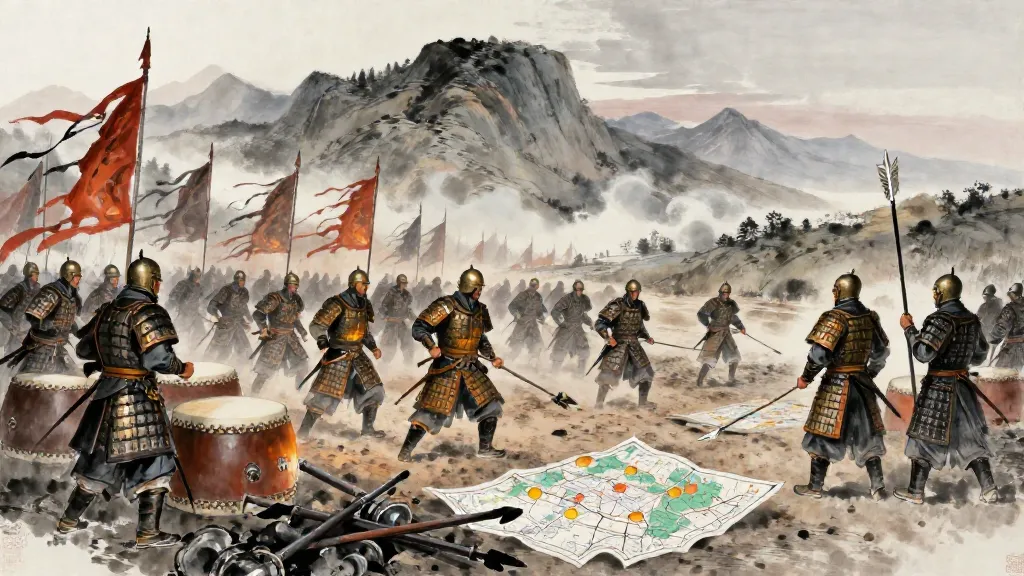
田單列傳 (Biography of Tian Dan) — Chinese ink painting

Chapter 82 of 130

田單列傳

Biography of Tian Dan

View:

田單守即墨

Tian Dan Defends Jimo

田單者,齊諸田疏屬也。湣王時,單為臨菑市掾,不見知。及燕使樂毅伐破齊,齊湣王出奔,已而保莒城。燕師長驅平齊,而田單走安平,令其宗人盡斷其車軸末而傅鐵籠。已而燕軍攻安平,城壞,齊人走,爭塗,以轊折車敗,為燕所虜,唯田單宗人以鐵籠故得脫,東保即墨。燕既盡降齊城,唯獨莒、即墨不下。燕軍聞齊王在莒,並兵攻之。淖齒既殺湣王於莒,因堅守,距燕軍,數年不下。燕引兵東圍即墨,即墨大夫出與戰,敗死。城中相與推田單,曰:"安平之戰,田單宗人以鐵籠得全,習兵。"立以為將軍,以即墨距燕。

Tian Dan was a distant kinsman of the Tian ruling house of Qi. During the reign of King Min, Tian Dan served as a minor market official in Linzi and was unknown. When Yan sent Yue Yi to invade and shatter Qi, King Min fled and eventually took refuge in the city of Ju. The Yan army drove deep into Qi and overran the country. Tian Dan escaped to Anping, but before doing so he ordered all his clansmen to saw off the protruding ends of their cart axles and cap them with iron sleeves. Soon after, the Yan army attacked Anping. When the walls were breached, the Qi refugees fled, fighting for space on the roads. Their axle-cap pins snapped and their carts broke down, and they were captured by Yan. Only Tian Dan's clansmen, thanks to their iron-capped axles, managed to escape. They fled east and took shelter in Jimo. After Yan had compelled the surrender of every city in Qi, only Ju and Jimo remained unconquered. The Yan army learned that the King of Qi was at Ju and concentrated its forces to attack there. After Nao Chi murdered King Min at Ju, the defenders nonetheless held firm and repelled the Yan army for several years. Yan then shifted its forces east to besiege Jimo. The commandant of Jimo rode out to give battle and was killed. The people inside the city consulted with one another and chose Tian Dan, saying: "At the battle of Anping, Tian Dan's clansmen survived thanks to the iron axle-caps — he understands military matters." They installed him as general, and from Jimo he resisted Yan.

Notes

1person田單Tián Dān

Tian Dan (田單) was a minor Qi official who rose from obscurity to become one of the most brilliant strategists of the Warring States period. His recovery of all seventy-plus cities of Qi from Yan occupation, culminating in the fire-ox attack at Jimo (c. 279 BC), is one of history's great reversals.

2place

Anping (安平) was a city in Qi, near modern Linzi, Shandong. It fell to the Yan invasion.

3context

The iron axle-cap (鐵籠) was Tian Dan's first stroke of practical ingenuity. Standard axle-caps were wooden and protruded, making them liable to shear off in a traffic jam. Iron caps flush with the wheel prevented this.

4person淖齒Nào Chǐ

Nao Chi (淖齒) was a Chu general sent ostensibly to aid Qi but who instead murdered King Min at Ju, allegedly by hanging him from the city rafters.

反間與心理戰

Disinformation and Psychological Warfare

頃之,燕昭王卒,惠王立,與樂毅有隙。田單聞之,乃縱反間於燕,宣言曰:"齊王已死,城之不拔者二耳。樂毅畏誅而不敢歸,以伐齊為名,實欲連兵南面而王齊。齊人未附,故且緩攻即墨以待其事。齊人所懼,唯恐他將之來,即墨殘矣。"燕王以為然,使騎劫代樂毅。

樂毅因歸趙,燕人士卒忿。而田單乃令城中人食必祭其先祖於庭,飛鳥悉翔舞城中下食。燕人怪之。田單因宣言曰:"神來下教我。"乃令城中人曰:"當有神人為我師。"有一卒曰:"臣可以為師乎?"因反走。田單乃起,引還,東鄉坐,師事之。卒曰:"臣欺君,誠無能也。"田單曰:"子勿言也!"因師之。每出約束,必稱神師。乃宣言曰:"吾唯懼燕軍之劓所得齊卒,置之前行,與我戰,即墨敗矣。"燕人聞之,如其言。城中人見齊諸降者盡劓,皆怒,堅守,唯恐見得。單又縱反間曰:"吾懼燕人掘吾城外冢墓,僇先人,可為寒心。"燕軍盡掘壟墓,燒死人。即墨人從城上望見,皆涕泣,俱欲出戰,怒自十倍。

Shortly after, King Zhao of Yan died and King Hui succeeded him. King Hui had a longstanding rift with Yue Yi. Tian Dan heard of this and planted disinformation agents in Yan, spreading the word: "The King of Qi is already dead — only two cities remain untaken. The reason Yue Yi has not stormed them sooner is that he fears punishment and dares not return. He uses the campaign against Qi as a pretext, but his real intention is to keep the army intact, face south, and make himself King of Qi. The people of Qi have not yet submitted to him, so he is deliberately slowing the attack on Jimo while he waits for his moment. What Qi truly fears is that a different general might come — then Jimo would be finished." The King of Yan believed this and sent Qi Jie to replace Yue Yi.

Yue Yi thereupon defected to Zhao. The Yan soldiers were resentful at the change. Tian Dan then ordered everyone inside the city to make offerings to their ancestors in the courtyard whenever they ate. Flocks of birds swooped and circled over the city, diving down to feed on the offerings. The Yan soldiers marveled at this. Tian Dan then spread the rumor: "A spirit has come down to instruct me." He told the people inside the city: "A divine being will serve as my teacher." One soldier said: "Could I serve as the teacher?" and turned to run away. Tian Dan rose, led him back, had him sit facing east, and treated him with the deference due a teacher. The soldier said: "I was deceiving you, sir — truly I have no abilities." Tian Dan replied: "Say nothing more!" and continued to treat him as his teacher. Whenever he issued orders, he invoked the authority of the Divine Teacher. He then let it be known: "My only fear is that the Yan army will cut off the noses of the Qi prisoners they have taken and place them in the front ranks to fight against us — then Jimo would surely fall." The Yan troops heard this and did exactly that. When the people inside the city saw that every Qi soldier who had surrendered had been mutilated, they were enraged. They defended the walls with fierce resolve, terrified of being captured. Tian Dan then planted another false rumor: "I fear that the Yan forces will dig up the graves outside our city walls and desecrate our ancestors — that would be truly chilling." The Yan army proceeded to dig up every burial mound and burn the corpses. The people of Jimo watched from the walls, all of them weeping. They begged to sally forth and fight, their fury increased tenfold.

Notes

1context

Tian Dan's use of reverse psychology — telling the enemy exactly what he wanted them to do, disguised as his 'greatest fear' — is a masterpiece of psychological warfare. By provoking the Yan army into mutilating prisoners and desecrating graves, he united the defenders in a fury that nothing else could have achieved.

2context

The 'Divine Teacher' (神師) ruse served two purposes: it boosted the morale of the defenders by suggesting supernatural backing, and it caused the Yan soldiers to fear that they were fighting against heaven-sent forces.

火牛陣破燕

The Fire-Ox Attack Shatters Yan

田單知士卒之可用,乃身操版插,與士卒分功,妻妾編於行伍之間,盡散飲食饗士。令甲卒皆伏,使老弱女子乘城,遣使約降於燕,燕軍皆呼萬歲。田單又收民金,得千溢,令即墨富豪遺燕將,曰:"即墨即降,原無虜掠吾族家妻妾,令安堵。"燕將大喜,許之。燕軍由此益懈。

田單乃收城中得千餘牛,為絳繒衣,畫以五彩龍文,束兵刃於其角,而灌脂束葦於尾,燒其端。鑿城數十穴,夜縱牛,壯士五千人隨其後。牛尾熱,怒而奔燕軍,燕軍夜大驚。牛尾炬火光明炫燿,燕軍視之皆龍文,所觸盡死傷。五千人因銜枚擊之,而城中鼓譟從之,老弱皆擊銅器為聲,聲動天地。燕軍大駭,敗走。齊人遂夷殺其將騎劫。燕軍擾亂奔走,齊人追亡逐北,所過城邑皆畔燕而歸田單,兵日益多,乘勝,燕日敗亡,卒至河上,而齊七十餘城皆復為齊。乃迎襄王於莒,入臨菑而聽政。

襄王封田單,號曰安平君。

Tian Dan saw that his soldiers were ready to be used. He personally took up tools and worked alongside the troops, assigning his own wives and concubines to the military ranks. He distributed all available food and drink to feast the soldiers. He ordered the armored troops to hide and stationed only the old, the weak, and the women on the walls. He sent an envoy to negotiate surrender with Yan. The Yan army shouted in triumph. Tian Dan then collected gold from the citizens — a thousand yi in all — and had the wealthy men of Jimo present it to the Yan general with the message: "Jimo is about to surrender. We beg that you not pillage our families and wives, but let them remain in peace." The Yan general was overjoyed and agreed. The Yan army grew ever more lax.

Tian Dan then gathered over a thousand oxen from within the city. He draped them in crimson silk painted with multicolored dragon patterns and bound blades to their horns. He smeared their tails with grease, bound them with bundles of reeds, and set the ends alight. He had dozens of holes cut through the city wall and released the oxen at night, with five thousand warriors following behind them. When the fire reached their tails, the oxen went mad with pain and charged into the Yan camp. The Yan army was thrown into panic in the darkness. The blazing torches on the oxen's tails cast a dazzling light, and the Yan soldiers saw nothing but dragon-marked beasts — everything they touched was killed or wounded. The five thousand warriors attacked with gags in their mouths to maintain silence, while from the city walls came the crash of drums and the roar of the defenders. Even the old and the weak beat on bronze vessels, and the noise shook heaven and earth. The Yan army was utterly terrified and broke in rout. The Qi forces cut down General Qi Jie. The Yan army scattered in chaos, and the Qi forces pursued the fleeing and hunted the defeated. Every city and town they passed through revolted against Yan and rallied to Tian Dan. His army grew larger by the day. Pressing the advantage, with Yan suffering defeat upon defeat, they drove all the way to the Yellow River. All seventy-odd cities of Qi were recovered. Tian Dan then welcomed King Xiang at Ju and escorted him into Linzi to resume governance.

King Xiang enfeoffed Tian Dan with the title Lord of Anping.

Notes

1context

The fire-ox attack (火牛陣) at Jimo (c. 279 BC) is one of the most famous tactical innovations in Chinese military history. The combination of psychological terror (fire, dragon patterns, noise) with physical violence (bladed horns, massed infantry) achieved total surprise against a complacent enemy.

2translation

銜枚 (xián méi) — 'holding gags in their mouths' — a wooden gag clenched between the teeth to prevent soldiers from making noise during a night attack. A standard technique described in military texts.

3person齊襄王Qí Xiāng Wáng

King Xiang of Qi (齊襄王, r. 283–265 BC), personal name Tian Fazhang (田法章), was King Min's son who was found hiding in a scribe's household in Ju. He was installed as king during the Yan occupation and returned to Linzi after Tian Dan's victories.

太史公曰與附傳

The Grand Historian's Comment and Supplementary Accounts

太史公曰:兵以正合,以奇勝。善之者,出奇無窮。奇正還相生,如環之無端。夫始如處女,適人開戶;後如脫兔,適不及距:其田單之謂邪!

初,淖齒之殺湣王也,莒人求湣王子法章,得之太史嬓之家,為人灌園。嬓女憐而善遇之。後法章私以情告女,女遂與通。及莒人共立法章為齊王,以莒距燕,而太史氏女遂為後,所謂"君王后"也。

燕之初入齊,聞畫邑人王蠋賢,令軍中曰"環畫邑三十里無入",以王蠋之故。已而使人謂蠋曰:"齊人多高子之義,吾以子為將,封子萬家。"蠋固謝。燕人曰:"子不聽,吾引三軍而屠畫邑。"王蠋曰:"忠臣不事二君,貞女不更二夫。齊王不聽吾諫,故退而耕於野。國既破亡,吾不能存;今又劫之以兵為君將,是助桀為暴也。與其生而無義,固不如烹!"遂經其頸於樹枝,自奮絕脰而死。齊亡大夫聞之,曰:"王蠋,布衣也,義不北面於燕,況在位食祿者乎!"乃相聚如莒,求諸子,立為襄王。

The Grand Historian comments: In war, one engages with the orthodox and wins with the unorthodox. Those who excel at it produce the unorthodox without limit. The orthodox and the unorthodox generate each other ceaselessly, like a ring with no end. At first one is like a maiden, so that the enemy opens his door; afterward one is like a hare bolting from its den, so that the enemy cannot resist in time — is this not a description of Tian Dan?

When Nao Chi first murdered King Min, the people of Ju searched for King Min's son Fazhang and found him in the household of the Grand Scribe Jiao, where he was working as a garden laborer. Jiao's daughter took pity on him and treated him well. Later Fazhang confided his true identity to the girl, and she became his consort. When the people of Ju together installed Fazhang as King of Qi and used Ju as a base to resist Yan, the daughter of the Grand Scribe became queen — the one known as "Queen Junwang."

When Yan first invaded Qi, the troops heard that Wang Zhu of Hua township was a worthy man and issued orders that no soldier was to enter within thirty li of Hua township, on Wang Zhu's account. Then they sent a messenger to Wang Zhu, saying: "The people of Qi greatly admire your righteousness. We will make you a general and enfeoff you with ten thousand households." Wang Zhu firmly declined. The Yan envoy said: "If you refuse, I will bring the entire army to slaughter Hua township." Wang Zhu replied: "A loyal subject does not serve two lords; a virtuous woman does not take a second husband. The King of Qi refused to heed my counsel, so I withdrew and plowed the fields. Now the state is destroyed and I could not save it. And you would compel me with force of arms to serve as your general — that would be helping a tyrant in his cruelty. Rather than live without honor, I would sooner be boiled alive!" He then looped his neck-cloth over a tree branch and hanged himself. When the exiled grandees of Qi heard of this, they said: "Wang Zhu was a commoner, yet his sense of honor would not let him face north and serve Yan — how much less should those of us who hold rank and receive stipends!" They gathered together at Ju, sought out the king's son, and installed him as King Xiang.

Notes

1context

The Grand Historian's opening comment paraphrases and applies concepts from Sunzi's Art of War (Chapter 5, 兵勢): 'engage with the orthodox (正), win with the unorthodox (奇).' The maiden-and-hare metaphor is also from Sunzi (Chapter 11).

2person王蠋Wáng Zhú

Wang Zhu (王蠋) was a commoner of Qi whose suicide in protest against Yan's occupation galvanized the Qi resistance. His declaration that 'a loyal subject does not serve two lords' became proverbial.

3translation

北面於燕 — 'to face north before Yan' — means to serve Yan as a subject. In Chinese political ritual, the ruler faces south and the subject faces north.

Edition & Source

Text
《史記》 Shiji
Edition
中華古詩文古書籍網 transcription
Commentary
裴駰《史記集解》、司馬貞《史記索隱》、張守節《史記正義》(Three Commentaries)