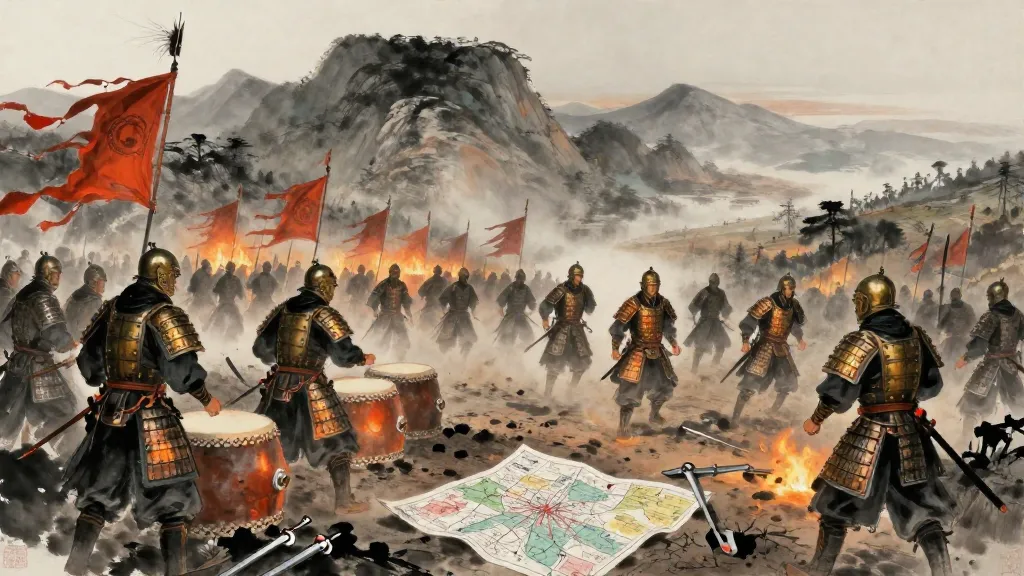
魯仲連鄒陽列傳 (Biographies of Lu Zhonglian and Zou Yang) — Chinese ink painting

Chapter 83 of 130

魯仲連鄒陽列傳

Biographies of Lu Zhonglian and Zou Yang

View:

魯仲連義不帝秦

Lu Zhonglian Refuses to Accept Qin as Emperor

魯仲連者,齊人也。好奇偉俶儻之畫策,而不肯仕宦任職,好持高節。游於趙。

趙孝成王時,而秦王使白起破趙長平之軍前後四十餘萬,秦兵遂東圍邯鄲。趙王恐,諸侯之救兵莫敢擊秦軍。魏安釐王使將軍晉鄙救趙,畏秦,止於盪陰不進。魏王使客將軍新垣衍間入邯鄲,因平原君謂趙王曰:「秦所為急圍趙者,前與齊湣王爭彊為帝,已而復歸帝;今齊已益弱,方今唯秦雄天下,此非必貪邯鄲,其意欲復求為帝。趙誠發使尊秦昭王為帝,秦必喜,罷兵去。」平原君猶預未有所決。

此時魯仲連適游趙,會秦圍趙,聞魏將欲令趙尊秦為帝,乃見平原君曰:「事將柰何?」平原君曰:「勝也何敢言事!前亡四十萬之眾於外,今又內圍邯鄲而不能去。魏王使客將軍新垣衍令趙帝秦,今其人在是。勝也何敢言事!」魯仲連曰:「吾始以君為天下之賢公子也,吾乃今然後知君非天下之賢公子也。梁客新垣衍安在?吾請為君責而歸之。」

Lu Zhonglian was a man of Qi. He delighted in bold and extraordinary stratagems and refused to serve in office or hold any appointment, preferring to maintain his lofty principles. He was traveling in Zhao.

During the reign of King Xiaocheng of Zhao, the King of Qin sent Bai Qi to destroy Zhao's army at Changping — over 400,000 troops in all. Qin's forces then moved east to besiege Handan. The King of Zhao was terrified, and none of the rescue forces from the other states dared engage the Qin army. King Anxi of Wei sent General Jin Bi to rescue Zhao, but fearing Qin, he halted at Dangyin and would not advance. The King of Wei sent his guest general Xinyuan Yan to slip into Handan, where he told the King of Zhao through Lord Pingyuan: "The reason Qin is pressing the siege of Zhao is not necessarily that it covets Handan — previously Qin contended with King Min of Qi for the title of Emperor, then gave it up; now Qi has grown weaker and only Qin dominates all under Heaven; its true aim is to once again seek the imperial title. If Zhao would sincerely send an envoy to honor King Zhao of Qin as Emperor, Qin would certainly be pleased and withdraw its troops." Lord Pingyuan was undecided.

At this time Lu Zhonglian happened to be traveling in Zhao. Meeting the Qin siege, he heard that the Wei general wanted Zhao to acknowledge Qin as emperor. He went to see Lord Pingyuan and asked: "What will happen?" Lord Pingyuan said: "How dare I speak of what will happen! We lost 400,000 troops abroad, and now we are besieged in Handan and cannot break free. The King of Wei has sent his guest general Xinyuan Yan to order Zhao to honor Qin as emperor, and he is here now. How dare I speak of it!" Lu Zhonglian said: "I had thought you were the most worthy lord in all the realm. Now I see you are not. Where is this Wei guest, Xinyuan Yan? Let me rebuke him and send him packing on your behalf."

Notes

1person魯仲連Lǔ Zhòngliān

Lu Zhonglian (魯仲連, also Lu Lian 魯連, c. 305–245 BC) was a freelance intellectual from Qi who refused all official positions and rewards. He became the archetype of the principled recluse who intervenes in worldly crises from conviction rather than self-interest.

2context

The Battle of Changping (長平之戰, 260 BC) was the most devastating battle in Chinese history. Bai Qi reportedly buried alive over 400,000 Zhao prisoners of war. The subsequent siege of Handan (259–257 BC) was one of the most critical moments of the Warring States period.

仲連辯新垣衍

Zhonglian Debates Xinyuan Yan

魯連見新垣衍而無言。新垣衍曰:「吾視居此圍城之中者,皆有求於平原君者也;今吾觀先生之玉貌,非有求於平原君者也,曷為久居此圍城之中而不去?」魯仲連曰:「世以鮑焦為無從頌而死者,皆非也。眾人不知,則為一身。彼秦者,棄禮義而上首功之國也,權使其士,虜使其民。彼即肆然而為帝,過而為政於天下,則連有蹈東海而死耳,吾不忍為之民也。所為見將軍者,欲以助趙也。」

新垣衍曰:「先生助之將柰何?」魯連曰:「吾將使梁及燕助之,齊、楚則固助之矣。」新垣衍曰:「燕則吾請以從矣;若乃梁者,則吾乃梁人也,先生惡能使梁助之?」魯連曰:「梁未睹秦稱帝之害故耳。使梁睹秦稱帝之害,則必助趙矣。」

新垣衍曰:「秦稱帝之害何如?」魯連曰:「昔者齊威王嘗為仁義矣,率天下諸侯而朝周。周貧且微,諸侯莫朝,而齊獨朝之。居歲餘,周烈王崩,齊後往,周怒,赴於齊曰:'天崩地坼,天子下席。東籓之臣因齊後至,則斮。'齊威王勃然怒曰:'叱嗟,而母婢也!'卒為天下笑。故生則朝周,死則叱之,誠不忍其求也。彼天子固然,其無足怪。」

Lu Zhonglian met Xinyuan Yan but said nothing at first. Xinyuan Yan said: "As I see it, everyone living in this besieged city has something to ask of Lord Pingyuan. But observing your distinguished countenance, sir, you do not seem to be someone with requests for Lord Pingyuan. Why do you remain in this besieged city and not leave?" Lu Zhonglian said: "The world thinks Bao Jiao died because he had no one who appreciated him. They are all wrong. It is simply that ordinary people do not understand — they think only of themselves. Qin is a state that has cast away ritual propriety and righteousness, valuing only headcounts of the slain. It manipulates its officers through coercion and treats its people like slaves. If Qin arrogantly assumes the imperial title and extends its governance over all under Heaven, then I, Zhonglian, would rather wade into the Eastern Sea and drown. I will not endure being its subject. My reason for seeing you, General, is that I wish to help Zhao."

Xinyuan Yan said: "How does the Master propose to help?" Lu Zhonglian said: "I will make Liang and Yan assist Zhao. Qi and Chu will assist of their own accord." Xinyuan Yan said: "I can accept that Yan might follow along; but Liang — I am myself a man of Liang — how could you make Liang help?" Lu Zhonglian said: "Liang has simply not yet seen the harm of Qin assuming the imperial title. Once Liang sees that harm, it will certainly help Zhao."

Xinyuan Yan said: "What harm would Qin's taking the imperial title cause?" Lu Zhonglian said: "In former times, King Wei of Qi once practiced benevolence and righteousness, leading all the lords to pay court to Zhou. Zhou was poor and insignificant — none of the lords paid court, yet Qi alone did so. A year later, King Lie of Zhou died. Qi arrived late for the mourning. Zhou was furious and sent word to Qi: 'Heaven has fallen and earth has split. The Son of Heaven has descended from his seat. The Eastern Shield-vassal Qi was late in arriving — he shall be executed.' King Wei of Qi flew into a rage and said: 'Bah! Your mother was a slave!' He ended up being laughed at by all under Heaven. Thus while the Zhou king was alive, Qi paid court; when he died, Qi cursed him — he truly could not bear the demands placed on him. That is the nature of a Son of Heaven. There should be nothing surprising about it."

Notes

1context

Lu Zhonglian's argument is that if Qin becomes emperor, all states — including Wei — will be subject to arbitrary humiliation, just as the Zhou king demanded submissive behavior from feudal lords. The core of his argument, which continues at length, uses historical analogies to show that accepting an emperor means accepting the possibility of being cooked alive, dismembered, or enslaved at his whim.

退秦軍與辭封賞

Qin's Retreat and Refusing Rewards

於是新垣衍起,再拜謝曰:「始以先生為庸人,吾乃今日知先生為天下之士也。吾請出,不敢復言帝秦。」秦將聞之,為卻軍五十里。適會魏公子無忌奪晉鄙軍以救趙,擊秦軍,秦軍遂引而去。

於是平原君欲封魯連,魯連辭讓者三,終不肯受。平原君乃置酒,酒酣起前,以千金為魯連壽。魯連笑曰:「所貴於天下之士者,為人排患釋難解紛亂而無取也。即有取者,是商賈之事也,而連不忍為也。」遂辭平原君而去,終身不復見。

Xinyuan Yan rose and bowed twice in gratitude: "At first I took you for an ordinary man, sir. Today I know you to be one of the great men of the realm. I shall withdraw and will never again speak of honoring Qin as emperor." When the Qin generals heard of this, they pulled their army back fifty li. Just then, Lord Xinling of Wei stole Jin Bi's army to rescue Zhao and struck the Qin forces, which thereupon retreated entirely.

Lord Pingyuan wished to enfeoff Lu Zhonglian, but Zhonglian declined three times and absolutely refused to accept. Lord Pingyuan then held a banquet. When the wine was flowing, he rose and presented a thousand jin of gold to honor Lu Zhonglian. Zhonglian laughed and said: "What is valued in a great man of the realm is that he resolves others' troubles, removes their difficulties, and untangles their disputes — without taking anything in return. If he takes something, that is the business of merchants and traders, and I, Zhonglian, will not stoop to it." He took his leave of Lord Pingyuan and departed, never seeing him again.

Notes

1person信陵君Xìnlíng Jūn

Lord Xinling (信陵君, Wei Wuji 魏無忌, d. 243 BC) was the most celebrated of the Four Lords of the Warring States. His rescue of Zhao by stealing Jin Bi's army command (using the forged tiger tally obtained through Hou Ying and Zhu Hai) is one of the most dramatic episodes in Chinese history.

射書救聊城

The Arrow-Letter That Saved Liaocheng

其後二十餘年,燕將攻下聊城,聊城人或讒之燕,燕將懼誅,因保守聊城,不敢歸。齊田單攻聊城歲餘,士卒多死而聊城不下。魯連乃為書,約之矢以射城中,遺燕將。書曰:

吾聞之,智者不倍時而棄利,勇士不卻死而滅名,忠臣不先身而後君。今公行一朝之忿,不顧燕王之無臣,非忠也;殺身亡聊城,而威不信於齊,非勇也;功敗名滅,後世無稱焉,非智也。三者世主不臣,說士不載,故智者不再計,勇士不怯死。今死生榮辱,貴賤尊卑,此時不再至,原公詳計而無與俗同。

More than twenty years later, a Yan general had captured Liaocheng, but people from Liaocheng slandered him to the Yan court. The general feared execution and therefore held Liaocheng in defiance, not daring to return to Yan. Qi's Tian Dan attacked Liaocheng for over a year; many soldiers died but Liaocheng would not fall. Lu Zhonglian then composed a letter, tied it to an arrow, and shot it into the city, addressing the Yan general. The letter said:

"I have heard that the wise man does not reject the times and throw away advantage; the brave man does not shrink from death and destroy his reputation; the loyal minister does not put himself before his lord. Now you act upon a moment's anger, heedless that the King of Yan will be left without a minister — this is not loyalty. You will die and lose Liaocheng, yet your authority will gain no credence in Qi — this is not bravery. Your achievements will fail and your name will perish, with no one in later generations to speak of you — this is not wisdom. A man who fails in all three will be disowned by rulers and ignored by persuaders. The wise do not calculate twice; the brave do not flinch from death. Life and death, glory and shame, honor and baseness — this moment will not come again. I ask you to consider carefully and not follow the common path."

Notes

1person田單Tián Dān

Tian Dan (田單) was the Qi general famous for his recovery of Qi from Yan occupation using the fire-ox stratagem (see Shiji Ch. 82). This later siege of Liaocheng was a separate, less successful campaign.

燕將自殺與鄒陽獄中上書

The Yan General's Suicide and Zou Yang's Letter from Prison

燕將見魯連書,泣三日,猶豫不能自決。欲歸燕,已有隙,恐誅;欲降齊,所殺虜於齊甚眾,恐已降而後見辱。喟然嘆曰:「與人刃我,寧自刃。」乃自殺。聊城亂,田單遂屠聊城。歸而言魯連,欲爵之。魯連逃隱於海上,曰:「吾與富貴而詘於人,寧貧賤而輕世肆志焉。」

鄒陽者,齊人也。游於梁,與故吳人莊忌夫子、淮陰枚生之徒交。上書而介於羊勝、公孫詭之間。勝等嫉鄒陽,惡之梁孝王。孝王怒,下之吏,將欲殺之。鄒陽客游,以讒見禽,恐死而負累,乃從獄中上書曰:臣聞忠無不報,信不見疑,臣常以為然,徒虛語耳。昔者荊軻慕燕丹之義,白虹貫日,太子畏之;衛先生為秦畫長平之事,太白蝕昴,而昭王疑之。夫精變天地而信不喻兩主,豈不哀哉!今臣盡忠竭誠,畢議原知,左右不明,卒從吏訊,為世所疑,是使荊軻、衛先生復起,而燕、秦不悟也。原大王孰察之。

The Yan general read Lu Zhonglian's letter and wept for three days, unable to decide. He wanted to return to Yan, but a rift already existed and he feared execution. He wanted to surrender to Qi, but he had killed and captured so many Qi people that he feared being humiliated after surrendering. With a deep sigh he said: "Rather than let another man's blade kill me, I shall use my own." He killed himself. Liaocheng fell into chaos, and Tian Dan slaughtered the city. Upon returning, Tian Dan spoke of Lu Zhonglian and wished to grant him a title. Lu Zhonglian fled and hid by the sea, saying: "I would rather be poor and humble, making light of the world and following my will, than be rich and noble yet beholden to others."

Zou Yang was a man of Qi. He traveled to Liang, where he associated with Zhuang Ji the Master (formerly of Wu) and Mei Sheng of Huaiyin and their circle. He submitted memorials and positioned himself between Yang Sheng and Gongsun Gui. But Yang Sheng and his allies grew jealous of Zou Yang and slandered him to King Xiao of Liang. The king was furious and had him arrested, intending to execute him. Zou Yang, a guest traveler who had been imprisoned on false charges, feared dying under unjust accusations. From prison he submitted a memorial: "I have heard that loyalty always receives its reward and that trust is never met with suspicion. I once believed this, but they are just empty words. In the past, Jing Ke admired Prince Dan of Yan's righteousness — a white rainbow pierced the sun — yet the prince feared him. Master Wei devised the Changping strategy for Qin — Venus eclipsed the Pleiades — yet King Zhao doubted him. Their very sincerity moved heaven and earth, yet it could not convince two rulers. Is this not tragic? Now I have exhausted my loyalty and sincerity, offered every counsel I know, yet those at court are unenlightened. I have been handed over to judicial interrogation, suspected by the world. It is as if Jing Ke and Master Wei were to rise again, and Yan and Qin would still fail to understand. I beg Your Majesty to examine the matter carefully."

Notes

1person鄒陽Zōu Yáng

Zou Yang (鄒陽) was a literary figure of the early Han who served at the court of King Xiao of Liang (梁孝王, d. 144 BC). His prison letter is celebrated as a masterpiece of parallel prose (駢文) and rhetorical persuasion.

2person梁孝王Liáng Xiào Wáng

King Xiao of Liang (梁孝王, Liu Wu 劉武, d. 144 BC) was a younger brother of Emperor Jing of Han and one of the most powerful princes of the early Han. His court at Suiyang attracted many literary talents.

鄒陽獄中書(續)與太史公論贊

Zou Yang's Prison Letter (Continued) and the Grand Historian's Assessment

書奏梁孝王,孝王使人出之,卒為上客。

太史公曰:魯連其指意雖不合大義,然余多其在布衣之位,蕩然肆志,不詘於諸侯,談說於當世,折卿相之權。鄒陽辭雖不遜,然其比物連類,有足悲者,亦可謂抗直不橈矣,吾是以附之列傳焉。

When the memorial was presented to King Xiao of Liang, the king had Zou Yang released and ultimately made him a premier guest.

The Grand Historian remarks: Though Lu Zhonglian's principles may not have fully accorded with the highest righteousness, I greatly admire how he, holding the position of a mere commoner, freely followed his will without yielding to the feudal lords, spoke his mind to the rulers of his day, and broke the power of ministers and chancellors. Though Zou Yang's rhetoric was sometimes intemperate, his comparisons and analogies are deeply moving. He may well be called unyielding and forthright. That is why I have appended his account to this biography.

Edition & Source

Text
《史記》 Shiji
Edition
中華古詩文古書籍網 transcription
Commentary
裴駰《史記集解》、司馬貞《史記索隱》、張守節《史記正義》(Three Commentaries)