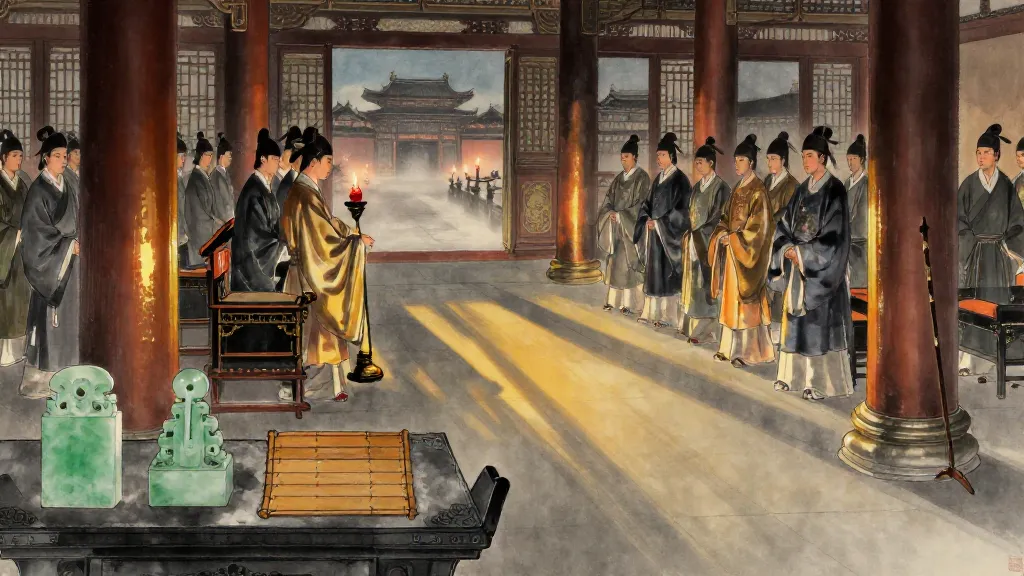
屈原賈生列傳 (Biographies of Qu Yuan and Jia Yi) — Chinese ink painting

Chapter 84 of 130

屈原賈生列傳

Biographies of Qu Yuan and Jia Yi

View:

屈原事楚懷王

Qu Yuan Serves King Huai of Chu

屈原者,名平,楚之同姓也。為楚懷王左徒。博聞彊志,明於治亂,嫺於辭令。入則與王圖議國事,以出號令;出則接遇賓客,應對諸侯。王甚任之。

上官大夫與之同列,爭寵而心害其能。懷王使屈原造為憲令,屈平屬草未定。上官大夫見而欲奪之,屈平不與,因讒之曰:「王使屈平為令,眾莫不知,每一令出,平伐其功,以為'非我莫能為'也。」王怒而疏屈平。

屈平疾王聽之不聰也,讒諂之蔽明也,邪曲之害公也,方正之不容也,故憂愁幽思而作離騷。離騷者,猶離憂也。夫天者,人之始也;父母者,人之本也。人窮則反本,故勞苦倦極,未嘗不呼天也;疾痛慘怛,未嘗不呼父母也。屈平正道直行,竭忠盡智以事其君,讒人間之,可謂窮矣。信而見疑,忠而被謗,能無怨乎?屈平之作離騷,蓋自怨生也。

Qu Yuan, personal name Ping, was of the same ruling surname as the Chu royal house. He served King Huai of Chu as Left Counselor. Widely learned with a powerful memory, perceptive about order and disorder, and skilled in rhetoric. At court he deliberated state affairs with the king and drafted royal edicts; abroad he received guests and responded to the feudal lords. The king placed great trust in him.

The Grand Officer of the Upper Court held the same rank and, competing for favor, was jealous of Qu Yuan's abilities. When King Huai commissioned Qu Yuan to draft new regulations, Qu Ping had not yet finalized the text. The Grand Officer saw it and tried to appropriate it, but Qu Ping refused to hand it over. The Grand Officer then slandered him, saying: "The king commissioned Qu Ping to draft the regulations — everyone knows it. Yet every time a regulation is issued, Ping boasts of his achievement, as if to say 'No one but I could have done this.'" The king was angered and distanced himself from Qu Ping.

Qu Ping was pained that the king's hearing was not discerning, that slanderers and flatterers obscured his judgment, that the crooked harmed the public good, and that the upright found no acceptance. In grief and deep contemplation, he composed the Li Sao. Li Sao means 'encountering sorrow.' Heaven is the origin of man; father and mother are man's root. When a person is driven to extremity, he returns to his root — thus in toil, exhaustion, and utter weariness, one never fails to cry out to Heaven; in pain and bitter anguish, one never fails to cry out to one's parents. Qu Ping walked the straight path and acted with rectitude, exhausting his loyalty and wisdom in service to his lord, yet slanderers came between them. He may be called a man driven to extremity. To be trusted yet suspected, to be loyal yet maligned — how could he not feel resentment? Qu Ping's composition of the Li Sao was born of this resentment.

Notes

1person屈原Qū Yuán

Qu Yuan (屈原, Qu Ping 屈平, c. 340–278 BC) was a poet and statesman of Chu, author of the Li Sao and other works in the Chuci (Songs of Chu) anthology. He is considered China's first great named poet. His death by drowning in the Miluo River is commemorated annually at the Dragon Boat Festival.

2person楚懷王Chǔ Huái Wáng

King Huai of Chu (楚懷王, r. 328–299 BC) was Qu Yuan's sovereign. Despite Qu Yuan's counsel, he was deceived by Zhang Yi's diplomacy, broke Chu's alliance with Qi, was trapped by Qin at a summit meeting, and died as a prisoner in Qin.

3context

The Li Sao (離騷, 'Encountering Sorrow') is the longest and most celebrated poem in the Chuci anthology, a 373-line allegorical poem in which the poet, cast as a loyal minister, journeys through mythological realms seeking an enlightened ruler.

張儀欺楚與懷王之死

Zhang Yi's Deception of Chu and the Death of King Huai

屈平既絀,其後秦欲伐齊,齊與楚從親,惠王患之,乃令張儀詳去秦,厚幣委質事楚,曰:「秦甚憎齊,齊與楚從親,楚誠能絕齊,秦原獻商、於之地六百里。」楚懷王貪而信張儀,遂絕齊,使使如秦受地。張儀詐之曰:「儀與王約六里,不聞六百里。」楚使怒去,歸告懷王。懷王怒,大興師伐秦。秦發兵擊之,大破楚師於丹、淅,斬首八萬,虜楚將屈匄,遂取楚之漢中地。懷王乃悉發國中兵以深入擊秦,戰於藍田。魏聞之,襲楚至鄧。楚兵懼,自秦歸。而齊竟怒不救楚,楚大困。

時秦昭王與楚婚,欲與懷王會。懷王欲行,屈平曰:「秦虎狼之國,不可信,不如毋行。」懷王稚子子蘭勸王行:「柰何絕秦歡!」懷王卒行。入武關,秦伏兵絕其後,因留懷王,以求割地。懷王怒,不聽。亡走趙,趙不內。復之秦,竟死於秦而歸葬。

After Qu Ping was dismissed, Qin plotted to attack Qi. Since Qi and Chu were in a vertical alliance, King Hui of Qin was worried. He ordered Zhang Yi to pretend to leave Qin's service, bring lavish gifts, and pledge himself to Chu, saying: "Qin deeply hates Qi. Since Qi and Chu are in an alliance, if Chu would truly sever its ties with Qi, Qin is willing to cede the 600-li territory of Shang and Yu." King Huai of Chu, greedy and trusting Zhang Yi, broke with Qi and sent envoys to Qin to receive the territory. Zhang Yi then said: "I agreed with the king on six li, not six hundred." The Chu envoy left in fury and reported to King Huai. King Huai was enraged and launched a massive invasion of Qin. Qin sent troops to counter, crushing the Chu army at Dan and Xi, beheading 80,000, capturing the Chu general Qu Gai, and seizing Chu's Hanzhong territory. King Huai then mobilized all remaining forces for a deep invasion of Qin, fighting at Lantian. Wei, hearing of this, raided Chu as far as Deng. The Chu troops were panicked and retreated from Qin. Qi, still furious, refused to rescue Chu. Chu was in dire straits.

Later, King Zhao of Qin formed a marriage alliance with Chu and wished to meet King Huai. King Huai intended to go. Qu Ping said: "Qin is a predatory state. It cannot be trusted. Better not to go." King Huai's youngest son Zilan urged the king to go: "How can you cut off Qin's goodwill?" King Huai went. Once inside the Wu Pass, Qin's hidden troops cut off his retreat. They detained King Huai and demanded territory. King Huai was furious and refused. He fled to Zhao, but Zhao would not admit him. He returned to Qin and ultimately died there. His body was sent back to Chu for burial.

Notes

1context

Zhang Yi's deception — promising 600 li but delivering only 6 — is one of the most notorious diplomatic betrayals in Chinese history. The disastrous Battle of Dan-Xi (312 BC) that followed was a turning point in Chu's decline.

2person子蘭Zǐ Lán

Zilan (子蘭) was King Huai's youngest son and later became Chief Minister (令尹) of Chu. Qu Yuan blamed Zilan for persuading King Huai to go to Qin, leading to the king's capture and death. Zilan later helped engineer Qu Yuan's second exile.

屈原沉江

Qu Yuan Drowns Himself in the River

長子頃襄王立,以其弟子蘭為令尹。楚人既咎子蘭以勸懷王入秦而不反也。

屈平既嫉之,雖放流,睠顧楚國,繫心懷王,不忘欲反,冀幸君之一悟,俗之一改也。其存君興國而欲反覆之,一篇之中三致志焉。然終無可柰何,故不可以反,卒以此見懷王之終不悟也。

令尹子蘭聞之大怒,卒使上官大夫短屈原於頃襄王,頃襄王怒而遷之。

屈原至於江濱,被發行吟澤畔。顏色憔悴,形容枯槁。漁父見而問之曰:「子非三閭大夫歟?何故而至此?」屈原曰:「舉世混濁而我獨清,眾人皆醉而我獨醒,是以見放。」漁父曰:「夫聖人者,不凝滯於物而能與世推移。舉世混濁,何不隨其流而揚其波?眾人皆醉,何不餔其糟而啜其醨?何故懷瑾握瑜而自令見放為?」屈原曰:「吾聞之,新沐者必彈冠,新浴者必振衣,人又誰能以身之察察,受物之汶汶者乎!寧赴常流而葬乎江魚腹中耳,又安能以皓皓之白而蒙世俗之溫蠖乎!」

於是懷石遂自汨羅以死。

King Huai's eldest son, King Qingxiang, was enthroned, and his brother Zilan was made Chief Minister. The people of Chu blamed Zilan for persuading King Huai to enter Qin, from which he never returned.

Though Qu Ping had been exiled, he still looked back toward Chu with longing, his heart bound to King Huai. He never ceased hoping to return, always trusting that the king might awaken and the customs of the state might be reformed. His desire to preserve the king and revive the state — this purpose is expressed three times in a single poem. But in the end there was nothing he could do. He could not return, and at last he saw that King Huai would never come to understanding.

Chief Minister Zilan heard of Qu Yuan's criticisms and was furious. He sent the Grand Officer of the Upper Court to slander Qu Yuan before King Qingxiang. The king was angered and banished him.

Qu Yuan came to the banks of the river, his hair disheveled, chanting as he walked along the marshes. His face was haggard, his body wasted. A fisherman saw him and asked: "Are you not the Grand Officer of the Three Gates? How have you come to this?" Qu Yuan said: "The whole world is murky and I alone am clear; all men are drunk and I alone am sober. That is why I have been cast out." The fisherman said: "The sage does not cling rigidly to things but moves with the times. If the whole world is murky, why not stir up the mud and ride the waves? If all men are drunk, why not eat the dregs and drink the thin wine? Why clutch jade and fine gems to your breast and bring exile upon yourself?" Qu Yuan said: "I have heard that one who has just washed his hair must dust his cap, and one who has just bathed must shake out his garments. How could anyone, with a body so clean, allow himself to be soiled by filthy things? I would rather plunge into the flowing current and be buried in the bellies of river fish, than let my radiant whiteness be stained by the world's grime."

He then clasped a stone to his chest and drowned himself in the Miluo River.

Notes

1place

The Miluo River (汨羅江) is a tributary of the Xiang River in modern Miluo, Hunan province. It is the traditional site of Qu Yuan's suicide, c. 278 BC, commemorated annually at the Dragon Boat Festival (端午節).

2translation

The dialogue between Qu Yuan and the fisherman (漁父) is one of the most famous passages in Chinese literature, contrasting the compromiser who adapts to survive with the principled man who prefers death to moral degradation.

賈誼傳

Biography of Jia Yi

自屈原沈汨羅後百有餘年,漢有賈生,為長沙王太傅,過湘水,投書以吊屈原。

賈生名誼,雒陽人也。年十八,以能誦詩屬書聞於郡中。吳廷尉為河南守,聞其秀才,召置門下,甚幸愛。孝文皇帝初立,聞河南守吳公治平為天下第一,故與李斯同邑而常學事焉,乃徵為廷尉。廷尉乃言賈生年少,頗通諸子百家之書。文帝召以為博士。

是時賈生年二十餘,最為少。每詔令議下,諸老先生不能言,賈生盡為之對,人人各如其意所欲出。諸生於是乃以為能,不及也。孝文帝說之,超遷,一歲中至太中大夫。

於是天子議以為賈生任公卿之位。絳、灌、東陽侯、馮敬之屬盡害之,乃短賈生曰:「雒陽之人,年少初學,專欲擅權,紛亂諸事。」於是天子後亦疏之,不用其議,乃以賈生為長沙王太傅。

後歲餘,賈生徵見。孝文帝方受釐,坐宣室。上因感鬼神事,而問鬼神之本。賈生因具道所以然之狀。至夜半,文帝前席。既罷,曰:「吾久不見賈生,自以為過之,今不及也。」居頃之,拜賈生為梁懷王太傅。

居數年,懷王騎,墮馬而死,無後。賈生自傷為傅無狀,哭泣歲餘,亦死。賈生之死時年三十三矣。

More than a hundred years after Qu Yuan drowned in the Miluo, the Han dynasty had Jia Sheng, who served as Grand Tutor to the Prince of Changsha. Passing the Xiang River, he cast a written eulogy to mourn Qu Yuan.

Jia Sheng's personal name was Yi; he was a man of Luoyang. At eighteen, his ability to recite the Odes and compose prose was known throughout his commandery. The Commandant of Justice, Wu, serving as Governor of Henan, heard of his talent, summoned him to his household, and was deeply fond of him. When Emperor Wen was newly enthroned, hearing that Governor Wu of Henan administered justice as the finest in the realm — and that Wu had once studied under Li Si in their shared hometown — he promoted Wu to Commandant of Justice. The Commandant then recommended Jia Sheng, saying the young man was well versed in the works of the various masters and Hundred Schools. Emperor Wen summoned him and appointed him Academician.

At that time Jia Sheng was just over twenty, the youngest of all. Whenever an edict was issued for deliberation, the senior scholars could not respond, but Jia Sheng answered everything as if reading each man's mind. They all conceded his ability was beyond them. Emperor Wen was pleased and promoted him rapidly — within a year he reached Grand Palace Grandee.

The Emperor then considered appointing Jia Sheng to a ministerial position. But the Marquis of Jiang, Marquis Guan, the Marquis of Dongyang, Feng Jing, and their group were all jealous and slandered him: "This Luoyang fellow is young and barely educated, yet he wants to monopolize power and throw everything into confusion." The Emperor thereafter distanced himself from Jia Sheng, ignored his proposals, and instead appointed him Grand Tutor to the Prince of Changsha.

After about a year, Jia Sheng was summoned for an audience. Emperor Wen had just performed the blessings ritual and was sitting in the Xuanshi Hall. Moved by thoughts about spirits and deities, the Emperor asked about the fundamental nature of ghosts and gods. Jia Sheng expounded the topic in full detail. By midnight, the Emperor had moved to the edge of his seat. When the audience ended, the Emperor said: "I had not seen Jia Sheng in a long time and thought I had surpassed him. Now I see I am not his equal." Shortly after, he appointed Jia Sheng as Grand Tutor to Prince Huai of Liang.

After several years, Prince Huai fell from his horse while riding and died, leaving no heir. Jia Sheng reproached himself for his failure as tutor, wept for over a year, and also died. Jia Sheng was thirty-three at the time of his death.

Notes

1person賈誼Jiǎ Yì

Jia Yi (賈誼, 200–168 BC) was one of the most brilliant political thinkers of the early Han dynasty. Despite being sidelined by court factions, his memorials on princely power, Xiongnu policy, and governance profoundly influenced later Han policy. His essay 'The Faults of Qin' (過秦論) became a classic of Chinese political literature.

2context

Sima Qian paired Qu Yuan and Jia Yi because both were brilliant officials who were slandered, exiled, and died young — tragic figures whose talents were wasted by unworthy rulers and jealous colleagues. The pairing also reflects Sima Qian's own bitter experience of unjust punishment.

太史公論贊

The Grand Historian's Assessment

太史公曰:余讀離騷、天問、招魂、哀郢,悲其志。適長沙,觀屈原所自沈淵,未嘗不垂涕,想見其為人。及見賈生吊之,又怪屈原以彼其材,游諸侯,何國不容,而自令若是。讀服烏賦,同死生,輕去就,又爽然自失矣。

The Grand Historian remarks: When I read the Li Sao, the Heavenly Questions, the Summoning of the Soul, and the Lament for Ying, I am moved by the author's purpose. When I traveled to Changsha and gazed upon the pool where Qu Yuan drowned himself, I never failed to weep, imagining the man. Then, reading Jia Sheng's eulogy for him, I wondered: with talents like Qu Yuan's, he could have traveled among the feudal lords — what state would not have welcomed him? Why did he bring himself to such a pass? But reading the Rhapsody on the Owl, which equates life and death and treats staying and leaving as matters of indifference, I was overcome and lost in thought.

Notes

1context

Sima Qian's emotional identification with Qu Yuan is widely understood as reflecting his own situation: like Qu Yuan, he suffered unjust punishment (castration) for speaking truth to power. His question 'why not travel elsewhere?' is rhetorical — he understands that a patriot cannot simply abandon his homeland.

Edition & Source

Text
《史記》 Shiji
Edition
中華古詩文古書籍網 transcription
Commentary
裴駰《史記集解》、司馬貞《史記索隱》、張守節《史記正義》(Three Commentaries)