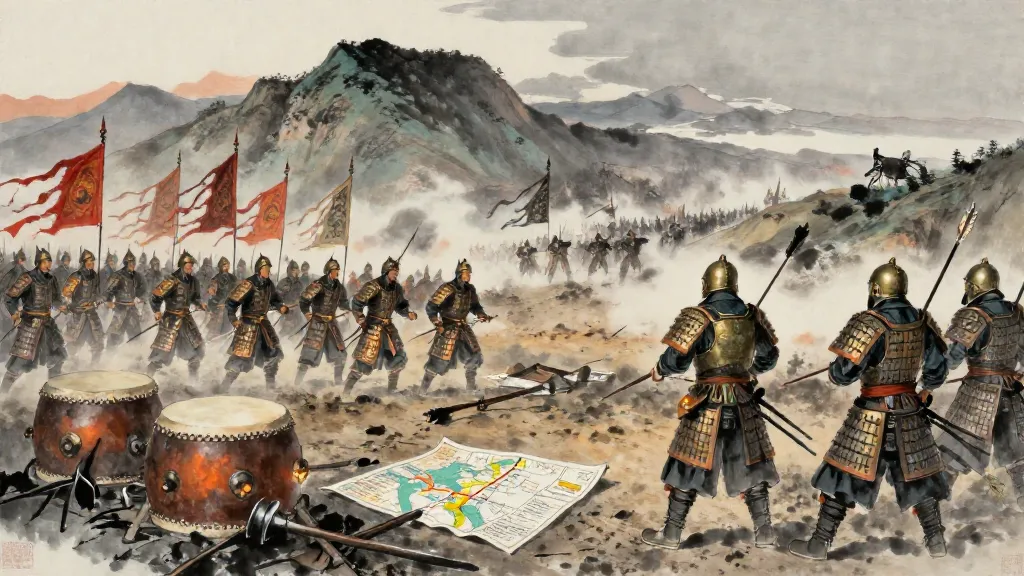
魏豹彭越列傳 (Biographies of Wei Bao and Peng Yue) — Chinese ink painting

Chapter 90 of 130

魏豹彭越列傳

Biographies of Wei Bao and Peng Yue

View:

魏豹繼兄為王

Wei Bao Succeeds His Brother as King

魏豹者,故魏諸公子也。其兄魏咎,故魏時封為寧陵君。秦滅魏,遷咎為家人。陳勝之起王也,咎往從之。陳王使魏人周市徇魏地。周市辭不受王位,迎魏咎立為魏王。章邯遂擊破殺周市等軍,圍臨濟。咎為其民約降,約定,咎自燒殺。魏豹亡走楚,楚懷王予魏豹數千人,復徇魏地。項羽封豹為西魏王,都平陽。

Wei Bao was a scion of the royal house of Wei. His elder brother Wei Jiu had been enfeoffed as Lord of Ningling under the old Wei state. When Qin destroyed Wei, Jiu was reduced to commoner status. After Chen Sheng's uprising, Jiu joined him. Zhou Shi was sent to pacify Wei territory but declined the throne, instead installing Wei Jiu as King of Wei. Zhang Han destroyed Zhou Shi's army and besieged Linji. Wei Jiu negotiated his people's surrender, and once the terms were set, burned himself to death. Wei Bao fled to Chu. King Huai of Chu gave him several thousand men to reconquer Wei territory. Xiang Yu enfeoffed Bao as King of Western Wei, with his capital at Pingyang.

Notes

1person魏豹Wèi Bào

Wei Bao (魏豹, d. 204 BC) was a member of the Wei royal house who became King of Western Wei under Xiang Yu's enfeoffment. He defected from Han after the Battle of Pengcheng and was captured by Han Xin, then killed during the siege of Xingyang.

2person彭越Péng Yuè

Peng Yue (彭越, d. 196 BC), styled Zhong, was a bandit leader from Changyi who became one of the three great generals of the Han founding. He was made King of Liang but was later executed by Emperor Gaozu on fabricated charges of rebellion.

魏豹叛漢與彭越起兵

Wei Bao's Defection and Peng Yue's Rise

漢王還定三秦,渡臨晉,魏王豹以國屬焉,遂從擊楚於彭城。漢敗,豹請歸視親病,至國,即絕河津畔漢。漢王遣韓信擊虜豹於河東。漢王令豹守滎陽。楚圍之急,周苛遂殺魏豹。

彭越者,昌邑人也,字仲。常漁鉅野澤中,為群盜。少年請彭越為長。越與期旦日日出會,後期者斬。旦日日出,十餘人後。於是越乃引一人斬之,設壇祭,乃令徒屬。徒屬皆大驚,畏越。

When the King of Han reconquered the Three Qins, Wei Bao submitted his kingdom to Han and joined the attack on Chu at Pengcheng. After Han's defeat, Bao asked leave to visit a sick relative, but upon returning to his kingdom, he cut the river crossings and defected. Han Xin captured him. The King of Han assigned Bao to guard Xingyang, but when Chu pressed the siege hard, Zhou Ke killed Wei Bao.

Peng Yue was a man of Changyi, styled Zhong. He had long fished in the marshes of Juye and led a bandit band. Local youths asked him to be their leader. Peng Yue set a dawn assembly and decreed that latecomers would be beheaded. Over ten arrived late. He executed one man, set up an altar, and administered an oath. His followers were terrified and none dared disobey.

Notes

1context

Peng Yue's method of establishing authority through exemplary punishment mirrors Sun Tzu's famous episode of training the King of Wu's concubines. It was a standard motif in Chinese military literature for showing how discipline was forged from chaos.

彭越游兵擾楚與封梁王

Peng Yue's Guerrilla Campaign and Enfeoffment as King of Liang

漢王三年,彭越常往來為漢游兵,擊楚,絕其後糧於梁地。漢五年秋,彭越復下昌邑旁二十餘城,得穀十餘萬斛,以給漢王食。留侯曰:“與此兩國約:即勝楚,睢陽以北至穀城,皆以王彭相國。”使者至,彭越乃悉引兵會垓下,遂破楚。春,立彭越為梁王,都定陶。

In the third year of Han, Peng Yue continually served as Han's mobile strike force, raiding Chu and severing their supply lines through the Liang region. In the autumn of the fifth year, Peng Yue took over twenty cities near Changyi and captured over a hundred thousand bushels of grain for the King of Han. The Marquis of Liu advised: "Promise these two states: if we defeat Chu, everything from Suiyang north to Gucheng will go to Chancellor Peng as his kingdom." When the envoy arrived, Peng Yue brought his entire army to Gaixia, and Chu was destroyed. In the spring, Peng Yue was made King of Liang, with his capital at Dingtao.

Notes

1place

Gaixia (垓下), in modern Lingbi County, Anhui, was the site of the final battle against Xiang Yu in 202 BC.

2context

Peng Yue's guerrilla warfare in Chu's rear was decisive to Han's victory. His disruption of supply lines kept Xiang Yu off balance throughout the war. Zhang Liang's advice to promise him a kingdom was the price of his full commitment to the final campaign.

彭越之死與太史公論

The Death of Peng Yue and the Grand Historian's Assessment

十年秋,陳豨反代地,高帝徵兵梁王。梁王稱病。高帝怒。梁王太僕亡走漢,告梁王與扈輒謀反。上使掩梁王,捕之,囚雒陽,赦以為庶人,傳處蜀青衣。西至鄭,逢呂后。呂后白上曰:“彭王壯士,今徙之蜀,此自遺患,不如遂誅之。”於是呂后乃令其舍人告彭越復謀反。遂夷越宗族,國除。

太史公曰:魏豹、彭越雖故賤,然已席捲千里,南面稱孤。懷畔逆之意,及敗,不死而虜囚,身被刑戮,何哉?

In the autumn of the tenth year, Chen Xi rebelled in Dai. Emperor Gaozu summoned troops from the King of Liang, but the King pleaded illness. The Emperor was furious. Peng Yue's chief groom fled to Han and accused the King of plotting rebellion with Hu Zhe. The Emperor seized Peng Yue, imprisoned him at Luoyang, pardoned him as a commoner, and ordered him exiled to Qingyi in Shu. Traveling west, Peng Yue encountered Empress Lu at Zheng. Empress Lu told the Emperor: "Peng Yue is a formidable warrior. Exiling him to Shu is leaving trouble for yourself — better to kill him outright." She then had Peng Yue's retainer accuse him of plotting rebellion again. His entire clan was exterminated and his kingdom abolished.

The Grand Historian remarks: Wei Bao and Peng Yue, though originally of low station, had swept over a thousand li and reigned as kings. When they harbored thoughts of resistance and then failed, they did not die but were captured alive and suffered execution. Why was that?

Notes

1person呂后Lǚ Hòu

Empress Lu (呂后, Lu Zhi 呂雉, 241-180 BC) was the consort of Emperor Gaozu and the most powerful woman in early Han politics. She systematically eliminated potential threats to her control, including Peng Yue, Han Xin, and Ying Bu.

2context

Peng Yue's execution followed a pattern: Empress Lu engineered accusations of rebellion against powerful kings who might challenge the Liu dynasty. Peng Yue's flesh was pickled and distributed to the other kings as a warning — an act so shocking it drove Ying Bu to rebel.

Edition & Source

Text
《史記》 Shiji
Edition
中華古詩文古書籍網 transcription
Commentary
裴駰《史記集解》、司馬貞《史記索隱》、張守節《史記正義》(Three Commentaries)