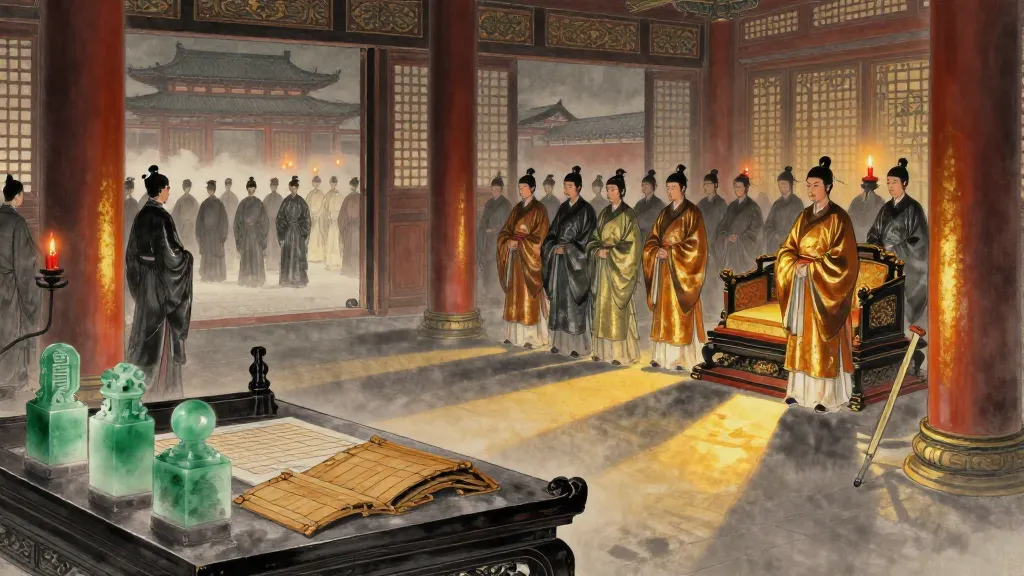
韓信盧綰列傳 (Biographies of Han Xin, King of Han, and Lu Wan) — Chinese ink painting

Chapter 93 of 130

韓信盧綰列傳

Biographies of Han Xin, King of Han, and Lu Wan

View:

韓王信降漢與遷邊

Han Xin, King of Han, Submits to Han and Is Relocated to the Border

韓王信者,故韓襄王孽孫也。及項梁之立楚後懷王也,立韓諸公子橫陽君成為韓王。沛公引兵擊陽城,使張良以韓司徒降下韓故地,得信,以為韓將。漢王還定三秦,乃許信為韓王。漢五年春,遂與剖符為韓王,王潁川。

明年春,上以韓信材武,所王北近鞏、洛,南迫宛、葉,皆天下勁兵處,乃詔徙韓王信王太原以北,備御胡,都晉陽。信上書請治馬邑。秋,匈奴冒頓大圍信,信數使使胡求和解。漢疑信有二心。信恐誅,因與匈奴約共攻漢,反,以馬邑降胡。

Han Xin, King of Han, was a collateral descendant of King Xiang of the old Han state. When Xiang Liang restored the Chu line, the Han royal house was also restored, with Hengyang Jun Cheng as King of Han. The Duke of Pei sent Zhang Liang to subdue the old Han territories and acquired Han Xin as a commander. After pacifying the Three Qins, the King of Han confirmed Han Xin as King of Han. In the spring of the fifth year, he received the tally as King of Han, ruling Yingchuan.

The following spring, the Emperor judged that Han Xin's territory — near the strategic regions of Gong, Luo, Wan, and Ye — was too close to the realm's military heartland. He decreed that Han Xin be relocated to rule north of Taiyuan and defend against the Hu, with his capital at Jinyang. Han Xin petitioned to govern from Mayi instead. That autumn, the Xiongnu under Maodun besieged him in force. Han Xin repeatedly sent envoys to negotiate with the Xiongnu. Han suspected him of disloyalty. Fearing execution, Han Xin allied with the Xiongnu to attack Han, surrendered Mayi to the barbarians, and defected.

Notes

1person韓王信Hán Wáng Xìn

Han Xin, King of Han (韓王信, d. 196 BC) should not be confused with the more famous Han Xin, Marquis of Huaiyin. This Han Xin was a descendant of the Han royal house who was made King of Han but defected to the Xiongnu after being relocated to the northern frontier.

2person冒頓Mòdú

Maodun (冒頓, r. 209-174 BC) was the founder of the Xiongnu empire, who unified the steppe peoples and posed the greatest external threat to the early Han dynasty.

白登之圍與韓信之死

The Siege of Baideng and Han Xin's Death

七年冬,上自往擊,破信軍銅鞮。信亡走匈奴。上遂至平城。上出白登,匈奴騎圍上,上乃使人厚遺閼氏。閼氏乃說冒頓。居七日,胡騎稍引去。

十一年春,故韓王信復與胡騎入居參合。漢使柴將軍擊之。韓王信報曰:“今仆有三罪於陛下,而欲求活於世,此伍子胥所以僨於吳也。仆之思歸,如痿人不忘起,盲者不忘視也,勢不可耳。”遂戰。柴將軍屠參合,斬韓王信。

In the winter of the seventh year, the Emperor personally led an attack, shattering Han Xin's army at Tongdi. Han Xin fled to the Xiongnu. The Emperor advanced to Pingcheng. At Baideng, the Xiongnu cavalry surrounded the Emperor. He sent generous gifts to the Chanyu's consort, who persuaded Maodun to lift the siege. After seven days, the Xiongnu cavalry gradually withdrew.

In the spring of the eleventh year, the former King Han Xin returned with Xiongnu cavalry and occupied Canhe. Han sent General Chai to attack. Han Xin wrote in reply: "I now bear three crimes against Your Majesty, yet I wish to live in this world — this is why Wu Zixu came to grief in Wu. My longing to return home is like a paralyzed man who never forgets standing, or a blind man who never forgets seeing — but circumstances make it impossible." They fought. General Chai destroyed Canhe and killed Han Xin.

Notes

1place

Baideng (白登), near modern Datong, Shanxi, was where Emperor Gaozu was surrounded by Maodun's forces for seven days in 200 BC. The humiliation shaped Han frontier policy for decades.

2context

Han Xin's final letter is one of the most poignant passages in this chapter — a man trapped between empires, longing for home but knowing return means death.

盧綰從高祖與叛走匈奴

Lu Wan Follows Gaozu and Flees to the Xiongnu

盧綰者,豐人也,與高祖同里。盧綰親與高祖太上皇相愛,及生男,高祖、盧綰同日生。高祖為布衣時,盧綰常隨出入上下。漢五年八月,乃立盧綰為燕王。

漢十二年,燕王綰悉將其宮人家屬騎數千居長城下,侯伺,幸上病癒,自入謝。四月,高祖崩,盧綰遂將其眾亡入匈奴。綰為蠻夷所侵奪,常思復歸。居歲餘,死胡中。

Lu Wan was a man of Feng, from the same village as the future Emperor Gaozu. Their fathers were close friends, and Gaozu and Lu Wan were born on the same day. When Gaozu was still a commoner, Lu Wan was his constant companion. In the eighth month of the fifth year, Lu Wan was made King of Yan.

In the twelfth year, Lu Wan gathered his palace women, family, and several thousand cavalry at the Great Wall, watching and waiting, hoping the Emperor would recover so he could go in person and beg forgiveness. In the fourth month, Emperor Gaozu died. Lu Wan then led his followers across the frontier into Xiongnu territory. The barbarians mistreated and plundered him, and he constantly longed to return. After a little over a year, he died among the Hu.

Notes

1person盧綰Lú Wǎn

Lu Wan (盧綰, d. 194 BC) was Emperor Gaozu's childhood friend from the same village, born on the same day. Made King of Yan, he was the last of the non-Liu kings. Accused of conspiracy, he fled to the Xiongnu rather than face trial.

2context

Lu Wan's story is tragic: the closest personal friend of the Emperor, yet unable to escape the logic that drove the Han dynasty to eliminate all non-Liu kings. His death in exile among people who despised him completes the pattern.

陳豨之反與太史公論

Chen Xi's Rebellion and the Grand Historian's Assessment

陳豨者,宛朐人也。高祖七年,封豨為列侯,以趙相國將監趙、代邊兵。豨常告歸過趙,賓客隨之者千餘乘。周昌見之,恐有變。高祖十年七月,豨遂與王黃等反,自立為代王。高祖十二年冬,樊噲軍卒追斬豨於靈丘。

太史公曰:韓信、盧綰非素積德累善之世,徼一時權變,以詐力成功。內見疑彊大,外倚蠻貊以為援,卒赴匈奴,豈不哀哉!

Chen Xi was a man of Yuanqu. In the seventh year of Gaozu, he was enfeoffed as a marquis and appointed chancellor of Zhao to supervise the border troops in Zhao and Dai. Whenever Chen Xi traveled through Zhao on home leave, over a thousand carriages of retainers followed him. Zhou Chang saw this and warned of trouble. In the seventh month of the tenth year, Chen Xi revolted with Wang Huang and others, declaring himself King of Dai. In the winter of the twelfth year, Fan Kuai's troops pursued and killed Chen Xi at Lingqiu.

The Grand Historian remarks: Han Xin and Lu Wan did not come from families that had accumulated generations of virtue and merit. They exploited the opportunities of a moment through cleverness and force. Internally they were suspected for being too powerful; externally they relied on barbarian peoples for support. In the end they fled to the Xiongnu — how pitiful!

Notes

1person陳豨Chén Xī

Chen Xi (陳豨, d. 195 BC) was a Han official who governed the Zhao-Dai border region. His lavish treatment of retainers and eventual rebellion followed the pattern of over-mighty subjects that haunted the early Han.

2context

Sima Qian's assessment points to the structural tragedy of the early Han: men who gained power through the civil war found themselves trapped between an emperor who distrusted them and barbarian neighbors who offered temporary refuge but no real safety.

Edition & Source

Text
《史記》 Shiji
Edition
中華古詩文古書籍網 transcription
Commentary
裴駰《史記集解》、司馬貞《史記索隱》、張守節《史記正義》(Three Commentaries)