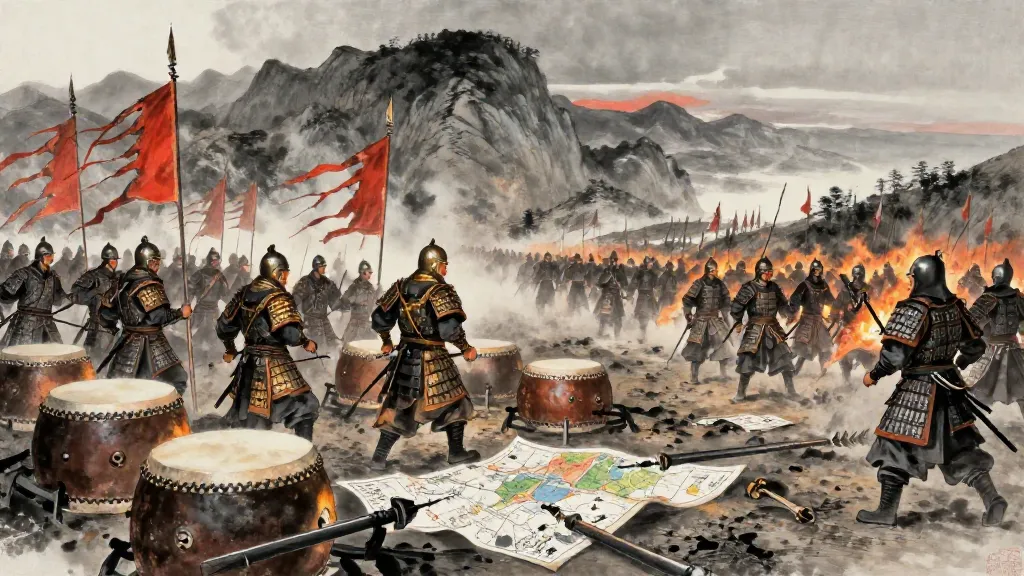
田儋列傳 (Biography of the Tian Clan of Qi) — Chinese ink painting

Chapter 94 of 130

田儋列傳

Biography of the Tian Clan of Qi

View:

田儋起兵復齊

Tian Dan Raises an Army and Restores Qi

田儋者,狄人也,故齊王田氏族也。儋從弟田榮,榮弟田橫,皆豪,宗彊,能得人。陳涉之初起王楚也,使周市略定魏地,北至狄。田儋詳為縛其奴,因擊殺狄令,遂自立為齊王。秦將章邯夜銜枚擊,殺田儋於臨濟下。

Tian Dan was a man of Di, from the old royal Tian clan of Qi. His cousins Tian Rong and Tian Heng were all powerful men who commanded strong clan networks. When Chen Sheng's uprising began, Tian Dan pretended to be bringing a slave for punishment, then used the opportunity to kill the magistrate of Di and declared himself King of Qi. The Qin general Zhang Han launched a night attack with gags in his soldiers' mouths and killed Tian Dan below Linji.

Notes

1person田儋Tián Dān

Tian Dan (田儋, d. 208 BC) was the first of the Tian brothers to restore the Qi kingdom during the anti-Qin uprisings. He should not be confused with the earlier Tian Dan of Qi who recovered Qi from Yan during the Warring States period.

2context

The Tian clan of Qi descended from the Tian family that had usurped the Qi throne from the Jiang family in 386 BC. Their strong clan identity drove repeated attempts to restore Qi's independence during the Qin-Han transition.

田榮拒救楚與項羽伐齊

Tian Rong Refuses to Aid Chu and Xiang Yu Invades Qi

田榮怒齊之立假,乃引兵歸,擊逐齊王假。田榮乃立田儋子市為齊王。項梁使使告趙、齊,發兵共擊章邯。田榮曰:“使楚殺田假,趙殺田角、田間,乃肯出兵。”楚、趙不聽。章邯果敗殺項梁。項羽由此怨田榮。

項王既歸,田榮使人助陳餘,而榮亦發兵以距擊田都。田榮乃自立為齊王,盡並三齊之地。項王聞之,大怒,乃北伐齊。齊王田榮兵敗,走平原,平原人殺榮。

Tian Rong was furious that Qi had installed Tian Jia as king. He led his army back, drove out King Jia, and installed Tian Dan's son Shi as King of Qi. When Xiang Liang asked Qi and Zhao to send troops against Zhang Han, Tian Rong demanded that Chu kill Tian Jia and Zhao kill the Tian princes first. Chu and Zhao refused. Zhang Han then defeated and killed Xiang Liang. Xiang Yu never forgave Tian Rong.

After Xiang Yu's return from the west, Tian Rong sent forces to help Chen Yu and attacked the Xiang-appointed kings, making himself King of Qi over all three Qi territories. Xiang Yu was enraged and marched north against Qi. Tian Rong's army was defeated; he fled to Pingyuan, where the local people killed him.

Notes

1context

Tian Rong's stubborn refusal to help against Zhang Han unless his personal grudges were satisfied directly caused Xiang Liang's death and Xiang Yu's invasion of Qi — a cascade of consequences from petty clan politics.

田橫五百士

Tian Heng and the Five Hundred Followers

漢滅項籍,田橫懼誅,而與其徒屬五百餘人入海,居島中。高帝使使赦田橫罪而召之。田橫乃與其客二人乘傳詣雒陽。未至三十里,橫謂其客曰:“橫始與漢王俱南面稱孤,今漢王為天子,而橫乃為亡虜而北面事之,其恥固已甚矣。”遂自剄,令客奉其頭馳奏高帝。高帝曰:“起自布衣,兄弟三人更王,豈不賢乎哉!”為之流涕,以王者禮葬田橫。既葬,二客皆自剄下從之。其餘五百人在海中,聞田橫死,亦皆自殺。

After Han destroyed Xiang Yu, Tian Heng, fearing execution, fled with over five hundred followers to an island in the sea. Emperor Gaozu sent an envoy pardoning him and summoning him to court. Tian Heng set out with two retainers for Luoyang. Thirty li from the capital, he told his companions: "I once faced south and called myself a solitary lord, the equal of the King of Han. Now the King of Han is Emperor, and I am a fugitive who would have to face north and serve him — the shame is already unbearable." He cut his own throat and had his retainers carry his head at a gallop to present to the Emperor. The Emperor said: "Rising from commoner origins, three brothers took turns as king — were they not remarkable men?" He wept for Tian Heng and buried him with royal rites. After the burial, the two retainers both cut their throats and followed him in death. The remaining five hundred followers on the island, upon hearing of Tian Heng's death, all killed themselves as well.

Notes

1person田橫Tián Héng

Tian Heng (田橫, d. 202 BC) was the last of the three Tian brothers who fought to restore Qi. His suicide and the mass suicide of his five hundred followers became one of the most famous loyalty narratives in Chinese history.

2context

The mass suicide of Tian Heng's five hundred followers had no parallel in Chinese history. It demonstrated the extraordinary personal loyalty the Tian brothers inspired — and provided Sima Qian with his closing image of what genuine devotion looked like, in contrast to the hollow friendship of Zhang Er and Chen Yu.

Edition & Source

Text
《史記》 Shiji
Edition
中華古詩文古書籍網 transcription
Commentary
裴駰《史記集解》、司馬貞《史記索隱》、張守節《史記正義》(Three Commentaries)