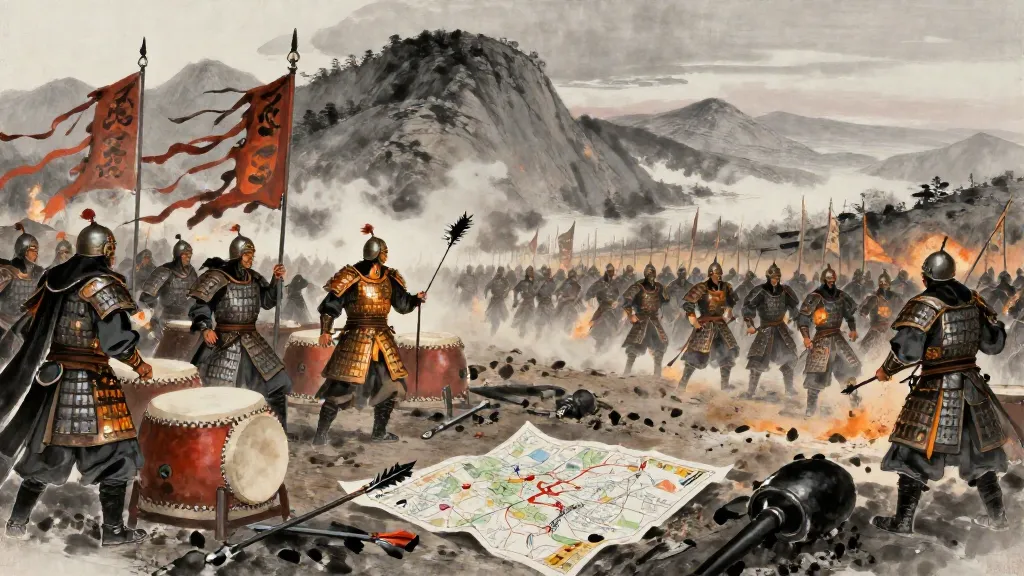
樊酈滕灌列傳 (Biographies of Fan Kuai, Li Shang, Teng Gong, and Guan Ying) — Chinese ink painting

Chapter 95 of 130

樊酈滕灌列傳

Biographies of Fan Kuai, Li Shang, Teng Gong, and Guan Ying

View:

樊噲從高祖起兵

Fan Kuai Rises with Gaozu

舞陽侯樊噲者,沛人也。以屠狗為事,與高祖俱隱。初從高祖起豐,攻下沛。從攻胡陵、方與,還守豐。常從,沛公擊章邯軍濮陽。從攻雍、斄城,先登。攻武關,至霸上,斬都尉一人。

Fan Kuai, Marquis of Wuyang, was a man of Pei. He made his living as a dog butcher and had been a companion of Gaozu since their early days. He followed Gaozu from the first rising at Feng, taking part in the capture of Pei. He served in campaigns against Huling, Fangyu, and the defense of Feng. He regularly accompanied the Duke of Pei in striking Zhang Han's army at Puyang. He was first to scale the walls at Yong, Si, and other cities. He fought his way through Wuguan Pass to Bashang, killing a commandant.

Notes

1person樊噲Fán Kuài

Fan Kuai (樊噲, d. 189 BC), Marquis of Wuyang, was Emperor Gaozu's closest military companion. A former dog butcher, he fought in virtually every campaign of the founding and married a sister of Empress Lu.

鴻門宴上護沛公

Fan Kuai Saves the Duke of Pei at the Hongmen Banquet

項羽在戲下,欲攻沛公。沛公從百餘騎因項伯面見項羽。項羽既饗軍士,中酒,亞父謀欲殺沛公,令項莊拔劍舞坐中。時獨沛公與張良得入坐,樊噲在營外,聞事急,乃持鐵盾入到營。營衛止噲,噲直撞入,立帳下。項羽目之,問為誰。項羽曰:“壯士。”賜之卮酒彘肩。噲既飲酒,拔劍切肉食,盡之。項羽曰:“能復飲乎?”噲曰:“臣死且不辭,豈特卮酒乎!”項羽默然。沛公如廁,麾樊噲去。是日微樊噲奔入營譙讓項羽,沛公事幾殆。

Xiang Yu at Hongmen intended to attack the Duke of Pei. The Duke came with a hundred cavalry to see Xiang Yu through Xiang Bo's mediation. During the feast, Fan Zeng plotted to kill the Duke, ordering Xiang Zhuang to dance with a sword. Only the Duke and Zhang Liang were admitted; Fan Kuai was outside the camp. Hearing the crisis, he seized an iron shield and forced his way past the guards, standing beneath the canopy. Xiang Yu stared at him and asked who he was. Told he was the Duke of Pei's bodyguard, Xiang Yu said: "A brave man!" and gave him a goblet of wine and a pork shoulder. Fan Kuai drained the wine, drew his sword, sliced the pork on the shield, and ate every bit. Xiang Yu asked: "Can you drink more?" Fan Kuai replied: "I would not refuse death itself — why would I refuse wine?" Xiang Yu fell silent. The Duke slipped out to the latrine and beckoned Fan Kuai to leave. Had Fan Kuai not burst into the camp and confronted Xiang Yu that day, the Duke's life would have been in grave danger.

Notes

1context

The Hongmen Banquet (鴻門宴, 206 BC) is one of the most famous episodes in Chinese history. Fan Kuai's dramatic entrance — bursting past guards with a shield — and his defiant drinking and meat-eating before Xiang Yu became the defining image of his character.

酈商從漢定天下

Li Shang Follows Han to Pacify the Realm

曲周侯酈商者,高陽人。陳勝起時,商聚少年東西略人,得數千。沛公略地至陳留,商以將卒四千人屬沛公。從沛公攻緱氏,絕河津,破秦軍洛陽東。從攻下宛、穰,定十七縣。漢王賜商爵信成君。以隴西都尉從擊項籍軍五月。項羽已死,從擊荼,戰龍脫,先登陷陣。剖符世世勿絕,食邑涿五千戶,號曰涿侯。

Li Shang, Marquis of Quzhou, was a man of Gaoyang. When Chen Sheng's uprising began, Li Shang gathered young men and recruited several thousand. When the Duke of Pei reached Chenliu, Li Shang joined with four thousand troops. He fought at Goushi, cut the Yellow River crossings, and broke Qin forces east of Luoyang. He helped take Wan, Rang, and seventeen counties. The King of Han gave him the title Lord of Xincheng. He served five months fighting Xiang Yu's army. After Xiang Yu's death, he fought at Longtuo against Zang Tu, being first to breach the enemy lines. He received a perpetual tally, with five thousand households at Zhuo, titled Marquis of Zhuo.

Notes

1person酈商Lì Shāng

Li Shang (酈商, d. 180 BC), Marquis of Quzhou, was the younger brother of Li Yiji (酈食其), the famous persuader who was boiled alive by the King of Qi. Li Shang had a long military career and his son Li Kuang played a crucial role in the suppression of the Lu clan.

夏侯嬰護孝惠與灌嬰功業

Xiahou Ying Saves the Heir and Guan Ying's Exploits

汝陰侯夏侯嬰,沛人也。為沛廄司御。從高祖起豐。漢王敗,馳去。見孝惠、魯元,載之。漢王急,馬罷,虜在後,常蹶兩兒欲棄之,嬰常收,竟載之,徐行面雍樹乃馳。漢王怒,行欲斬嬰者十餘,卒得脫,而致孝惠、魯元於豐。

潁陰侯灌嬰者,睢陽販繒者也。以中涓從擊破東郡尉。漢王擇軍中可為騎將者,拜灌嬰為中大夫,將郎中騎兵。項籍敗垓下去也,嬰以御史大夫受詔將車騎別追項籍至東城。所將卒五人共斬項籍。絳侯勃免相就國,嬰為丞相。

Xiahou Ying, Marquis of Ruyin, was a man of Pei who served as the stable master's charioteer. He followed Gaozu from the first rising at Feng. After the King of Han's defeat at Pengcheng, the King fled by chariot. He found the future Emperor Hui and Princess Lu Yuan and took them aboard. The pursuit was close, the horses exhausted, and the King repeatedly kicked the two children off the chariot to lighten the load. Each time, Xiahou Ying picked them up and kept them on board, driving slowly, shielding them with his body. The King was so enraged he tried to kill Xiahou Ying over ten times, but Xiahou Ying ultimately brought both children safely to Feng.

Guan Ying, Marquis of Yingyin, was a silk merchant from Suiyang. He joined as a close attendant and fought in the campaign against the commandant of Dongjun. The King of Han sought a cavalry commander; Guan Ying was appointed and given command of the palace cavalry. When Xiang Yu fled after his defeat at Gaixia, Guan Ying led the cavalry pursuit to Dongcheng, where five of his soldiers together killed Xiang Yu. When Marquis Jiang Bo resigned as chancellor, Guan Ying succeeded him as chancellor.

Notes

1person夏侯嬰Xiàhóu Yīng

Xiahou Ying (夏侯嬰, d. 172 BC), Marquis of Ruyin, also known as Teng Gong (滕公), was Gaozu's personal charioteer throughout the entire founding war. His rescue of the future Emperor Hui and Princess Lu Yuan from the Pengcheng rout was one of the most dramatic episodes of the war.

2person灌嬰Guàn Yīng

Guan Ying (灌嬰, d. 176 BC), Marquis of Yingyin, rose from being a silk merchant to cavalry commander and eventually chancellor. He was part of the team that physically killed Xiang Yu at Dongcheng.

3context

The scene of Emperor Gaozu repeatedly kicking his own children off the fleeing chariot while Xiahou Ying kept saving them is one of the most revealing character portraits in the Shiji — showing Gaozu's ruthless pragmatism and Xiahou Ying's stubborn decency.

Edition & Source

Text
《史記》 Shiji
Edition
中華古詩文古書籍網 transcription
Commentary
裴駰《史記集解》、司馬貞《史記索隱》、張守節《史記正義》(Three Commentaries)