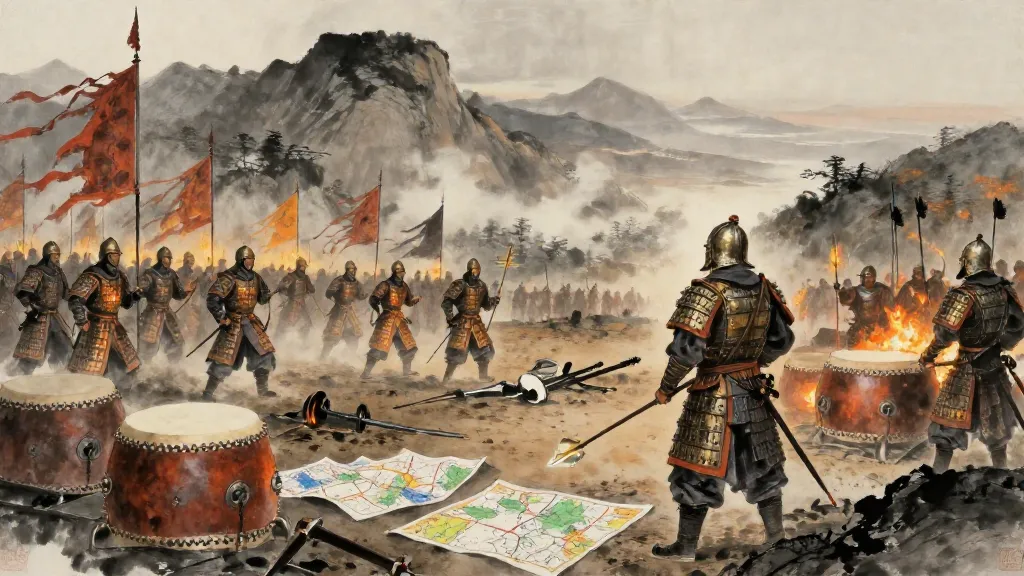
八陣 (The Eight Formations) — Chinese ink painting

孫臏兵法 Sun Bin Bingfa · Chapter 7

八陣

The Eight Formations

View:

知道者為王者之將

The General Who Knows the Way Serves as Commander of Kings

孫子曰:智不足,將兵,自恚也。勇不足,將兵,自廣也。不知道,數戰不足,將兵,幸也。夫安萬乘國,廣萬乘王,全萬乘之民命者,唯知道。知道者,上知天之道,下知地之理,內得其民之心,外知敵之情,陣則知八陣之經,見勝而戰,弗見而諍,此王者之將也。

Sun Bin said: To command troops with insufficient wisdom is to invite self-inflicted frustration. To command troops with insufficient courage is to overextend oneself. To command troops without understanding the Way, relying on frequent battles and inadequate resources, is to depend on luck. To secure a state of ten thousand chariots, to expand the territory of a king of ten thousand chariots, to preserve the lives of a people of ten thousand chariots — only understanding the Way can accomplish this. One who understands the Way knows the patterns of heaven above, knows the principles of earth below, wins the hearts of his people within, and knows the enemy's situation without. In deploying formations he knows the principles of the eight formations. He fights when he sees victory and holds back when he does not. This is the commander worthy of a king.

Notes

1context

The 'eight formations' (八陣) is one of the most important tactical concepts in Chinese military history. Later attributed in legend to Zhuge Liang, the concept originates in earlier military thought. Sun Bin's version emphasizes that mastery of formations requires comprehensive understanding — heaven, earth, people, and the enemy.

用八陣之法

Methods of Employing the Eight Formations

孫子曰:用八陣戰者,因地之利,用八陣之宜。用陣三分,誨陣有鋒,誨鋒有後,皆侍令而動。斗一,守二。以一侵敵,以二收。敵弱以亂,先其選卒以乘之。敵強以治,先其下卒以誘之。車騎與戰者,分以為三,一在於右,一在於左,一在於後。易則多其車,險則多其騎,厄則多其弩。險易必知生地、死地,居生擊死。

Sun Bin said: Those who fight using the eight formations adapt to the terrain's advantages and employ the appropriate formation. Divide the formation into three parts. Each formation has a vanguard, and each vanguard has a rear guard. All await orders before moving. Use one part to fight and two to hold in reserve. With one part attack the enemy; with two parts consolidate. If the enemy is weak and disordered, lead with elite troops to exploit the opening. If the enemy is strong and well-organized, lead with inferior troops to lure him. When chariots and cavalry engage in battle, divide them into three groups: one on the right, one on the left, one in the rear. On level ground, increase the chariots. On rugged ground, increase the cavalry. In narrow passes, increase the crossbowmen. Whether the terrain is rugged or level, you must know which is viable ground and which is deadly ground — occupy the viable and strike toward the deadly.

Notes

1context

The principle of 'fight with one, hold with two' (斗一守二) represents a 1:2 commitment ratio — one-third of forces engage while two-thirds remain in reserve. This conservative approach ensures the commander always retains uncommitted forces to exploit success or cover retreat. The terrain-weapon matching (level/chariots, rough/cavalry, narrow/crossbows) is a foundational principle of combined-arms tactics.

Edition & Source

Text
《孫臏兵法》 Sun Bin Bingfa
Edition
中華古詩文古書籍網 transcription (Yinqueshan bamboo strips reconstruction)
Commentary
Modern reconstruction from 1972 Yinqueshan tomb excavation