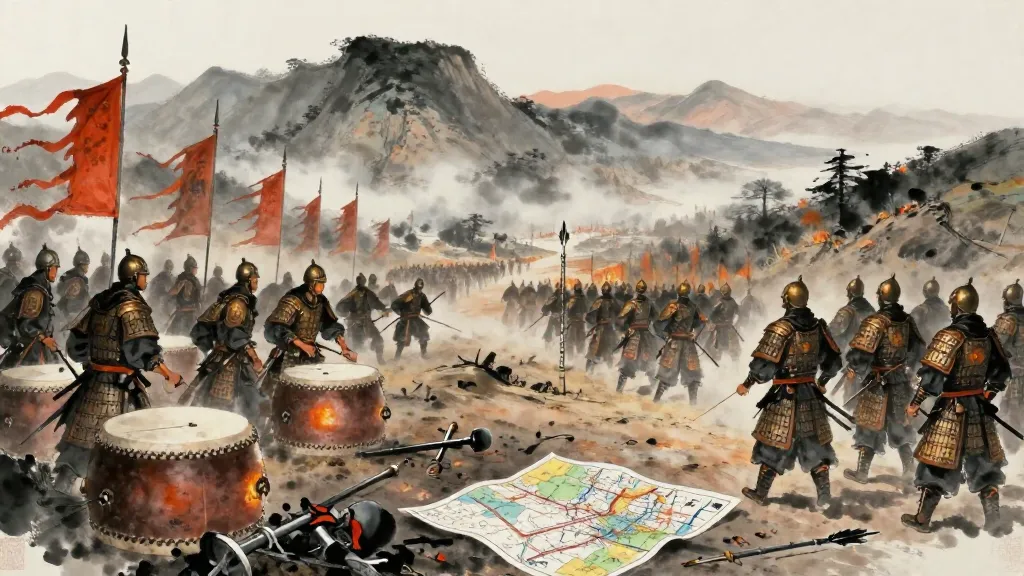
官一 (Offices, Part One) — Chinese ink painting

孫臏兵法 Sun Bin Bingfa · Chapter 14

官一

Offices, Part One

View:

處卒利陣之法

Methods for Positioning Troops and Advantageous Formations

孫子曰:凡處卒利陣體甲兵者,立官則以身宜,賤令以采章,乘削以倫物,序行以□□,制卒以州閭,授正以鄉曲,辨疑以旌輿,申令以金鼓,齊兵以從跡,庵結以人雄,邋軍以索陣,茭肆以囚逆,陳師以危□,射戰以雲陣,御裹以羸渭,取啄以闔燧,即敗以包□,奔救以皮傅,燥戰以錯行。

Sun Bin said: In all matters of positioning troops, arranging advantageous formations, equipping armor and weapons: establish offices based on the person's suitability. Differentiate commands using colored insignia. Assign chariots based on systematic classification. Order the ranks by [lacuna]. Organize troops by administrative districts. Assign commands by native regions. Resolve confusion using banners and pennants. Transmit orders using gongs and drums. Align troops by following tracks. Secure encampments with heroic men. Control an entangled army by seeking out formations. Bind and display prisoners to deter rebellion. Deploy the army using dangerous [lacuna]. For archery combat use cloud formations. For defensive encirclement use the enveloping method. For taking fortifications use fire signals. When defeated, use envelopment [lacuna]. For emergency rescue use close-contact support. For dry-terrain combat use interlaced marching.

Notes

1context

This chapter is a dense catalog of military organizational principles, almost encyclopedic in nature. Each line prescribes a specific administrative or tactical technique for a specific situation. Many of the technical terms are obscure, and the fragmentary nature of the bamboo strips makes some passages uncertain. The chapter title '官一' (Offices, Part One) suggests this was the first of a multi-part treatment of military organization.

用兵之法

Methods for Employing Different Troop Types

用□以正□,用輕以正散,攻兼用行城,□地□□用方,迎陵而陣用刲,險□□□用圜,交易武退用兵,□□陳臨用方翼,汜戰接厝用喙逢,囚險解谷以□遠,草駔沙荼以陽削,戰勝而陣以奮國,而..為畏以山胠。秦怫以透迤,便罷以雁行,險厄以雜管。還退以蓬錯,繞山林以曲次,襲國邑以水則,辨夜退以明簡,夜警以傳節。

Use [heavy troops] to rectify [lacuna]. Use light troops to rectify scattered formations. For combined assault use mobile siege towers. On [lacuna] ground use square formations. When facing hills and deploying, use the cleaving formation. On dangerous [lacuna] ground use circular formations. For alternating advance and retreat use armed force. For [lacuna] deployment facing the enemy use flanked square formations. For general engagement at close quarters use the beak formation. To escape from dangerous terrain and exit valleys, use [lacuna] distance marching. On grassy, sandy, and marshy terrain, use yang-cutting methods. After winning a battle, form up to invigorate the state. To [...] create fear, use the mountain-flank formation. Against Qin's fury, use the winding march. For convenience and ease, use the goose formation. In dangerous defiles, use mixed pipes [for signals]. For withdrawal, use the tangled-bramble formation. To encircle mountain forests, use curved sequential deployment. To raid cities and towns, use the water method. To manage nighttime withdrawal, use bright tallies. For night watch, use transmitted tokens.

Notes

1context

This passage catalogs dozens of tactical situations with their prescribed formation or method. Many terms are specialized military jargon whose precise meanings have been debated by scholars. The mention of 'Qin's fury' (秦怫) is notable as a specific reference to a rival state's characteristic combat style, suggesting this text was composed when Qin was already a significant military threat.

諸陣之用

The Uses of Various Formations

厝入內寇以棺士,遇短乒以必輿,火輸積以車。陣刃以錐行,陣少卒以合雜。合雜,所以御裹也。修行連削,所以結陣也。雲折重雜,所以權趮也。猋凡振陳,所以乘疑也。隱匿謀詐,所以釣戰也。龍隋陳伏,所以山斗也。□□乖舉,所以厭津也。□□□卒,所以□□也。不意侍卒,所以昧戰也。遏溝□陳,所以合少也。疏削明旗,所以疑敵也。剽陣車,所以從遺也。椎下移師,所以備強也。浮沮而翼,所以燧斗也。禪蘩避,所以莠也。筒練剽便,所以逆喙也。堅陣敦□,所以攻槥也。揆斷藩薄,所以眩疑也。偽遺小亡,所以聭敵也。重害,所以茭□也。順明到聲,所以夜軍也。佰奉離積,所以利勝也。剛者,所以御劫也。更者,所以過□也。□者,所以御□也。..者,所以厭□也。胡退侍入,所以解困也。

For penetrating raids into enemy territory, use coffin soldiers. When encountering short-range troops, always use chariots. For burning accumulated supplies, use wagons. Deploy blades in wedge formation. When deploying with few troops, use combined mixed formations. Combined mixed formations are used to resist encirclement. Extended ranks linked together are used to bind the formation. Cloud-folding overlapping mixed deployments are used for leveraged maneuver. Whirlwind general shaking formations are used to exploit the enemy's uncertainty. Concealment and deception are used to bait the enemy into battle. Dragon-trail formations with ambush are used for mountain combat. [Lacuna] divergent deployment is used to dominate river crossings. [Lacuna] troops are used for [lacuna]. Unexpected reserve troops are used for concealed battle. Blocking ditches [lacuna] formations are used to concentrate small forces. Sparse ranks with prominent flags are used to create doubt in the enemy. Fast chariot formations are used to pursue retreating forces. Hammer-down repositioning is used to guard against strong enemies. Floating on marshes with wings extended is used for fire-signal combat. [Lacuna] avoidance is used for [lacuna]. Streamlined, trained, fast, and agile troops are used to counter the beak formation. Solid formation with dense [lacuna] is used to assault fortifications. Cutting hedges and palisades is used to dazzle and confuse. Feigning the abandonment of small things is used to lure the enemy. Heavy damage is used to [lacuna]. Following light and arriving at sound is used for night operations. Distributing supplies from separate stockpiles is used to benefit from victory. Hardness is used to resist sudden attacks. Rotation is used to [lacuna]. [Lacuna] is used to resist [lacuna]. [Lacuna] is used to suppress [lacuna]. Strategic withdrawal awaiting entry is used to break free from encirclement.

Edition & Source

Text
《孫臏兵法》 Sun Bin Bingfa
Edition
中華古詩文古書籍網 transcription (Yinqueshan bamboo strips reconstruction)
Commentary
Modern reconstruction from 1972 Yinqueshan tomb excavation