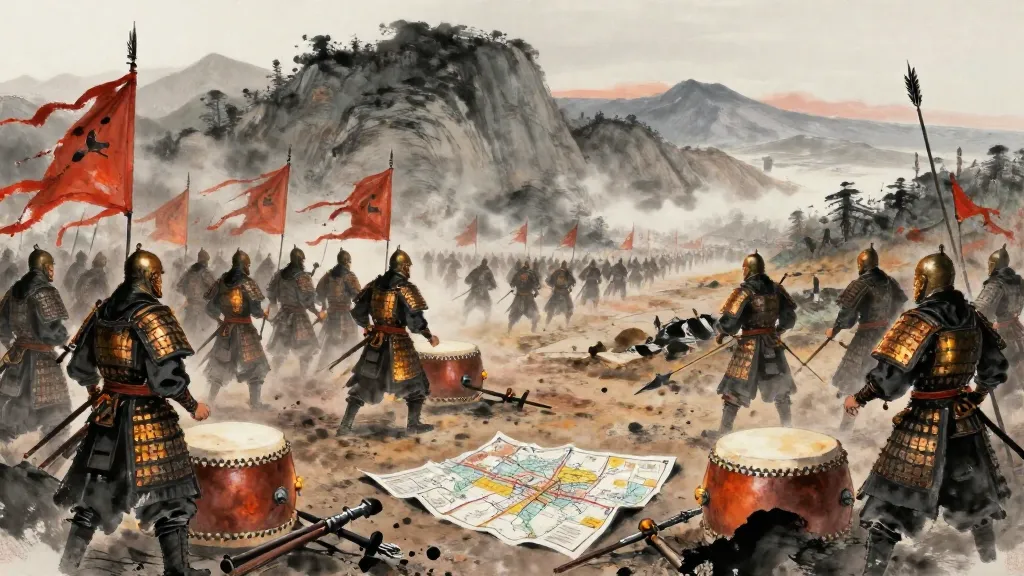
客主人分 (The Division Between Guest and Host) — Chinese ink painting

孫臏兵法 Sun Bin Bingfa · Chapter 19

客主人分

The Division Between Guest and Host

View:

客主之勢

The Strategic Positions of Attacker and Defender

兵有客之分,有主人之分。客之分眾,主人之分少。客倍主人半,然可敵也。負..定者也。客者,後定者也。主人安地撫勢以胥。夫客犯隘逾險而至,夫犯隘..退則刎頸,進不敢拒敵,其故何也?勢不便,地不利也。勢便地利則民自..自退。所謂善者戰,便勢利地者也。

In warfare there is the role of the guest (attacker) and the role of the host (defender). The guest requires a larger share of troops; the host requires a smaller share. When the guest has double and the host has half, then they can match each other. [The host is] the one who is established first. The guest is the one who is established later. The host secures his ground and controls the situation while waiting. The guest must force through narrows and cross over dangerous terrain to arrive. Having forced through narrows [...] retreat means death, yet advancing they dare not confront the enemy. Why is this? Because the strategic situation is unfavorable and the terrain is disadvantageous. When the situation is favorable and the terrain advantageous, then the people will naturally [...] and naturally withdraw. What is called skillful warfare is making the situation favorable and the terrain advantageous.

Notes

1context

The guest-host (客主) distinction is a fundamental concept in Chinese military theory. The 'guest' (客) is the invading force that must operate on unfamiliar ground; the 'host' (主人) is the defender with knowledge of local terrain and established supply lines. Sun Bin establishes that the attacker needs at least a 2:1 numerical advantage to compensate for the defender's inherent advantages.

分兵之道

The Way of Dividing Forces

帶甲數十萬,民有餘糧弗得食也,有餘..居兵多而用兵少也,居者有餘而用者不足。帶甲數十萬,千千而出,千千而□之..萬萬以遺我。所謂善戰者,善翦斷之,如□會挩者也。能分人之兵,能按人之兵,則錙銖而有餘。不能分人之兵,不能按人之兵,則數倍而不足。

With hundreds of thousands of armored troops, the people have surplus grain yet cannot eat; there are surpluses [...]. Garrisoned troops are many but deployed troops are few; those in garrison have excess while those in the field are insufficient. With hundreds of thousands of armored troops, they go out by thousands and [lacuna] by thousands [...] tens of thousands to bequeath to us. What is called a skilled fighter is one who is skilled at cutting and severing, like [lacuna] one who unties knots. If you can divide the enemy's forces and suppress the enemy's forces, then even a tiny amount will have a surplus. If you cannot divide the enemy's forces and cannot suppress the enemy's forces, then even several times their number will be insufficient.

勝敗在道

Victory and Defeat Depend on the Way

眾者勝乎?則投算而戰耳。富者勝乎?則量粟而戰耳。兵利甲堅者勝乎?則勝易知矣。故富未居安也,貧未居危也;眾未居勝也,少未居敗也。以決勝敗安危者,道也。敵人眾,能使之分離而不相救也,受敵者不得相..以為固,甲堅兵利不得以為強,士有勇力不得以衛其將,則勝有道矣。故明主、知道之將必先□,可有功於未戰之前,故不失;可有之功於已戰之後,故兵出而有功,入而不傷,則明於兵者也。

Do the numerous always win? Then just count heads and fight. Do the wealthy always win? Then just measure grain and fight. Do those with sharp weapons and strong armor always win? Then victory would be easy to predict. Therefore wealth does not guarantee security, nor poverty danger. Numbers do not guarantee victory, nor scarcity defeat. What determines victory and defeat, security and danger, is the Way. If the enemy is numerous but you can cause them to be separated and unable to rescue each other, so the defenders cannot [...] make a stronghold, strong armor and sharp weapons cannot serve as strength, and soldiers with courage and power cannot protect their general — then there is a Way to victory. Therefore an enlightened ruler and a general who knows the Way must first [lacuna]; achievements can be had before battle is joined, so nothing is lost. Achievements can be had after battle is concluded, so the army goes out and succeeds, returns without harm — this is one who is enlightened in warfare.

客主散簡

Scattered Strips on Guest and Host

(以下為散簡)..焉。為人客則先人作....兵曰:主人逆客於境,....客好事則....使勞,三軍之士可使畢失其志,則勝可得而據也。是以按左抶右,右敗而左弗能救;按右扶左,左敗而右弗能救。是以兵坐而不起,避而不用,近者少而不足用,遠者疏而不能..

[The following are scattered strips.] ...As the guest (attacker), one must act before the enemy [...]. The military text says: the host intercepts the guest at the border [...]. If the guest is fond of taking action, then [...] cause them to be exhausted. When the soldiers of the three armies can all be made to lose their resolve, then victory can be grasped and held. Thus press the left and strike the right — the right is defeated and the left cannot rescue it. Press the right and support the left — the left is defeated and the right cannot rescue it. Thus troops sit and do not rise, avoid and are not employed. Those nearby are few and insufficient; those far away are dispersed and cannot [respond].

Notes

1context

The fragment describing the 'press left, strike right' (按左抶右) tactic is a concise formulation of the principle of defeating the enemy in detail — preventing mutual support between different elements of the enemy's force. This connects to the chapter's main thesis that dividing the enemy is more important than outnumbering him.

Edition & Source

Text
《孫臏兵法》 Sun Bin Bingfa
Edition
中華古詩文古書籍網 transcription (Yinqueshan bamboo strips reconstruction)
Commentary
Modern reconstruction from 1972 Yinqueshan tomb excavation