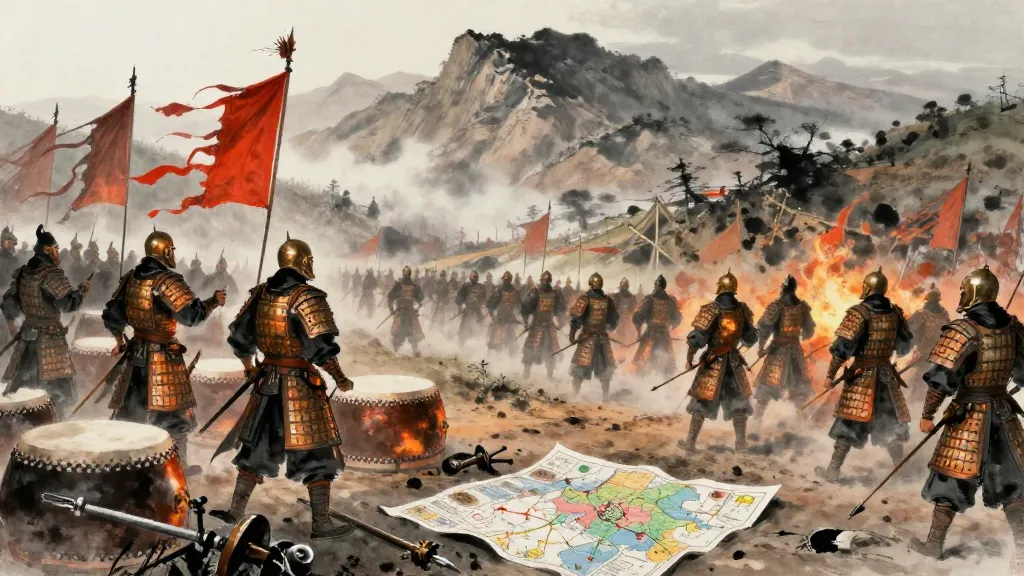
善者 (The Skilled Commander) — Chinese ink painting

孫臏兵法 Sun Bin Bingfa · Chapter 20

善者

The Skilled Commander

View:

善者制敵

The Skilled Commander Controls the Enemy

善者,敵人軍□人眾,能使分離而不相救也,受敵而不相知也。故溝深壘高不得以為固,車堅兵利不得以為威,士有勇力而不得以為強。故善者制險量阻,敦三軍,利屈伸,敵人眾能使寡,積糧盈軍能使飢,安處不動能使勞,得天下能使離,三軍和能使柴。

The skilled commander, when the enemy's army [lacuna] and men are numerous, is able to make them divide and not rescue each other, to receive attack and not be aware of each other. Thus deep moats and high ramparts cannot serve as a stronghold. Strong chariots and sharp weapons cannot serve as a deterrent. Soldiers with courage and strength cannot serve as a source of power. Therefore the skilled commander controls dangerous ground and measures obstacles, strengthens the three armies, and makes flexible use of advance and withdrawal. When the enemy is numerous, he can make them few. When supplies are abundant and the army full, he can make them hungry. When they are safely encamped and not moving, he can make them exhausted. When they hold the realm, he can make them isolated. When their three armies are united, he can make them fragmentary.

四路五動

Four Paths and Five Movements

故兵有四路、五動:進,路也;退,路也;左,路也;右,路也。進,動也;退,動也;左,動也;右,動也;默然而處,亦動也。善者四路必徹,五動必工。故進不可迎於前,退不可絕於後,左右不可陷於阻,默然而處,□□於敵之人。故使敵四路必窮,五動必憂。進則傅乾前,退則絕於後,左右則陷於阻,默然而處,軍不免於患。

Therefore an army has four paths and five movements. Advance is a path; retreat is a path; left is a path; right is a path. Advance is a movement; retreat is a movement; left is a movement; right is a movement; remaining still and holding position is also a movement. The skilled commander ensures all four paths are clear and all five movements are effective. Thus when advancing, the enemy cannot block the front; when retreating, the enemy cannot cut off the rear; moving left or right, the enemy cannot trap one in obstacles; holding still, [lacuna] against the enemy's forces. The aim is to make the enemy's four paths all blocked and five movements all perilous. When they advance, press upon their front; when they retreat, cut off their rear; when they move left or right, trap them in obstacles; when they hold still, the army cannot escape danger.

Notes

1context

The 'four paths, five movements' (四路五動) framework is one of Sun Bin's most distinctive theoretical contributions. By including stillness as a 'movement,' he emphasizes that remaining stationary is a deliberate tactical choice, not the absence of action. The asymmetric goal — keeping your own paths open while closing the enemy's — encapsulates the essence of operational art.

以逸待勞

Awaiting the Exhausted with the Rested

善者能使敵卷甲趨遠,倍道兼行,倦病而不得息,饑渴而不得食。以此薄敵,戰必不勝矣。我飽食而侍其飢也,安處以侍其勞也,正靜以侍其動也。故民見進而不見退,蹈白刃而不還踵。

The skilled commander can make the enemy roll up their armor and march far, covering double marches day and night, exhausted and sick without rest, hungry and thirsty without food. Engaging the enemy in this state, they will surely fail to win. We eat our fill and await their hunger. We rest securely and await their exhaustion. We remain calm and still and await their movement. Therefore the people see only advance and never retreat; they tread upon naked blades without turning their heels.

Notes

1context

The principle of 'awaiting the exhausted with the rested' (以逸待勞) became one of the Thirty-Six Stratagems. Sun Bin's formulation here is among the earliest and most complete articulations: the skilled commander manipulates the enemy into exhausting himself through forced marches while preserving his own forces in comfort. The final image — soldiers treading on blades without hesitation — describes the morale effect of this advantage.

Edition & Source

Text
《孫臏兵法》 Sun Bin Bingfa
Edition
中華古詩文古書籍網 transcription (Yinqueshan bamboo strips reconstruction)
Commentary
Modern reconstruction from 1972 Yinqueshan tomb excavation