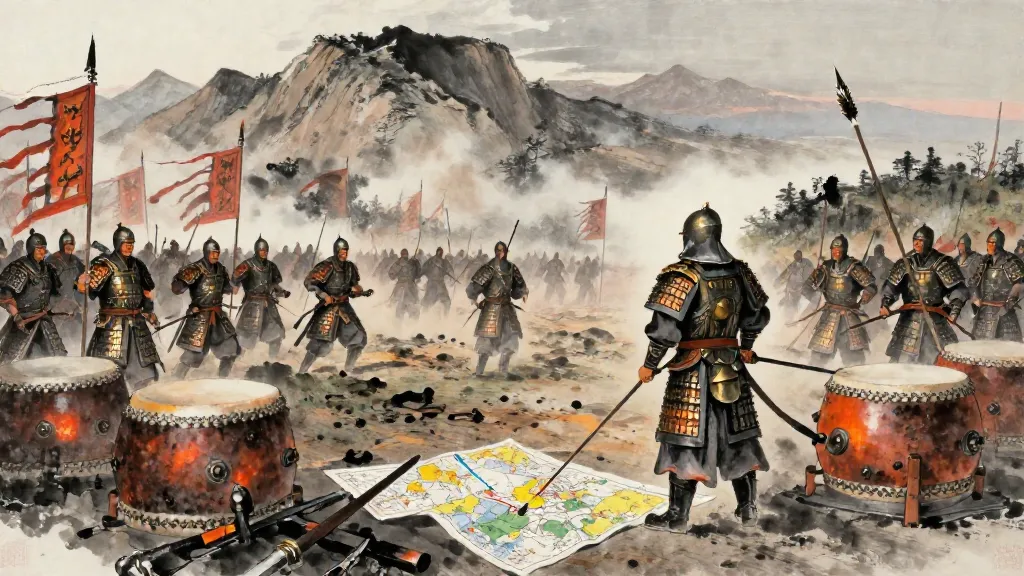
將失三十二條
Thirty-Two Errors of the General
將失:一曰,失所以往來,可敗也。二曰,收亂民而還用之,止北卒而還斗之,無資而有資,可敗也。三曰,是非爭,謀事辨訟,可敗也。四曰,令不行,眾不壹,可敗也。五曰,下不服,眾不為用,可敗也。六曰,民苦其師,可敗也。七曰,師老,可敗也。八曰,師懷,可敗也。九曰,兵遁,可敗也。十曰,兵□不□,可敗也。十一曰,軍數驚,可敗也。十二曰,兵道足陷,眾苦,可敗也。十三曰,軍事險固,眾勞,可敗也。十四曰,□□□備,可敗也。十五曰,日暮路遠,眾有至氣,可敗也。十六曰,..可敗也。十七曰,..眾恐,可敗也。十八曰,令數變,眾偷,可敗也。十九曰,軍淮,眾不能其將吏,可敗也。廿曰,多幸,眾怠,可敗也。廿一曰,多疑,眾疑,可敗也。廿二曰,惡聞其過,可敗也。廿三曰,與不能,可敗也。廿四曰,暴露傷志,可敗也。廿五曰,期戰心分,可敗也。廿六曰,恃人之傷氣,可敗也。廿七曰,事傷人,恃伏詐,可敗也。廿八曰,軍輿無□,可敗也。廿九曰,□下卒,眾之心惡,可敗也。卅曰,不能以成陣,出於夾道,可敗也。卅一曰,兵之前行後行之兵,不參齊於陣前,可敗也。卅二曰,戰而憂前者後虛,憂後者前虛,憂左者右虛,憂右者左虛,戰而有憂,可敗也。
The general's errors: First, losing control of movements to and fro — this can lead to defeat. Second, collecting disordered people and reusing them, stopping routed soldiers and making them fight again, having no resources yet acting as if one does — this can lead to defeat. Third, disputes over right and wrong, arguments and litigation over plans — this can lead to defeat. Fourth, orders not carried out and the masses not unified — this can lead to defeat. Fifth, subordinates not submissive and the masses not willing to serve — this can lead to defeat. Sixth, the people suffering from their army — this can lead to defeat. Seventh, the army being old and tired — this can lead to defeat. Eighth, the army being homesick — this can lead to defeat. Ninth, troops deserting — this can lead to defeat. Tenth, troops [lacuna] — this can lead to defeat. Eleventh, the army being frequently alarmed — this can lead to defeat. Twelfth, the march route trapping the army's feet and the masses suffering — this can lead to defeat. Thirteenth, military tasks being arduous and fortified, with the masses exhausted — this can lead to defeat. Fourteenth, [lacuna] preparations — this can lead to defeat. Fifteenth, dusk falling with a long road ahead and the masses losing their will — this can lead to defeat. Sixteenth, [lacuna] — this can lead to defeat. Seventeenth, [lacuna] and the masses being afraid — this can lead to defeat. Eighteenth, orders changing frequently and the masses becoming negligent — this can lead to defeat. Nineteenth, the army's [organization failing] and the masses not trusting their officers — this can lead to defeat. Twentieth, too much favoritism and the masses becoming negligent — this can lead to defeat. Twenty-first, too much suspicion and the masses becoming doubtful — this can lead to defeat. Twenty-second, hating to hear of one's own mistakes — this can lead to defeat. Twenty-third, associating with the incapable — this can lead to defeat. Twenty-fourth, exposure to the elements damaging morale — this can lead to defeat. Twenty-fifth, anticipating battle with a divided mind — this can lead to defeat. Twenty-sixth, relying on the enemy's depleted morale — this can lead to defeat. Twenty-seventh, harming people through deeds and relying on ambush and deception — this can lead to defeat. Twenty-eighth, military vehicles without [lacuna] — this can lead to defeat. Twenty-ninth, [mistreating] subordinate soldiers so the masses' hearts are resentful — this can lead to defeat. Thirtieth, being unable to form up and marching out through a defile — this can lead to defeat. Thirty-first, the front and rear ranks not aligned before the formation — this can lead to defeat. Thirty-second, in battle worrying about the front so the rear is empty, worrying about the rear so the front is empty, worrying about the left so the right is empty, worrying about the right so the left is empty — fighting with worry can lead to defeat.
Notes
This exhaustive catalog of thirty-two errors distinguishes itself from the previous chapter's character flaws (將敗) by focusing on operational and organizational mistakes. Where Chapter 25 addresses who the general is, this chapter addresses what the general does wrong. The final item — fighting while worrying about every direction — describes the paralysis of a commander who has lost the initiative and can only react to the enemy, a condition the 'four paths, five movements' doctrine of Chapter 20 is designed to prevent.