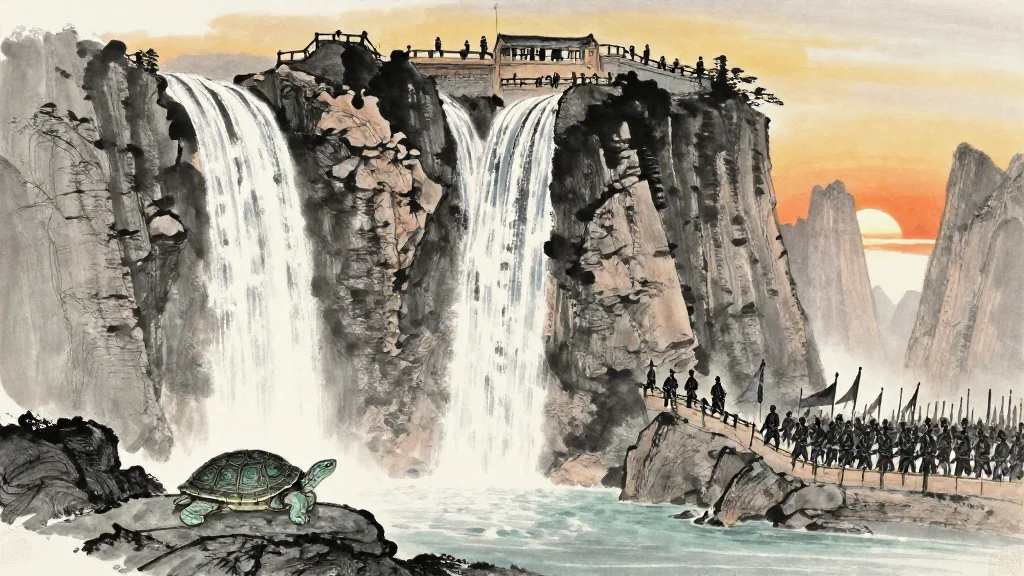
軍形 (Tactical Dispositions) — Chinese ink painting

Chapter 4 of 13

軍形

Tactical Dispositions

View:

先為不可勝

First Make Yourself Invincible

孫子曰:昔之善戰者,先為不可勝,以待敵之可勝。不可勝在己,可勝在敵。故善戰者,能為不可勝,不能使敵之必可勝。故曰:勝可知,而不可為。

Master Sun said: In antiquity, those skilled in warfare first made themselves unconquerable, then waited for the enemy to become conquerable. Unconquerability lies in yourself; conquerability lies in the enemy. Thus the skilled warrior can make himself unconquerable, but cannot guarantee that the enemy will be conquerable. Therefore it is said: victory can be foreseen, but it cannot be forced.

Notes

1translation

不可勝 (buke sheng) — 'unconquerable.' The term 勝 throughout this chapter means 'to prevail over' or 'to conquer.' Sunzi's argument rests on an asymmetry: defence (making yourself unconquerable) is within your control; offence (conquering the enemy) depends on the enemy's mistakes.

2translation

勝可知而不可為 — 'victory can be foreseen but cannot be forced.' 知 here means to recognise the conditions for victory; 為 means to manufacture or compel. You can see when victory is possible, but you cannot create the opening by will alone.

守攻之道

The Principles of Defence and Attack

不可勝者,守也;可勝者,攻也。守則不足,攻則有餘。善守者,藏於九地之下;善攻者,動於九天之上,故能自保而全勝也。

Unconquerability is a matter of defence; conquerability is a matter of attack. One defends when one's strength is insufficient; one attacks when one's strength is more than sufficient. The skilled defender conceals himself beneath the ninth depth of earth; the skilled attacker strikes from above the ninth height of heaven. Thus he is able both to protect himself and to achieve total victory.

Notes

1context

九地 (nine depths of earth) and 九天 (nine heights of heaven) are cosmological terms. In classical Chinese cosmology, heaven and earth were each divided into nine layers. Sunzi uses them as metaphors for the extremes of concealment (in defence) and overwhelming force (in attack).

2translation

守則不足,攻則有餘 — this passage has been debated. The straightforward reading: you defend because your forces are insufficient (relative to the enemy), you attack because you have a surplus. Cao Cao's commentary agrees: 'When the enemy has a surplus, I defend; when I have a surplus, I attack.'

善之善者

The Highest Excellence

見勝不過衆人之所知,非善之善者也;戰勝而天下曰善,非善之善者也。故舉秋毫不為多力,見日月不為明目,聞雷霆不為聰耳。

To foresee a victory that the common crowd could also foresee is not the highest excellence. To win a battle and have all the world say 'well done' is not the highest excellence. To lift an autumn hair is no sign of great strength. To see the sun and moon is no sign of sharp eyesight. To hear a thunderclap is no sign of keen hearing.

Notes

1context

秋毫 (autumn hair) — the fine tip of an animal's fur in autumn, proverbially the lightest thing imaginable. This metaphor recurs in other classical texts (e.g. Mengzi 1A.7) as a standard for the smallest perceptible object.

2translation

善之善者 — literally 'the good of the good,' meaning the highest degree of excellence. Sunzi's point: true mastery is invisible. If everyone can see why you won, the victory required no special skill.

勝於易勝

Victory Over the Already Defeated

古之所謂善戰者,勝於易勝者也。故善戰者之勝也,無智名,無勇功。故其戰勝不忒。不忒者,其所措必勝,勝已敗者也。故善戰者,立於不敗之地,而不失敵之敗也。是故勝兵先勝而後求戰,敗兵先戰而後求勝。善用兵者,修道而保法,故能為勝敗之政。

Those whom the ancients called skilled in warfare prevailed over enemies who were easy to prevail over. Therefore the victories of the skilled warrior win him neither a reputation for wisdom nor credit for courage. His victories in battle are unerring. Unerring means that whatever he does is certain to prevail — he conquers an enemy already defeated. Thus the skilled warrior takes his stand on ground where he cannot lose, and does not miss the moment when the enemy can be defeated. A victorious army first secures the conditions for victory, then seeks battle. A losing army first rushes into battle, then hopes for victory. The skilled commander cultivates the Way and preserves the regulations, and thereby controls the outcome of victory and defeat.

Notes

1translation

不忒 (bu te) — 'without error' or 'unerring.' 忒 means to err or deviate. The Yinqueshan bamboo strips confirm this reading.

2translation

修道而保法 — 'cultivates the Way and preserves the regulations.' 道 (the Way) here refers to political and moral governance; 法 (regulations) refers to military organisation, discipline, and institutional structure. Together they represent the total preparation — political and military — needed before battle.

3textual

勝敗之政 — 'the governance of victory and defeat.' Some editions read 勝敗之制 (the control of victory and defeat). The meaning is the same: the skilled commander determines the outcome before fighting begins.

4context

勝已敗者也 — 'he conquers an enemy already defeated.' This is the core thesis of the chapter: true skill means arranging conditions so completely that the battle itself is a formality. The enemy is defeated before the fight begins.

度量數稱勝

The Five Factors: Measurement to Victory

兵法:一曰度,二曰量,三曰數,四曰稱,五曰勝。地生度,度生量,量生數,數生稱,稱生勝。故勝兵若以鎰稱銖,敗兵若以銖稱鎰。勝者之戰民也,若決積水於千仞之溪者,形也。

The methods of war are: first, measurement; second, estimation of quantity; third, calculation; fourth, comparison; fifth, victory. Terrain gives rise to measurement. Measurement gives rise to estimation of quantity. Estimation of quantity gives rise to calculation. Calculation gives rise to comparison. Comparison gives rise to victory. A victorious army is like a yi weighed against a zhu; a defeated army is like a zhu weighed against a yi. The victorious commander unleashes his people into battle like releasing dammed water into a gorge a thousand ren deep — this is a matter of disposition.

Notes

1context

度 (measurement), 量 (estimation), 數 (calculation), 稱 (comparison), 勝 (victory) — Sunzi presents a causal chain from terrain analysis to final victory. 度 measures distances and terrain features; 量 estimates the resources (men, grain, materiel) the terrain can support; 數 calculates force ratios; 稱 weighs the balance of forces; and 勝 is the resulting verdict on which side will prevail.

2context

鎰 (yi) and 銖 (zhu) are units of weight. One yi (鎰) equals 24 liang (兩), and one liang equals 24 zhu (銖), so one yi equals 576 zhu. The ratio of a victorious army to a defeated one is thus compared to 576:1 — an overwhelming preponderance.

3context

仞 (ren) is a unit of depth/height, approximately 7-8 chi (roughly 1.6-1.8 metres in the Warring States period). A gorge a thousand ren deep is about 1,600-1,800 metres — a metaphor for irresistible, cascading force.

4translation

形也 — 'this is form/disposition.' The chapter's title character 形 appears here as the final word, tying the entire argument together. 形 is the visible, structural arrangement of forces — the shape your army presents. Sunzi's point: the devastating flood-like release of force is not luck or bravery but the product of calculated disposition.

Edition & Source

Text
《孫子兵法》 Sunzi Bingfa
Edition
《武經七書》(Seven Military Classics) canonical text
Commentary
Cao Cao (曹操) and the Eleven Commentators tradition