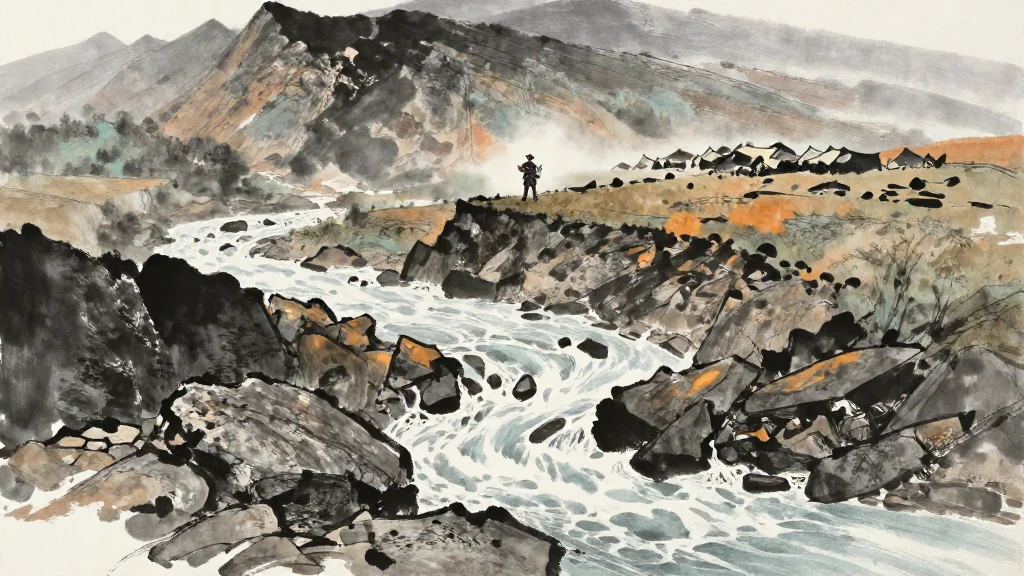
虛實 (Emptiness and Fullness) — Chinese ink painting

Chapter 6 of 13

虛實

Emptiness and Fullness

View:

致人而不致於人

Make the Enemy Come to You

孫子曰:凡先處戰地而待敵者佚,後處戰地而趨戰者勞。故善戰者,致人而不致於人。

Master Sun said: Whoever occupies the battlefield first and awaits the enemy is rested. Whoever arrives at the battlefield late and rushes into the fight is exhausted. Therefore the skilled warrior compels the enemy to come to him and is not compelled to go to the enemy.

Notes

1translation

致人而不致於人 — 'compels others and is not compelled by others.' This six-character phrase is the thesis of the entire chapter. 致 means to cause to come, to summon, to compel. The skilled commander controls the initiative: the enemy reacts to him, never the reverse.

2translation

佚 (yi) — 'rested,' 'at ease.' An alternate form of 逸. Contrasted with 勞 (lao), 'exhausted.' The advantage of arriving first is not merely positional — it means your troops are fresh, fed, and deployed, while the enemy arrives winded and disorganised.

利害動敵

Moving the Enemy Through Advantage and Harm

能使敵自至者,利之也;能使敵不得至者,害之也。故敵佚能勞之,飽能饑之,安能動之。出其所不趨,趨其所不意。

What makes the enemy come of his own accord is the lure of advantage. What prevents the enemy from coming is the threat of harm. Thus you can exhaust a rested enemy, starve a well-fed enemy, and unsettle a securely positioned enemy. Appear where he cannot rush to defend; strike where he does not expect.

Notes

1translation

利之也...害之也 — 'it is advantage...it is harm.' These two levers — offering gain and threatening damage — are the only tools needed to control the enemy's movement. Every manoeuvre reduces to one or both.

2translation

出其所不趨趨其所不意 — 'appear where he cannot rush to; strike where he does not expect.' 趨 means to hasten, to rush. The enemy cannot rush to defend every point; by threatening unexpected locations, you force him into reactive, exhausting redeployment.

攻其所不守

Attack Where He Does Not Defend

行千里而不勞者,行於無人之地也。攻而必取者,攻其所不守也;守而必固者,守其所不攻也。故善攻者,敵不知其所守;善守者,敵不知其所攻。微乎微乎!至于無形;神乎神乎!至于無聲,故能為敵之司命。

One who marches a thousand li without fatigue travels through country where there is no enemy. One who attacks and always takes his objective attacks where the enemy does not defend. One who defends and is always impregnable defends where the enemy cannot attack. Against the skilled attacker, the enemy does not know where to defend. Against the skilled defender, the enemy does not know where to attack. Subtle — oh, how subtle! — he approaches the formless. Divine — oh, how divine! — he approaches the soundless. Thus he can be the arbiter of the enemy's fate.

Notes

1context

千里 (a thousand li) — approximately 500 km in Warring States measurements. The point is not literal distance but the principle: even long marches need not be exhausting if the route avoids enemy contact.

2translation

司命 (si ming) — 'arbiter of fate,' literally 'master of destiny.' In Chinese mythology, the Siming was a celestial deity who controlled life and death. Sunzi borrows the term: the commander who masters emptiness and fullness holds the enemy's life in his hands.

3translation

微乎微乎...神乎神乎 — rhetorical exclamations rare in Sunzi's usually austere prose. 微 means subtle, minute, imperceptible; 神 means spirit-like, divine, uncanny. The paired exclamations mark this passage as a climactic statement.

沖虛與乖之

Striking the Empty, Deflecting the Advance

進而不可禦者,沖其虛也;退而不可追者,速而不可及也。故我欲戰,敵雖高壘深溝,不得不與我戰者,攻其所必救也;我不欲戰,雖畫地而守之,敵不得與我戰者,乖其所之也。

Advance in a way that cannot be resisted — by striking where the enemy is empty. Retreat in a way that cannot be pursued — by moving too swiftly to be caught. When I wish to fight, the enemy cannot avoid battle even behind high ramparts and deep moats — because I attack what he must rescue. When I do not wish to fight, even if I merely draw a line on the ground to defend, the enemy cannot engage me — because I deflect him from his objective.

Notes

1translation

沖其虛 — 'strike at his emptiness.' 沖 means to rush at, to charge. 虛 is the empty, undefended point. This is the core tactic of xu-shi warfare: concentrate your fullness against the enemy's emptiness.

2translation

攻其所必救 — 'attack what he must rescue.' This is the principle behind all diversionary attacks: threaten something the enemy cannot afford to lose (his capital, his supply line, his sovereign), and he must come out of his fortifications to defend it.

3translation

畫地而守之 — 'draw a line on the ground and defend it.' A vivid image of minimal defence — not even proper fortifications, just a line in the dirt. The point: if you have successfully misdirected the enemy, you need no walls.

4translation

乖其所之 — 'deflect him from where he is going.' 乖 means to deviate, to go astray, to misdirect. You make the enemy lose his sense of direction and purpose, so he no longer knows how to bring his force to bear.

我專敵分

Concentration Against Dispersal

故形人而我無形,則我專而敵分。我專為一,敵分為十,是以十攻其一也,則我衆而敵寡。能以衆擊寡者,則吾之所與戰者,約矣。吾所與戰之地不可知,不可知,則敵所備者多,敵所備者多,則吾之所與戰者寡矣。故備前則後寡,備後則前寡,備左則右寡,備右則左寡,無所不備,則無所不寡。寡者,備人者也;衆者,使人備己者也。

When I impose a form on the enemy while remaining formless myself, then I am concentrated and the enemy is dispersed. I concentrate as one; the enemy disperses into ten. Thus I strike with ten times his strength at the point of contact, so I am many and he is few. If I can strike with the many against the few, then those I engage in battle will be hard-pressed.

The place where I intend to fight must not be known. If it is not known, the enemy must prepare in many places. If the enemy prepares in many places, then those I engage at any one point will be few. Defend the front, and the rear is weakened. Defend the rear, and the front is weakened. Defend the left, and the right is weakened. Defend the right, and the left is weakened. Defend everywhere, and everywhere is weakened. The few are those who must defend against others. The many are those who make others defend against them.

Notes

1translation

形人而我無形 — 'impose form on the enemy while I remain formless.' This is the xu-shi principle in action: make the enemy reveal his dispositions (by probing, feinting, threatening) while keeping your own intentions invisible. The enemy who is 'formed' is predictable; you, being 'formless,' are not.

2context

我專為一敵分為十是以十攻其一也 — the mathematics of concentration. If the enemy must spread his forces across ten possible points of attack, and you concentrate everything at one point, you achieve local 10:1 superiority even if your total forces are equal. This principle — achieving local superiority through concentration — is fundamental to all subsequent military theory, from Napoleon to Clausewitz.

3translation

約 (yue) — 'hard-pressed' or 'constrained,' literally 'restricted.' The enemy at the point of contact faces overwhelming numbers and has no room to manoeuvre.

4context

寡者備人者也衆者使人備己者也 — the chapter's key strategic insight distilled into a single antithesis. The 'few' (the side at a disadvantage) are those forced to defend against the enemy's initiative. The 'many' (the side at an advantage) are those who seize the initiative and force the enemy to defend. Numbers are not absolute — they are a function of who holds the initiative.

知戰之地知戰之日

Knowing the Place and the Day

故知戰之地,知戰之日,則可千里而會戰;不知戰之地,不知戰之日,則左不能救右,右不能救左,前不能救後,後不能救前,而況遠者數十里,近者數里乎!以吾度之,越人之兵雖多,亦奚益於勝敗哉!故曰:勝可為也。敵雖衆,可使無鬥。

If you know the place of battle and the day of battle, you can march a thousand li and join the fight. If you do not know the place of battle or the day of battle, then your left cannot rescue your right, your right cannot rescue your left, your front cannot rescue your rear, your rear cannot rescue your front — how much less when the separated forces are tens of li apart, or even a few li apart! By my assessment, though the troops of Yue are many, what advantage is that for victory? Therefore I say: victory can be manufactured. Even if the enemy is numerous, he can be rendered unable to fight.

Notes

1context

越人之兵 — 'the troops of Yue.' Yue (越) was a southeastern state (modern Zhejiang/Fujian) that famously defeated its rival Wu in 473 BC. Sunzi is traditionally associated with Wu. This reference to Yue's troops has been taken as evidence both for and against the traditional attribution of the text to Sun Wu.

2translation

勝可為也 — 'victory can be manufactured/created.' Contrast this with Chapter 4's statement that 勝可知而不可為 ('victory can be foreseen but cannot be forced'). The apparent contradiction resolves when you note the different contexts: in Chapter 4, you cannot force the enemy to be conquerable; in Chapter 6, you can manufacture your own conditions for victory through concentration and deception.

3translation

可使無鬥 — 'can be rendered unable to fight.' Not that the enemy chooses not to fight, but that his forces are so dispersed, so dislocated, that he cannot bring them to bear. He has men but cannot use them.

策作形角

Probing the Enemy's Dispositions

故策之而知得失之計,作之而知動靜之理,形之而知死生之地,角之而知有餘不足之處。故形兵之極,至於無形;無形,則深間不能窺,智者不能謀。因形而措勝於衆,衆不能知;人皆知我所以勝之形,而莫知吾所以制勝之形。故其戰勝不復,而應形於無窮。

Probe him to learn his plans and their strengths and weaknesses. Provoke him to learn his patterns of movement and stillness. Shape a situation to learn where the ground is deadly and where it is safe. Skirmish with him to learn where he has a surplus and where he is deficient.

The ultimate in disposing your forces is to have no discernible form. When you have no form, the deepest spy cannot penetrate you and the wisest counsellor cannot scheme against you. I present a winning form to the multitude, yet the multitude cannot perceive it. Everyone can see the form by which I achieved victory, but no one can see the form by which I contrived the victory. Therefore my victories are never repeated — I respond to form in inexhaustible ways.

Notes

1translation

策 (ce) — to probe, to assess, to calculate. 作 (zuo) — to stir up, to provoke into action. 形 (xing) — to shape a situation, to make the enemy reveal himself. 角 (jue/jiao) — to cross horns, to skirmish, to test in a limited engagement. These four verbs describe an escalating sequence of intelligence-gathering: analysis, provocation, deception, and combat reconnaissance.

2translation

深間 (shen jian) — 'deep spies' or 'deeply planted agents.' 間 is the word for spy/agent used extensively in Chapter 13. Even the best-placed spies cannot discover a disposition that does not exist.

3translation

人皆知我所以勝之形而莫知吾所以制勝之形 — a crucial distinction. 勝之形 is the visible shape of the victory — the troop movements, the battle formation that won. 制勝之形 is the underlying strategic logic that created the conditions for that formation to succeed. The public sees the battle; no one sees the campaign of deception, concentration, and timing that made the battle a foregone conclusion.

4translation

戰勝不復 — 'victories are never repeated.' Each engagement is unique because the configuration of xu and shi — emptiness and fullness — is always different. A commander who tries to repeat a previous winning formula will fail because the enemy adapts.

兵形象水

The Form of War Is Like Water

夫兵形象水,水之形,避高而趨下;兵之形,避實而擊虛。水因地而制流,兵因敵而制勝。故兵無常勢,水無常形;能因敵變化而取勝者,謂之神。故五行無常勝,四時無常位,日有短長,月有死生。

The form of war is like water. Water's form avoids the high and flows to the low. War's form avoids the full and strikes the empty. Water shapes its course according to the terrain; war shapes its victory according to the enemy. War has no constant momentum; water has no constant form. One who can adapt to the enemy's changes and achieve victory — this is called divine.

The Five Phases have no constant dominance. The four seasons have no fixed position. Days are sometimes long and sometimes short. The moon waxes and wanes.

Notes

1translation

兵形象水 — 'the form of war is like water.' This is Sunzi's most famous metaphor and the summary of the entire chapter. Water is the perfect model for xu-shi warfare: it flows to the empty spaces, it fills the low ground, it follows the path of least resistance, and it does so without fixed shape.

2translation

避實而擊虛 — 'avoid the full and strike the empty.' This six-character phrase distills the chapter's argument. 實 (shi, 'full') is where the enemy is concentrated and strong; 虛 (xu, 'empty') is where he is dispersed and weak. This formulation became a foundational maxim in Chinese strategic thought.

3context

五行 (wuxing) — the Five Phases: wood, fire, earth, metal, water. Each phase overcomes and is overcome by another in a cycle (wood overcomes earth, earth overcomes water, etc.), but none permanently dominates — hence 'no constant dominance' (無常勝). Sunzi invokes this cosmological principle to reinforce his argument: nothing in war is fixed.

4translation

謂之神 (wei zhi shen) — 'this is called divine.' 神 is the highest praise in the classical Chinese vocabulary for military skill, meaning something beyond human understanding — uncanny, spirit-like, transcending ordinary calculation. The chapter ends where it began, with the idea that mastery of xu-shi produces results so extraordinary they appear supernatural.

5context

The chapter closes with a cosmological coda: the Five Phases, the four seasons, the length of days, the phases of the moon — nothing in nature stays fixed. Sunzi's final argument is that war, like nature, is an endless process of change. The commander who grasps this and adapts fluidly will never be defeated.

Edition & Source

Text
《孫子兵法》 Sunzi Bingfa
Edition
《武經七書》(Seven Military Classics) canonical text
Commentary
Cao Cao (曹操) and the Eleven Commentators tradition