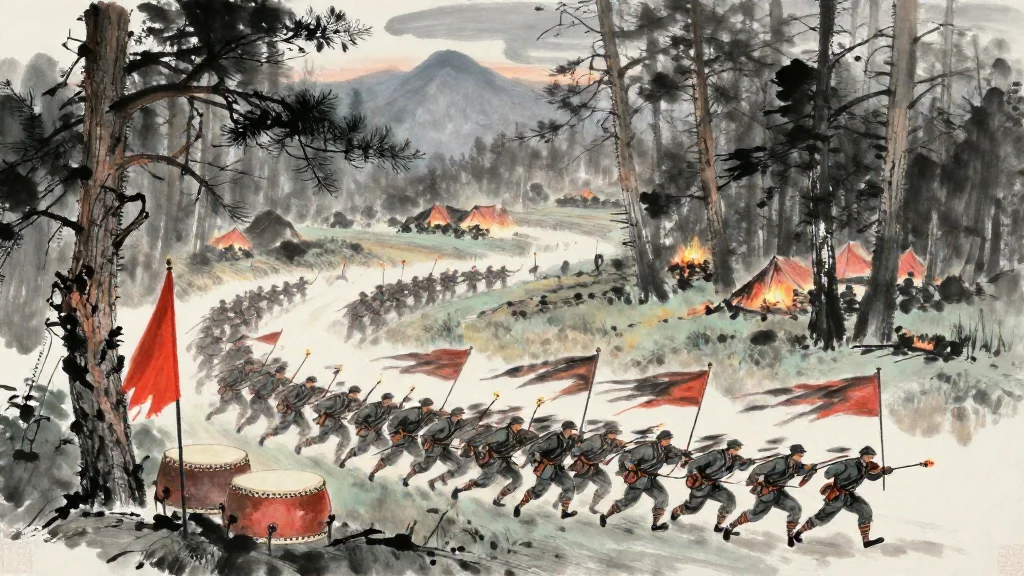
軍爭 (Maneuvering) — Chinese ink painting

Chapter 7 of 13

軍爭

Maneuvering

View:

迂直之計

The Strategy of the Indirect Approach

孫子曰:凡用兵之法,將受命於君,合軍聚衆,交和而舍,莫難於軍爭。軍爭之難者,以迂為直,以患為利。故迂其途,而誘之以利,後人發,先人至,此知迂直之計者也。

Master Sun said: In the general principles of war, the commander receives his mandate from the sovereign, assembles the army and musters the troops, and takes the field. Nothing is more difficult than the contention of armies.

The difficulty of contention lies in turning the circuitous into the direct, and turning misfortune into advantage. Therefore, take a roundabout route and lure the enemy with some gain. Setting out after the enemy yet arriving before him — this is to understand the strategy of the indirect approach.

Notes

1context

軍爭 (contention of armies) refers to the competitive maneuvering between opposing forces to seize advantageous positions before battle is joined. It is not 'battle' itself but the strategic race for positional advantage.

2translation

迂直之計 (the strategy of the indirect approach): literally 'the calculation of the circuitous and the direct.' The concept is that the skilled commander takes an apparently longer route but arrives first, converting a disadvantage into an advantage. This anticipates Liddell Hart's 'indirect approach' by two millennia.

3context

交和而舍: 'to face the enemy at the border and encamp.' 和 here refers to the border gate (和門) between the two forces. Some commentators read 交和 as the two armies drawing up opposite each other.

爭利之危

The Dangers of Contending for Advantage

故軍爭為利,軍爭為危。舉軍而爭利,則不及;委軍而爭利,則輜重捐。是故卷甲而趨,日夜不處,倍道兼行,百里而爭利,則擒三軍將,勁者先,疲者後,其法十一而至;五十里而爭利,則蹶上軍將,其法半至;三十里而爭利,則三分之二至。是故軍無輜重則亡,無糧食則亡,無委積則亡。故不知諸侯之謀者,不能豫交;不知山林、險阻、沮澤之形者,不能行軍;不用鄉導者,不能得地利。

Contending for advantage brings both profit and peril. If the whole army contends for advantage, it will not arrive in time. If a detachment contends for advantage, the supply train is lost.

Therefore, if you roll up your armor and march without rest day or night, covering double the normal distance, and contend for advantage at a hundred li, the commanders of all three divisions may be captured. The strongest troops arrive first, the exhausted straggle behind — by this method only one in ten reaches the objective. Contend for advantage at fifty li, and the commander of the vanguard division may fall; by this method half the force arrives. Contend at thirty li, and two-thirds arrive.

An army without its supply train is lost. Without provisions it is lost. Without stores and reserves it is lost.

Therefore: one who does not know the plans of the neighboring lords cannot negotiate alliances. One who does not know the terrain — mountains and forests, passes and obstacles, marshes and swamps — cannot march an army. One who does not employ local guides cannot gain the advantage of the ground.

Notes

1context

三軍 (three armies/divisions): the standard Zhou-era army organization divided forces into upper (上軍), middle (中軍), and lower (下軍) divisions. A full-strength 三軍 fielded approximately 37,500 men.

2context

倍道兼行 (double-marching): covering two days' march in one. A normal day's march for an ancient Chinese army was approximately 30 li (roughly 15 km). Double-marching thus meant about 60 li per day.

3translation

輜重 (supply train): heavy baggage, equipment, and provisions transported by cart. Abandoning it (委軍) meant sending a fast detachment ahead while the baggage followed slowly — gaining speed but risking the supplies.

4context

其法十一而至 (one in ten arrives): this arithmetic illustrates the attrition of a forced march. At 100 li, 90% of the force drops out from exhaustion. Sunzi's point is that the longer the race for advantage, the more fragmented the army becomes on arrival.

5translation

鄉導 (local guides): people native to the area who know the roads, water sources, and terrain. This is one of Sunzi's recurring themes — intelligence from those with local knowledge is indispensable.

風林火山

Swift as the Wind, Silent as the Forest

故兵以詐立,以利動,以分合為變者也。故其疾如風,其徐如林,侵掠如火,不動如山,難知如陰,動如雷震。掠鄉分衆,廓地分利,懸權而動。先知迂直之計者勝,此軍爭之法也。

War is founded on deception, driven by advantage, and transformed through division and concentration.

Swift as the wind. Silent as the forest. Fierce and ravenous as fire. Immovable as the mountain. Inscrutable as shadow. Sudden as a thunderclap.

When you plunder a district, divide the spoils among your troops. When you expand your territory, distribute the profits. Weigh the balance of advantage before you move.

He who first understands the strategy of the indirect approach wins. This is the method of strategic maneuvering.

Notes

1context

風林火山 (Wind, Forest, Fire, Mountain): these four similes became the most iconic passage in East Asian military thought. The Sengoku-era Japanese warlord Takeda Shingen (1521-1573) famously emblazoned them on his war banner (孫子四如之旗). The full passage contains six similes, adding 'inscrutable as shadow, sudden as thunder,' but the four-character abbreviation became standard.

2translation

兵以詐立 (war is founded on deception): 詐 means 'stratagem' or 'artifice.' This echoes and summarizes the thesis of Chapter 1: 兵者,詭道也 (war is the way of deception).

3translation

懸權而動 (weigh the balance before moving): 懸權 literally means 'to suspend a weight on a scale' — to calculate and judge the situation carefully before committing to action.

金鼓旌旗

Gongs, Drums, Banners, and Flags

《軍政》曰:「言不相聞,故為金鼓;視不相見,故為旌旗。」夫金鼓旌旗者,所以一民之耳目也。民既專一,則勇者不得獨進,怯者不得獨退,此用衆之法也。故夜戰多金鼓,晝戰多旌旗,所以變人之耳目也。

The Military Governance text states: 'Since words cannot be heard, use gongs and drums. Since gestures cannot be seen, use banners and flags.'

Gongs, drums, banners, and flags are the means of unifying the eyes and ears of the troops. Once the men are unified in attention, the brave cannot advance alone and the cowardly cannot retreat alone. This is the method of commanding large forces.

Therefore in night battles use many gongs and drums; in daylight battles use many banners and flags. Vary these signals to direct the eyes and ears of the troops.

Notes

1context

《軍政》(Military Governance) is a lost military text that Sunzi quotes. Nothing survives of it beyond the fragments cited here and elsewhere in pre-Qin literature. It may have been a Zhou-dynasty military manual.

2context

金 (metal) refers to bronze gongs and bells used to signal retreat or halt, while 鼓 (drums) signaled the advance. These auditory signals were essential for coordinating forces on pre-modern battlefields where the noise of combat drowned out spoken commands.

3translation

一民之耳目 (unify the eyes and ears of the people): 'people' (民) here means the common soldiers. The principle is that signal systems replace individual judgment with unified command — no soldier acts on his own initiative but only on the signal.

治氣治心治力治變

Controlling Morale, Mind, Strength, and Adaptation

三軍可奪氣,將軍可奪心。是故朝氣銳,晝氣惰,暮氣歸。故善用兵者,避其銳氣,擊其惰歸,此治氣者也;以治待亂,以靜待嘩,此治心者也;以近待遠,以佚待勞,以飽待饑,此治力者也;無邀正正之旗,無擊堂堂之陣,此治變者也。

The morale of an entire army can be broken; the will of its commander can be shattered.

In the morning, spirits are keen. By midday, they flag. By evening, men think only of returning home. The skilled commander avoids the enemy when his spirit is keen, and strikes when it flags and thoughts turn homeward. This is the control of morale.

Oppose disorder with discipline. Meet clamor with calm. This is the control of mind.

Stay close while the enemy comes from afar. Rest while the enemy exhausts himself. Be well-fed while the enemy starves. This is the control of strength.

Do not intercept an enemy whose banners are in perfect order. Do not attack formations that are grand and imposing. This is the control of adaptation.

Notes

1translation

奪氣 (break the morale): 奪 means 'to seize away' or 'rob.' The metaphor is that the enemy's fighting spirit (氣) is something that can be stolen from him through timing and psychological pressure.

2context

朝氣銳,晝氣惰,暮氣歸 (morning keen, midday sluggish, evening homeward): this observation about the daily rhythm of fighting spirit became a standard principle in Chinese military thought. Cao Cao's commentary links it to the Battle of Changshao (684 BC), where the state of Lu defeated Qi by waiting for the enemy's drumming — and thus morale — to fade.

3translation

The four categories — 治氣 (controlling morale), 治心 (controlling mind), 治力 (controlling strength), 治變 (controlling adaptation) — form a systematic framework. 治 means 'to govern' or 'to manage,' implying that these are disciplines the commander cultivates, not one-time tactics.

4translation

正正之旗 (banners in perfect order) and 堂堂之陣 (grand and imposing formations): doubled characters indicate superlative degree. The point is to avoid engaging an enemy at peak readiness — the mirror image of 'strike when morale flags.'

用兵八則

Eight Tactical Principles

故用兵之法,高陵勿向,背丘勿逆,佯北勿從,銳卒勿攻,餌兵勿食,歸師勿遏,圍師必闕,窮寇勿迫,此用兵之法也。

The principles of war:

Do not attack uphill. Do not engage an enemy with a hill at his back. Do not pursue a feigned retreat. Do not attack elite troops at their peak. Do not take the enemy's bait. Do not block an army heading home. When you surround an enemy, leave an opening. Do not press a cornered enemy to desperation.

These are the principles of war.

Notes

1context

圍師必闕 (when surrounding, leave a gap): one of Sunzi's most cited maxims. A completely encircled enemy fights with the courage of desperation (死地). Leaving an apparent escape route causes the enemy to think of flight rather than fighting to the death, making them easier to defeat in the pursuit.

2context

窮寇勿迫 (do not press a cornered enemy): closely related to the previous principle. A desperate enemy with no hope of survival will fight far beyond normal capacity. The shrewd commander gives the enemy a reason to run rather than die fighting.

3translation

佯北勿從 (do not pursue a feigned retreat): 北 here is used in its military sense of 'defeat/retreat' (敗北), not 'north.' A feigned retreat (佯北) was a standard tactic to lure pursuers into an ambush.

4translation

餌兵勿食 (do not take the bait): 餌 means 'bait' as in a lure. The 'bait troops' (餌兵) are a small detachment left exposed to tempt the enemy into attacking, drawing them into an unfavorable position.

Edition & Source

Text
《孫子兵法》 Sunzi Bingfa
Edition
《武經七書》(Seven Military Classics) canonical text
Commentary
Cao Cao (曹操) and the Eleven Commentators tradition