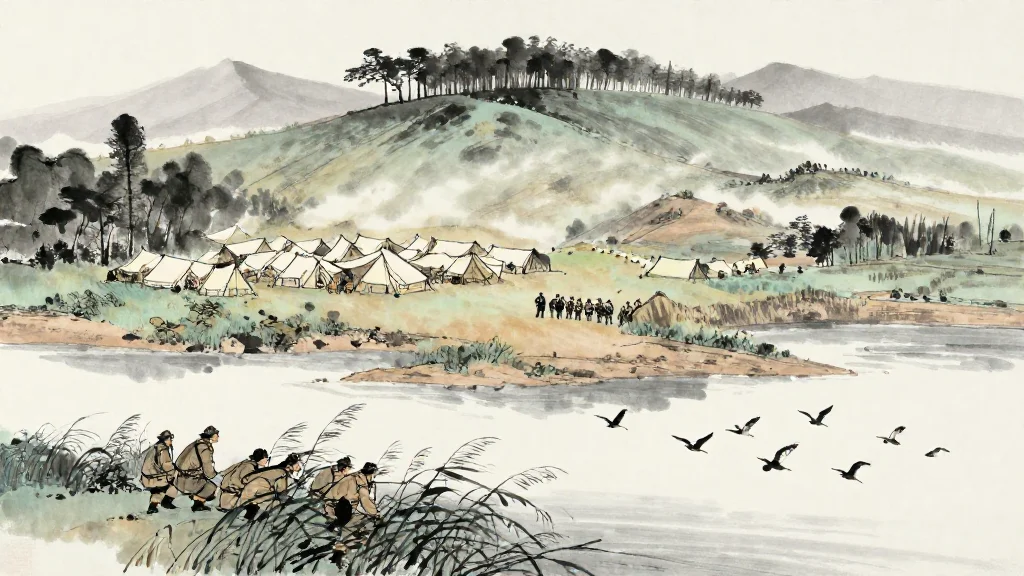
行軍 (The Army on the March) — Chinese ink painting

Chapter 9 of 13

行軍

The Army on the March

View:

四地之處軍

Deploying on Four Types of Terrain

孫子曰:凡處軍相敵,絕山依谷,視生處高,戰隆無登,此處山之軍也。絕水必遠水,客絕水而來,勿迎之于水內,令半濟而擊之,利;欲戰者,無附于水而迎客,視生處高,無迎水流,此處水上之軍也。絕斥澤,惟亟去無留,若交軍於斥澤之中,必依水草,而背衆樹,此處斥澤之軍也。平陸處易,而右背高,前死後生,此處平陸之軍也。凡此四軍之利,黃帝之所以勝四帝也。

Master Sun said: When positioning the army and reading the enemy —

In mountains: cross them by keeping to the valleys. Camp on high ground facing the sunlit side. Fight downhill; never attack uphill. This is the principle of mountain warfare.

At rivers: after crossing, move well away from the water. When an enemy crosses toward you, do not meet him in the water; let him get halfway across, then strike — this is advantageous. If you wish to fight, do not deploy right at the water's edge to receive the enemy. Take high ground facing the sun; do not position downstream. This is the principle of river warfare.

In salt marshes: cross them quickly without lingering. If you must fight in a marsh, keep close to water and grass with trees at your back. This is the principle of marsh warfare.

On open plains: take level ground with high terrain to your right and rear. Let the deadly ground be in front and the living ground behind. This is the principle of plains warfare.

These four principles of terrain advantage are how the Yellow Emperor defeated the Four Emperors.

Notes

1translation

相敵 (reading the enemy): 相 means 'to observe and assess.' This chapter's subject is twofold: how to position your own forces (處軍), and how to read signs of the enemy's condition and intentions (相敵).

2translation

視生處高 (face the sunlit side, camp high): 生 (life/growth) here refers to the yang (south-facing) side of terrain where there is sunlight, warmth, and dry ground — conditions that promote health and morale.

3context

半濟而擊 (strike when half-crossed): attacking an enemy while fording a river — when his forces are split between both banks and those in the water cannot fight — became a canonical tactical principle. The most famous application was the Battle of the Bi River (泓水之戰, 638 BC), where Song Xianggong refused to attack Chu while crossing and was decisively defeated.

4context

The Yellow Emperor (黃帝) defeating the Four Emperors is a mythological reference. Traditional accounts say Huangdi fought and conquered rival tribal leaders — Yandi (炎帝) and Chiyou (蚩尤) among them. Sunzi invokes this to give his principles the authority of primal antiquity.

5translation

前死後生 (deadly ground in front, living ground behind): 'deadly ground' (死) means low, exposed ground facing the enemy; 'living ground' (生) means high ground with supplies and escape routes at the rear.

處軍之要

Essential Principles of Encampment

凡軍好高而惡下,貴陽而賤陰,養生而處實,軍無百疾,是謂必勝。丘陵堤防,必處其陽,而右背之,此兵之利,地之助也。上雨,水沫至,欲涉者,待其定也。

As a general rule, armies prefer high ground and avoid low ground. They prize the sunny side and shun the shady side. Nurture health and occupy solid ground — the army will be free of disease. This is called certain victory.

On hills and embankments, always occupy the sunny side with the heights to your right and rear. This gives the advantage of terrain to your troops.

When rain upstream causes the water to foam and rise, wait for it to subside before attempting a crossing.

Notes

1context

貴陽而賤陰 (prize yang, shun yin): beyond the cosmological overtones, this is practical advice. South-facing slopes (陽) receive more sunlight, dry faster after rain, and promote troop health. North-facing slopes (陰) are damp, cold, and prone to disease.

2context

軍無百疾 (the army free of a hundred diseases): disease was by far the greatest killer in ancient armies. Sunzi's insistence on high, dry, sunlit ground reflects an empirical understanding that camp conditions directly determined casualty rates, often more than combat itself.

3translation

水沫 (foaming water): indicates flash flooding from upstream rainfall. The warning is against crossing a river when the current is suddenly swollen — the danger is being swept away mid-crossing.

危地伏奸

Dangerous Ground and Hidden Ambushes

凡地有絕澗,遇天井、天牢、天羅、天陷、天隙,必亟去之,勿近也。吾遠之,敵近之;吾迎之,敵背之。軍旁有險阻、潢井、葭葦、林木、蘙薈者,必謹覆索之,此伏奸之所處也。

Wherever the terrain features steep ravines, confined hollows, enclosed basins, tangled undergrowth, quagmires, or narrow crevasses — leave such places quickly and do not approach them. Keep your distance from them while maneuvering the enemy toward them. Face them so the enemy has them at his back.

Whenever the army passes through areas with precipitous obstacles, stagnant pools, reeds and rushes, dense forest, or thick undergrowth — search them thoroughly and with care. These are places where ambushes and scouts hide.

Notes

1translation

The 'six calamitous terrains' — 絕澗 (steep ravines), 天井 (natural wells/confined hollows), 天牢 (natural prisons/enclosed basins), 天羅 (natural nets/tangled ground), 天陷 (natural traps/quagmires), 天隙 (natural crevasses) — are all named with the prefix 天 (heaven/natural), emphasizing that these are formations created by nature that function as traps. Each restricts movement and makes an army vulnerable.

2translation

伏奸 (hidden treachery): ambush parties and enemy scouts. 奸 can mean 'spy,' 'scout,' or any covert enemy element. The principle is that any terrain feature offering concealment must be searched — dense vegetation is the natural hiding place for ambush forces.

相敵三十二法

Thirty-Two Methods of Reading the Enemy

敵近而靜者,恃其險也;遠而挑戰者,欲人之進也;其所居易者,利也;衆樹動者,來也;衆草多障者,疑也;鳥起者,伏也;獸駭者,覆也;塵高而銳者,車來也;卑而廣者,徒來也;散而條達者,樵采也;少而往來者,營軍也;辭卑而益備者,進也;辭強而進驅者,退也;輕車先出,居其側者,陣也;無約而請和者,謀也;奔走而陳兵者,期也;半進半退者,誘也;杖而立者,饑也;汲而先飲者,渴也;見利而不進者,勞也;鳥集者,虛也;夜呼者,恐也;軍擾者,將不重也;旌旗動者,亂也;吏怒者,倦也;粟馬肉食,軍無懸缻,而不返其舍者,窮寇也;諄諄翕翕,徐與人言者,失衆也;數賞者,窘也;數罰者,困也;先暴而後畏其衆者,不精之至也;來委謝者,欲休息也。兵怒而相迎,久而不合,又不相去,必謹察之。

The enemy is close yet remains still — he is relying on a strong position.

The enemy is distant yet provokes battle — he wants you to advance.

He occupies open ground — he sees advantage in it.

Trees are moving — he is coming.

There are many obstacles in the grass — he wants you to be suspicious.

Birds take flight suddenly — an ambush lies below.

Animals bolt in panic — a large force is approaching.

Dust rising high and sharp — chariots are coming.

Dust low and broad — infantry is coming.

Dust scattered in thin trails — they are gathering firewood.

Dust light and intermittent — they are making camp.

His envoys speak humbly while preparations intensify — he is about to advance.

His envoys speak aggressively and his troops press forward — he is about to retreat.

Light chariots come out first and take positions on the flanks — he is forming battle lines.

He seeks peace without prior agreement — he is plotting something.

Troops rush about and deploy in formation — he has set a timetable.

Half advance, half retreat — he is luring you.

Soldiers lean on their weapons — they are hungry.

Water-carriers drink before delivering — the army is thirsty.

They see advantage but do not advance — they are exhausted.

Birds gather on his position — the camp is empty.

Cries in the night — the army is afraid.

The camp is in disorder — the commander lacks authority.

Banners shift about — the army is in confusion.

Officers are angry — the troops are weary.

They feed grain to the horses and slaughter the draft animals for meat, the troops do not hang up their cooking pots, and they do not return to their shelters — this is a cornered force prepared for a final stand.

The commander speaks to his men in a low, earnest, halting voice — he has lost their trust.

Frequent rewards — he is running out of other means.

Frequent punishments — he is in dire straits.

First brutal, then fearful of his own men — the height of incompetence.

He sends envoys with conciliatory gifts — he wants a respite.

When the enemy advances angrily to meet you but neither engages nor withdraws for a long time — observe him with the greatest care.

Notes

1context

This passage is the longest sustained section of tactical observation in the Sunzi. It catalogs visual and behavioral indicators (what modern intelligence doctrine calls 'indicators and warnings') that reveal the enemy's true condition. The section functions as a field manual for reading the battlefield.

2translation

粟馬肉食 (feed grain to the horses and slaughter animals for meat): in normal operations, horses grazed and draft animals were preserved. Feeding horses grain from stores and butchering the animals that hauled supplies meant the army had abandoned any thought of sustained campaign — it was consuming all its reserves for one last effort.

3translation

軍無懸缻 (the army does not hang up its cooking pots): 缻 (fǒu) is an earthenware vessel. When an army stopped to camp, the standard procedure was to hang pots and cook. Not doing so indicates the army has no intention of staying — or no hope of another meal.

4translation

諄諄翕翕 (earnest and halting): 諄諄 means 'repeatedly, earnestly' — the commander pleads with his men. 翕翕 suggests murmuring or speaking in hushed, confidential tones. Together they paint a picture of a leader who has lost authority and must beg rather than command.

5translation

先暴而後畏其衆者 (first brutal, then fearful of his own men): this describes a commander who lacks judgment — he begins by imposing excessive punishments, alienating his troops, then realizes the army may mutiny and becomes timid. 不精之至也 (the height of incompetence): 精 here means 'skilled' or 'discerning.'

兵非貴多

Strength Lies Not in Numbers

故兵非貴益多也,惟無武進,足以併力、料敵、取人而已。夫惟無慮而易敵者,必擒於人。

Military strength does not lie in sheer numbers. What matters is not to advance recklessly. It is enough to concentrate your force, assess the enemy accurately, and win the confidence of your men.

He who plans without thinking deeply and takes the enemy lightly will surely be captured.

Notes

1translation

無武進 (do not advance recklessly): 武進 means advancing through brute force without forethought. The character 武 here does not mean 'martial' in a positive sense but implies rash, aggressive action without calculation.

2translation

取人 (win men): this can mean 'win people over' (earn the soldiers' trust) or 'overcome the enemy.' Most commentators take it as winning the loyalty of one's own troops, which fits the context of the following section on discipline.

令文齊武

Lead with Benevolence, Enforce with Discipline

卒未親附而罰之,則不服,不服則難用也。卒已親附而罰不行,則不可用也。故令之以文,齊之以武,是謂必取。令素行以教其民,則民服;令素不行以教其民,則民不服。令素行者,與衆相得也。

If troops are punished before they feel loyal, they will not submit; and if they do not submit, they are hard to use. If troops already feel loyal but punishments are not enforced, they are equally useless.

Therefore: command them with civil virtue; keep them in line with martial discipline. This is called certain success.

When orders have been consistently enforced and the troops are trained accordingly, they obey. When orders have never been consistently enforced and are now imposed, they will not obey. Orders consistently carried out reflect a relationship of mutual trust between the commander and his men.

Notes

1translation

令之以文,齊之以武 (command with civil virtue, align with martial discipline): 文 and 武 form the classic Chinese complementary pair — the civil/cultural and the martial/coercive. A commander must first earn loyalty through fair treatment (文), then maintain order through consistent discipline (武). Neither alone suffices.

2translation

與衆相得 (mutual trust between commander and men): 相得 literally means 'to get along with each other.' The chapter ends on a strikingly humanistic note for a military manual: effectiveness rests not on fear but on a genuine bond of trust between leader and soldiers, built through consistent and fair command.

3context

This closing section echoes the Confucian ideal of governance through virtue backed by law. Sunzi does not advocate harshness or leniency alone but their careful balance — a theme that resonates with the Legalist-Confucian synthesis that would later characterize Chinese political thought.

Edition & Source

Text
《孫子兵法》 Sunzi Bingfa
Edition
《武經七書》(Seven Military Classics) canonical text
Commentary
Cao Cao (曹操) and the Eleven Commentators tradition