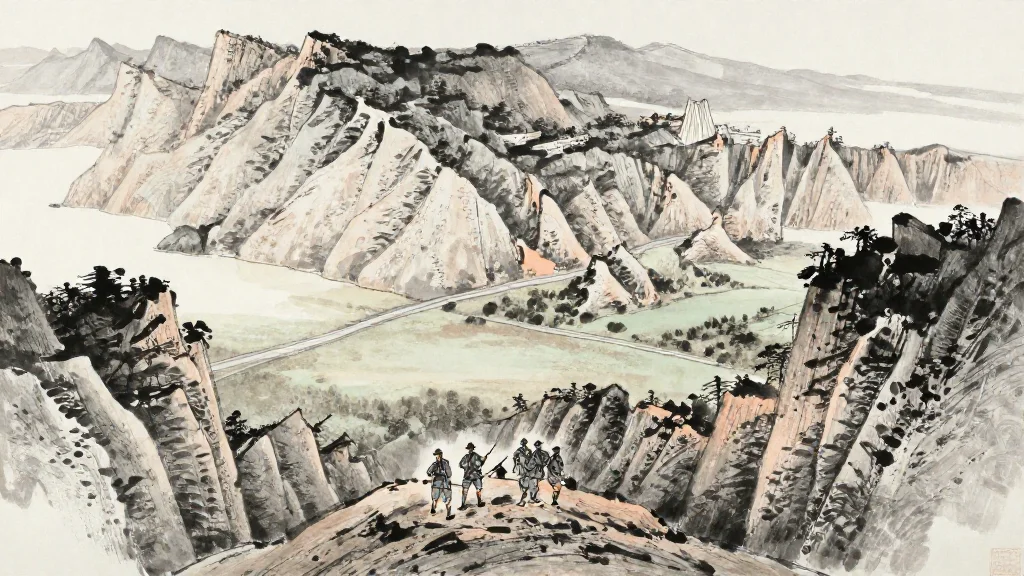
地形 (Terrain) — Chinese ink painting

Chapter 10 of 13

地形

Terrain

View:

六地形

The Six Types of Terrain

孫子曰:凡地形有通者、有掛者、有支者、有隘者、有險者、有遠者。我可以往,彼可以來,曰通。通形者,先居高陽,利糧道,以戰則利。可以往,難以返,曰掛。掛形者,敵無備,出而勝之;敵若有備,出而不勝,難以返,不利。我出而不利,彼出而不利,曰支。支形者,敵雖利我,我無出也,引而去之,令敵半出而擊之,利。隘形者,我先居之,必盈之以待敵。若敵先居之,盈而勿從,不盈而從之。險形者,我先居之,必居高陽以待敵;若敵先居之,引而去之,勿從也。遠形者,勢均,難以挑戰,戰而不利。凡此六者,地之道也,將之至任,不可不察也。

Sunzi said: There are six kinds of terrain: accessible, entangling, temporizing, narrow passes, precipitous, and distant.

Ground that both sides can freely traverse is called accessible. On accessible ground, occupy the sunny heights first, secure your supply lines, and fight — this is advantageous.

Ground you can advance into but cannot easily withdraw from is called entangling. On entangling ground, if the enemy is unprepared, strike and you will win. But if the enemy is prepared and you fail to win, retreat will be difficult — this is disadvantageous.

Ground where it is unfavorable for either side to advance is called temporizing. On temporizing ground, even if the enemy dangles an advantage, do not go out. Withdraw and lure the enemy halfway out, then strike — this is advantageous.

On narrow passes: if you occupy them first, you must fill them with troops and wait for the enemy. If the enemy occupies them first — if he has filled them, do not follow; if he has not filled them, follow.

On precipitous ground: if you occupy it first, you must hold the sunny heights and wait for the enemy. If the enemy occupies it first, withdraw and do not follow.

On distant ground, when forces are evenly matched, it is difficult to provoke battle, and fighting is disadvantageous.

These six are the principles of terrain. It is the general's paramount responsibility to study them carefully.

Notes

1context

The six terrain types (通、掛、支、隘、險、遠) form a systematic taxonomy of ground based on freedom of movement. This complements Chapter 11's nine strategic situations (九地), which classify ground by a force's overall strategic position rather than physical features.

2translation

通 (tōng, 'accessible') literally means 'open' or 'passable in all directions'. 掛 (guà, 'entangling') literally means 'hanging' — you can go forward but are left dangling if you try to come back. 支 (zhī, 'temporizing') literally means 'propping' or 'standoff' — neither side profits from advancing.

3context

高陽 ('high and sunny') — throughout the Sunzi, occupying high ground with southern exposure is a cardinal principle. High ground provides tactical advantage; southern exposure (陽) provides warmth, dryness, and better morale.

4translation

盈 ('fill') in the context of narrow passes means to block them completely with your own troops, denying the enemy passage. If you arrive first, garrison the pass fully; if the enemy has only partially garrisoned it, there is an opening to exploit.

六敗

The Six Calamities

故兵有走者、有弛者、有陷者、有崩者、有亂者、有北者。凡此六者,非天之災,將之過也。夫勢均,以一擊十,曰走;卒强吏弱,曰弛;吏强卒弱,曰陷;大吏怒而不服,遇敵懟而自戰,將不知其能,曰崩;將弱不嚴,教道不明,吏卒無常,陳兵縱橫,曰亂;將不能料敵,以少合衆,以弱擊強,兵無選鋒,曰北。凡此六者,敗之道也,將之至任,不可不察也。

There are six calamities that befall an army: flight, insubordination, collapse, ruin, disorder, and rout. None of these six are natural disasters — they are the general's fault.

When forces are evenly matched but one attacks ten times its number, the result is flight.

When the soldiers are strong but the officers are weak, the result is insubordination.

When the officers are strong but the soldiers are weak, the result is collapse.

When senior officers are enraged and insubordinate, and on encountering the enemy rush into battle on their own authority — and the general does not know their capabilities — the result is ruin.

When the general is weak and lax, his instructions unclear, his officers and men without discipline, and his formations in disarray — the result is disorder.

When the general cannot assess the enemy, engages a larger force with a smaller one, strikes strength with weakness, and has no picked vanguard — the result is rout.

These six are the paths to defeat. It is the general's paramount responsibility to study them carefully.

Notes

1translation

The six calamities (走、弛、陷、崩、亂、北) are named with single characters, each a precise diagnosis: 走 is 'flight' (troops simply run); 弛 is 'slackness/insubordination' (soldiers ignore orders); 陷 is 'collapse' (officers charge ahead, soldiers cannot follow); 崩 is 'ruin' (command structure fractures); 亂 is 'disorder' (systemic breakdown); 北 is 'rout' (total defeat).

2context

選鋒 ('picked vanguard') refers to elite troops selected to lead the attack. The concept appears in several military texts of the period. An army without designated shock troops to spearhead the assault will be repulsed on contact.

3context

Sunzi's insistence that defeat comes from the general's errors — not from heaven or fate — is characteristic of his rationalist approach to warfare. This parallels Chapter 1's emphasis on calculation (計) as the basis of victory.

地形為兵之助

Terrain as the Soldier's Ally

夫地形者,兵之助也。料敵制勝,計險厄遠近,上將之道也。知此而用戰者必勝,不知此而用戰者必敗。故戰道必勝,主曰無戰,必戰可也;戰道不勝,主曰必戰,無戰可也。是故進不求名,退不避罪,唯民是保,而利合於主,國之寶也。

Terrain is the soldier's ally. Assessing the enemy, controlling the victory, calculating the dangers and distances — this is the way of the superior general. He who knows these things and wages war will surely win; he who does not know them and wages war will surely lose.

Therefore: if the analysis of battle says you will win, you may fight even if the ruler forbids it. If the analysis says you will not win, you may refuse to fight even if the ruler commands it.

A general who advances without seeking glory, retreats without fearing disgrace, whose only concern is to protect the people and serve his lord's interests — such a man is a treasure to the state.

Notes

1context

The passage asserting a general's right to disobey the ruler is one of the boldest claims in the Sunzi. It establishes that battlefield authority must override political authority when the two conflict. This principle recurs in Chapter 8 (九變): 'There are commands from the sovereign that must not be obeyed' (君命有所不受).

2translation

唯民是保 ('his only concern is to protect the people') uses the emphatic 唯...是 construction. Some commentators read 民 as 'soldiers'; others as 'the common people.' In context, Sunzi means the general protects his troops first, which ultimately serves the ruler's strategic interests.

視卒如子

Treat Your Soldiers as Your Own Sons

視卒如嬰兒,故可以與之赴深溪;視卒如愛子,故可與之俱死。厚而不能使,愛而不能令,亂而不能治,譬若驕子,不可用也。

Treat your soldiers as infants, and they will follow you into the deepest valleys. Treat your soldiers as beloved sons, and they will stand by you unto death.

But if you are generous yet cannot command them, loving yet cannot enforce discipline, and they fall into disorder yet you cannot control them — they are like spoiled children, and cannot be used.

Notes

1context

This passage captures Sunzi's nuanced view of military leadership: genuine care for troops builds loyalty unto death, but care without discipline produces an army that is useless. The image of the 驕子 ('spoiled child') warns against the sentimentality that undermines command authority.

知彼知己

Know the Enemy, Know Yourself

知吾卒之可以擊,而不知敵之不可擊,勝之半也;知敵之可擊,而不知吾卒之不可以擊,勝之半也;知敵之可擊,知吾卒之可以擊,而不知地形之不可以戰,勝之半也。故知兵者,動而不迷,舉而不窮。故曰:知彼知己,勝乃不殆;知天知地,勝乃可全。

To know that your troops can strike but not know that the enemy cannot be struck — this is half of victory.

To know that the enemy can be struck but not know that your own troops are unable to strike — this is half of victory.

To know that the enemy can be struck and that your troops can strike, but not know that the terrain makes battle impossible — this is still only half of victory.

Therefore the one who truly understands warfare moves without confusion and acts without being confounded.

Hence the saying: know the enemy and know yourself, and your victory will never be imperiled. Know heaven and know earth, and your victory will be complete.

Notes

1context

This passage extends the famous maxim from Chapter 3 (知彼知己,百戰不殆 — 'know the enemy and know yourself, and in a hundred battles you will not be imperiled'). Here Sunzi adds a third dimension: terrain. Victory requires the intersection of three kinds of knowledge — self, enemy, and ground.

2translation

勝之半 ('half of victory') is deliberately ambiguous — it means 'only a fifty-fifty chance,' not 'halfway to victory.' Each form of incomplete knowledge leaves the outcome to chance. Only the conjunction of all three forms of knowledge removes uncertainty.

3context

知天知地 ('know heaven and know earth') — 'heaven' (天) refers to weather, seasons, and timing; 'earth' (地) refers to terrain, distances, and physical conditions. Together with knowledge of self and enemy, these constitute Sunzi's complete epistemology of war.

Edition & Source

Text
《孫子兵法》 Sunzi Bingfa
Edition
《武經七書》(Seven Military Classics) canonical text
Commentary
Cao Cao (曹操) and the Eleven Commentators tradition