九地之定義
Definitions of the Nine Grounds
孫子曰:凡用兵之法,有散地,有輕地,有爭地,有交地,有衢地,有重地,有圮地,有圍地,有死地。諸侯自戰其地者,為散地;入人之地而不深者,為輕地;我得則利,彼得亦利者,為爭地;我可以往,彼可以來者,為交地;諸侯之地三屬,先至而得天下之衆者,為衢地;入人之地深,背城邑多者,為重地;山林、險阻、沮澤,凡難行之道者,為圮地;所由入者隘,所從歸者迂,彼寡可以擊吾之衆者,為圍地;疾戰則存,不疾戰則亡者,為死地。是故散地則無戰,輕地則無止,爭地則無攻,交地則無絕,衢地則合交,重地則掠,圮地則行,圍地則謀,死地則戰。
Sunzi said: In the conduct of war, there are nine kinds of ground: dispersive, light, contentious, open, intersecting, serious, difficult, encircled, and desperate.
When feudal lords fight in their own territory, this is dispersive ground.
When you enter enemy territory but not deeply, this is light ground.
Ground that would be advantageous to whichever side holds it is contentious ground.
Ground that both sides can freely traverse is open ground.
Ground that borders three states, where the first to arrive gains the support of the other states, is intersecting ground.
When you penetrate deep into enemy territory with many fortified cities at your back, this is serious ground.
Mountains, forests, defiles, marshes — any terrain that is hard to traverse — this is difficult ground.
Ground where the way in is narrow, the way out is circuitous, and the enemy's few can strike your many — this is encircled ground.
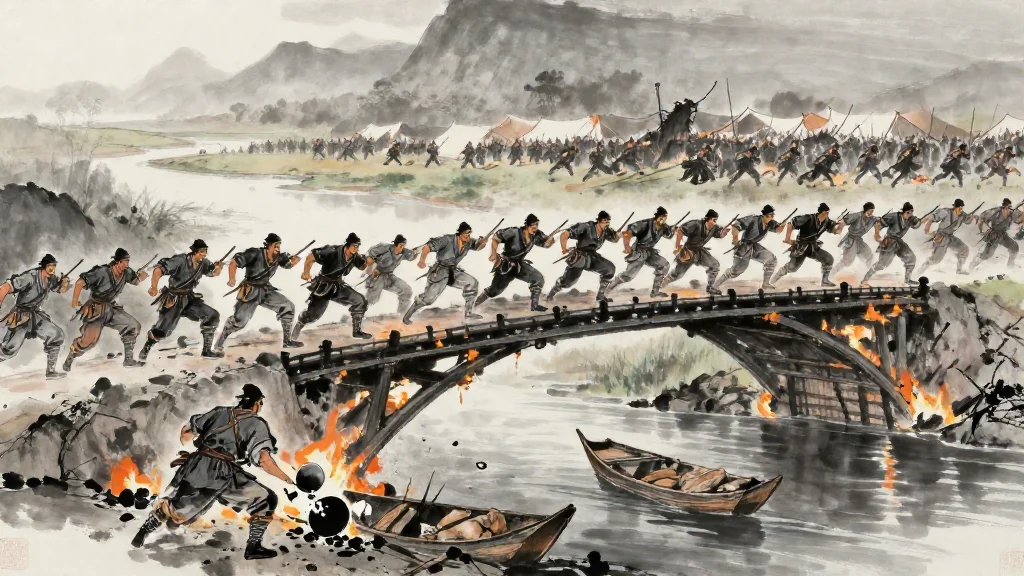
Ground where you survive only by fighting without delay and perish if you do not — this is desperate ground.
Therefore: on dispersive ground, do not fight. On light ground, do not halt. On contentious ground, do not attack. On open ground, do not let your formations be cut off. On intersecting ground, form alliances. On serious ground, plunder for supplies. On difficult ground, press on. On encircled ground, devise stratagems. On desperate ground, fight.
Notes
The nine grounds (九地) classify strategic situations by a force's position relative to its own territory, the enemy's territory, and the surrounding political geography. Unlike Chapter 10's six terrain types, which describe physical features, the nine grounds describe a commander's overall strategic situation.
散地 ('dispersive ground') — when troops fight on their own soil, they are close to home and prone to scatter. The name describes the psychological effect on morale, not the terrain itself.
衢地 ('intersecting ground') — 衢 means a crossroads or intersection. Sunzi's prescription 合交 ('form alliances') makes this a uniquely diplomatic category: the correct response is not military but political.
The nine prescriptions form a concise operational doctrine. Several are counterintuitive: on contentious ground, do not attack (let the enemy overextend); on encircled ground, use stratagems (force creates desperate resistance). The logic throughout is psychological as much as tactical.