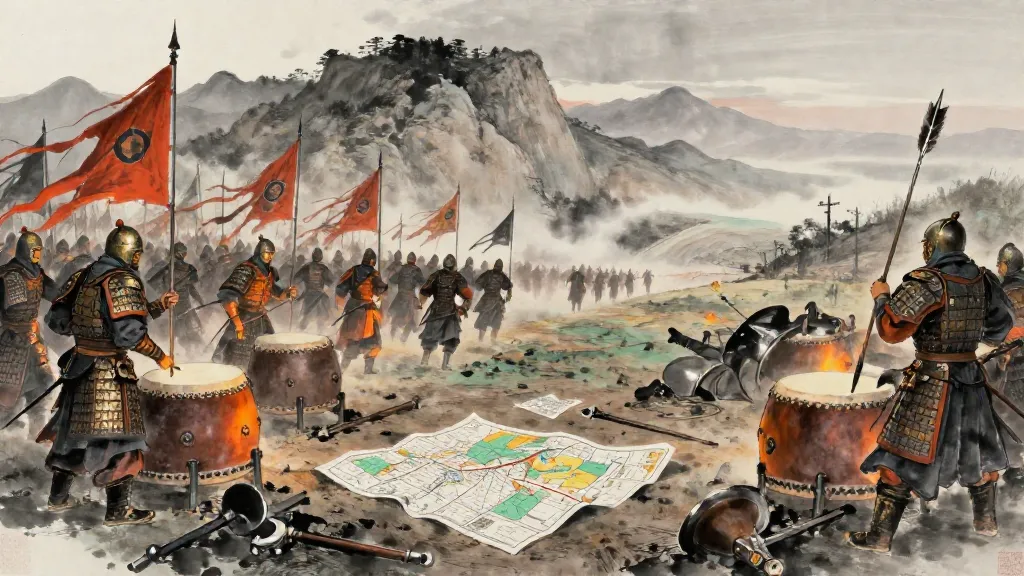
兵談 (On Warfare) — Chinese ink painting

尉繚子 Weiliaozi · Chapter 2

兵談

On Warfare

View:

地人粟三相稱

The Balance of Land, Population, and Grain

量土地肥墝而立邑建城。[以城]稱地,以(城)[地]稱人,以人稱粟。三相稱,則內可以固守,外可以戰勝。戰勝於外,(備主)[福生]於內,勝(備)[福]相應,猶合符節,無異故也。

Survey the fertility of the land and then establish towns and build fortifications. Match the fortifications to the land, match the land to the population, match the population to the grain supply. When these three are in balance, you can hold fast on defense internally and win victories externally. Winning abroad and generating prosperity at home reinforce each other, fitting together like the two halves of a tally. There is no other secret.

Notes

1context

The 'three balances' (三相稱) framework -- land, population, and grain -- reflects the Legalist emphasis on material foundations for military power. Compare Shang Yang's similar emphasis on agriculture as the basis for warfare.

2translation

符節 (fu jie): a tally or credential split in two halves, used for verification. The metaphor emphasizes that internal prosperity and external military success are two halves of the same system.

不戰而威制天下

Controlling All-Under-Heaven Without Fighting

治兵者,若秘於地,若秘於天,生於無。故(關)[開]之,大不窕;[關之,]小不恢。明乎禁舍開塞,民流者親之,地不任者任之。夫土廣而任則國富,民眾而(治)[制]則國治。富治者,(民)[車]不發軔,(車)[甲]不出(暴)[櫜],而威制天下。故曰:「兵勝於朝廷。」

Governing the military should be as hidden as the earth and as hidden as the sky -- appearing to come from nothing. Thus when you open operations, even the largest force leaves no gaps; when you close operations, even the smallest force wastes nothing. Be clear about what to prohibit and what to permit, what to open and what to block. Draw displaced people to you with benevolence; put unused land to productive use.

When territory is vast and fully utilized, the state grows wealthy. When the population is large and well regulated, the state is well governed. A state that is both wealthy and well governed need not set its chariots rolling or bring its armor out of storage -- it can control All-Under-Heaven through sheer power. Therefore it is said: "The war is won at court."

Notes

3context

兵勝於朝廷 ('the war is won at court') is one of the Weiliaozi's key maxims. It means that victory is determined by administrative excellence -- taxation, agriculture, population policy, and institutional design -- before armies ever march. This echoes the Sunzi's concept of 'temple calculations' (廟算).

4translation

禁舍開塞 (jin she kai sai): literally 'prohibit, release, open, block' -- the four basic regulatory actions of the state. This is administrative vocabulary shared with the Guanzi and Shangjunshu.

主勝與將勝

The Ruler's Victory and the General's Victory

不暴甲而勝者,主勝也。陳而勝者,將勝也。兵起,非可以忿也。見勝則興,不見勝則止。患在百里之內,不起一日之師;患在千里之內,不起一月之師;患在四海之內,不起一歲之師。

To win without ever deploying armor is the ruler's victory. To win through battlefield formations is the general's victory.

War must never be initiated in anger. Launch operations when you see a path to victory; halt when you do not. If the threat is within a hundred li, do not mobilize for a single day's campaign. If the threat is within a thousand li, do not mobilize for a month's campaign. If the threat extends across the four seas, do not mobilize for a year's campaign.

Notes

5context

The distinction between 'ruler's victory' (主勝) and 'general's victory' (將勝) establishes a hierarchy: strategic-political victory through governance is superior to tactical-military victory through combat. The escalating mobilization timelines warn against overreacting -- the greater the threat, the more time should be taken to prepare.

將者不制於天地人

The General Must Not Be Constrained

將者,上不制於天,下不制於地,中不制於人。寬不可激而怒,清不可事以財。夫心狂、目盲、耳聾,以三悖率人者,難矣。

A general must not be constrained by the heavens above, the terrain below, or other people around him. His tolerance should be such that he cannot be provoked to anger. His integrity should be such that he cannot be corrupted by wealth. A general who is deranged in mind, blind in sight, and deaf to intelligence -- to lead men with these three defects is impossible.

Notes

6context

The three freedoms of the general (不制於天、地、人) parallel the Sunzi's language and reinforce the anti-superstition theme of Chapter 1: the general must act on rational assessment, not on astrological constraints, terrain superstitions, or political interference.

兵之所及

Wherever the Army Reaches

兵之所及,羊腸亦勝,鋸齒亦勝,緣山亦勝,入谷亦勝,方亦勝,圓亦勝。重者如山如林,如江如河;輕者如炮如燔[,如漏如潰]。如垣壓之,如雲覆之,令之聚不得以散,散不得以聚,左不得以右,右不得以左。兵如總木,弩如羊角。人人無不騰陵張膽,絕乎疑慮,堂堂決而去。

Wherever the army reaches -- on narrow passes it wins, on jagged ridges it wins, scaling mountains it wins, entering valleys it wins, in square formation it wins, in circular formation it wins.

When massed, it is immovable as a mountain, dense as a forest, vast as a river. When dispersed, it strikes like a catapult's blast, scorches like wildfire, bursts through like a breach in a dam. It crushes like a collapsing wall, envelops like a descending cloud. It commands those who are gathered not to scatter, those who are scattered not to regroup, those on the left not to go right, those on the right not to go left.

The army moves like bundled timber, the crossbows like interlocking horns. Every man surges forward with fierce courage, free of all doubt and hesitation, advancing in grand formation without looking back.

Notes

7translation

羊腸 (yang chang, 'sheep's intestine') is a metaphor for narrow, winding mountain passes. 鋸齒 (ju chi, 'saw teeth') refers to jagged, uneven ridgeline terrain.

8context

The series of natural metaphors (mountain, forest, river, fire, wall, cloud) for military operations closely parallels the Sunzi's famous 'swift as the wind, silent as the forest' passage. The Weiliaozi emphasizes that a well-trained army can win in any terrain, making the terrain question irrelevant -- reinforcing the chapter's overall theme that human factors trump everything else.

Edition & Source

Text
《尉繚子》 Weiliaozi
Edition
中華古詩文古書籍網 transcription
Commentary
Traditional military commentaries