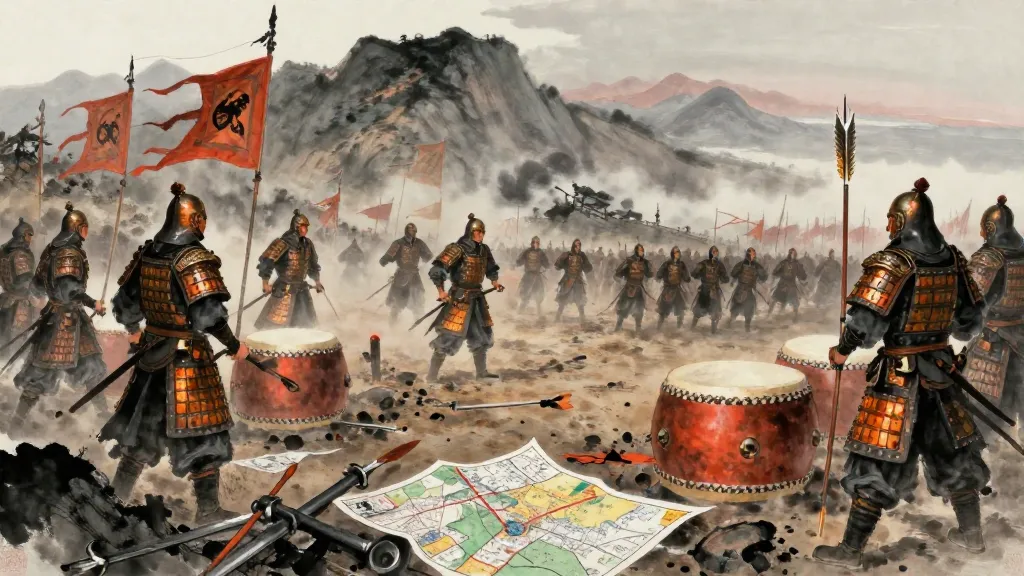
制談 (On Regulations) — Chinese ink painting

尉繚子 Weiliaozi · Chapter 3

制談

On Regulations

View:

制先定則士不亂

When Regulations Are Fixed, Soldiers Do Not Panic

凡兵,制必先定。制先定則士不亂,士不亂則形乃明。金鼓所指,則百人盡斗。陷行亂陳,則千人盡斗。覆軍殺將,則萬人齊刃。天下莫能當其戰矣。

In all military matters, regulations must be established first. When regulations are fixed in advance, soldiers do not fall into disorder. When soldiers are not in disorder, their formations become clear and effective.

When gongs and drums direct them, a hundred men fight with full commitment. When breaking enemy lines and disrupting enemy formations, a thousand men fight with full commitment. When destroying armies and killing generals, ten thousand men draw their blades as one. Nothing under Heaven can withstand such a force.

Notes

1context

This chapter's title 制談 ('On Regulations') announces the Weiliaozi's core thesis: that military effectiveness depends on institutional structure (制) rather than individual heroism or cosmic forces. The escalating scale -- 100, 1000, 10000 -- shows how regulations multiply individual courage into collective power.

2translation

金鼓 (jin gu): literally 'metal and drums' -- the bronze gong (金) signals retreat or halt, the drum (鼓) signals advance. These were the primary command-and-control instruments of ancient Chinese armies.

世將四不能禁

Four Failures That Ordinary Generals Cannot Prevent

古者,士有什伍,車有偏列。鼓鳴旗麾,先登者未嘗非多力國士也,先死者亦未嘗非多力國士也。損敵一人而損我百人,此資敵而傷我甚焉,世將不能禁。征役分軍而逃歸,或臨戰自北,則逃傷甚焉,世將不能禁。殺人於百步之外者,弓矢也。殺人於五十步之內者,矛戟也。將已鼓,而士卒相囂,拗矢折矛抱戟,利後發。戰有此數者,內自敗也,世將不能禁。士失什伍,車失偏列,奇兵捐將而走,大眾亦走,世將不能禁。夫將能禁此四者,則高山陵之,深水絕之,堅陳犯之。不能禁此四者,猶亡舟楫絕江河,不可得也。

In ancient times, soldiers were organized into squads of five and ten, and chariots into wing formations. When drums sounded and flags waved, those who climbed the walls first were always the strongest warriors -- but those who died first were also always the strongest warriors. Killing one enemy at the cost of a hundred of our own -- this subsidizes the enemy and grievously harms us. Ordinary generals cannot prevent this.

Soldiers deserting during mobilization or fleeing before battle -- the damage from desertion is even worse. Ordinary generals cannot prevent this.

Bows and arrows kill at a hundred paces; spears and halberds kill within fifty paces. Yet after the drums have sounded, soldiers shout at each other, snap their arrows, break their spears, clutch their halberds, and wait for others to strike first. When this happens in battle, the army defeats itself from within. Ordinary generals cannot prevent this.

Soldiers lose their squad formations, chariots lose their wing positions, the flanking force abandons its commander and runs, and the main body follows. Ordinary generals cannot prevent this.

A general who can prevent these four failures can cross mountains, ford deep rivers, and break through hardened formations. A general who cannot prevent them is like someone trying to cross the Yangtze without a boat -- it simply cannot be done.

Notes

3translation

什伍 (shi wu): the squad-and-platoon system, where soldiers are organized into units of five (伍) and ten (什) with mutual responsibility. This is the foundational organizational unit discussed throughout the Weiliaozi.

4context

The 'four failures' (四不能禁) are: (1) wasting elite troops in heroic but uncoordinated charges, (2) desertion, (3) soldiers refusing to engage, and (4) formation collapse. Wei Liao argues these are not character flaws but systemic failures that proper regulations can fix.

明賞決罰使民死戰

Clear Rewards and Decisive Punishments Make Soldiers Fight to the Death

民非樂死而惡生也,號令明,法制審,故能使之前。明賞於前,決罰於後,是以發能中利,動則有功。令百人一卒,千人一司馬,萬人一將,以少誅眾,以弱誅強。試聽臣言其術,足使三軍之眾誅一人無失刑。父不敢舍子,子不敢舍父,況國人乎?一賊杖劍擊於市,萬人無不避之者,臣謂非一人之獨勇,萬人皆不肖也。何則?必死與必生,固不侔也。聽臣之術,足使三軍之眾為一死賊,莫當其前,莫隨其後,而能獨出獨入焉。獨出獨入者,王霸之兵也。

People do not enjoy dying or hate living. When orders are clear and the legal system is rigorous, you can make them advance. Announce rewards before them and enforce punishments behind them -- then every move will hit the mark and every action will achieve results.

Assign one centurion to every hundred men, one marshal to every thousand, one general to every ten thousand. The few control the many, the weak control the strong. Hear my method: it can make an entire army of three armies execute a single man without error in punishment. A father would not dare shield his son, a son would not dare shield his father -- how much less would ordinary citizens!

When a lone bandit swings a sword in the marketplace, ten thousand people flee. I say this is not because one man is uniquely brave or ten thousand are all cowards -- it is because one man is certain he will die, while the others are certain they want to live. Those two certainties are not equal.

Hear my method: it can make the masses of three armies into that lone desperate bandit -- no one dares face them, no one dares pursue them, and they can strike and withdraw at will. An army that can strike and withdraw at will -- that is the army of a true king and hegemon.

Notes

5context

The 'lone bandit in the marketplace' analogy is famous in Chinese military literature. The logic is pure Legalism: individual motivation is not inherently brave or cowardly -- it responds to institutional incentives. If soldiers face certain punishment for retreating and certain reward for advancing, they become as desperate and dangerous as a cornered criminal.

6translation

獨出獨入 (du chu du ru): 'going out alone and coming in alone' -- meaning the army can advance and withdraw freely, without opposition. This phrase appears several times in the Weiliaozi as shorthand for decisive military superiority.

歷代名將兵力

The Army Sizes of Famous Commanders

有提十萬之眾,而天下莫當者誰?曰桓公也。有提七萬之眾,而天下莫當者誰?曰吳起也。有提三萬之眾,而天下莫當者誰?曰武子也。今天下諸國士,所率無不及二十萬眾者,然不能濟功名者,不明乎禁舍開塞也。明其制,一人勝之,則十人亦以勝之也。十人勝之,則百千萬人亦以勝之也。故曰:便吾器用,養吾武勇,發之如鳥擊,如赴千仞之溪。

Who led a hundred thousand and none under Heaven could withstand him? Duke Huan of Qi. Who led seventy thousand and none under Heaven could withstand him? Wu Qi. Who led thirty thousand and none under Heaven could withstand him? Sunzi.

Today, every state's commanders lead no fewer than two hundred thousand -- yet they cannot accomplish anything notable. This is because they do not understand the principles of regulation. When the system is properly designed, what one man can accomplish, ten men can also accomplish. What ten men can accomplish, hundreds, thousands, and tens of thousands can also accomplish.

Therefore it is said: sharpen our equipment, cultivate our military valor, and launch them like a hawk's strike, like plunging into a thousand-ren gorge.

Notes

7person

桓公 (Huán Gōng): Duke Huan of Qi (r. 685-643 BC), the first of the Five Hegemons of the Spring and Autumn period. With the help of his minister Guan Zhong, he built Qi into the dominant power.

8person

吳起 (Wú Qǐ): Wu Qi (c. 440-381 BC), one of China's greatest military commanders and reformers. He served Lu, Wei, and Chu, and is traditionally credited with the Wuzi military treatise. His army of 70,000 reportedly never lost a battle.

9person

武子 (Wǔ Zǐ): Sunzi (Sun Wu), author of the Art of War. Tradition holds he demonstrated his methods to the King of Wu with a force of 30,000.

10context

The argument is that smaller, well-regulated armies outperform larger, poorly organized ones. The scaling principle (一人勝之...萬人亦以勝之) is the Weiliaozi's core contribution: proper regulations make individual effectiveness infinitely scalable.

盟國援軍不可恃

Allied Reinforcements Cannot Be Relied Upon

今國被患者,以重寶出聘,以愛子出質,以地界出割,得天下助卒。名為十萬,其實不過數萬爾。其兵來者,無不謂其將曰:「無為天下先戰。」其實不可得而戰也。

Today when a state faces crisis, it sends out lavish gifts as diplomatic presents, sends beloved sons as hostages, and cedes border territory to gain allied troops from across the realm. They are called a hundred thousand, but in reality they number only a few tens of thousands. Every allied contingent tells its own commander: 'Do not be the first to fight for someone else.' In reality, they cannot be made to fight at all.

Notes

11context

This passage reflects the reality of Warring States coalition warfare: allied forces had divided loyalties and were reluctant to bear casualties for another state's cause. This is why Wei Liao argues for self-reliance through strong internal regulation rather than dependence on alliances.

自強之道

The Way of Self-Strengthening

量吾境內之民,無伍莫能正矣。經制十萬之眾,而王必能使之衣吾衣,食吾食。戰不勝,守不固者,非吾民之罪,內自致也。天下諸國助我戰,猶良驥騄耳之駛,彼駑馬鬐興角逐,何能紹吾氣哉?吾用天下之用為用,吾制天下之制為制。修吾號令,明吾刑賞,使天下非農無所得食,非戰無所得爵,使民揚臂爭出農戰,而天下無敵矣。故曰:發號出令,信行國內。

Assess the people within our borders: without the squad system, none of them can be properly organized. Regulate and organize a hundred thousand men, and the king can ensure they wear our uniforms and eat our rations.

If we cannot win in battle or hold in defense, it is not the fault of our people -- the failure comes from within our system. When the states of All-Under-Heaven send troops to help us fight, it is like fine thoroughbreds running at full gallop while nags struggle to keep pace -- how can they match our spirit?

Use the best methods in All-Under-Heaven as our methods; adopt the best regulations in All-Under-Heaven as our regulations. Perfect our orders, clarify our system of rewards and punishments. Ensure that no one can obtain food except through farming, and no one can obtain rank except through military service. When the people eagerly compete to farm and fight, we will be invincible under Heaven.

Therefore it is said: 'Issue orders and ensure they are faithfully enforced throughout the state.'

Notes

12context

非農無所得食,非戰無所得爵 ('no food except from farming, no rank except from war') directly echoes the Shangjunshu (Book of Lord Shang), which established this 'farming and fighting' (耕戰) policy as the foundation of Qin's rise. The Weiliaozi shares the Legalist conviction that a state's power rests on channeling all human energy into agriculture and military service.

治內方能有天下

Only by Governing Internally Can One Possess All-Under-Heaven

民言有可以勝敵者,毋許其空言,必試其能戰也。視人之地而有之,分人之民而畜之,必能內有其賢者也。不能內有其賢而欲有天下,必覆軍殺將。如此,雖戰勝而國益弱,得地而國益貧,由國中之制弊矣。

When someone claims they can defeat the enemy, do not accept empty talk -- put them to the test of actual combat.

To seize another's territory and hold it, to divide another's people and govern them, you must first have capable men within your own system. If you cannot retain capable men internally yet seek to possess All-Under-Heaven, you will inevitably suffer army destruction and general death.

Under such conditions, even victories weaken the state, and even territorial gains impoverish it -- because the internal system of regulations is broken.

Notes

13context

This closing argument ties the chapter together: military expansion without institutional strength is self-defeating. Conquests without internal capacity to govern them drain the state rather than enriching it. This insight applies directly to Warring States reality, where many states won battles but failed to consolidate gains.

Edition & Source

Text
《尉繚子》 Weiliaozi
Edition
中華古詩文古書籍網 transcription
Commentary
Traditional military commentaries