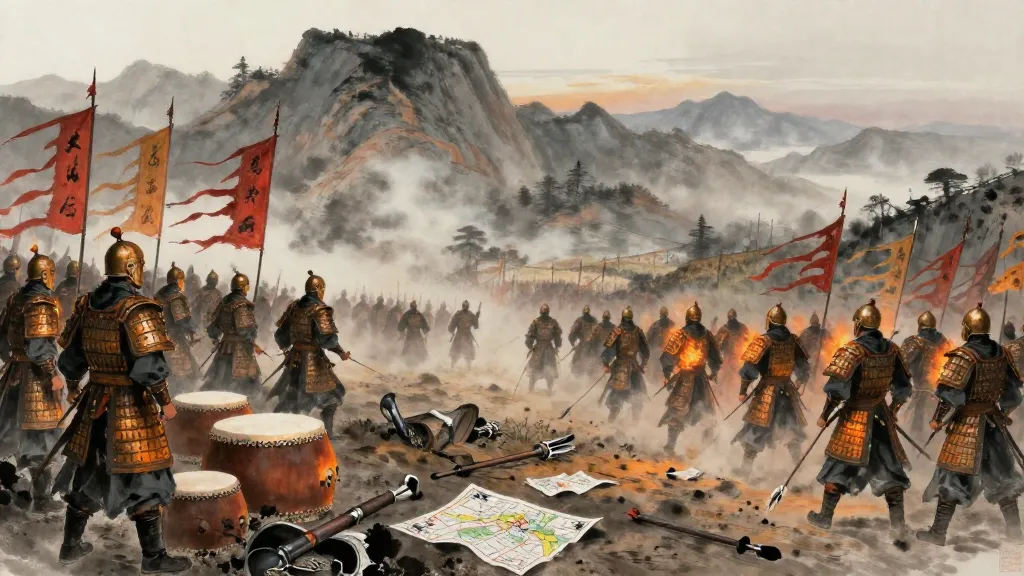
戰威 (The Authority of War) — Chinese ink painting

尉繚子 Weiliaozi · Chapter 4

戰威

The Authority of War

View:

三勝之道

The Three Paths to Victory

凡兵,有以道勝,有以威勝,有以力勝。講武料敵,使敵之氣失而師散,雖形全而不為之用,此道勝也。審法制,明賞罰,便器用,使民有必戰之心,此威勝也。破軍殺將,乘闉發機,潰眾奪地,成功乃返,此力勝也。王侯如此,[所]以三勝者畢矣。

In warfare, there are three paths to victory: victory through strategic method, victory through institutional authority, and victory through force.

Studying military arts and assessing the enemy so that the enemy's morale collapses and his forces scatter -- even though his formations remain intact, they are useless. This is victory through strategic method.

Refining the legal system, clarifying rewards and punishments, and optimizing equipment so that the people are resolved to fight. This is victory through institutional authority.

Destroying armies, killing generals, scaling walls and launching siege engines, routing masses and seizing territory, then returning after the objective is achieved. This is victory through force.

A ruler who understands all three has mastered the complete art of victory.

Notes

1context

The three victories (道勝, 威勝, 力勝) form a hierarchy: strategic method is highest because it defeats the enemy without battle; institutional authority is next because it ensures troops will fight; raw force is lowest because it requires actual bloodshed. This parallels the Sunzi's preference for winning without fighting.

2translation

闉 (yin): the ramp or siege mound built against city walls. 機 (ji): siege engines or crossbow mechanisms. Together 乘闉發機 describes the full assault on a fortified city.

奪敵之氣

Seizing the Enemy's Morale

夫將(卒)[之]所以戰者,民也;民之所以戰者,氣也。氣實則斗,氣奪則走。刑(如)未加,兵未接,而所以奪敵者五:一曰廟勝之論,二曰受命之論,三曰逾垠之論,四曰深溝高壘之論,五曰舉陳加刑之論。此五者,先料敵而後動,是以擊虛奪之也。

What enables a general to fight is his people; what enables the people to fight is morale. When morale is full they fight; when morale is shattered they flee.

Before punishments are imposed and before blades cross, there are five ways to shatter the enemy's morale: first, the argument for victory planned at court; second, the argument for the mandate received; third, the argument made after crossing the border; fourth, the argument made behind deep ditches and high ramparts; fifth, the argument made when formations are arrayed and discipline enforced.

These five all involve assessing the enemy first and then acting -- striking at what is empty to seize what is undefended.

Notes

3context

The 'five arguments' (五論) are a sequence of morale-building speeches delivered at progressive stages of a campaign: (1) at court before deployment, (2) when receiving the royal mandate, (3) after crossing into enemy territory, (4) after fortifying a position, (5) before engaging in battle. Each aims to fill friendly morale while draining the enemy's.

4translation

氣 (qi) here means battlefield morale or fighting spirit -- not the cosmological/medical concept. The metaphor is of a vessel: morale can be 'full' (實) or 'seized/emptied' (奪).

令不疑則眾不二

Unambiguous Orders Create Undivided Obedience

善用兵者,能奪人而不奪於人。奪者,心之機也。令者,一眾心也。眾不審則數變,數變則令雖出眾不信矣。故令之法,小過無更,小疑無申。故上無疑令,則眾不二聽;動無疑事,則眾不二志。

Those skilled in warfare can seize the enemy's initiative without having their own seized. Seizing the initiative is a function of psychological control. Orders are what unify the minds of the masses.

When the masses are uncertain, orders change frequently; when orders change frequently, the troops no longer trust them even when issued. Therefore the principle of command is: do not revise orders over minor errors, and do not issue clarifications over minor doubts.

When superiors issue no ambiguous orders, the troops do not listen with divided attention. When actions involve no doubtful matters, the troops do not serve with divided purpose.

Notes

5context

The principle of not constantly amending orders is a practical insight: excessive revisions destroy confidence in the chain of command. Better to tolerate small imperfections than to undermine the authority of the command system through constant changes.

禮信廉恥為本

Ritual, Trust, Integrity, and Shame as Foundations

[古率民者,]未有不信其心,而能得其力者[也];未有不得其力,而能致其死戰者也。故國必有禮[信]親愛之義,則可以飢易飽;國必有孝慈廉恥之俗,則可以死易生。古者率民,必先禮信而後爵祿,先廉恥而後刑罰,先親愛而後律其身。故戰者必本乎率身以勵眾士,如心之使四(支)[肢]也。志不勵,則士不死節;士不死節,則眾不戰。勵士之道,民之生不可不厚也;爵列之等,死喪之(親)[禮],民之所營,不可不顯也。必(也)因民所生而制之,因民所(榮)[營]而顯之,田祿之實,飲食之(親)[糧],鄉里相勸,死(生)[喪]相救,兵役相從,此民之所勵也。使什伍如親戚,卒伯如朋友,止如堵牆,動如風雨,車不結轍,士不鏇踵,此本戰之道也。

No leader has ever gained the strength of his people without first earning their trust. No leader has ever achieved soldiers fighting to the death without first gaining their strength.

Therefore a state must have the principles of ritual propriety, trustworthiness, and mutual affection -- then men will accept hunger in place of fullness. A state must have the customs of filial piety, compassion, integrity, and a sense of shame -- then men will accept death in place of life.

The ancients who led the people always established ritual and trust before conferring rank and salary, cultivated integrity and shame before imposing punishments, and fostered mutual affection before regulating conduct.

Therefore the foundation of war lies in leading by personal example to inspire the troops, as the mind directs the four limbs. If the will is not inspired, soldiers will not die for their duty. If soldiers will not die for their duty, the masses will not fight.

The way to inspire soldiers: do not fail to enrich their livelihoods. The ranks of nobility and the rites for the war dead must be prominently honored. Work within what sustains the people and regulate accordingly; take what the people value and elevate it publicly. The substance of land and salary, the provisions of food and drink, mutual encouragement within villages, mutual rescue in death and mourning, mutual accompaniment on military service -- these are what inspire the people.

Make squads of five and ten as close as family. Make centurions and company commanders as close as friends. Standing still, they are like a solid wall. In motion, they are like wind and rain. Chariots never tangle their tracks; soldiers never turn on their heels. This is the fundamental way of war.

Notes

6context

This section reveals the Weiliaozi as more than pure Legalism. While Chapters 1-3 emphasize institutional regulation, this passage argues that regulations alone are insufficient -- they must be grounded in genuine community bonds (禮信親愛) and a social contract where the state enriches its people before demanding their lives.

7translation

什伍如親戚,卒伯如朋友: 'squads like kinfolk, companies like friends.' The squad system (什伍) works not just through legal enforcement but through cultivated bonds of trust and mutual obligation -- making military units function like extended families.

務耕務守務戰

Devote to Farming, Defense, and War

地所以養民也,城所以守地也,戰所以守城也。故務耕者民不飢,務守者地不危,務戰者城不圍。三者,先王之本務[也]。本務[者],兵最急(本者)。故先王專於兵,有五焉:委積不多則士不行,賞祿不厚則民不勸,武士不選則眾不強,備用不便則力不壯,刑賞不中則眾不畏。務此五者,靜能守其所(固)[有],動能成其所欲。夫以居攻出,則居欲重,陣欲堅,發欲畢,(闕)[斗]欲齊。

Land supports the people; cities protect the land; war protects the cities. Therefore: devote effort to farming and the people will not starve; devote effort to defense and the land will not be endangered; devote effort to war and the cities will not be besieged. These three were the fundamental priorities of the ancient kings, and among them, military affairs are the most urgent.

The ancient kings concentrated on military affairs in five respects: without abundant supplies, soldiers will not march; without generous rewards, the people will not exert themselves; without selecting skilled warriors, the army will not be strong; without well-designed equipment, fighting power will not be robust; without accurate rewards and punishments, the masses will not be obedient.

Devote effort to these five and in stillness you can hold what you possess; in action you can achieve what you desire. When defending a position to launch an attack: the position should be heavily fortified, the formations should be solid, the strike should be total, and the assault should be unified.

Notes

8context

The land-city-war chain (地→城→戰) establishes a causal hierarchy: military power ultimately rests on agricultural productivity. The five military priorities (委積, 賞祿, 武士, 備用, 刑賞) form a practical checklist for military readiness.

富民與治國

Enriching the People and Governing the State

王國富民,霸國富士,僅存之國富大夫,亡國富倉府,(所)[是]謂上滿下漏,患無所救。故曰:舉賢任能,不時日而事利;明法審令,不卜筮而事吉;貴功養勞,不禱祠而得福。又曰:天時不如地利,地利不如人和。聖人所貴,人事而已。

A kingdom enriches its common people. A hegemonic state enriches its warrior-officials. A state barely surviving enriches its grandees. A doomed state enriches only its treasuries. This is called 'full at the top, leaking at the bottom' -- a crisis beyond rescue.

Therefore it is said: promote the worthy and employ the capable, and affairs prosper without consulting auspicious days. Clarify the laws and scrutinize the orders, and affairs succeed without consulting divination. Honor achievement and support those who have toiled, and blessings come without praying at shrines.

It is also said: favorable timing is not as good as advantageous terrain; advantageous terrain is not as good as unity among people. What the sages valued was human effort -- nothing more.

Notes

9context

The four-level classification of states (王國, 霸國, 僅存之國, 亡國) by where wealth accumulates is a powerful diagnostic. A state where wealth flows upward to the treasury while the people are impoverished is headed for collapse -- a classic Legalist insight shared with the Guanzi.

10context

天時不如地利,地利不如人和: this famous phrase also appears in the Mencius (2A.1). Whether the Weiliaozi is quoting Mencius or both draw from a common source is debated, but the meaning is clear: human factors are paramount.

將必先身

The General Must Lead by Personal Example

夫勤勞之師,將(不)[必]先己。暑不張蓋,寒不重衣,險必下步,軍井成而後飲,軍食熟而後飯,軍壘成而後舍,勞佚必以身同之。如此,師雖久而不老不弊。

In a hardworking army, the general must always put himself first in enduring hardship. In heat he does not raise a sunshade; in cold he does not wear extra layers. On dangerous terrain he dismounts and walks. He does not drink until the army's wells are dug, does not eat until the army's food is cooked, does not rest until the army's ramparts are built. In toil and rest alike, he shares everything with his men.

An army led this way, even if campaigning for a long time, will neither age nor deteriorate.

Notes

11context

This passage closely parallels descriptions of Wu Qi's leadership in the Wuzi and Shiji. The principle that a general must share his soldiers' hardships to earn their loyalty is a consistent theme across all the Seven Military Classics. It bridges the gap between Legalist regulation and genuine moral leadership.

Edition & Source

Text
《尉繚子》 Weiliaozi
Edition
中華古詩文古書籍網 transcription
Commentary
Traditional military commentaries