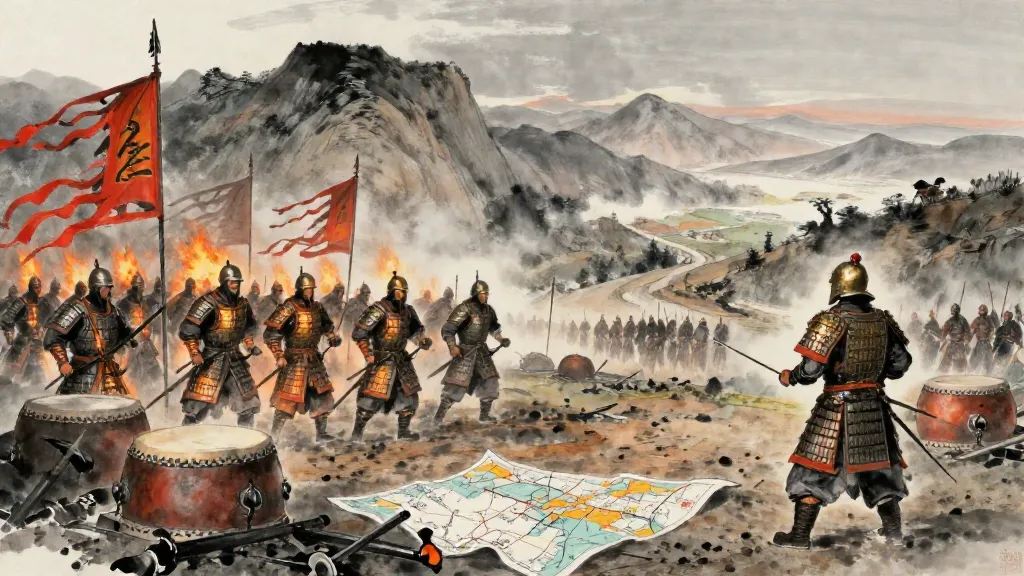
將理 (The General's Administration of Justice) — Chinese ink painting

尉繚子 Weiliaozi · Chapter 9

將理

The General's Administration of Justice

View:

將者萬物之主

The General as Master of All Affairs

凡將,理官也,萬物之主也,不私於一人。夫能無私於一人,故萬物至而制之,萬物至而命之。

A general is an administrator of justice, the master of all affairs, and must not show favoritism toward any individual. Because he shows no favoritism, he can manage all matters that come before him and command all situations that arise.

Notes

1context

理官 ('administrator of justice') defines the general's role as fundamentally judicial and administrative, not merely combative. This chapter shifts focus from battlefield tactics to the general's role in maintaining legal order within his command.

審囚不待箠楚

Interrogation Without Torture

君子不救囚於五步之外,雖鉤矢射之,弗追也。故善審囚之情,不待箠楚,而囚之情可畢矣。笞人之背,灼人之脅,束人之指,而訊囚之情,雖國士有不勝其酷而自誣矣。

A principled man does not pursue a prisoner beyond five paces -- even if the prisoner were shot with a barbed arrow, he would not be chased further. Therefore, one who is skilled at examining prisoners' circumstances can ascertain the full truth without resorting to beatings.

When you flog someone's back, burn someone's sides, and crush someone's fingers to extract confessions, even the most honorable men will make false confessions to escape the agony.

Notes

2context

This is a remarkable passage advocating against judicial torture, centuries before similar arguments appeared in European legal philosophy. Wei Liao's reasoning is practical rather than moral: torture produces false confessions, which corrupt the information on which military and judicial decisions are based.

千金不死百金不刑

A Thousand in Gold Buys Off Death, A Hundred Buys Off Punishment

今世諺云:「千金不死,百金不刑。」試聽臣之言、行臣之術,雖有堯舜之智,不能開一言;雖有萬金,不能用一銖。

A current proverb says: 'With a thousand in gold you escape death; with a hundred in gold you escape punishment.' But try hearing my proposals and implementing my methods: even someone with the wisdom of Yao and Shun could not open his mouth to intervene, and even someone with ten thousand in gold could not spend a single grain of it.

Notes

3person

堯 (Yáo) and 舜 (Shùn): the legendary sage-kings of Chinese antiquity, paragons of wise and virtuous rule. Invoking them here means: even the wisest possible intercessor could not subvert a properly designed legal system.

4context

The proverb about wealth buying impunity reveals the corruption of Warring States justice. Wei Liao's proposed system would be so procedurally rigorous that no amount of personal connections or bribery could circumvent it -- an ideal consistent with Legalist thought.

獄訟關聯良民

Imprisonment Entangles Productive Citizens

今夫系者,小圄不下十數,中圄不下百數,大圄不下千數。十人聯百人之事,百人聯千人之事,千人聯萬人之事。所聯之者,親戚兄弟也,其次婚姻也,其次知識故人也。是農無不離田業,賈無不離肆宅,士大夫無不離官府。如此關聯良民,皆囚之情也。兵法曰:「十萬之師出,日費千金。」今良民十萬而聯於囹圄,上不能省,臣以為危也。

Today, a small jail holds no fewer than a dozen prisoners, a medium jail no fewer than a hundred, and a large jail no fewer than a thousand. Each ten prisoners entangle a hundred people in their affairs; each hundred entangle a thousand; each thousand entangle ten thousand. Those entangled are first their relatives and siblings, then their in-laws, then their acquaintances and old friends.

As a result, farmers are pulled from their fields, merchants from their shops, and officials from their offices. Entangling productive citizens this way is the true consequence of imprisonment.

The military classics state: 'When an army of a hundred thousand marches, it costs a thousand in gold per day.' Now a hundred thousand productive citizens are entangled in the prison system, yet the ruler cannot see this cost. I consider this a danger to the state.

Notes

5context

This passage treats excessive imprisonment as a military-economic problem: every prisoner creates a cascade of disruption through family and social networks, pulling productive workers away from agriculture, commerce, and administration. Wei Liao equates the hidden cost of mass incarceration with the visible cost of fielding an army -- both drain the state equally.

Edition & Source

Text
《尉繚子》 Weiliaozi
Edition
中華古詩文古書籍網 transcription
Commentary
Traditional military commentaries