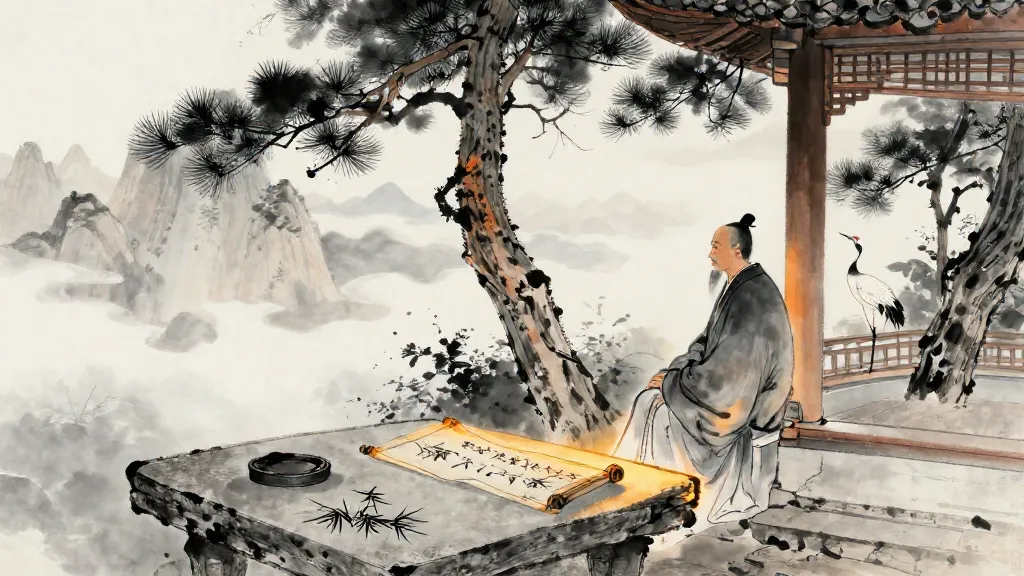
原官 (The Origins of Government) — Chinese ink painting

尉繚子 Weiliaozi · Chapter 10

原官

The Origins of Government

View:

官治之本

Government as the Foundation of Order

官者,事之所主,為治之本也。制者,職分四民,治之分也。貴爵富祿必稱,尊卑之體也。好善罰惡,正比法,會計民之具也。均(井地)[地分],節賦斂,取與之度也。程工人,備器用,匠工之功也。分地塞要,殄怪禁淫之事也。

Government offices are the center from which all affairs are managed -- the foundation of order. Regulations are what assign the four classes of people to their proper functions -- the structure of governance.

Noble ranks and generous salaries must be proportionate to merit -- this embodies the hierarchy of honor and rank. Encouraging virtue and punishing vice, rectifying standards against the law, and auditing the population -- these are the tools of administration. Equalizing land distribution and regulating taxation -- these are the standards for what the state takes and gives. Evaluating craftsmen and stocking equipment -- these are the achievements of skilled labor. Assigning territory and blocking strategic passes, suppressing disorder and prohibiting excess -- these are the tasks of security.

Notes

1context

四民 (si min, 'four classes of people'): scholars (士), farmers (農), artisans (工), and merchants (商). This classification, attributed to Guan Zhong, was the standard social taxonomy of the Warring States period.

2context

This chapter reads like an administrative manual rather than a military treatise, reflecting the Weiliaozi's thesis that military power is inseparable from good governance. Every line describes a government function that ultimately supports the state's capacity to wage war.

主操臣節

The Ruler's Control and the Minister's Discipline

守法稽斷,臣下之節也。明法稽驗,主上之操也。明主守,等輕重,臣主之權也。明賞賚,嚴誅責,止奸之術也。審開塞,守一道,為政之要也。下達上通,至聰之聽也。知國有無之數,用其仂也。知彼弱者,強之體也。知彼動者,靜之決也。官分文武,惟王之二術也。

Upholding the law and verifying decisions -- this is the discipline of ministers and subordinates. Clarifying the law and examining evidence -- this is the ruler's exercise of control. For the ruler to understand what he should guard and to weigh priorities -- this is the balance of power between ruler and minister.

Clarifying rewards and making punishments severe -- this is the technique for stopping corruption. Carefully controlling what to open and what to block, and adhering to a single governing principle -- this is the key to administration.

Information flowing from below to above without obstruction -- this is the height of perceptive governance. Knowing the precise count of what the state has and lacks, and using the surplus -- this is practical administration. Knowing where the enemy is weak is the body of your own strength. Knowing when the enemy moves is the basis for deciding to remain still.

Dividing government offices into civil and military -- these are the two arts of the king.

Notes

3context

The emphasis on information flow (下達上通, 'information reaching from below to above') anticipates modern organizational theory. A state where bad news is filtered or suppressed cannot make sound decisions. This is the 'perceptive governance' (至聰之聽) that Wei Liao prizes.

正議禁間

Proper Counsel and the Exclusion of Spies

俎豆同制,天子之會也。遊說(開)[間]諜無自入,正議之術也。諸侯有謹天子之禮,君民繼世,承王之命也。更(造)[號]易常,違王明德,故禮得以伐也。

官無事治,上無慶賞,民無獄訟,國無商賈,何王之至!明舉上達,在王垂聽也。

When ritual vessels follow a unified standard, this is the assembly of the Son of Heaven. Ensuring that traveling persuaders and enemy agents have no way to infiltrate -- this is the technique of proper counsel.

When the feudal lords observe the rites due to the Son of Heaven and rulers succeed their fathers in governing the people by the king's mandate -- this is the established order. When someone changes the state's titles and alters its customs, violating the king's manifest virtue -- then ritual propriety permits a punitive campaign.

When officials have no cases to adjudicate, the ruler has no rewards to distribute, the people have no lawsuits, and the state has no profiteering merchants -- how perfect the king's governance! Promoting the worthy and ensuring information reaches upward -- this depends on the king being willing to listen.

Notes

4context

The vision of a state with no lawsuits, no need for rewards, and no profiteering represents an idealized end-state where governance is so effective that enforcement becomes unnecessary. This utopian note is unusual in the otherwise pragmatic Weiliaozi and echoes Confucian ideals of governance without coercion.

Edition & Source

Text
《尉繚子》 Weiliaozi
Edition
中華古詩文古書籍網 transcription
Commentary
Traditional military commentaries