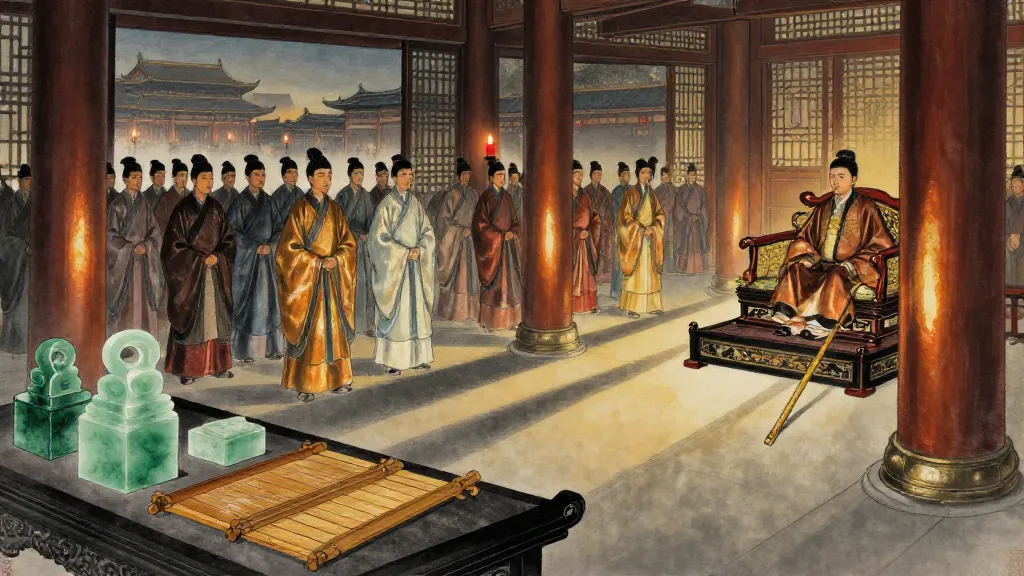
治本 (The Root of Governance) — Chinese ink painting

尉繚子 Weiliaozi · Chapter 11

治本

The Root of Governance

View:

充腹蓋形

Filling Bellies and Covering Bodies

凡治人者何?曰:非五穀無以充腹,非絲麻無以蓋形。故充腹有粒,蓋形有縷。

夫在芸耨,妻在機杼,民無二事,則有積蓄。夫無雕文刻鏤之事,女無繡飾纂組之作。木器液,金器腥。聖人飲於土,食於土,故埏埴以為器,天下無費。

What is the root of governing people? Without the five grains there is nothing to fill bellies; without silk and hemp there is nothing to cover bodies. Therefore fullness depends on grain, and clothing depends on thread.

When the husband is weeding in the fields and the wife is working the loom, and the people have no secondary occupations, then they accumulate surplus. When men have no work of ornamental carving and engraving, and women have no work of embroidery and decorative weaving -- when wooden vessels are simply lacquered and metal vessels simply cast -- then the sages drank from earthenware and ate from earthenware. They shaped clay into vessels, and All-Under-Heaven had no waste.

Notes

1context

The emphasis on agricultural self-sufficiency and the elimination of luxury production is pure Legalist economic policy. Compare the Shangjunshu's insistence that all labor be directed toward farming and fighting. The idealization of earthenware over bronze or lacquer reflects the primitivist strand in Warring States thought.

古治今失

The Governance of Antiquity versus Today's Failures

今也,金木之性不寒而衣繡飾,馬牛之性食草飲水而給菽粟。是治失其本,而宜設之制也。春夏夫出於南畝,秋冬女練於布帛,則民不困。今短褐不蔽形,糟糠不充腹,失其治也。古者,土無肥磽,人無勤惰,古人何得,而今人何失邪?耕有不終畝,織有日斷機,而奈何寒飢!蓋古治之行,今治之止也。

Today, metal and wood by nature do not feel cold, yet they are dressed in embroidered coverings. Horses and cattle by nature eat grass and drink water, yet they are fed beans and grain. This is governance that has lost its root -- the regulations need to be redesigned.

In spring and summer, men go out to the southern fields; in autumn and winter, women work at refining cloth. Then the people would not be in difficulty. Yet today, short jackets cannot cover their bodies and chaff cannot fill their bellies -- governance has failed.

In ancient times, the soil was no more fertile and the people no more diligent. What did the ancients gain that we have lost? Some do not finish plowing a single acre, some break off weaving in the middle of the day -- and then wonder about hunger and cold! It is simply that the governance of antiquity was practiced, while today's governance has stopped.

Notes

2context

The critique of dressing metal objects and feeding livestock luxury foods while the common people starve is a vivid illustration of misallocated resources. Wei Liao's argument is structural, not moral: the problem is not that rulers are evil but that the system incentivizes waste over production.

民無私則天下一家

When the People Have No Private Interests, All-Under-Heaven Is One Family

夫謂治者,使民無私也。民無私,則天下為一家,而無私耕私織。共寒其寒,共飢其飢。故如有子十人,不加一飯;有子一人,不損一飯。焉有喧呼酖酒以敗善類乎?民相輕佻,則欲心興,爭奪之患起矣。橫生於一夫,則民私飯有儲食,私用有儲財。民一犯禁,而拘以刑治,烏有以為人上也。善政執其制,使民無私。為下不敢私,則無為非者矣。反本緣理,出乎一道,則欲心去,爭奪止,囹圄空,野充粟多,安民懷遠,外無天下之難,內無暴亂之事,治之至也。

What is meant by governance is making the people have no private interests. When the people have no private interests, All-Under-Heaven becomes one family, without private farming or private weaving. They share each other's cold and share each other's hunger. Whether a family has ten children or one, rations neither increase nor decrease. Where then is there room for carousing and drunkenness to corrupt good people?

When people treat each other with contempt and frivolity, desires arise and the troubles of contention begin. When lawlessness springs from even one man, people hoard private food stores and private wealth. When someone violates prohibitions and is restrained by criminal punishment -- how can this be considered good governance?

Good governance holds to its regulations and ensures the people have no private interests. When those below dare not act for private gain, no one commits offenses. Return to the root, follow principle, and proceed from a single unified way: then desires depart, contention ceases, prisons stand empty, fields are full, grain is abundant, the people are secure, distant peoples are attracted, there are no difficulties abroad and no violent disturbances at home. This is the perfection of governance.

Notes

3context

The vision of a society without private interests (民無私) where 'All-Under-Heaven is one family' (天下為一家) sounds utopian, but in Warring States context it describes the Legalist ideal of a state where individual interests are completely aligned with state interests through regulation. Compare the Shangjunshu's vision of a society with no private commerce.

天子四事

The Four Qualities of the Son of Heaven

蒼蒼之天,莫知其極。帝王之君,誰為法則?往世不可及,來世不可待,求己者也。

所謂天子者四焉:一曰神明,二曰垂光,三曰洪敘,四曰無敵。此天子之事也。

野物不為犧牲,雜學不為通儒。

The vast expanse of heaven -- no one knows its limits. Among rulers of emperors and kings -- who sets the standard? Past ages cannot be reached; future ages cannot be waited for. One can only look to oneself.

The Son of Heaven possesses four qualities: first, divine clarity of judgment; second, radiance that illuminates all; third, a grand system of order; fourth, invincibility. These are the affairs of the Son of Heaven.

Wild game is not fit for sacrificial offerings; scattered learning does not make a comprehensive scholar.

Notes

4translation

神明 here means not supernatural divinity but supreme clarity of perception and judgment -- 'seeing as clearly as a spirit would.' This is consistent with the Weiliaozi's rationalist stance.

禁以武成以文

Enforcement Through Force, Completion Through Culture

今說者曰:「百里之海,不能飲一夫;三尺之泉,足止三軍渴。」臣謂:欲生於無度,邪生於無禁。太上神化,其次因物,其下在於無奪民時,無損民財。夫禁必以武而成,賞必以文而成。

Today's persuaders say: 'A sea of a hundred li cannot quench one man's thirst; a spring of three feet can satisfy the thirst of three armies.' I say: desire arises from the absence of standards, and depravity arises from the absence of prohibitions.

The highest form of governance transforms people unconsciously. The next best works with circumstances. The lowest merely avoids taking the people's time and depleting the people's wealth.

Prohibitions must be enforced through military force; rewards must be achieved through civil culture.

Notes

5context

The sea-and-spring metaphor means that vast but unfocused resources are less useful than small but concentrated ones. The three levels of governance (神化, 因物, 無奪民時) echo the Daoist-Legalist hierarchy where the best ruler governs so subtly that people do not notice, while the worst can only avoid actively harming them.

Edition & Source

Text
《尉繚子》 Weiliaozi
Edition
中華古詩文古書籍網 transcription
Commentary
Traditional military commentaries