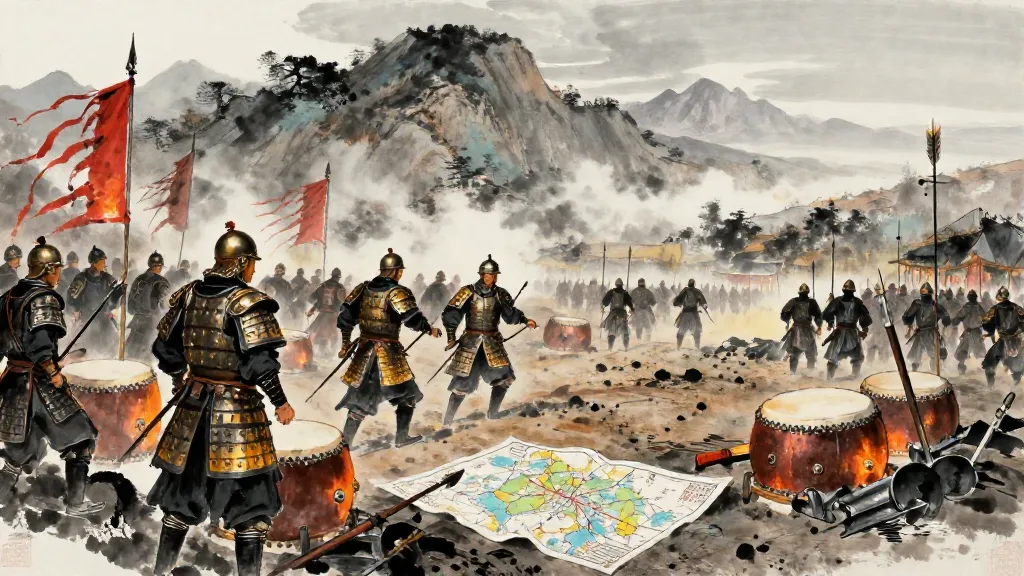
戰權 (The Balance of Battle) — Chinese ink painting

尉繚子 Weiliaozi · Chapter 12

戰權

The Balance of Battle

View:

權武先加

Seizing the Initiative in Authority and Force

兵法曰:「千人而成權,萬人而成武。」權先加人者,敵不力交;武先加人者,敵無威接。故兵貴先,勝於此,則勝彼矣;弗勝於此,則弗勝彼矣。

The Art of War says: 'A thousand men establish authority; ten thousand men establish martial power.' He who first imposes his authority upon the enemy denies the enemy the strength to engage. He who first imposes martial force upon the enemy denies the enemy the will to resist. Therefore in warfare, seizing the initiative is paramount: if you prevail here, you will prevail there; if you cannot prevail here, you will not prevail there.

Notes

1context

權 (quan) here carries the dual meaning of 'authority/weight' and 'strategic balance.' The opening maxim establishes a threshold principle: a thousand men constitute a decisive weight of authority, ten thousand a decisive force. The chapter title 戰權 thus means the decisive balance-point of battle.

往來勝敗之理

The Principle of Attack and Counter-Attack

凡我往則彼來,彼來則我往,相為勝敗,此戰之理然也。夫精誠在乎神明,戰權在乎道之所極。有者無之,無者有之,安所信之。

When we advance, the enemy responds; when the enemy advances, we respond -- each side alternately gaining and losing advantage. This is the natural principle of battle. Utmost sincerity lies in clarity of perception; the balance of battle lies at the furthest reach of the Way. What appears present may be absent; what appears absent may be present -- where then shall you place your trust?

Notes

2context

The dialectic of 有 (presence) and 無 (absence) echoes the Sunzi's doctrine of 'when capable, appear incapable' (能而示之不能). The principle is that appearances in warfare are fundamentally unreliable, and only penetrating judgment (神明) can discern reality.

正道圖止

The Upright Way and Knowing When to Stop

先王之所傳聞者,任正去詐,存其慈順,決無留刑。故知道者,必先圖不知止之敗,惡在乎必往有功。輕進而求戰,敵復圖止,我往而敵制勝矣。故兵法曰:「求而從之,見而加之,主人不敢當而陵之,必喪其權。」

What the former kings transmitted was this: uphold the righteous and eliminate deceit; preserve benevolence and compliance; execute punishments without delay. Therefore one who understands the Way must first consider the defeat that comes from not knowing when to stop -- the danger lies precisely in pressing forward to seek merit.

If you advance rashly seeking battle while the enemy has planned a halt, then your advance hands the enemy victory. Therefore the Art of War says: 'Pursue what the enemy seeks and follow it; when the enemy shows himself, press the attack. But when the defender refuses to engage and you press forward recklessly, you will certainly lose your strategic advantage.'

Notes

3context

不知止之敗 ('the defeat of not knowing when to stop') is a core Weiliaozi concept. Unlike the Sunzi which emphasizes the initiative, Wei Liao warns that aggressive pursuit without strategic calculation leads to overextension -- a principle confirmed by many Warring States campaigns.

兵道之極

The Ultimate Principle of Military Conduct

凡奪者無氣,恐者不可守,敗者無人,兵無道也。意往而不疑則從之,奪敵而無敗則加之,明視而高居則威之,兵道極矣。

Those who have been overwhelmed lose their fighting spirit. Those who are terrified cannot hold a defense. Those who have been routed have no men left. In all these cases, the army lacked the Way.

When your intent to advance is resolute and free of doubt, then advance. When you can seize what the enemy holds without risk of failure, then seize it. When you can observe clearly from a commanding position, then overawe the enemy from that position. This is the ultimate principle of military conduct.

Notes

4context

The three conditions -- resolute advance (意往而不疑), seizure without risk (奪敵而無敗), and overwatch from high ground (明視而高居) -- form a practical triad of operational principles. Each requires certainty before commitment, reinforcing the chapter's theme of calculated initiative.

不戰而服

Subduing the Enemy Without Battle

其言無謹,偷矣;其陵犯無節,破矣。水潰雷擊,三軍亂矣。必安其危,去其患,以智決之。高之以廊廟之論,重之以受命之論,銳之以逾垠之論,則敵國可不戰而服。

When speech lacks discipline, the army grows lax. When aggression lacks measure, the army will be broken. When the army collapses like a flood-burst or scatters like a thunder-strike, all three divisions fall into chaos.

You must stabilize what is endangered, eliminate what is harmful, and resolve matters through intelligence. Elevate affairs to the level of court deliberation; weigh them with the gravity of a mandate received from the sovereign; sharpen them with the urgency of an argument for crossing borders. Then the enemy state can be subdued without battle.

Notes

5context

廊廟之論 refers to deliberations in the ancestral temple and court corridors -- the highest level of state strategic planning. 受命之論 refers to the formal mandate the general receives from the ruler. 逾垠之論 refers to the argument for crossing borders to campaign. The three levels represent escalating strategic discourse: policy, commission, and operational planning.

6context

The final phrase 不戰而服 ('subdue without battle') directly echoes the Sunzi's famous 不戰而屈人之兵. Wei Liao's path to this ideal, however, emphasizes institutional discipline and strategic deliberation rather than deception.

Edition & Source

Text
《尉繚子》 Weiliaozi
Edition
中華古詩文古書籍網 transcription
Commentary
Traditional military commentaries