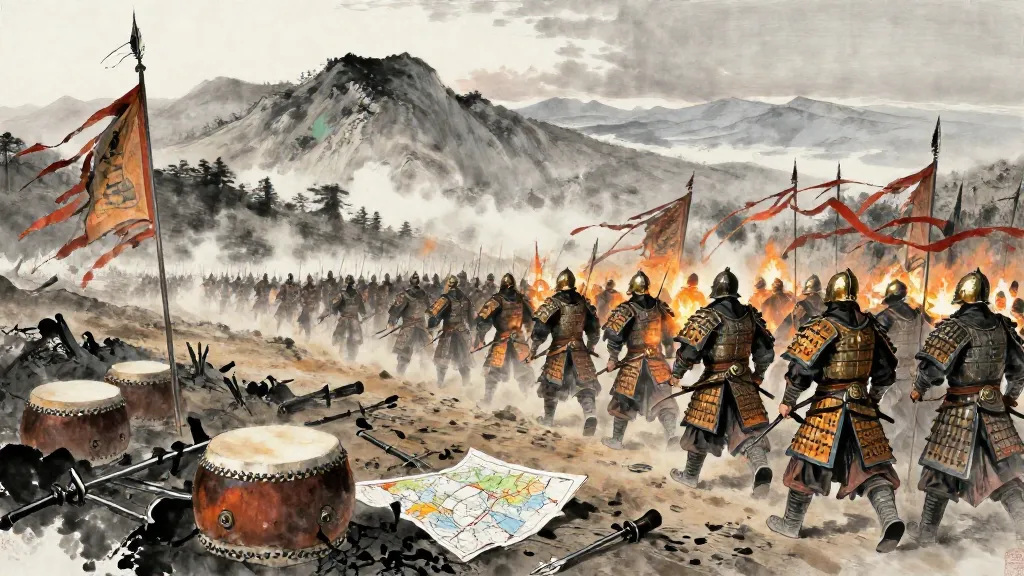
經卒令 (Ordinance on Organizing the Troops) — Chinese ink painting

尉繚子 Weiliaozi · Chapter 17

經卒令

Ordinance on Organizing the Troops

View:

三軍旗羽之分

Distinguishing the Three Divisions by Flags and Plumes

經卒者,以經令分之為三分焉:左軍蒼旗,卒戴蒼羽;右軍白旗,卒戴白羽;中軍黃旗,卒戴黃羽。

Organizing the troops means dividing them into three divisions by standing orders. The left division carries blue-green flags, and its soldiers wear blue-green plumes. The right division carries white flags, and its soldiers wear white plumes. The center division carries yellow flags, and its soldiers wear yellow plumes.

Notes

1context

The color assignments follow Five Phases (五行) associations: 蒼 (blue-green/east), 白 (white/west), 黃 (yellow/center). This color-coding system allowed instant visual identification of unit affiliation on the battlefield, preventing friendly-fire incidents and enabling commanders to track troop movements.

五章之制

The System of Five Badges

卒有五章:前一行蒼章,次二行赤章,次三行黃章,次四行白章,次五行黑章。次以經卒,亡章者有誅。前一五行,置章於首;次二五行,置章於項;次三五行,置章於胸;次四五行,置章於腹;次五五行,置章於腰。如此,卒無非其吏,吏無非其卒。見非而不詰,見亂而不禁,其罪如之。

Soldiers are distinguished by five colored badges: the first rank wears blue-green badges, the second rank wears red badges, the third rank wears yellow badges, the fourth rank wears white badges, and the fifth rank wears black badges. These badges organize the troops; anyone who loses his badge is executed.

The first group of five ranks wears badges on the head. The second group wears badges on the nape. The third group wears badges on the chest. The fourth group wears badges on the abdomen. The fifth group wears badges at the waist.

In this way, no soldier can be separated from his officer, and no officer can lose track of his soldiers. Anyone who sees an irregularity and does not challenge it, or sees disorder and does not prohibit it, bears the same guilt as the offender.

Notes

2context

The five badge colors (蒼, 赤, 黃, 白, 黑) correspond to the full Five Phases cycle. Combined with five badge positions (head, nape, chest, abdomen, waist), this creates a 25-cell matrix that can uniquely identify up to 25 distinct subunits within each of the three color-coded divisions. This is one of the most detailed unit identification systems described in any Warring States military text.

鼓進退之法

Regulations for Drumbeat Advance and Retreat

鼓行交斗,則前行進為犯難,後行退為辱眾。逾五行而前者有賞,逾五行而後者有誅。所以知進退先後,吏卒之功也。故曰:「鼓之,前如雷霆,動如風雨,莫敢當其前,莫敢躡其後。」言有經也。

When the drums beat for the advance and battle is joined, the front ranks pushing forward are 'braving danger,' while the rear ranks falling back are 'shaming the army.' Anyone who advances more than five ranks ahead of his line is rewarded. Anyone who falls more than five ranks behind is executed.

The ability to know who advanced and who retreated, who was first and who was last -- this is the achievement of the officer-and-soldier identification system. Therefore it is said: 'When the drums sound, the advance is like thunder, the movement like a storm -- none dare stand before them, none dare pursue behind them.' This is what having proper organization means.

Notes

3context

犯難 ('braving danger') and 辱眾 ('shaming the army') are technical designations that carry reward and punishment respectively. The five-rank threshold provides a measurable standard for both valor and cowardice, removing subjective judgment from the assessment of battlefield conduct.

Edition & Source

Text
《尉繚子》 Weiliaozi
Edition
中華古詩文古書籍網 transcription
Commentary
Traditional military commentaries