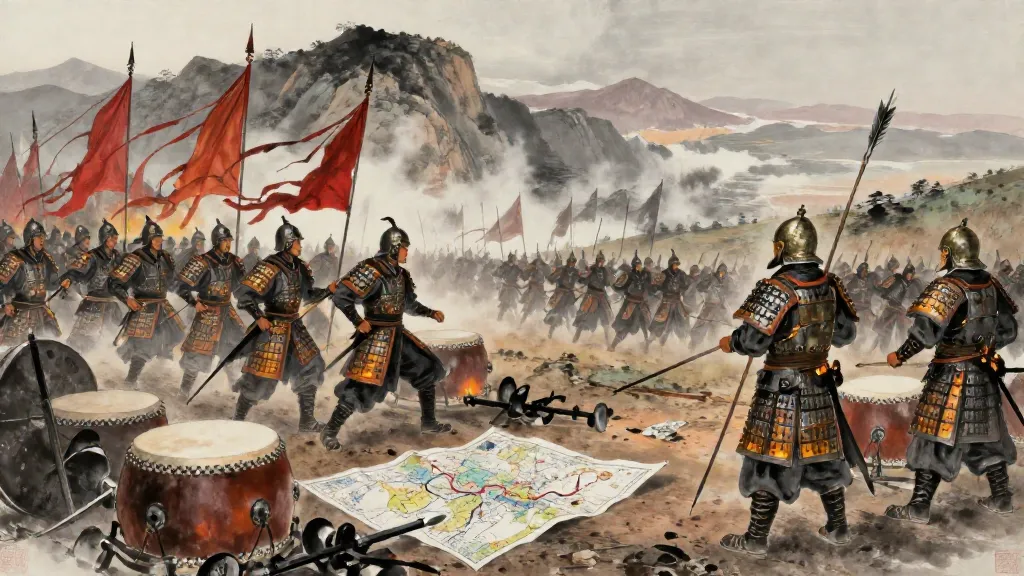
勒卒令 (Ordinance on Marshaling the Troops) — Chinese ink painting

尉繚子 Weiliaozi · Chapter 18

勒卒令

Ordinance on Marshaling the Troops

View:

金鼓鈴旗之法

Regulations for Gongs, Drums, Bells, and Flags

金、鼓、鈴、旗,四者各有法。鼓之則進,重鼓則擊。金之則止,重金則退。鈴,傳令也。旗,麾之左則左,麾之右則右。奇兵則反是。

Gongs, drums, bells, and flags -- each of the four has its own regulations. A drumbeat signals advance; a double drumbeat signals attack. A gong signals halt; a double gong signals retreat. Bells transmit orders. When the flag waves left, go left; when it waves right, go right. For unorthodox troops, these signals are reversed.

Notes

1context

The four signal instruments (金鼓鈴旗) formed the battlefield command-and-control system. 金 (jin) refers to bronze gongs or cymbals, not bells. The reversal of signals for 奇兵 (qi bing, 'unorthodox/flanking troops') is a security measure: if the enemy observes and decodes the main signal system, the flanking force still operates independently.

鼓法詳制

Detailed Drum Regulations

一鼓一擊而左,一鼓一擊而右。一步一鼓,步鼓也。十步一鼓,趨鼓也。音不絕,鶩鼓也。商,將鼓也。角,帥鼓也。小鼓,伯鼓也。三鼓同,則將、帥、伯其心一也。奇兵則反是。鼓失次者有誅,喧嘩者有誅,不聽金、鼓、鈴、旗而動者有誅。

One drumbeat followed by one strike: turn left. One drumbeat followed by one strike: turn right. One beat per step is the marching drum. One beat per ten steps is the quick-step drum. A continuous unbroken roll is the charging drum.

The shang tone is the general's drum. The jue tone is the brigade commander's drum. The small drum is the company commander's drum. When all three drums sound together, the general, brigade commander, and company commander are united in purpose. For unorthodox troops, these are reversed.

Anyone who misses the drum sequence is executed. Anyone who creates noise and clamor is executed. Anyone who moves without heeding the gongs, drums, bells, and flags is executed.

Notes

2context

鶩鼓 (wu gu, 'charging drum'): literally 'rushing drum,' from 鶩 meaning 'to rush/dash.' The continuous roll signals an all-out charge. The three drum tempos (步鼓 one-per-step, 趨鼓 one-per-ten-steps, 鶩鼓 continuous) control the speed of advance from march to quick-step to charge.

3context

商 (shang) and 角 (jue) are two of the five tones in the Chinese pentatonic scale. Using different musical tones to distinguish command levels allowed multiple commanders to issue simultaneous orders without confusion. The 三鼓同 (three drums together) signals unified action across all echelons.

Edition & Source

Text
《尉繚子》 Weiliaozi
Edition
中華古詩文古書籍網 transcription
Commentary
Traditional military commentaries